1. Executive Summary
As artificial intelligence rapidly transitions from predictive and generative models to autonomous, goal-directed agentic systems, traditional AI governance paradigms are fracturing under the strain of unprecedented scale, speed, and operational complexity. The historical reliance on “Human in the Loop” (HITL) oversight is increasingly recognized as a scalability bottleneck that introduces unacceptable latency into real-time digital ecosystems. In response, regulated organizations across North America and Europe are systematically migrating toward architectural controls, embedding policy enforcement directly into software pipelines, and fundamentally redefining the role of human oversight to safely harness autonomous capabilities.
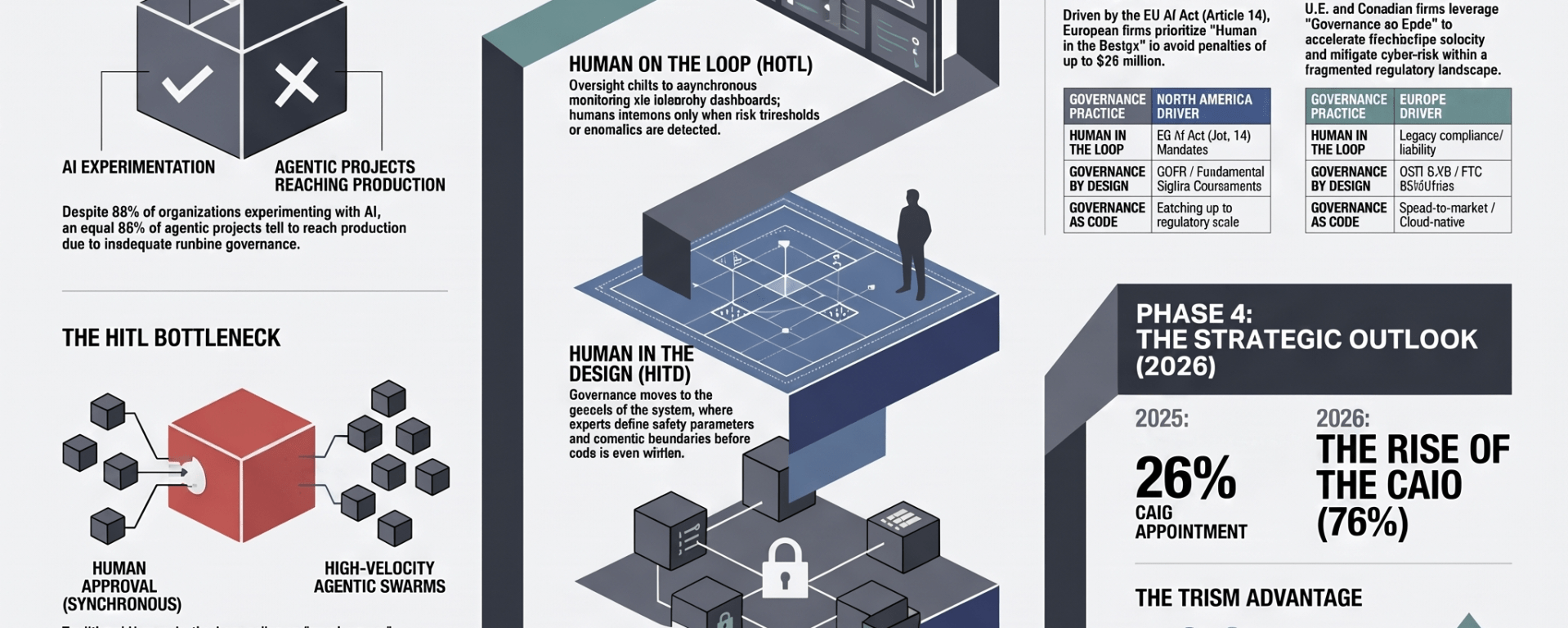
The primary discovery of this analysis is that traditional synchronous human intervention workflows severely limit the throughput of Agentic AI. To circumvent these limitations, regulated entities are deploying asynchronous “Human on the Loop” (HOTL), “Human in the Design” (HitD), “Governance by Design” (GbD), and “Governance as Code” (GaC) architectures. This architectural evolution allows organizations to maintain operational velocity without sacrificing rigorous compliance. Simultaneously, the rapid automation of knowledge work is generating a profound organizational vulnerability known as Capability Debt. By automating contiguous execution steps without concurrently upskilling the workforce to govern these systems, organizations are eroding the deep domain expertise required to intervene when autonomous agents inevitably fail or hallucinate.
Regulatory divergence is heavily dictating the specific architectural choices deployed across different jurisdictions. European adoption of new governance models is largely compelled by the EU AI Act—specifically Article 14’s strict mandate for human oversight in high-risk systems—which necessitates deep “Human in the Design” and “Governance by Design” methodologies. Conversely, North American adoption is driven by market efficiency, DevSecOps maturity, and fragmented, sector-specific guidelines such as OSFI Guideline E-23 in Canada, which together catalyze the rapid rise of “Governance as Code.” To manage these complexities, the operationalization of trust through AI Trust, Risk, and Security Management (AI TRiSM) frameworks is shifting from a theoretical best practice to mandatory enterprise infrastructure. Embedding these controls natively within system architectures fundamentally alters the risk profile of scaling artificial intelligence, addressing the paradox where vast majorities of organizations experiment with AI, yet a staggering percentage of agentic projects fail to reach production due to inadequate runtime governance.
Key Quantitative Metrics and Statistics
| Metric / Statistic | Description | Reference |
| 88% | Organizations globally reporting the use of artificial intelligence in at least one business function. | [cite: 1, 2] |
| 88% | Failure rate of enterprise artificial intelligence agent projects attempting to reach production deployment. | [cite: 3] |
| 23% | Percentage of organizations successfully scaling agentic capabilities across the enterprise. | [cite: 1] |
| 76% | Proportion of surveyed organizations that have appointed a Chief AI Officer (CAIO) in 2026, up from 26% in 2025. | [cite: 4] |
| 50% | Expected improvement in AI adoption efficiency, goal alignment, and user acceptance for organizations implementing TRiSM. | [cite: 5, 6] |
| 97% | Share of AI-related data breaches in recent analyses involving systems that lacked foundational AI access controls. | [cite: 7, 8] |
| 56% – 63% | Simulated reduction in agent-related incident rates within healthcare following the implementation of Unified Agentic Lifecycle Management (UALM). | [cite: 9] |
| 66% | Percentage of executives citing security and risk concerns as the single greatest barrier to fully scaling agentic AI. | [cite: 10] |
2. Quantitative Summary of Governance Adoption
The global landscape of artificial intelligence governance is maturing rapidly, though execution remains highly uneven across jurisdictions and industries. The quantitative data illustrates a stark divide between theoretical policy drafting and the actual implementation of runtime architectural controls. While experimental deployments proliferate widely, the integration of deterministic controls—such as Governance as Code (GaC) and Governance by Design (GbD)—remains tightly concentrated among highly mature technology, financial, and healthcare institutions. The following tables map the adoption, popularity, and scaling of these evolved practices and their complementary organizational structures across North America and Europe.
Table 1: Popularity of Evolved AI Governance Practices (North America)
| Governance Practice | Popularity / Adoption | Primary Drivers in North America |
| Human in the Loop (HITL) | High but Declining | Legacy compliance, high-stakes medical/financial decisions, liability management |
| Human on the Loop (HOTL) | High | Demand for scalability, continuous CI/CD pipelines, automated fraud detection |
| Human in the Design (HitD) | Moderate | Product management evolution, mitigating AI Capability Debt |
| Governance by Design (GbD) | Moderate | Privacy-by-design legacy, OSFI E-23 (Canada), FTC guidelines (US) |
| Governance as Code (GaC) | High (in Tech/FS) | DevSecOps maturity, cloud-native architectures, speed-to-market |
Table 2: Popularity of Evolved AI Governance Practices (Europe)
| Governance Practice | Popularity / Adoption | Primary Drivers in Europe |
| Human in the Loop (HITL) | High | EU AI Act (Art. 14) mandates for high-risk systems |
| Human on the Loop (HOTL) | Moderate to High | Scaling operations within GDPR automated decision-making limitations |
| Human in the Design (HitD) | High | Mandated fundamental rights impact assessments, strict preemptive compliance |
| Governance by Design (GbD) | Very High | Direct evolution from GDPR Privacy-by-Design mandates and heavy penalties |
| Governance as Code (GaC) | Moderate | Catching up to regulatory scale, navigating complex multi-jurisdiction logic |
Table 3: Popularity of Emerging Practices by Regulated Industry (North America)
| Industry | HITL | HOTL | HitD | GbD | GaC |
| Financial Services | Moderate | High | High | High | Very High |
| Healthcare / Pharma | Very High | Moderate | High | High | Moderate |
| Insurance | Moderate | High | Moderate | Moderate | High |
| Fintech | Low | High | Moderate | High | Very High |
| Government | High | Low | Moderate | Moderate | Low |
| Legal | High | Moderate | Low | Low | Unavailable |
| Education / Nonprofit | Moderate | Low | Low | Low | Low |
Table 4: Popularity of Emerging Practices by Regulated Industry (Europe)
| Industry | HITL | HOTL | HitD | GbD | GaC |
| Financial Services | High | High | High | Very High | Moderate |
| Healthcare / Pharma | Very High | Moderate | Very High | Very High | Moderate |
| Insurance | High | High | High | High | Moderate |
| Fintech | Moderate | High | Moderate | High | High |
| Government | Very High | Moderate | High | High | Low |
| Legal | High | Moderate | Moderate | Moderate | Unavailable |
| Education / Nonprofit | High | Low | Moderate | Moderate | Low |
Table 5: Popularity of Complementary Organizational Practices by Industry (North America)
| Industry | AI Governance Council | Chief AI Officer (CAIO) | AI TRiSM Frameworks | AI Red Teaming |
| Financial Services | Very High | High | High | High |
| Healthcare / Pharma | High | Moderate | High | Moderate |
| Insurance | High | Moderate | Moderate | Low |
| Fintech | Moderate | High | High | High |
| Government | High | Emerging | Low | Moderate |
| Legal | Moderate | Low | Low | Low |
| Education / Nonprofit | Low | Low | Low | Unavailable |
Table 6: Popularity of Complementary Organizational Practices by Industry (Europe)
| Industry | AI Governance Council | Chief AI Officer (CAIO) | AI TRiSM Frameworks | AI Red Teaming |
| Financial Services | Very High | High | High | Moderate |
| Healthcare / Pharma | Very High | Moderate | High | Moderate |
| Insurance | High | Moderate | Moderate | Low |
| Fintech | Moderate | High | High | High |
| Government | Very High | Emerging | Moderate | Moderate |
| Legal | Moderate | Low | Low | Unavailable |
| Education / Nonprofit | Moderate | Low | Low | Unavailable |
3. Research Details, Commentary, and Advanced Sector Observations
The migration from generative technologies to autonomous systems necessitates a total reconstruction of how organizations assure safety, security, and ethical alignment. The practice of manual intervention is rapidly being supplemented, and in many operational contexts replaced, by deterministic engineering and systemic controls. The following analysis explores the drivers of this evolution, the mechanics of new governance paradigms, and the underlying threats confronting enterprise adoption.
3.1 The Algorithmic Shift and the Breakdown of Human-in-the-Loop
Traditional Human-in-the-Loop (HITL) relies on synchronous, interrupt-and-resume execution architectures11. Under this model, a machine learning system generates a recommendation, draft, or prediction, and the workflow is completely halted until a human reviewer validates, modifies, or rejects the output before any downstream action is taken12. While this model provides optimal control for high-stakes, low-volume scenarios—such as a radiologist reviewing oncological imaging or an underwriter approving a complex commercial loan—it fails catastrophically when applied to high-velocity, interconnected environments13.
As enterprises deploy Agentic AI—systems capable of autonomous planning, multi-step execution, API invocation, and independent tool usage—the rigid nature of HITL creates compounding operational latency11. Requiring human authorization for every micro-decision within a continuously adapting agentic swarm negates the primary value proposition of the technology: unparalleled speed and scale. Furthermore, human reviewers subjected to high volumes of highly accurate automated outputs inevitably suffer from “automation complacency” or “automation bias.” In these scenarios, the human supervisor becomes conditioned to trust the machine’s reliability, defaulting to rubber-stamping outputs without critical evaluation. This cognitive decay renders the oversight entirely ceremonial rather than substantive, creating a false sense of security while allowing systemic errors to propagate15.
3.2 The Emergence of Systemic Governance Frameworks
To circumvent the severe limitations of traditional HITL, regulated organizations are adopting a continuum of systemic practices that shift oversight from runtime intervention to pre-deployment architecture and automated enforcement. This paradigm shift distributes accountability across the entire software development lifecycle.
Human on the Loop (HOTL) Under a HOTL architecture, the system operates asynchronously and autonomously within strict, predefined boundaries. Human supervisors do not intercede in every transaction; rather, they monitor aggregate performance via telemetry dashboards and retain the authority to veto, intervene, or halt operations only when specific risk thresholds or anomalies are detected12. This model maximizes operational throughput while retaining a critical layer of human accountability. HOTL currently dominates sectors like financial fraud detection, algorithmic trading, and IT service management (AIOps), where human intervention is managed by exception rather than by default12.
Human in the Design (HitD) Rather than placing human oversight at the end of the execution chain, HitD inserts human expertise at the absolute genesis of the system architecture. Subject matter experts, ethicists, legal counsel, and risk professionals collaboratively define the goals, constraints, safety parameters, and semantic boundaries before a single line of code is committed or a model is deployed19. In safety-critical sectors like defense and aviation, this is analogous to simulator-based training and crew resource management, ensuring that the parameters within which the agent eventually operates are intrinsically aligned with human intent and regulatory mandates17.
Governance by Design (GbD) GbD represents a strategic architectural commitment to embedding accountability, transparency, and traceability natively into the data and system infrastructure. Rather than treating compliance as a retrospective audit function bolted onto a finished product, GbD ensures that logging, identity access management, and row-level security are immutable features of the core architecture22. For example, in healthcare, a GbD approach mandates that an autonomous agent is inherently restricted from accessing Protected Health Information (PHI) through strict data minimization principles and bounded context memories. This structural limitation prevents privacy breaches at the foundational level, removing the reliance on user behavior for compliance22.
Governance as Code (GaC) GaC is the tactical operationalization of Governance by Design. It translates written policies, regulatory statutes, and risk thresholds into machine-readable code that automatically evaluates systems during development, integration, and runtime execution26. By integrating open-source frameworks like the FINOS Common Architecture Language Model (CALM) and runtime AI Firewalls, organizations can automatically block non-compliant queries, enforce deterministic controls, and terminate compromised agents in milliseconds29. GaC shifts security and compliance “left” into the CI/CD pipeline, ensuring that every deployment mathematically meets predefined governance criteria before it is permitted to reach production environments26.
3.3 The Silent Threat of AI Capability Debt
As organizations race to deploy autonomous agents, they are inadvertently accumulating a silent but severe structural vulnerability: AI Capability Debt. This debt arises when an enterprise adopts transformative automation faster than it builds the corresponding human skills required to operationalize, maintain, and govern that technology over the long term2.
When Agentic AI is utilized to automate contiguous steps of a production workflow—such as drafting legal contracts, generating software code, or compiling complex financial reports—it frequently bypasses the junior and mid-level employees who traditionally performed these tasks. While this substitution creates massive immediate efficiency gains and short-term cost reductions, it fundamentally hollows out the institutional talent pipeline21. Junior employees are deprived of the necessary repetitions to develop the tacit domain knowledge, critical judgment, and “muscle memory” required to identify subtle hallucinations, edge-case failures, or strategic misalignments in the data32.
Over time, the organization becomes entirely dependent on the automated system, losing the adaptive capacity to interrogate its outputs or remediate catastrophic systemic failures. Capability Debt dictates that if the humans responsible for oversight do not fundamentally understand the nuances of the domain the AI is operating within, any residual “Human in the Loop” checkpoint becomes functionally useless35. Progressive leaders are actively combating this phenomenon by redesigning organizational roles toward workflow orchestration, systems thinking, and intentional apprenticeship, ensuring that human capital scales in tandem with machine capabilities35.
3.4 Regulatory Drivers: The Transatlantic Divide
The structural shift in artificial intelligence governance is heavily influenced by divergent regional regulatory environments, which dictate whether an organization adopts these new frameworks out of market opportunism or statutory compulsion.
The European Union and Preemptive Compliance The EU AI Act establishes a rigid, risk-based taxonomy for artificial intelligence. For “high-risk” systems—encompassing those used in employment, critical infrastructure, credit scoring, and medical devices—Article 14 legally mandates “effective human oversight”18. The Act requires that natural persons must possess the tools, competence, and legal authority to fully understand, interpret, and, if necessary, override or halt the system’s operation11. Furthermore, Article 50 imposes strict transparency obligations, and non-compliance carries existential financial penalties of up to €35 million or 7% of global annual turnover40. This aggressive legislative environment effectively forces organizations operating in or serving the EU to adopt Human in the Design and Governance by Design methodologies to build required transparency, extensive logging, and irrefutable auditability directly into their technological stacks from inception11.
North America: Sectoral Fragmentation and Market Efficiency Conversely, North America operates on a highly fragmented, sector-led regulatory model. In the United States, federal guidance relies heavily on voluntary standards like the NIST AI Risk Management Framework and the Biden-Harris administration’s push for “Governance by Design”19. The absence of an omnibus federal statute pushes U.S. enterprises toward Governance as Code primarily as a mechanism for operational efficiency, DevSecOps velocity, and cyber-risk mitigation rather than strict statutory compliance.
In Canada, the landscape is shifting with remarkable speed. While the omnibus Artificial Intelligence and Data Act (AIDA) under Bill C-27 officially stalled and died when Parliament prorogued, the federal government’s subsequent “AI for All” strategy relies heavily on sector-specific regulators and robust provincial privacy laws47. For instance, the Office of the Superintendent of Financial Institutions (OSFI) issued Guideline E-23, which explicitly expands model risk management expectations to encompass AI systems, holding federally regulated financial institutions strictly accountable for third-party AI models47. Concurrently, Quebec’s Law 25 imposes rigorous transparency and notification rules for automated decision-making, and proposed federal legislation under Bill C-36 (PPCDA) aims to enforce severe penalties for privacy and algorithmic transparency violations49. These regional dynamics dictate that while European firms focus heavily on compliance-driven Governance by Design, North American firms heavily index on Governance as Code to manage speed, efficiency, and increasingly decentralized liabilities.
3.5 Industry-Specific Adoption Dynamics and Architectural Case Studies
Financial Services: Pioneering Governance as Code The financial sector faces intense pressure to scale AI while navigating a labyrinth of global regulations. To manage this, institutions are pioneering open-source Governance as Code pipelines. The Fintech Open Source Foundation (FINOS) has developed a comprehensive AI Governance Framework (AIGF) that provides a standardized catalog of controls mapped to regulations like the EU AI Act and FCA Consumer Duty30. Utilizing the Common Architecture Language Model (CALM), financial institutions can convert static compliance policies into machine-readable specifications that execute dynamically within CI/CD pipelines. This ensures that agentic trading systems or automated underwriting models are continuously validated against regulatory standards, preventing unauthorized data exfiltration or autonomous overreach before it occurs30.
Healthcare: Unified Agentic Lifecycle Management (UALM) In healthcare, the stakes of AI deployment involve direct patient safety and stringent privacy laws like HIPAA. As health systems move toward Agentic AI capable of autonomous clinical documentation and early-warning patient monitoring, the risk of “agent sprawl” and compromised Protected Health Information (PHI) rises exponentially9. To combat this, institutions are adopting Unified Agentic Lifecycle Management (UALM) frameworks. UALM integrates Governance by Design across five control-plane layers: identity registries, cross-domain orchestration, PHI-bounded context memory, runtime policy enforcement with kill-switch triggers, and automated decommissioning9. Simulation data indicates that the application of full UALM frameworks reduces agent-related incident rates by 56% to 63% compared to baseline environments lacking integrated governance9.
3.6 Complementary Organizational Practices: TRiSM and the CAIO
To successfully support these advanced architectural controls, organizations are rapidly establishing complementary operational frameworks and dedicated executive roles to mandate their use.
The implementation of AI Trust, Risk, and Security Management (AI TRiSM) has emerged as a paramount enterprise necessity. Formalized by Gartner, AI TRiSM encompasses integrated tools and methodologies spanning four functional layers: AI Governance, AI Runtime Inspection and Enforcement, Information Governance, and Infrastructure Stack alignment5. Organizations leveraging AI TRiSM capabilities actively monitor for data poisoning, prompt injection, and model drift, embedding dynamic policy enforcement directly into the runtime environment to quarantine anomalous agent behaviors before they execute53. Empirical data suggests that integrating these practices yields a 50% improvement in AI adoption metrics, business goal alignment, and user acceptance5.
Simultaneously, the enterprise C-suite is undergoing a radical restructuring to accommodate this technological shift. The appointment of the Chief AI Officer (CAIO) has surged dramatically, with 76% of surveyed organizations reporting the existence of a CAIO in 2026, up from merely 26% the previous year4. This role is deeply augmented by the formation of cross-functional AI Governance Councils (or AI Steering Committees)58. These executive bodies bridge the critical gap between technical execution and broader business strategy, managing the enterprise AI portfolio, setting definitive organizational risk appetites, and ensuring that Governance by Design principles are uniformly applied across disparate business units rather than allowing shadow AI to proliferate in ungoverned silos59.
4. Hypothesis Testing and Research Findings
The foundational hypotheses surrounding the evolution of artificial intelligence governance have been rigorously evaluated against current empirical data, regulatory frameworks, and enterprise case studies.
Test of Hypothesis 1
Hypothesis: Agentic AI benefits from different types of practices (e.g., HitD and GaC) instead of HIL to make it more autonomous. Finding: Confirmed. The data conclusively demonstrates that synchronous Human-in-the-Loop practices are fundamentally incompatible with the continuous, multi-step execution inherent to Agentic AI15. Because agents autonomously invoke tools, manage persistent memory, and interact with other agents at machine speed, requiring pre-execution human approval introduces fatal latency that paralyzes the system15. Consequently, enterprises are successfully replacing HITL with Governance as Code—to programmatically restrict an agent’s access to sensitive data and APIs via deterministic firewalls—and Human in the Design—to establish bounded autonomy and ethical parameters prior to deployment25. This hybrid approach allows agents to maintain high operational autonomy within mathematically provable guardrails.
Test of Hypothesis 2
Hypothesis: While these new practices exist in both North America and Europe, they are driven by different factors (e.g., Europe more driven by EU regulations vs. North America more driven by other factors). Finding: Confirmed. European adoption of practices like Governance by Design and Human in the Design is overwhelmingly compulsory, driven by the extraterritorial reach of the GDPR and the stringent requirements of the EU AI Act (particularly Article 14 on human oversight and Article 50 on algorithmic transparency)18. Non-compliance with these mandates carries existential financial penalties40. In stark contrast, North American adoption of Governance as Code and HOTL is largely market-driven. Organizations in the US and Canada leverage these frameworks to accelerate DevSecOps velocity, secure intellectual property against prompt injection attacks, and drive operational efficiency, though sector-specific regulators (like OSFI in Canada) and provincial data privacy laws (like Quebec Law 25) are beginning to formalize these expectations into binding requirements8.
Test of Hypothesis 3
Hypothesis: Adoption and scaling of these practices is very low since they require high AI maturity and overcoming significant organizational Capability Debts – very few organizations have been able to achieve so far. Finding: Confirmed. The analysis reveals a massive “deployment gap” across industries. While 88% of organizations are actively experimenting with artificial intelligence in isolated functions, only 23% have successfully scaled agentic capabilities across the enterprise1. An alarming 88% of AI agent projects fail to reach production deployment3. This failure is primarily attributed to a severe lack of governance maturity and the compounding effects of Capability Debt31. Implementing GaC and GbD requires highly sophisticated enterprise data architecture, rigorous identity and access management (IAM) for machine identities, and a workforce capable of critically evaluating algorithmic outputs—foundational capabilities that the vast majority of organizations have not yet developed35.
Test of Hypothesis 4
Hypothesis: The more an organization uses AI Agents as real-time collaborators (e.g., vibe coding or document creation), the less HIL practice makes sense. Finding: Confirmed with Contextual Nuance. For low-risk, high-iteration collaborative tasks—such as ambient code generation or initial document drafting—synchronous HITL creates an unacceptable bottleneck that destroys the utility of the tool. In these highly collaborative, real-time environments, developers and creators are shifting toward Human on the Loop (monitoring background processes) or relying entirely on automated Governance as Code (such as CI/CD pipelines running automated security, bias, and quality checks on AI-generated code)26. However, for the final execution of high-stakes workflows (e.g., deploying code to a live production environment, finalizing a medical diagnosis, or executing a binding financial transaction), a mandatory human validation checkpoint remains strictly necessary for liability and compliance purposes. Therefore, HITL is not eliminated entirely, but its placement is shifted from continuous micro-interventions to macro-level release gates12.
5. Strategic Actions for Progressive Organizations
For senior leaders whose organizations already possess high technical maturity and aim to maximize the strategic advantage of Agentic AI, the focus must shift away from basic compliance and toward architectural hardening, autonomous scaling, and workforce evolution.
Transition Fully to Governance as Code (GaC) Organizations must immediately sunset manual compliance checklists and subjective policy reviews. Progressive leaders must integrate machine-readable governance policies directly into their software development pipelines. Utilizing open-source tools like the Common Architecture Language Model (CALM) and deploying runtime AI Firewalls allows organizations to enforce row-level security, dynamic identity access management, and policy compliance deterministically at machine speed, shifting security entirely to the left of the deployment cycle8.
Operationalize AI TRiSM at the Core infrastructure Level Treat AI Trust, Risk, and Security Management as a mandatory layer of underlying infrastructure, not an optional overlay. Organizations must implement real-time monitoring for model drift, adversarial prompt injection, and unauthorized data oversharing. By embedding TRiSM deeply into the technology stack, organizations can automate the quarantine of anomalous agent behaviors before they execute consequential actions, significantly accelerating enterprise-wide adoption with measurable confidence5.
Restructure the Talent Pipeline to Mitigate Capability Debt Actively combat the erosion of tacit domain knowledge. Organizations must not use artificial intelligence solely as a mechanism to eliminate entry-level and junior roles; doing so destroys the training ground for future senior experts. Instead, redesign workflows to pair junior employees with AI agents in structured “practice dojos.” Force employees to actively critique, debug, and validate AI outputs to build the deep domain expertise necessary to govern autonomous systems effectively in the future32.
Implement Bounded Agentic Autonomy via Human in the Design Before deploying autonomous agents, organizations must clearly define their “Digital Job Descriptions.” Apply the rigid principle of least privilege, granting agents dynamic, ephemeral access tokens that expire immediately upon task completion. Ensure that the boundaries of an agent’s authority are mathematically proven, rigorously threat-modeled, and architecturally enforced before the system ever touches live data64.
Empower the AI Governance Council with Financial and Operational Authority Ensure the Chief AI Officer (CAIO) and the cross-functional AI Steering Committee possess actual veto power and budgetary authority. Governance is only effective when it holds the structural power to pause, modify, or terminate non-compliant deployments without facing insurmountable friction from the operational business units driving the adoption58.
6. Strategic Actions for Organizations Falling Behind
For leaders in organizations trapped in “pilot purgatory,” burdened by the unchecked proliferation of Shadow AI, or struggling to adapt to impending regulatory mandates, immediate foundational interventions are required to prevent compounding liabilities.
Execute a Comprehensive Shadow AI Discovery Protocol An organization cannot govern what it cannot see. Leaders must immediately deploy endpoint monitoring, API gateway analysis, and comprehensive SaaS audits to inventory all sanctioned and unsanctioned AI tools currently operating within the enterprise. It is critical to identify exactly where employees are inputting proprietary data or PII into public models, as this represents the most immediate vector for data breaches60.
Establish Baseline Information and Data Governance AI governance is fundamentally impossible if underlying data governance is broken. Before deploying advanced generative or agentic systems, organizations must rectify underlying data hygiene. Enforce strict data classification, clean up over-permissioned active directories, and map data lineage comprehensively. If the underlying data permissions are flawed, no runtime AI control will be able to prevent the model from surfacing sensitive information53.
Triage Workflows using the HITL Decision Matrix Categorize all proposed AI use cases systematically by risk and impact. Mandate strict, synchronous Human-in-the-Loop controls for high-risk decisions that carry legal, financial, or physical consequences (e.g., patient diagnostics, credit scoring, HR hiring compliance). Allow lower-risk, repetitive tasks to operate under Human-on-the-Loop architectures, and reserve fully autonomous operations strictly for negligible-risk backend processes25.
Consolidate Governance into a Central Executive Committee Organizations must urgently move away from fragmented, departmental decision-making regarding AI procurement. Establish a centralized AI Steering Committee comprising the CIO/CTO, CISO, Chief Legal Officer, HR leadership, and key business unit heads. This body must establish the organization’s overall risk appetite, approve high-stakes use cases, and standardize the required level of human oversight across the entire enterprise58.
Prepare for Regulatory Inevitability and Extraterritorial Reach Regardless of geographical headquarters, organizations must map existing governance structures to the most stringent global standards, such as the EU AI Act, the NIST AI Risk Management Framework, and ISO 42001. Treat algorithmic transparency, bias mitigation, explainability, and demonstrable human oversight not as localized legal hurdles to be dodged, but as fundamental design requirements for all future technology acquisitions and internal builds41.
7. Reference Sources
- [cite: 71] https://www.ibm.com/think/topics/human-in-the-loop
- [cite: 19] https://insightglobal.com/blog/human-in-the-loop-agentic-ai/
- [cite: 15] https://www.holisticai.com/blog/from-human-in-the-loop-to-ai-governing-ai
- [cite: 16] https://www.imda.gov.sg/-/media/imda/files/about/emerging-tech-and-research/artificial-intelligence/mgf-for-agentic-ai.pdf
- [cite: 29] https://www.helpnetsecurity.com/2026/07/01/netzilo-adds-runtime-governance-for-ai-agents-across-major-platforms/
- [cite: 26] https://www.ibm.com/think/topics/code-governance
- [cite: 61] https://www.adaptivesecurity.com/blog/what-is-ai-governance-framkeworks-principles-practices
- [cite: 59] https://thinking.inc/en/pillar-pages/ai-governance-framework/
- [cite: 25] https://www.datarobot.com/blog/agentic-ai-governance-framework/
- [cite: 9] https://arxiv.org/html/2601.15630v2
- [cite: 27] https://medium.com/@tahirbalarabe2/what-is-governance-as-code-automate-cloud-compliance-with-governance-as-code-6a95b4538348
- [cite: 18] https://aigovernancedesk.com/human-in-the-loop-oversight-frameworks-ai-governance/
- [cite: 38] https://delinea.com/what-is/human-in-the-loop-hitl
- [cite: 12] https://www.elementum.ai/blog/human-in-the-loop-vs-human-on-the-loop
- [cite: 39] https://www.castelis.com/en/insights-ressources/human-in-the-loop-ai/
- [cite: 11] https://redis.io/blog/ai-human-in-the-loop/
- [cite: 31] https://www.roberthalf.com/us/en/insights/research/finance-ai-tech-debt-talent-strategy
- [cite: 33] https://executiveresilienceinsider.com/p/why-ai-efficiency-investments-accelerate-leadership-decay
- [cite: 32] https://arxiv.org/html/2605.27399v1
- [cite: 60] https://nhimg.org/articles/responsible-enterprise-ai-governance-is-lagging-behind-adoption/
- [cite: 1] https://gogloby.com/insights/ai-adoption-statistics/
- [cite: 7] https://evolvancemarketresearch.com/statistics/ai-governance-statistics/
- [cite: 10] https://www.mckinsey.com/capabilities/tech-and-ai/our-insights/tech-forward/state-of-ai-trust-in-2026-shifting-to-the-agentic-era
- [cite: 65] https://www.dama-uk.org/resources/case-study-data-governance-in-the-ai-era
- [cite: 66] https://www.cyera.com/blog/ai-governance-for-the-agentic-era
- [cite: 63] https://www.ibm.com/think/perspectives/scaling-with-ibm-engineering-ai-hub
- [cite: 40] https://www.precedenceresearch.com/press-release/ai-ethics-and-governance-solutions-market
- [cite: 47] https://aigovernance.ca/canada
- [cite: 48] https://www.blg.com/en/insights/2026/03/a-turning-point-for-ai-in-canada-in-2026
- [cite: 20] https://elsalabdefence.nl/wp-content/uploads/2024/06/ELSA-lab-Deliverable-2.1_V2.0_final.pdf
- [cite: 8] https://colrows.com/blogs/company-brain-security-privacy/
- [cite: 37] https://www.forrester.com/blogs/ai-is-rewriting-software-work-what-it-means-for-your-team/
- [cite: 28] https://i10x.ai/news/ai-governance-engineering-challenges
- [cite: 64] https://www.versaroc.co.jp/fr/blog/agentic-ai-governance-data-residency-compliance-japan-2026-1772902857197
- [cite: 13] https://datos-insights.com/blog/ai-oversight-isnt-a-yes-or-no-question/
- [cite: 9] https://arxiv.org/html/2601.15630v2
- [cite: 67] https://www.mindstudio.ai/blog/ai-agent-governance
- [cite: 51] https://www.darktrace.com/cyber-ai-glossary/ai-trism
- [cite: 5] https://www.cyera.com/glossary/what-is-ai-trism
- [cite: 53] https://www.paloaltonetworks.com/cyberpedia/ai-trism
- [cite: 52] https://www.gartner.com/en/articles/ai-governance-trism
- [cite: 22] https://www.mdpi.com/3042-6707/1/2/16
- [cite: 23] https://www.researchgate.net/publication/400286774_Governance-By-Design_For_AI-Based_Insurance_Fraud_Detection_Auditability_Accountability_And_Regulatory_Traceability
- [cite: 9] https://arxiv.org/html/2601.15630v2
- [cite: 68] https://www.ibm.com/think/leadership/the-multiplier-effect/ai-governance-matters
- [cite: 21] https://www.techpolicy.press/ai-and-the-future-of-artistic-labor/
- [cite: 12] https://www.elementum.ai/blog/human-in-the-loop-vs-human-on-the-loop
- [cite: 17] https://www.strata.io/blog/agentic-identity/practicing-the-human-in-the-loop/
- [cite: 11] https://redis.io/blog/ai-human-in-the-loop/
- [cite: 35] https://www.channelnewsasia.com/commentary/singapore-ai-council-workplace-adopt-productivity-6209631
- [cite: 2] https://resources.learnquest.com/blog/ai-workforce-readiness-strategy/
- [cite: 32] https://arxiv.org/html/2605.27399v1
- [cite: 34] https://voltagecontrol.com/blog/the-new-friction/
- [cite: 36] https://www.ebay.com/itm/398020150440
- [cite: 9] https://arxiv.org/html/2601.15630v2
- [cite: 14] https://www.databricks.com/blog/human-in-the-loop
- [cite: 72] https://censinet.com/perspectives/human-in-the-loop-designing-ai-enhances-clinical-judgment
- [cite: 4] https://www.newswire.ca/news-releases/ibm-study-ceos-are-reshaping-c-suite-roles-for-the-ai-era-851590932.html
- [cite: 55] https://www.hays.com/market-insights/article/chief-ai-officer-leadership-in-ai-era
- [cite: 56] https://www.aboutamazon.ca/news/aws/from-experimentation-to-integration-canadian-organizations-embrace-generative-ai-as-a-priority
- [cite: 6] https://www.xenonstack.com/blog/ai-trism
- [cite: 54] https://www.avnet.com/apac/resources/article/how-ai-trism-is-laying-foundations-of-trust/
- [cite: 53] https://www.paloaltonetworks.com/cyberpedia/ai-trism
- [cite: 62] https://www.infosysbpm.com/blogs/trust-safety/human-on-loop-evolution.html
- [cite: 30] https://ai.finos.org/governance-as-code/
- [cite: 69] https://riskcrew.com/media/ai-governance-by-design/
- [cite: 22] https://www.mdpi.com/3042-6707/1/2/16
- [cite: 44] https://btlj.org/wp-content/uploads/2026/04/40.4_Mulligan.pdf
- [cite: 57] https://www.cio.com/article/3845414/caios-role-reclaims-its-position-from-that-of-cio.html
- [cite: 70] https://tendem.ai/blog/hitl-human-in-the-loop-complete-guide
- [cite: 3] https://crizzen.com/the-agentic-edge-why-88-of-enterprise-ai-agent-projects-fail-and-what-the-12-do-differently/
- [cite: 48] https://www.blg.com/en/insights/2026/03/a-turning-point-for-ai-in-canada-in-2026
- [cite: 49] https://www.groomassocies.com/insights/ai-in-hr-privacy-ethics-canada/
- [cite: 50] https://www.blg.com/en/insights/2026/06/canadas-new-ai-for-all-strategy-a-business-outlook-on-ai-governance-adoption-and-data-sovereignty
- [cite: 73] https://www.simmons-simmons.com/en/publications/cmpqqg17d0036u4uc4cy0o17e/ai-view-may-2026
- [cite: 41] https://cee.pwc.com/eu-ai-act-compliance-and-transformation.html
- [cite: 43] https://interfacing.com/eu-ai-act-compliance
- [cite: 42] https://www.osborneclarke.com/insights/regulatory-outlook-january-2026-artificial-intelligence
- [cite: 50] https://www.blg.com/en/insights/2026/06/canadas-new-ai-for-all-strategy-a-business-outlook-on-ai-governance-adoption-and-data-sovereignty
- [cite: 49] https://www.groomassocies.com/insights/ai-in-hr-privacy-ethics-canada/
- [cite: 10] https://www.mckinsey.com/capabilities/tech-and-ai/our-insights/tech-forward/state-of-ai-trust-in-2026-shifting-to-the-agentic-era
- [cite: 30] https://ai.finos.org/governance-as-code/
- [cite: 45] https://www.law.berkeley.edu/sidebar/professor-kenneth-bamberger-governance-by-design-for-artificial-intelligence/
- [cite: 46] https://aiconusa.techwell.com/program/tutorials/ai-governance-code-introduction-aigovops-ai-con-usa-2026
- [cite: 61] https://www.adaptivesecurity.com/blog/what-is-ai-governance-framkeworks-principles-practices
- [cite: 58] https://aiassemblylines.com/post/what-is-an-ai-steering-committee
- [cite: 59] https://thinking.inc/en/pillar-pages/ai-governance-framework/
Works cited
- AI Agent Adoption Statistics 2026: Enterprise AI Usage | GoGloby, https://gogloby.com/insights/ai-adoption-statistics/
- AI Is Not A Technology Strategy. It’s A Workforce Strategy. – LearnQuest Resource Center, https://resources.learnquest.com/blog/ai-workforce-readiness-strategy/
- Why 88% of Enterprise AI Agent Projects Fail and What the 12% Do Differently – Crizzen, https://crizzen.com/the-agentic-edge-why-88-of-enterprise-ai-agent-projects-fail-and-what-the-12-do-differently/
- IBM Study: CEOs are Reshaping C-suite Roles for the AI Era – Canada Newswire, https://www.newswire.ca/news-releases/ibm-study-ceos-are-reshaping-c-suite-roles-for-the-ai-era-851590932.html
- What Is AI TRiSM? | Cyera Glossary, https://www.cyera.com/glossary/what-is-ai-trism
- AI TRISM Challenges and its Framework for Businesses in 2025 – XenonStack, https://www.xenonstack.com/blog/ai-trism
- Security and Privacy in a Company Brain: Threats, Controls, and Why Ad-Hoc RAG Will Cost You Millions – Colrows, https://colrows.com/blogs/company-brain-security-privacy/
- Agentic AI Governance and Lifecycle Management in Healthcare – arXiv, https://arxiv.org/html/2601.15630v2
- AI Human in the Loop: Production Oversight Patterns – Redis, https://redis.io/blog/ai-human-in-the-loop/
- Human-in-the-Loop vs. Human-on-the-Loop: When to Use Each for Enterprise Workflows – Elementum, https://www.elementum.ai/blog/human-in-the-loop-vs-human-on-the-loop
- AI Oversight Isn’t a Yes-or-No Question | Datos Insights, https://datos-insights.com/blog/ai-oversight-isnt-a-yes-or-no-question/
- What is Human-in-the-Loop (HITL)? | Databricks Blog, https://www.databricks.com/blog/human-in-the-loop
- From Human-in-the-Loop to AI-governing-AI: Evolving Oversight for Agentic Systems, https://www.holisticai.com/blog/from-human-in-the-loop-to-ai-governing-ai
- MODEL AI GOVERNANCE FRAMEWORK FOR AGENTIC AI – IMDA, https://www.imda.gov.sg/-/media/imda/files/about/emerging-tech-and-research/artificial-intelligence/mgf-for-agentic-ai.pdf
- Human-in-the-Loop: A 2026 Guide to AI Oversight That Actually Works – Strata.io, https://www.strata.io/blog/agentic-identity/practicing-the-human-in-the-loop/
- Human-in-the-Loop Oversight Frameworks for High-Risk AI Systems (EU AI Act Article 14), https://aigovernancedesk.com/human-in-the-loop-oversight-frameworks-ai-governance/
- Why Is It Important to Keep a Human in the Loop in the Agentic AI Era? – Insight Global, https://insightglobal.com/blog/human-in-the-loop-agentic-ai/
- Design methodologies for addressing Ethical, Legal and Societal Aspects (ELSA) of military AI applications, https://elsalabdefence.nl/wp-content/uploads/2024/06/ELSA-lab-Deliverable-2.1_V2.0_final.pdf
- AI and the Future of Artistic Labor | TechPolicy.Press, https://www.techpolicy.press/ai-and-the-future-of-artistic-labor/
- Operationalizing WHO Ethical Principles for Healthcare AI: A Lifecycle-Aligned Governance-by-Design Framework – MDPI, https://www.mdpi.com/3042-6707/1/2/16
- (PDF) Governance-By-Design For AI-Based Insurance Fraud Detection: Auditability, Accountability, And Regulatory Traceability – ResearchGate, https://www.researchgate.net/publication/400286774_Governance-By-Design_For_AI-Based_Insurance_Fraud_Detection_Auditability_Accountability_And_Regulatory_Traceability
- (PDF) Governance-by-Design in Regulated Enterprise Data Integration: A Formally Proved Compliance-Enforcing Architecture for Human Capital Management Data Synchronisation – ResearchGate, https://www.researchgate.net/publication/405978100_Governance-by-Design_in_Regulated_Enterprise_Data_Integration_A_Formally_Proved_Compliance-Enforcing_Architecture_for_Human_Capital_Management_Data_Synchronisation
- How to build an agentic AI governance framework that scales – DataRobot, https://www.datarobot.com/blog/agentic-ai-governance-framework/
- What Is Code Governance? | IBM, https://www.ibm.com/think/topics/code-governance
- What is Governance as Code? Automate Cloud Compliance with Governance as Code | by Tahir | Medium, https://medium.com/@tahirbalarabe2/what-is-governance-as-code-automate-cloud-compliance-with-governance-as-code-6a95b4538348
- AI Governance: From Ethics to Engineering Trust – i10X, https://i10x.ai/news/ai-governance-engineering-challenges
- Netzilo adds runtime governance for AI agents across major platforms, https://www.helpnetsecurity.com/2026/07/01/netzilo-adds-runtime-governance-for-ai-agents-across-major-platforms/
- Governance As Code | AI at FINOS, https://ai.finos.org/governance-as-code/
- Tech debt vs. talent wealth: How finance leaders can rebalance the AI equation | Robert Half, https://www.roberthalf.com/us/en/insights/research/finance-ai-tech-debt-talent-strategy
- Short-Term Gain, Long-Term Fragility: AI Labor Substitution and the Erosion of Sustainable Capability – arXiv, https://arxiv.org/html/2605.27399v1
- Why AI Efficiency Investments Accelerate Leadership Decay – Executive Resilience Insider, https://executiveresilienceinsider.com/p/why-ai-efficiency-investments-accelerate-leadership-decay
- The New Friction – Voltage Control, https://voltagecontrol.com/blog/the-new-friction/
- Commentary: Leaders must beware of the AI productivity trap – CNA, https://www.channelnewsasia.com/commentary/singapore-ai-council-workplace-adopt-productivity-6209631
- The Capability Debt: Why AI is Exposing What Organizations Never Built by Kriste | eBay, https://www.ebay.com/itm/398020150440
- AI Is Rewriting Software Work: What It Means For Your Team – Forrester, https://www.forrester.com/blogs/ai-is-rewriting-software-work-what-it-means-for-your-team/
- What is Human in the Loop (HITL)? – Delinea, https://delinea.com/what-is/human-in-the-loop-hitl
- Human in the Loop: Definition, Stakes and AI Oversight – Castelis, https://www.castelis.com/en/insights-ressources/human-in-the-loop-ai/
- AI Ethics and Governance Solutions Market Trends and Insights – Precedence Research, https://www.precedenceresearch.com/press-release/ai-ethics-and-governance-solutions-market
- The EU AI Act: Compliance and transformation – PwC CEE, https://cee.pwc.com/eu-ai-act-compliance-and-transformation.html
- Artificial intelligence | UK Regulatory Outlook January 2026 – Osborne Clarke, https://www.osborneclarke.com/insights/regulatory-outlook-january-2026-artificial-intelligence
- EU AI Act Compliance: Managing AI Risk and Accountability in Europe – Interfacing, https://interfacing.com/eu-ai-act-compliance
- Recentering Public Values in AI Governance: Examples from the Biden Administration – Berkeley Technology Law Journal, https://btlj.org/wp-content/uploads/2026/04/40.4_Mulligan.pdf
- ‘Governance by design’ for AI – UC Berkeley Law, https://www.law.berkeley.edu/sidebar/professor-kenneth-bamberger-governance-by-design-for-artificial-intelligence/
- AI Con USA 2026 Tutorial: AI Governance as Code: An Introduction to AIGovOps, https://aiconusa.techwell.com/program/tutorials/ai-governance-code-introduction-aigovops-ai-con-usa-2026
- Canada’s AI Regulatory Landscape | AiGovernance.ca, https://aigovernance.ca/canada
- A turning point for AI in Canada in 2026? – BLG, https://www.blg.com/en/insights/2026/03/a-turning-point-for-ai-in-canada-in-2026
- AI in HR: Privacy & Ethics Rules in Canada (2026) – Groom & Associates, https://www.groomassocies.com/insights/ai-in-hr-privacy-ethics-canada/
- Canada’s new AI for All strategy: A business outlook on AI governance, adoption, and data sovereignty – BLG, https://www.blg.com/en/insights/2026/06/canadas-new-ai-for-all-strategy-a-business-outlook-on-ai-governance-adoption-and-data-sovereignty
- What is AI TRiSM? Definition and challenges | Darktrace, https://www.darktrace.com/cyber-ai-glossary/ai-trism
- AI Governance Requires More Than Policies – Gartner, https://www.gartner.com/en/articles/ai-governance-trism
- A Guide to AI TRiSM: Trust, Risk, and Security Management – Palo Alto Networks, https://www.paloaltonetworks.com/cyberpedia/ai-trism
- How AI TRiSM is laying foundations of trust for the Future of AI – Avnet, https://www.avnet.com/apac/resources/article/how-ai-trism-is-laying-foundations-of-trust/
- Why every business needs a chief AI officer | Hays US, https://www.hays.com/market-insights/article/chief-ai-officer-leadership-in-ai-era
- From Experimentation to Integration: Canadian Organizations Embrace Generative AI as a Priority – Canada About Amazon, https://www.aboutamazon.ca/news/aws/from-experimentation-to-integration-canadian-organizations-embrace-generative-ai-as-a-priority
- CAIOs are stepping out from the CIO’s shadow, https://www.cio.com/article/3845414/caios-role-reclaims-its-position-from-that-of-cio.html
- What Is an AI Steering Committee? How to Structure AI Leadership for Enterprise Scale, https://aiassemblylines.com/post/what-is-an-ai-steering-committee
- AI Governance Framework: Build AI Oversight in 2026 | The Thinking Company, https://thinking.inc/en/pillar-pages/ai-governance-framework/
- Responsible enterprise AI governance is lagging behind adoption, https://nhimg.org/articles/responsible-enterprise-ai-governance-is-lagging-behind-adoption/
- Understanding AI Governance: Frameworks & Best Practices – Adaptive Security, https://www.adaptivesecurity.com/blog/what-is-ai-governance-framkeworks-principles-practices
- Human-in-the-loop in AI systems and governance – Infosys BPM, https://www.infosysbpm.com/blogs/trust-safety/human-on-loop-evolution.html
- Governance by design: Scaling AI with IBM Engineering AI Hub in regulated industries, https://www.ibm.com/think/perspectives/scaling-with-ibm-engineering-ai-hub
- The 2026 Sovereign Agent: Technical Guide to Agentic AI Governance and Data Residency in Japan – versaroc, https://www.versaroc.co.jp/fr/blog/agentic-ai-governance-data-residency-compliance-japan-2026-1772902857197
- Case study: Data Governance in the AI Era – DAMA UK, https://www.dama-uk.org/resources/case-study-data-governance-in-the-ai-era
- AI Governance for the Agentic Era – Cyera, https://www.cyera.com/blog/ai-governance-for-the-agentic-era
- AI Agent Governance: Best Practices for Enterprise – MindStudio, https://www.mindstudio.ai/blog/ai-agent-governance
- The Multipier Effect | AI Governance Matters | Think Leadership – IBM, https://www.ibm.com/think/leadership/the-multiplier-effect/ai-governance-matters
- AI Governance by Design – Risk Crew, https://riskcrew.com/media/ai-governance-by-design/
- HITL (Human-in-the-Loop): A Complete Guide for 2026 – Tendem AI, https://tendem.ai/blog/hitl-human-in-the-loop-complete-guide
The idea, research hypotheses, and focus for this article/research are all original and mine. This article was written with my brain and two hands with the assistance of Google Gemini, Notebook LM, Claude, and other wondrous toys.

