Executive Summary
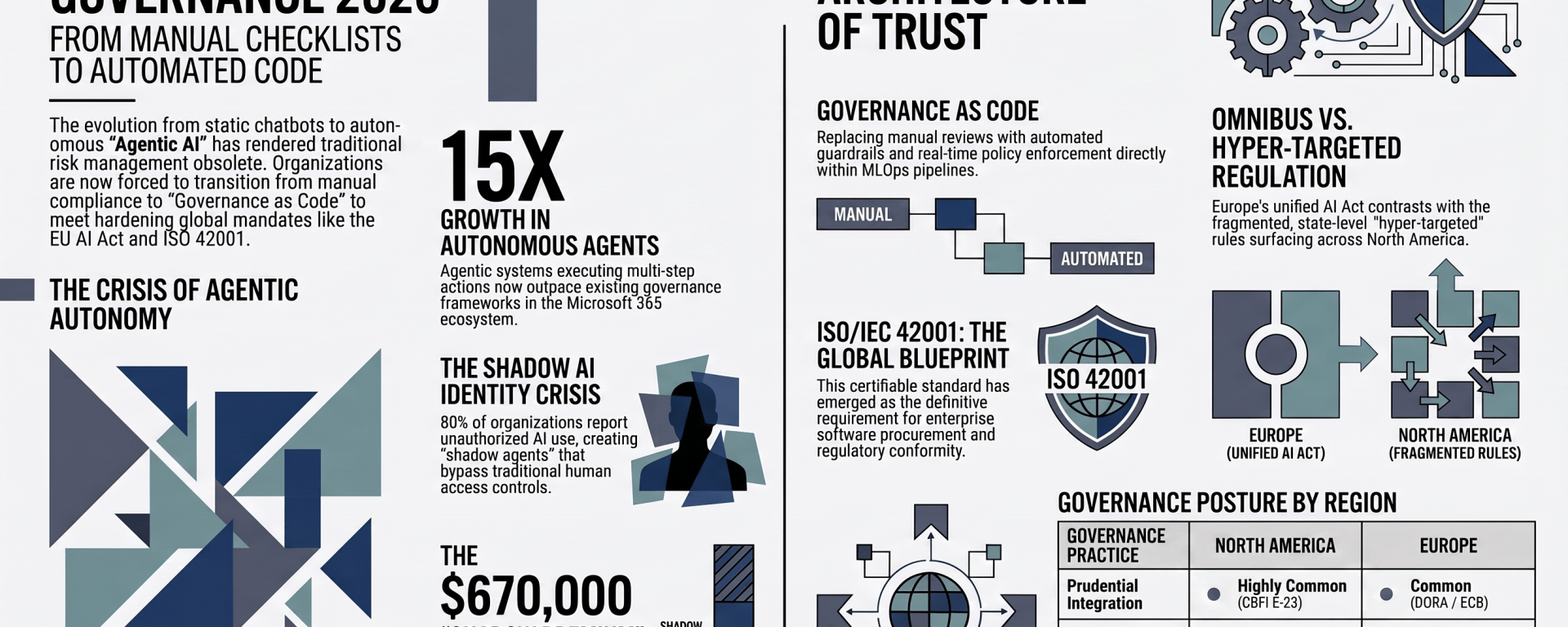
The rapid operationalization of artificial intelligence—particularly the evolution from static generative models to autonomous, multi-step agentic AI—has outpaced legacy enterprise risk management frameworks across global markets. Regulated organizations in North America, Europe, and Australia are currently confronting a severe governance crisis characterized by widespread shadow AI, escalating regulatory mandates, and the urgent need for certifiable AI management systems.
Comprehensive analysis reveals that AI governance is no longer a theoretical exercise isolated to ethics committees; it is an immediate legal, operational, and financial imperative. Governance by design, driven by automated evidence generation and “Governance as Code,” is replacing manual compliance checklists. Simultaneously, regulatory perimeters are hardening. The European Union has operationalized the AI Act, Canadian prudential regulators are pulling all AI models into strict capital-grade oversight, and hyper-targeted regulations such as California’s automated decision-making technology (ADMT) rules are establishing new global benchmarks for transparency and consumer choice.
The most pressing vulnerability identified is the unchecked proliferation of agentic AI. As these autonomous systems gain the ability to execute code, access enterprise data, and interact with external application programming interfaces (APIs), the traditional access controls designed for human identities are failing. The subsequent strategic imperative for regulated enterprises is the unification of information security, model risk management, and privacy-by-design under comprehensive, internationally recognized frameworks such as ISO/IEC 42001.
Key Insights
- The Agentic Escalation and Shadow AI Sprawl: The transition from simple chatbot interfaces to agentic AI—systems that execute multi-step actions autonomously—has rendered traditional access controls obsolete. Shadow AI has evolved into “shadow agents,” vastly expanding the enterprise attack surface and requiring Kubernetes-native control planes and non-human identity (NHI) management.
- Prudential Regulatory Expansion is Forcing Market Convergence: Financial supervisors are abandoning AI-specific siloes in favor of integrating AI into enterprise model risk management (MRM). Canada’s OSFI Guideline E-23 exemplifies this, explicitly expanding rigorous MRM standards to all AI and machine learning models, effectively neutralizing the “vendor defense” for third-party systems.
- The Rise and Privatization of Certifiable Standards: ISO/IEC 42001 has emerged as the definitive global blueprint for AI management systems (AIMS). Furthermore, procurement mandates are increasingly requiring ISO 42001 certification as a prerequisite for enterprise software contracts, effectively privatizing regulatory enforcement across global supply chains.
- Governance as Code is a Technical Mandate: Manual compliance reviews cannot match machine-speed operations. Progressive organizations are embedding governance directly into MLOps pipelines via automated guardrails, latency benchmarks, and dynamic policy enforcement to generate immutable audit trails.
- The Dichotomy of Hyper-Targeted State vs. Omnibus Regulation: In the absence of cohesive federal frameworks in jurisdictions like the United States, hyper-targeted regulations (e.g., California’s CPPA ADMT rules) are creating a fragmented, high-risk compliance environment that demands localized yet scalable governance architectures, in stark contrast to Europe’s unified AI Act.
- Sector-Specific Clinical Stringency: Healthcare and pharmaceutical organizations face unique algorithmic challenges governed by distinct frameworks, such as the FDA’s Good Machine Learning Practice (GMLP) and Predetermined Change Control Plans (PCCP), emphasizing clinical validation and health equity over mere data privacy.
Key Statistics and Metrics
- 80% of organizations report moderate to pervasive shadow AI use across their workforce, with 52% of employees utilizing tools their employer did not provide1.
- 15x Year-over-Year Growth has been observed in active autonomous agents within the Microsoft 365 ecosystem, drastically outpacing existing governance frameworks1.
- $4.88 Million is the average cost of a data breach in 2024, with shadow AI contributing an estimated $670,000 premium to average breach costs2.
- 40% of healthcare professionals have encountered unauthorized AI tools in the workplace, presenting acute regulatory and patient safety risks1.
- €35 Million or 7% of global turnover represents the maximum penalty under the newly enforced EU AI Act for prohibited AI practices4.
- 30-40% reduction in implementation time for ISO/IEC 42001 certification is achievable if an organization already holds a mature ISO 27001 certification6.
- 20.2% of OECD firms officially adopted AI in 2025, more than doubling from 8.7% in 2023, while large enterprises report adoption rates up to 38 percentage points higher than small enterprises7.
Quantitative Summary: Modern AI Governance Landscapes
The deployment of AI governance practices is heavily dictated by jurisdictional regulatory posture and sector-specific operational realities. As organizations scale AI, they are forced to adopt a matrix of modern practices, including Monitoring Shadow AI with Agentic AI, navigating Hyper-Targeted regulations, integrating into Prudential Frameworks, automating evidence generation, adopting Certifiable Standards, and deploying Governance as Code.
Regional Commonality of AI Governance Practices
The global regulatory landscape dictates the baseline for AI governance adoption. Europe’s omnibus approach, North America’s fragmented prudential and state-level approach, and Australia’s principles-based operational risk mandates create distinct operational realities for multinational enterprises.
| Governance Practice | North America (US & Canada) | Europe (UK, Germany, France, Spain) | Australia |
| Prudential Framework Integration | Highly Common: Driven explicitly by Canada’s OSFI E-23 and US SR 11-7/SR 26-2 updates mandating enterprise model risk management8. | Common: Driven by Digital Operational Resilience Act (DORA) and European Central Bank (ECB) supervisory expectations5. | Common: Governed broadly through APRA CPS 230 operational risk and resilience mandates13. |
| Certifiable Standards (e.g., ISO 42001) | Emerging: Increasing rapidly as a procurement prerequisite and competitive differentiator for technology vendors11. | Highly Common: Utilized heavily to demonstrate a presumption of conformity with the EU AI Act requirements15. | Emerging: Adopted nationally as AS ISO/IEC 42001:2023, driven primarily by enterprise and government procurement14. |
| Hyper-Targeted Regulations | Highly Common: State-level fragmentation defines the US market (e.g., California CPPA ADMT, Colorado AI Act)18. | Rare: Largely replaced by sweeping pan-European regulations such as the comprehensive EU AI Act4. | Rare: Relies largely on voluntary frameworks, sovereign security stacks, and existing privacy laws20. |
| Shadow AI Monitoring (Agentic AI) | Common: Driven by high data breach costs, cybersecurity audits, and widespread unauthorized BYO-AI usage2. | Common: Mandated by strict data sovereignty requirements and deep GDPR compliance parameters12. | Emerging: Increasing focus from the Australian Signals Directorate and local cybersecurity frameworks23. |
| Automated Evidence Generation | Emerging: Necessary to meet strict MLOps, CI/CD, and GxP validation in North American healthcare and pharmaceutical sectors24. | Common: Essential for maintaining Annex IV technical documentation under the EU AI Act26. | Emerging: Slowly replacing manual compliance checks to provide real-time risk observability14. |
| Governance as Code | Emerging: Maturing rapidly in large technology and financial sectors scaling complex agentic AI architectures28. | Emerging: Utilized to hardcode real-time transparency markers and watermarks required by Article 5029. | Rare: Currently isolated to highly mature, cloud-native financial entities and sovereign government deployments20. |
Industry-Specific Effectiveness of Governance Practices
Governance efficacy is not monolithic. The effectiveness of a specific practice is intrinsically linked to the unique regulatory burdens, data sensitivity, and operational constraints of specific industry verticals within each geographic region.
Table 2: Most Effective Governance Practices by Industry (North America)
| Industry | Most Effective Governance Practice | Key Drivers & Operational Context |
| Financial Services | Integration into Prudential Frameworks | OSFI E-23 in Canada legally mandates enterprise-wide model risk management (MRM) covering all AI models by May 20278. In the US, SR 26-2 drives similar stringent requirements10. |
| Healthcare & Pharma | Automated Evidence Generation & GMLP | The FDA’s Good Machine Learning Practice (GMLP) and Predetermined Change Control Plans (PCCP) require continuous, immutable evidence of model validity, safety, and lack of algorithmic bias24. |
| Insurance | Hyper-Targeted Regulations & Certifiable Standards | Compliance is heavily driven by NAIC model bulletins and California’s ADMT rules regarding algorithmic underwriting, disparate impact, and consumer profiling10. |
| Government / Public | Shadow AI Monitoring & NIST AI RMF | U.S. federal agencies require NIST AI RMF alignment; the Canadian government mandates strict AI strategies to combat shadow AI and maintain public trust in sovereign operations34. |
| Legal / Education | Governance as Code | Essential for preventing the unauthorized ingestion of highly sensitive client or student records into public LLMs through hardcoded API access policies and strict data boundary enforcement21. |
Table 3: Most Effective Governance Practices by Industry (Europe)
| Industry | Most Effective Governance Practice | Key Drivers & Operational Context |
| Financial Services | Certifiable Standards (ISO 42001) | ISO 42001 provides the required management system evidence for DORA and aligns directly with the EU AI Act’s High-Risk system obligations11. |
| Healthcare & Pharma | Automated Evidence Generation | European Medicines Agency (EMA) reflection papers and the EU AI Act require continuous lifecycle monitoring and conformity assessment documentation36. |
| Insurance | Certifiable Standards (ISO 42001) | Provides defensible architectures against EU AI Act penalties (which scale up to €35M) for systemic bias in pricing, claims management, and underwriting models4. |
| Government / Public | Shadow AI Monitoring & AI Sandboxes | Strong reliance on national initiatives like Spain’s AESIA and the establishment of regulatory sandboxes for safe, monitored public deployment38. |
| Legal / Education | Hyper-Targeted (Sectoral GDPR) | European data protection supervisors heavily restrict automated decision-making that impacts citizens, creating a strong intersection between the AI Act and GDPR40. |
Table 4: Most Effective Governance Practices by Industry (Australia)
| Industry | Most Effective Governance Practice | Key Drivers & Operational Context |
| Financial Services | Prudential Frameworks (APRA CPS 230) | APRA CPS 230 operational risk mandates require strict oversight of critical operations, effectively capturing AI agents within broader operational resilience frameworks13. |
| Healthcare & Pharma | Certifiable Standards (AS ISO/IEC 42001) | Therapeutic Goods Administration (TGA) Software as a Medical Device (SaMD) requirements synergize effectively with AS ISO/IEC 42001 quality management standards14. |
| Insurance | Governance as Code | Automated guardrails are highly effective in ensuring compliance with Australian privacy principles during dynamic pricing and automated claims processing14. |
| Government / Public | Certifiable Standards (ISO 42001) | The Australian government increasingly utilizes AS ISO/IEC 42001 certification as a fast-track procurement mechanism to filter out high-risk AI vendors11. |
| Legal / Education | Shadow AI Monitoring | High rates of unsanctioned tool usage in Australian education require strict network-level detection to protect intellectual property and student privacy41. |
Organizational Enablers of Modern AI Governance
The adoption of AI governance is fundamentally a sociotechnical challenge. Successful implementation relies heavily on specific organizational enablers that transform governance from a compliance bottleneck into an operational accelerant.
Table 5: Top Organizational Enablers by Industry (North America)
| Industry | Top Enabler 1 | Top Enabler 2 | Top Enabler 3 |
| Financial Services | Existing MRM Culture and Frameworks | Executive Sponsorship (Board level) | Centralized AI Asset Inventory Systems |
| Healthcare & Pharma | Unified GxP / QMS Integration | Dedicated Interdisciplinary AI Ethics Boards | MLOps and CI/CD Automation Capabilities |
| Insurance | Legacy ISO 27001 Security Maturity | API-driven GRC Management Platforms | Cross-functional Legal, Risk, and IT Alignment |
| Government / Public | Sovereign Cloud Infrastructure | Centralized AI Procurement Mandates | Public Trust and AI Literacy Initiatives |
| Legal / Education | Robust Data Classification Taxonomies | Advanced Identity Access Management (IAM) | Established Vendor Risk Management Programs |
Table 6: Top Organizational Enablers by Industry (Europe)
| Industry | Top Enabler 1 | Top Enabler 2 | Top Enabler 3 |
| Financial Services | DORA Compliance Readiness | GDPR-compliant Corporate Data Lakes | EU AI Act Regulatory Mapping Tools |
| Healthcare & Pharma | Adoption of Harmonised Standards | Active Participation in Regulatory Sandboxes | Cross-border Data Governance Protocols |
| Insurance | Dual ISO 27001 & ISO 9001 Maturity | Specialized Algorithmic Bias Testing Tools | Automated Documentation Generation Engines |
| Government / Public | National AI Strategies (e.g., AESIA in Spain) | EDIH (European Digital Innovation Hubs) | Implementation of Open Algorithm Registers |
| Legal / Education | Strong Trade Union Collaboration | Extensive Staff AI Literacy Programs | Privacy-by-Design System Architecture |
Table 7: Top Organizational Enablers by Industry (Australia)
| Industry | Top Enabler 1 | Top Enabler 2 | Top Enabler 3 |
| Financial Services | APRA CPS 230 Resiliency Frameworks | Agile AI Governance Committees | Enterprise AI Gateway Infrastructures |
| Healthcare & Pharma | AS ISO/IEC 42001 Certification Efforts | Secure Sovereign Data Centers | Emergence of Clinical-IT Hybrid Roles |
| Insurance | Scalable Cloud-Native Infrastructures | Threat Modeling Frameworks (e.g., MAESTRO) | Routine Third-party Risk Audits |
| Government / Public | Centralized Digital Transformation Strategies | Robust Citizen Feedback Mechanisms | Standardized AI Vendor Contracts |
| Legal / Education | Dedicated Change Management Programs | Shadow AI Endpoint Discovery Tools | Identity-based Access Controls |
Key Organizational Barriers to Adoption
Despite clear regulatory pressures, organizations face significant friction when deploying AI governance. The sprawl of Agentic AI, the opacity of foundation models, and fragmented legal frameworks create distinct and often intractable barriers.
Table 8: Top Organizational Barriers by Industry (North America)
| Industry | Top Barrier 1 | Top Barrier 2 | Top Barrier 3 |
| Financial Services | Legacy MRM systems ill-equipped for LLMs | Fragmented State Regulations (e.g., CPPA) | Complete Opacity of Third-Party AI Models |
| Healthcare & Pharma | Inability to prove explainability (CDS exemption) | Latent Algorithmic Bias in Clinical Data | Ambiguous FDA PCCP Guidelines |
| Insurance | Disparate NAIC State-by-State Adoptions | Lack of Immutable AI Audit Trails | Exorbitant Cost of Continuous Validation |
| Government / Public | Severe Tech Talent/Skill Shortages | Outdated, Sluggish Procurement Cycles | Chronic Budgetary Constraints |
| Legal / Education | Unchecked Shadow AI (BYO-AI Culture) | Decentralized IT Infrastructure | Data Privacy and Copyright Ambiguities |
Table 9: Top Organizational Barriers by Industry (Europe)
| Industry | Top Barrier 1 | Top Barrier 2 | Top Barrier 3 |
| Financial Services | Massive EU AI Act Compliance Costs | Overlapping Regulations (DORA vs. AI Act) | Lack of Published Harmonized Tech Standards |
| Healthcare & Pharma | Strict Biometric and Medical Data Laws | High-Risk System Audit Bottlenecks | Complex Legacy System Integration |
| Insurance | Article 50 Transparency Execution Burden | Difficulty in Model Drift Detection | Algorithmic Fairness Parity Verification |
| Government / Public | Deep Bureaucratic Inertia | Fragmented Regional Data Spaces | Severe Lack of Post-Deployment Audits |
| Legal / Education | Prohibited Practice Categorization Ambiguities | Copyright/IP Disputes on Training Data | Digital Divide and Access Inequity |
Table 10: Top Organizational Barriers by Industry (Australia)
| Industry | Top Barrier 1 | Top Barrier 2 | Top Barrier 3 |
| Financial Services | Overreliance on Foreign AI Vendors | Agentic AI Orchestration Security Risks | Rapid Shifts in APRA Guidance |
| Healthcare & Pharma | Data Sovereignty Conflicts | Lack of Localized Clinical Testing Datasets | Extremely Limited AI Validator Talent |
| Insurance | Evolving Privacy Law Reforms | Pervasive Shadow AI in Underwriting Teams | Legacy Actuarial System Clashes |
| Government / Public | Poor Impact Measurement Metrics | General Public Trust Deficits regarding AI | High Vendor Lock-in Risks |
| Legal / Education | Unclear Copyright Liabilities | High Shadow AI Penetration in Academia | Inconsistent Public Service Standards |
The Evolving Role and Skills of Risk Managers
The era of the “paperwork compliance officer” is decidedly over. The introduction of Agentic AI—where autonomous agents execute code, modify files, and initiate API calls—requires Risk Managers to adopt highly technical, system-level oversight capabilities bridging traditional governance, cybersecurity, and MLOps.
Table 11: Top Skills and Capabilities for Risk Managers (North America)
| Industry | Top Skill / Capability 1 | Top Skill / Capability 2 | Top Skill / Capability 3 |
| Financial Services | Policy-as-Code Implementation & Review | AI Inventory Architecture (OSFI E-23 scale) | Quantitative Bias & Parity Testing |
| Healthcare & Pharma | Clinical Decision Support (CDS) Triage | GxP Validation for Probabilistic AI | Algorithmic Health Equity Analysis |
| Insurance | Agentic Threat Modeling | State-Level ADMT Compliance Mapping | Synthetic Data Verification |
| Government / Public | NIST AI RMF Operational Mapping | AI Vendor/Third-Party Deep Auditing | Public Trust and Risk Communication |
| Legal / Education | Shadow AI Discovery & Network Detection | Prompt Injection Threat Awareness | Copyright & IP Lineage Tracking |
Table 12: Top Skills and Capabilities for Risk Managers (Europe)
| Industry | Top Skill / Capability 1 | Top Skill / Capability 2 | Top Skill / Capability 3 |
| Financial Services | ISO/IEC 42001 Auditing and Implementation | DORA/AI Act Overlap Management | Model Registry Configuration |
| Healthcare & Pharma | Annex IV Technical Documentation Assembly | High-Risk Conformity Assessment | GDPR Automated Processing Interpretation |
| Insurance | Article 50 Transparency Execution | Human-in-the-Loop Workflow Design | Fairness Parity Calculation |
| Government / Public | Regulatory Sandbox Navigation | Fundamental Rights Impact Assessment (FRIA) | Open Data Governance |
| Legal / Education | AI Literacy Program Design & Deployment | Prohibited Practice Identification | Immutable Data Provenance Auditing |
Table 13: Top Skills and Capabilities for Risk Managers (Australia)
| Industry | Top Skill / Capability 1 | Top Skill / Capability 2 | Top Skill / Capability 3 |
| Financial Services | APRA CPS 230 AI Integration | Non-Human Identity (NHI) Management | Red Teaming LLMs and Agents |
| Healthcare & Pharma | TGA SaMD Framework Alignment | Continuous Model Drift Monitoring | MLOps Pipeline Security Assessment |
| Insurance | Dynamic Policy Enforcement Configuration | Vendor Stack Traceability Analysis | Explainable AI (XAI) Interpretation |
| Government / Public | AS ISO/IEC 42001 Gap Analysis | Sovereign Cloud AI Architecture Planning | Algorithmic Impact Measurement |
| Legal / Education | Access Control & Entitlements Management | Automated Evidence Aggregation | Shadow AI Remediation Protocols |
Deep Research Details, Commentary, and Key Insights
The Agentic AI Escalation and Shadow Agents
The foremost insight derived from current enterprise telemetry is that AI governance is no longer strictly concerned with regulating static chatbots or predictive algorithms. In 2025 and into 2026, the technology paradigm shifted decisively toward “Agentic AI”—autonomous systems capable of multi-step planning, iterative tool use, persistent memory retention, and independent execution2. The Microsoft 365 ecosystem alone reported a 15x year-over-year growth in active autonomous agents1. As employees continuously bypass IT procurement to leverage these advanced tools—with a staggering 78% of knowledge workers bringing their own AI to work—they generate vast, unmonitored delegation chains acting on enterprise data2.
This phenomenon, termed “shadow AI,” presents a profound identity and access management (IAM) crisis. Traditional application security tools are inherently blind to non-human identities (NHIs) executing tasks at machine speed. Research indicates that 60% of enterprise security teams currently lack visibility into AI usage2, and only 34% of organizations apply the same security controls to their agentic labor force as they do to their human workforce41. If left ungoverned, agentic AI introduces massive, uncontrolled risks of data exfiltration, automated prompt injection, and operational drift. Progressive organizations are consequently deploying specialized Agentic AI Governance frameworks—such as the Agentic Risk & Capability (ARC) framework and the Unified Agent Lifecycle Management (UALM) framework45. These frameworks emphasize the deployment of Kubernetes-native control planes, such as AAGATE or SAGA-BFT, to monitor active agents, enforce policies dynamically at the capability layer, and provide real-time kill switches to halt rogue autonomous processes45.
Prudential Expansions: OSFI E-23 and Enterprise Model Risk
In North America, financial regulators are asserting aggressive, uncompromising dominance over AI through the expansion of Model Risk Management (MRM). The Office of the Superintendent of Financial Institutions (OSFI) in Canada has fundamentally altered the landscape with the finalized Guideline E-23, which takes effect on May 1, 2027, following a transition period8.
Crucially, OSFI E-23 shifts the regulatory perimeter from historical capital models to all models exhibiting non-negligible risk, explicitly encompassing AI and machine learning systems across all federally regulated financial institutions (FRFIs), including insurance companies, trust companies, and foreign branches8. Furthermore, E-23 effectively destroys the “vendor defense.” Regulated entities can no longer outsource their risk; third-party AI agents, vendor-supplied LLMs, and cloud-hosted scoring engines are fully in scope. The regulation requires exhaustive documentation, independent validation, and human-in-the-loop controls spanning a mandated 17-field Appendix A model inventory8. To manage the sheer volume and probabilistic nature of generative models under these strict regimes, financial institutions are being forced to transition to automated MRM platforms capable of continuous runtime monitoring52. Similarly, in the United States, SR 26-2 replaces SR 11-7, dragging foundational AI models into the harsh light of banking MRM standards10, while in Australia, APRA CPS 230 categorizes AI systems under severe operational risk and resilience mandates13.
The Dichotomy of Hyper-Targeted Regulations vs. Omnibus Acts
A stark divergence exists between the European and American approaches to AI governance, forcing multinational enterprises to maintain highly adaptive, multi-jurisdictional compliance architectures. Europe has adopted a sweeping, omnibus approach with the EU AI Act, which entered into force on August 1, 2024. The Act categorizes AI into strict risk tiers, outright banning prohibited practices (such as social scoring and untargeted facial scraping) as of February 2025, and enforcing stringent conformity assessments for high-risk systems by August 20264. Article 50 of the Act introduces unprecedented transparency rules, requiring machine-readable markings for AI-generated deepfakes and explicit disclosures for chatbot interactions29. Penalties for non-compliance are severe, capping at €35 million or 7% of global turnover4. Proactive Member States like Spain have established dedicated oversight bodies—the Spanish Agency for the Supervision of Artificial Intelligence (AESIA)—and launched regulatory sandboxes to accelerate safe adoption while clarifying legal ambiguities38.
Conversely, the United States lacks a comprehensive federal omnibus law, resulting in a patchwork of hyper-targeted state regulations. The most consequential among these are the California Privacy Protection Agency (CPPA) regulations on Automated Decision-Making Technology (ADMT), effective January 1, 2026, with enforcement ramping up heavily through 2027 and 202819. These rules mandate that any business using ADMT for “significant decisions”—such as lending, healthcare, housing, or employment—must provide plain-language pre-use notices, grant consumers the right to opt-out, and conduct exhaustive, executive-certified cybersecurity audits and risk assessments22. This shift from a passive “notice-and-consent” model to an active “proactive governance” framework creates massive compliance friction, forcing US enterprises to map their algorithmic footprints with the same rigor required under the EU AI Act, despite the absence of a federal mandate.
Certifiable Standards: The Privatization of Regulation via ISO/IEC 42001
Because sweeping laws like the EU AI Act dictate what must be governed but provide limited guidance on the specific technical execution, the market has rapidly standardized on ISO/IEC 42001:2023 as the operational blueprint12. As the world’s first certifiable Artificial Intelligence Management System (AIMS), ISO 42001 applies a structured Plan-Do-Check-Act methodology across the entire AI lifecycle12.
ISO 42001 is rapidly becoming a non-negotiable procurement requirement in enterprise software contracts across Europe, Australia, and North America11. This dynamic effectively privatizes regulatory enforcement; large enterprises will simply refuse to onboard AI vendors lacking ISO 42001 certification. Fortunately, enterprises that already maintain mature ISO 27001 Information Security Management Systems (ISMS) are finding they can implement ISO 42001 up to 40% faster due to significant structural overlaps6. By providing a structured mechanism for AI System Impact Assessments (AIIA)—further supported by the newly released ISO/IEC 42005 standard on impact assessments—ISO 42001 translates abstract ethical concepts like fairness and transparency into auditable, technical controls58.
Sector-Specific Clinical AI Governance
Healthcare and pharmaceutical organizations face an entirely distinct regulatory gauntlet. Algorithmic bias in clinical decision support (CDS) systems presents immediate risks to patient safety and health equity. In the US, the 21st Century Cures Act provides a narrow exemption for CDS software, but only if the AI system can fully explain its reasoning to a clinician61. Given the inherent opacity of deep learning and complex LLMs, most modern clinical AI fails this transparency test, throwing it directly into the regulatory purview of the FDA as Software as a Medical Device (SaMD)61.
To manage this, the FDA, in collaboration with Health Canada and the UK MHRA, relies on the Good Machine Learning Practice (GMLP) guiding principles24. Because AI models are intended to learn and shift over time, static validation is insufficient. The FDA introduced Predetermined Change Control Plans (PCCP), which allow AI devices to self-update within pre-approved boundaries without requiring a new 510(k) submission, provided the organization maintains a Total Product Life Cycle (TPLC) approach to continuous monitoring32. This requires pharmaceutical and medical device companies to build highly specialized MLOps pipelines capable of capturing automated, immutable evidence of model validity to satisfy stringent GxP validation requirements24.
Governance as Code and Automated Evidence Generation
Traditional governance relies heavily on manual risk assessments housed in spreadsheets, which become instantly obsolete the moment an AI model dynamically learns, drifts, or ingests new data. Modern AI governance demands the transition to “Governance as Code” and “Automated Evidence Generation”25.
By integrating governance platforms directly into MLOps and CI/CD pipelines, organizations can enforce policies automatically at runtime12. For example, automated checks can act as physical gates, halting the deployment of a pricing model if its bias threshold exceeds a predefined 5% demographic parity band, or blocking an autonomous agent if data lineage tracking indicates the ingestion of unauthorized personal information12. This methodology creates an immutable, continuous audit trail—evidence generated on-demand for regulators—drastically reducing the operational cost of compliance and systematically mitigating the risks associated with unmonitored shadow AI18.
Hypothesis Testing and Findings
Test First Hypothesis: How pervasive/common these modern approaches are will differ by country.
- Finding: Strongly Supported.
- Commentary: Regulatory philosophy strictly dictates the pervasiveness of specific governance mechanisms. Europe’s approach is omnibus and centralized (EU AI Act), resulting in a uniform, continent-wide push for certifiable standards like ISO 42001 to secure a legal presumption of conformity4. In North America, the approach is highly fragmented; Canada focuses heavily on prudential MRM (OSFI E-23)8, while the US relies on hyper-targeted state laws (California ADMT) and sector-specific guidance (FDA GMLP)19. Australia remains highly focused on principles-based operational resilience and procurement-led adoption of voluntary standards14.
Test Second Hypothesis: Top 3 ENABLERS and BARRIERS will be quite consistent across different industries.
- Finding: Refuted.
- Commentary: While certain structural enablers share commonalities (such as executive sponsorship), the barriers are radically disparate based on industry-specific data sensitivity and legacy architectures. The assumption that all regulated industries face the same friction is demonstrably false. Financial services fight legacy MRM inflexibility; healthcare fights clinical bias and FDA rigidity; government fights public trust deficits and procurement lag.
Test Third Hypothesis: Top 3 ENABLERS will be quite consistent across different industries.
- Finding: Partially Supported.
- Commentary: There is a strong baseline consistency in technical and cultural enablers. Across Finance, Healthcare, and Government, leveraging existing ISO 27001 maturity6, integrating MLOps automation25, and securing Board-level executive sponsorship58 universally accelerate governance adoption. However, specialized enablers deviate significantly: regulatory sandboxes are unique catalysts for Government and Healthcare38, while existing MRM culture is a uniquely powerful enabler exclusively for the Financial sector9.
Test Fourth Hypothesis: Top 3 BARRIERS will be quite consistent across different industries.
- Finding: Strictly Refuted.
- Commentary: The empirical data challenges this assumption entirely. Healthcare is obstructed by entirely unique barriers such as strict biometric data laws, algorithmic bias impacting clinical health equity, and ambiguous FDA Pre-determined Change Control Plans (PCCP)32. Financial services are primarily hindered by legacy MRM infrastructures that cannot compute the probabilistic nature of agentic LLMs, and overlapping, contradictory regulations (DORA vs. AI Act)52. The Public Sector is uniquely paralyzed by severe public trust deficits, bureaucratic procurement cycles, and systemic talent shortages67. Barriers are fundamentally heterogeneous.
Test Fifth Hypothesis: Risk Manager roles are going through significant role shifts to enable these new AI Governance practices.
- Finding: Strongly Supported.
- Commentary: The operational profile of Risk Managers must evolve from analog policy enforcers to technical, systems-level orchestrators. Governing agentic AI requires a deep understanding of Non-Human Identities (NHIs), API threat modeling, Policy-as-Code integration, and dynamic LLM evaluation28. The risk management function now intersects deeply with DevSecOps and MLOps, requiring the technical capability to interpret automated drift metrics and configure Kubernetes-native control planes for agent oversight25.
Strategic Mandates for Senior Leadership
Key Actions for Progressive Organizations to Maximize Opportunities
For organizational leaders who have already established basic AI literacy and pilot programs, maintaining a competitive edge requires shifting from reactive compliance to proactive, automated governance architectures:
Pursue ISO/IEC 42001 Certification Immediately Do not wait for regulatory enforcement deadlines (e.g., the EU AI Act’s August 2026 high-risk enforcement date). Progressive organizations must utilize ISO 42001 certification as a strategic competitive differentiator. Certification accelerates enterprise software sales by bypassing exhaustive vendor risk questionnaires, satisfies expanding procurement mandates, and secures favorable cybersecurity insurance underwriting terms by providing defensible evidence of an integrated AI Management System11.
Transition Radically to Governance as Code Deprecate all manual, spreadsheet-based risk assessments. Invest heavily in AI governance platforms that natively integrate with your existing MLOps stack (e.g., MLflow, SageMaker, Vertex AI) to enforce guardrails at runtime. By codifying governance into the CI/CD pipeline, organizations can automatically generate immutable evidence for regulators, seamlessly test for algorithmic bias prior to deployment, and monitor model drift in production without slowing innovation velocity12.
Implement Advanced Agentic AI Control Planes As workforce AI rapidly shifts from prompt-response chatbots to autonomous agents executing multi-step workflows, Identity and Access Management (IAM) must be fundamentally upgraded. Treat AI agents as privileged insiders. Implement Kubernetes-native control planes and non-human identity (NHI) solutions that monitor agent telemetry, enforce strict cross-app access protocols, and provide automated kill-switches to prevent rogue delegation chains41.
Unify the GRC Architecture Across Jurisdictions For financial, healthcare, and insurance institutions operating globally, map disjointed requirements—such as OSFI E-23, SR 26-2, CPPA ADMT, FDA GMLP, and the EU AI Act—into a single, unified control taxonomy. A single piece of automated evidence extracted from an MLOps pipeline should be mapped to satisfy multiple regulatory frameworks simultaneously, eliminating redundant compliance overhead51.
Key Actions for Organizations Falling Behind
For leaders who have deferred AI governance under the mistaken belief that the technology is too nascent to regulate, the window for voluntary compliance has definitively closed. Immediate triage is required to mitigate existential legal, operational, and financial exposure:
Execute a Comprehensive Shadow AI Discovery Audit Operating under the assumption that your organization is free of shadow AI is a statistical impossibility. Assume shadow AI is already pervasive. Immediately deploy network telemetry, endpoint discovery tools, and cloud access security brokers (CASB) to identify exactly which unsanctioned LLMs and agents your employees are actively feeding sensitive enterprise IP, PII, or PHI2.
Establish a Centralized, Mandated AI Inventory You cannot govern what you cannot see. Immediately mandate the creation of a centralized registry of all AI models in development, production, and procurement. This is a foundational, non-negotiable requirement for compliance with the EU AI Act, Canada’s OSFI E-23, and ISO 42001. Ensure this inventory captures model purpose, data lineage, risk classification, and assigned human owners12.
Publish Strict Acceptable Use and ADMT Policies Halt the uncontrolled bleed of intellectual property. Issue clear, enforceable policies regarding the use of external generative AI tools. If your organization operates in California, immediately draft pre-use notices and establish consumer opt-out workflows for any system replacing human decision-making to comply with the fast-approaching CPRA/ADMT rules33.
Appoint an Accountable Executive with Authority Ambiguous ownership is the primary fuel for shadow AI sprawl. Consolidate AI risk accountability immediately under a designated Chief AI Officer (CAIO), or formally elevate the Chief Information Security Officer’s (CISO) mandate to explicitly include algorithmic risk, algorithmic fairness, and agentic AI threat modeling1.
Works cited
- Shadow AI stats for 2026: The hidden adoption gap defining enterprise risk – Optro, https://optro.ai/blog/shadow-ai-stats
- Shadow AI Statistics: Key Data Points Every CISO Needs in 2026 – Airia, https://airia.com/blog/shadow-ai-statistics-key-data-points-every-ciso-needs-in-2026/
- What is AI Governance? 2026 Framework Guide | Kong Inc., https://konghq.com/blog/learning-center/what-is-ai-governance
- SAIT™ RESEARCH & EVIDENCE BASE – IndustrioTech, https://industriotech.com/sait-research-evidence-base/
- The EU AI Act: Compliance and transformation – PwC CEE, https://cee.pwc.com/eu-ai-act-compliance-and-transformation.html
- AI governance: Why ISO 42001 is the natural next certification step USA – Protecht, https://www.protechtgroup.com/en-us/blog/ai-governance-iso-42001-certification
- Global AI Adoption Statistics 2026: Country Rankings & Data – Alice Labs, https://alicelabs.ai/reports/global-ai-adoption-index-2026
- OSFI Guideline E-23: how AI and ML models fit the new model risk rules – VerifyWise, https://verifywise.ai/blog/osfi-e-23-ai-model-risk-management-canada
- OSFI E-23 Model Risk Management: What Changes for AI – iTmethods, https://itmethods.com/reign/osfi-e23
- Five moves to fix AI governance now | Domino.ai, https://domino.ai/blog/five-fixes-for-ai-governance-now
- When ISO 42001 Certification Is Required | ISMS.online, https://www.isms.online/iso-42001/certification/when-iso-42001-certification-is-required/
- ISO 42001 Implementation: A Practical Guide to Building an AI Management System (AIMS), https://secureprivacy.ai/blog/iso-42001-implementation-guide-2026
- Operational risk management – APRA, https://www.apra.gov.au/consultations/operational-risk-management
- ISO 42001 Implementation Australia – Aegentra, https://aegentra.com.au/services/govern/iso-42001
- The role of harmonised standards as tools for AI act compliance – DLA Piper, https://www.dlapiper.com/en-ca/insights/publications/2024/01/the-role-of-harmonised-standards-as-tools-for-ai-act-compliance
- The role of harmonised standards as tools for AI act compliance – DLA Piper, https://www.dlapiper.com/en-us/insights/publications/2024/01/the-role-of-harmonised-standards-as-tools-for-ai-act-compliance
- Top ISO/IEC 42001 Lead Implementer Career Opportunities in Australia, https://gaicc.org/blog/top-iso-iec-42001-lead-implementer-career-opportunities-australia/
- Top 10 AI Governance Solutions for Regulated Industries in 2026 – Kiteworks, https://www.kiteworks.com/cybersecurity-risk-management/ai-governance-solutions-regulated-industries/
- CPPA Regulations Are Moving Forward: Here is What You Need To Know | Mintz, https://www.mintz.com/insights-center/viewpoints/2826/2025-08-11-cppa-regulations-are-moving-forward-here-what-you-need
- AI governance: Why ISO 42001 is the natural next certification step AU – Protecht, https://www.protechtgroup.com/en-au/blog/ai-governance-iso-42001-certification
- Full article: Reframing AI governance in education: insights from the social model of disability – Taylor & Francis, https://www.tandfonline.com/doi/full/10.1080/17439884.2025.2595443
- California Finalizes CCPA Regulations for Automated Decision-Making Technology, Risk Assessments and Cybersecurity Audits | Insights | Skadden, Arps, Slate, Meagher & Flom LLP, https://www.skadden.com/insights/publications/2025/10/california-finalizes-cppa-regulations
- AI View: May 2026, https://www.simmons-simmons.com/en/publications/cmpqqg17d0036u4uc4cy0o17e/ai-view-may-2026
- Good Machine Learning Practice (GMLP) – ProPharma, https://www.propharmagroup.com/thought-leadership/good-machine-learning-practice-gmlp
- AI-Operations-Foundations-Building-Scalable-and-Resilient-AI-Systems.pdf – EC-Council, https://www.eccouncil.org/cybersecurity-exchange/wp-content/uploads/2026/05/AI-Operations-Foundations-Building-Scalable-and-Resilient-AI-Systems.pdf
- Insights, AI Governance & Compliance Analysis – RegCore.AI, https://regcore.ai/insights
- Best AI Governance Platforms: Enterprise Buyer’s Guide (2026), https://adeptiv.ai/best-ai-governance-platforms-guide/
- AI readiness framework 2026 strategy guide for CTO teams – Samta.ai, https://samta.ai/blogs/ai-readiness-ctos-2026
- EU AI Act Transparency: Real-World Examples – CMS.law, https://cms.law/en/int/legal-updates/eu-ai-act-transparency-real-world-examples
- A Continuous Governance Framework for Autonomous AI Observability and Zero-Trust Compliance in Enterprise Environments – arXiv, https://arxiv.org/html/2604.04749v1
- Governance-as-Code Explained: 2026 Guide | Avestian, https://www.avestian.com/blog/governance-as-code-guide-operations-leaders
- A Complete Guide to the FDA’s AI/ML Guidance for Medical Devices – Ketryx, https://www.ketryx.com/blog/a-complete-guide-to-the-fdas-ai-ml-guidance-for-medical-devices
- California’s new automated decisionmaking technology rules: what financial institutions need to know – Capco, https://www.capco.com/intelligence/capco-intelligence/californias-new-automated-decision-making-technology-rules
- Artificial Intelligence Index Report | Stanford HAI, https://hai.stanford.edu/assets/files/ai_index_report_2026.pdf
- AI Strategy for the Federal Public Service 2025-2027, https://publications.gc.ca/collections/collection_2025/sct-tbs/BT48-55-2025-eng.pdf
- EU AI Act Compliance Tooling Market Research Report 2034, https://marketintelo.com/report/eu-ai-act-compliance-tooling-market
- Artificial intelligence | European Medicines Agency (EMA), https://www.ema.europa.eu/en/about-us/how-we-work/data-regulation-big-data-other-sources/artificial-intelligence
- Spain – Digital Economy – International Trade Administration, https://www.trade.gov/country-commercial-guides/spain-digital-economy
- AI Regulatory Sandbox Approaches: EU Member State Overview, https://artificialintelligenceact.eu/ai-regulatory-sandbox-approaches-eu-member-state-overview/
- Artificial intelligence law in Spain: Technical requirements, risks, and adaptation for businesses – Chakray, https://chakray.com/artificial-intelligence-law-in-spain-technical-requirements-risks-and-adaptation-for-businesses/
- AI Agents at Work 2026: Securing the agentic enterprise – Okta, https://www.okta.com/en-gb/newsroom/articles/ai-agents-at-work-2026-agentic-enterprise-security/
- 2781_Cyber Australia 2025-26.indd – Australian Information Security Association, https://www.aisa.org.au/common/Uploaded%20files/PDF/Cyber%20Australia/Cyber%20Australia%202025-26_sm.pdf
- Agentic AI Governance and Lifecycle Management in Healthcare – arXiv, https://arxiv.org/html/2601.15630v1
- Governance by Design: Architecting Agentic AI for Organizational Learning and Scalable Autonomy – arXiv, https://arxiv.org/html/2605.20210v1
- Agentic AI Governance and Lifecycle Management in Healthcare – arXiv, https://arxiv.org/html/2601.15630v2
- Introducing the Agentic Risk & Capability Framework for Governing Agentic AI Systems – arXiv, https://arxiv.org/html/2512.22211v1
- [2605.12364] Attacks and Mitigations for Distributed Governance of Agentic AI under Byzantine Adversaries – arXiv, https://arxiv.org/abs/2605.12364
- [2510.25863] AAGATE: A NIST AI RMF-Aligned Governance Platform for Agentic AI – arXiv, https://arxiv.org/abs/2510.25863
- Model risk management for federally regulated financial institutions – Dentons, https://www.dentons.com/en/insights/alerts/2025/october/8/model-risk-management-for-federally-regulated-financial-institutions
- OSFI’s E-23 Model Risk Management Guideline | Protiviti Canada, https://www.protiviti.com/ca-en/insights-paper/strengthening-decision-making-with-osfi-e-23-model
- AI Regulatory Frameworks, Canada & Global – RegCore.AI, https://regcore.ai/frameworks
- AI in Model Risk Management: A Guide for Financial Services – ValidMind, https://validmind.com/blog/ai-in-model-risk-management-financial-services/
- Model Risk Management: A Comprehensive Overview – ValidMind, https://validmind.com/blog/model-risk-management-a-comprehensive-overview/
- Law / proposed law in France – AI Laws of the World – DLA Piper Intelligence, https://intelligence.dlapiper.com/artificial-intelligence/?t=01-law&c=FR
- AI Watch: Global regulatory tracker – Spain | White & Case LLP, https://www.whitecase.com/insight-our-thinking/ai-watch-global-regulatory-tracker-spain
- New California Regulations Regarding Employer Use of Automated Decision-Making Technology: Compliance Required by January 1, 2027 – Akin Gump, https://www.akingump.com/en/insights/alerts/new-california-regulations-regarding-employer-use-of-automated-decision-making-technology-compliance-required-by-january-1-2027
- Updates to the CCPA Regulations: What Businesses Need to Know Now About Automated Decision-Making, Cybersecurity Audits and Risk Assessments | Insights | Mayer Brown, https://www.mayerbrown.com/en/insights/publications/2026/01/updates-to-the-ccpa-regulations-what-businesses-need-to-know-now-about-automated-decision-making-cybersecurity-audits-and-risk-assessments
- ISO/IEC 42001:2023 – A new standard for AI governance – KPMG International, https://kpmg.com/ch/en/insights/artificial-intelligence/iso-iec-42001.html
- ISO/IEC 42001 Artificial Intelligence (AI) Proven Protection – IMSM Canada, https://imsm-iso.ca/iso-42001/
- ISO/IEC 42005:2025 – A New Blueprint for Legal and Commercial Leaders Navigating AI Risk and Governance – CMS.law, https://cms.law/en/che/legal-updates/iso-iec-42005-2025-a-new-blueprint-for-legal-and-commercial-leaders-navigating-ai-risk-and-governance
- AI Governance for Healthcare, Pharma & Medical Devices | Regulated AI Consulting, https://regulatedai.consulting/healthcare-pharma/
- Black boxes, white coats and red tape: Regulating the use of AI in drug development, https://www.ropesgray.com/en/insights/alerts/2026/03/black-boxes-white-coats-and-red-tape-regulating-the-use-of-ai-in-drug-development
- White Paper on AI Healthcare Governance – UNPAN, https://unpan.un.org/sites/default/files/resource/2026/White%20Paper%20on%20AI%20Healthcare%20Governance%202026.pdf
- Regulatory Perspectives for AI/ML Implementation in Pharmaceutical GMP Environments, https://pmc.ncbi.nlm.nih.gov/articles/PMC12195787/
- What is AI Compliance? Definition and Important Standards – Truefoundry, https://www.truefoundry.com/blog/what-is-ai-compliance
- Understanding AI Governance: Frameworks & Best Practices Guide – Adaptive Security, https://www.adaptivesecurity.com/blog/what-is-ai-governance-complete-guide-2026
- Adopting and governing AI in government: Digital Government Outlook 2026 | OECD, https://www.oecd.org/en/publications/digital-government-outlook_0496b2bc-en/full-report/adopting-and-governing-ai-in-government_7ef312a9.html
- PUBLIC INSTITUTIONS IN THE AGE OF AI – World Bank Documents and Reports, https://documents1.worldbank.org/curated/en/099051226113013516/pdf/P502259-818d6459-642d-4c32-829b-7c76a085b561.pdf
- What is AI Agent Orchestration? – GitHub, https://github.com/resources/articles/what-is-ai-agent-orchestration
- Guideline E-23 – Model Risk Management (2027) – Office of the Superintendent of Financial Institutions – OSFI, https://www.osfi-bsif.gc.ca/en/guidance/guidance-library/guideline-e-23-model-risk-management-2027
- Responsible AI Governance: A Practical Framework for Business Leaders | Databricks Blog, https://www.databricks.com/blog/responsible-ai-governance
The idea, research hypotheses, and focus for this article/research are all original and mine. This article was written with my brain and two hands with the assistance of Google Gemini, Notebook LM, Claude, and other wondrous toys.

