The integration of artificial intelligence within heavily regulated sectors has advanced past the phase of speculative experimentation, establishing itself as the fundamental infrastructural backbone of modern enterprise operations. As of 2026, empirical data demonstrates a near-universal deployment paradigm, with enterprise artificial intelligence adoption reaching 82% in North America and 80% in Europe.1 The global artificial intelligence market, expanding from $93.27 billion in 2020, is definitively on pace to reach an estimated $826.73 billion by 2030, with generative and agentic models driving the bulk of enterprise capital expenditure.1
However, this surface-level adoption data obscures a profound bifurcation in true organizational capability. While physical technology deployment is widespread, structural maturity—defined by the seamless, secure, and governed integration of technology, human capital, and strategic alignment—remains highly concentrated within a small fraction of high-performing enterprises known as “AI Achievers”.2 The vast majority of regulated organizations, particularly in sectors such as healthcare, education, and legal services, are accumulating severe “capability debt” by scaling technological endpoints faster than their underlying operating models can mature.3 This exhaustive report investigates the prevailing organizational maturity frameworks, dimensional interdependencies, and industry-specific adoption stages across North American and European regulated entities.
Executive Summary
The comprehensive synthesis of 2026 enterprise data, regulatory frameworks, and maturity models yields the following critical insights regarding artificial intelligence organizational maturity:
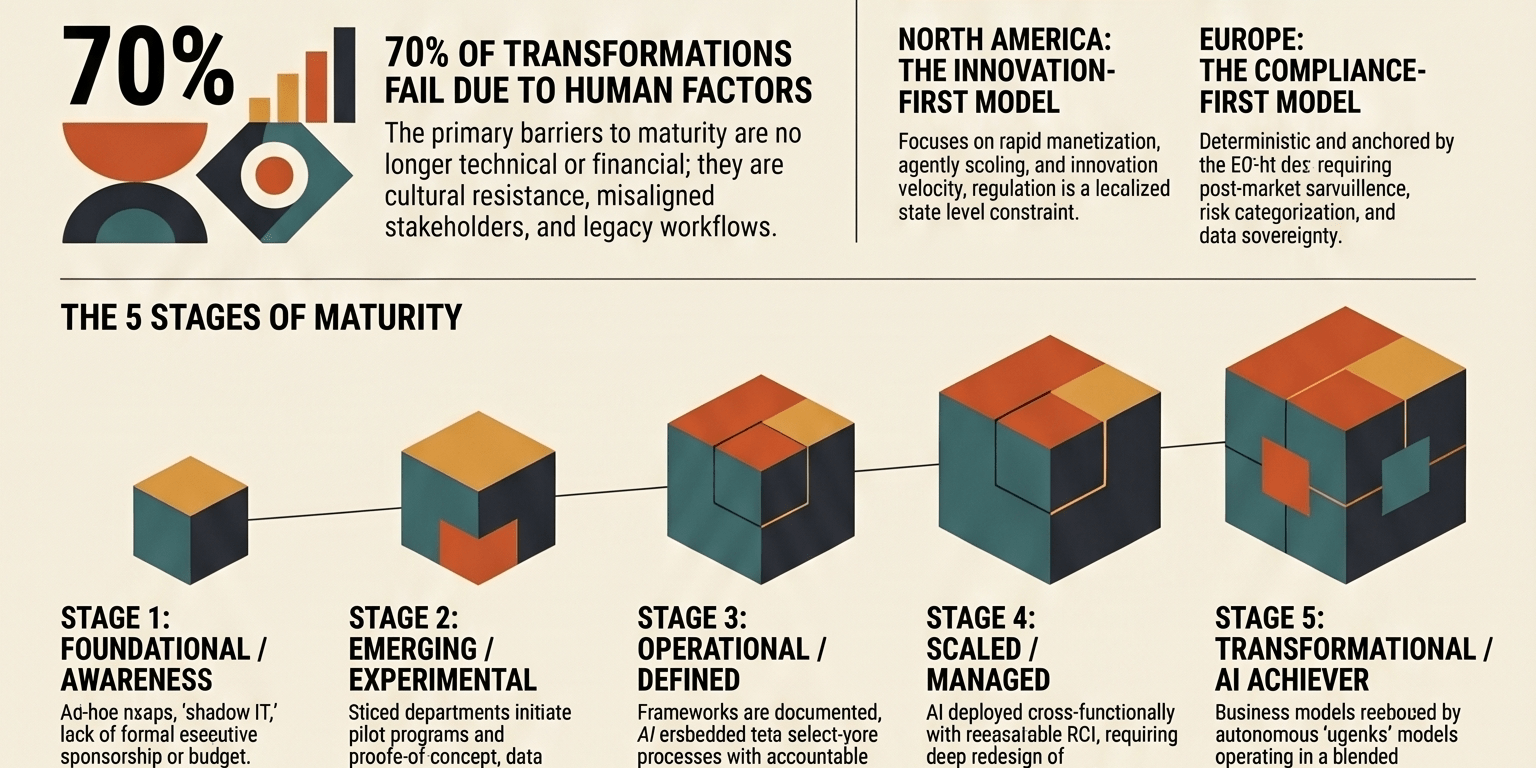
- The Transatlantic Regulatory Divergence: A definitive schism has emerged between North American and European maturity models. European frameworks are fundamentally deterministic and compliance-driven, anchored by the enforcement of the European Union Artificial Intelligence Act, which mandates continuous post-market surveillance, risk-based categorization, and stringent data sovereignty.5 Conversely, North American frameworks prioritize rapid monetization, innovation velocity, and agentic scaling, treating regulatory compliance as a localized state-level constraint (e.g., Texas HB 149, Colorado SB 24-205) rather than the foundational baseline.7
- The Interdependency of Maturity Dimensions: Enterprise maturity dimensions do not advance in isolation. Technological infrastructure, human capital, governance, and strategy are inextricably linked. Attempting to accelerate technical deployment without proportionally advancing algorithmic literacy and governance creates “capability debt,” a systemic vulnerability where the weakest operational dimension permanently establishes the ceiling for the entire organization’s maturity.4
- The Fallacy of Linear Organizational Progression: Modern maturity frameworks reject the assumption of linear, whole-enterprise progression. Large, complex regulated organizations operate at multiple, decentralized velocities. It is highly common for a single financial institution to operate at a Stage 4 (Scaled) level in customer relationship management while simultaneously languishing at Stage 1 (Foundational) in compliance and internal human resources.11
- The Agentic Maturation Shift: The frontier of organizational maturity has evolved from generative outputs to autonomous, task-executing “agentic” artificial intelligence. By the end of 2026, 40% of enterprise applications are projected to feature task-specific agents.13 In the financial sector, 89% of executives now anticipate a seamlessly blended workforce of human employees and autonomous agents within five years.14
- The Dominance of Organizational Over Technical Barriers: The primary impediment to achieving scaled maturity is no longer algorithmic limitation or computing cost. Empirical research confirms that 70% of artificial intelligence transformation failures stem from human factors: cultural resistance, misaligned stakeholder expectations, and a failure to re-engineer legacy workflows.15
- The Severe Educational Governance Deficit: The education sector represents the most volatile maturity environment globally. While 92% of higher education students in Europe and 86% of K-12 students in North America utilize generative tools, global governance has collapsed under the weight of adoption velocity. Only 20% of universities currently maintain formal, scaled governance frameworks, exposing institutions to massive academic integrity and data privacy risks.17
- The Illusion of Scale in Legal and Healthcare: Both the legal and healthcare sectors exhibit near-universal exploration (98% in legal, 85% in healthcare), yet only a fraction operate at genuine scale.3 Technology investments have vastly outpaced operating model maturity, meaning standalone tools are widely deployed, but core workflows, enterprise data pipelines, and regulatory frameworks remain deeply fragmented.3
- The Nonprofit Capital Constraint: The nonprofit and charity sector has achieved surprisingly high ad-hoc adoption (92% usage in specific administrative functions) due to the necessity of offsetting chronic resource shortages.20 However, because they rely heavily on consumer-grade applications rather than enterprise architectures, only 1% of health-focused nonprofits have successfully scaled artificial intelligence across their organizations, severely hampered by a lack of capital for robust data governance.19
Evolution and Structure of Artificial Intelligence Organizational Maturity Frameworks
The systematic measurement of enterprise capability requires the deployment of structured maturity frameworks. These frameworks provide a shared vocabulary and diagnostic benchmarking required to transition organizations from chaotic experimentation to predictable, governed value generation.
The 2026 landscape features four primary categories of maturity methodologies, each exhibiting distinct approaches to managing complexity within regulated organizations:
- Big 4 and Strategic Management Consulting Methodologies: Frameworks such as McKinsey’s Rewired and Accenture’s Total Enterprise Reinvention emphasize profound strategic alignment, defining maturity through executive sponsorship, commercial monetization, and top-down workflow redesign.16 While offering unparalleled strategic depth (scoring 4.5/5.0), these models occasionally treat change management as a parallel workstream rather than an embedded operational requirement.16
- Vendor Platform Methodologies: Provided by hyperscalers (e.g., AWS Cloud Adoption Framework for AI), these frameworks offer peerless technical architectures and infrastructural playbooks.16 However, they systematically fail to account for the human element, scoring a mere 1.0/5.0 in organizational change integration, often incorrectly treating adoption merely as software user training rather than active cultural resistance management.15
- Open and Academic Methodologies: Models such as the Gartner AI Maturity Model and the MIT Sloan Enterprise AI Maturity Model provide high-level, vendor-neutral benchmarking. The MIT Sloan model empirically proves that financial performance correlates strictly with maturity stage; organizations in early stages perform below industry averages, while those in Stages 3 and 4 perform well above.21
- Boutique Practitioner Methodologies: Emerging as the most effective frameworks for mid-market regulated entities, these models fundamentally fuse organizational change management with technological deployment. Acknowledging that roughly 70% of AI initiatives fail due to organizational friction, these frameworks measure cultural readiness, stakeholder mapping, and resistance metrics as co-equal components alongside data infrastructure.15
Linear Progression versus Multi-Speed Capability
A fundamental shift in 2026 framework architecture is the explicit rejection of the linear progression assumption. Prevailing historical models assumed an enterprise moved uniformly from Stage 1 to Stage 5. Contemporary research demonstrates that maturity in large regulated organizations is a “multidimensional, non-linear, and ecosystem-embedded capability”.11
The MITRE AI Maturity Model, specifically designed for government and regulated entities, qualitatively assesses organizations across 5 levels, 6 pillars, and 20 discrete dimensions.22 It explicitly acknowledges that different departments within an agency will exhibit radically different maturity states. A healthcare provider’s radiology department might utilize highly optimized, Stage 4 ambient listening and diagnostic algorithms, while the same organization’s procurement department relies on Stage 1 manual workflows.22 Advanced frameworks now measure how effectively organizations can federate localized successes into internal development platforms without forcing the entire enterprise to move at the velocity of its slowest department.12
Key Recommended Artificial Intelligence Organizational Maturity Dimensions
To execute a successful transformation, maturity frameworks deconstruct an organization’s abstract “readiness” into discrete, measurable dimensions. These dimensions span the technological, human, and regulatory spectrums. True maturity demands synchronized advancement across these vectors.2
Because the regulatory environments of North America and Europe impose different operational constraints, the prioritization and specific composition of these dimensions have diverged.
Recommended Dimensions for North American Regulated Organizations
In North America, where federal regulation remains relatively fragmented and market forces dictate velocity, dimensions prioritize infrastructural scalability, monetization, and decentralized innovation, though state-level mandates (e.g., Texas and Colorado) are beginning to force stricter governance.1
| Dimension Category | Core Focus and Sub-Components | Progress Dynamics |
| Strategy & Alignment | Commercial monetization; aligning algorithmic initiatives with core revenue generation; executive sponsorship; decentralized innovation hubs.2 | Highly Interdependent |
| Data Architecture | Globally federated datasets; elimination of localized data silos; transition from structured to highly unstructured data pipelines; data democratization.22 | Highly Interdependent |
| Technology Enablers | Rapid cloud infrastructure scaling; internal developer platforms; transition from generative text to autonomous agentic architectures.8 | Independent |
| Culture & Human Capital | AI literacy and awareness; shifting workforce toward higher-value tasks; prompt engineering; active resistance management.16 | Highly Interdependent |
| Governance & Compliance | Intellectual property protection; internal auditing; alignment with emerging state laws (Texas HB 149, Colorado SB 24-205); brand protection.7 | Interdependent |
| Financial Investments | Dynamic ROI tracking; aggressive capital expenditure ($124M average enterprise budget); funding agentic workflows.13 | Independent |
Recommended Dimensions for European Regulated Organizations
In Europe, the overarching presence of the EU AI Act dictates that governance, transparency, and ethical compliance are not parallel tracks but the foundational bedrock required before any technological scaling is legally permissible.5
| Dimension Category | Core Focus and Sub-Components | Progress Dynamics |
| Regulatory Governance | Continuous post-market surveillance; mandatory EU AI Act compliance; algorithmic risk categorization; strict bias mitigation protocols.6 | Highly Interdependent |
| Data Privacy & Ethics | Absolute GDPR adherence; ethical data sourcing; establishment of locally controlled data models; privacy-preserving architectures.24 | Highly Interdependent |
| Responsible Design | Industrialized responsible AI frameworks; transparency in automated decision making; explainability of algorithmic outputs.2 | Highly Interdependent |
| Strategic Sustainability | Alignment of AI strategy with the European digital future agenda; using technology to address supply chain and sustainability concerns.2 | Interdependent |
| Specialized Human Capital | Integration of non-technical oversight roles (behavioral scientists, ethicists); systemic ethical awareness training.2 | Highly Interdependent |
| Sovereign Infrastructure | Utilization of secure, sovereign cloud environments; auditable processing layers; strict lifecycle management controls.2 | Independent |
The Principle of Dimensional Interdependency and Capability Debt
Empirical validation of these frameworks, particularly research surrounding the Microsoft Responsible AI Maturity Model, reveals that the vast majority of these dimensions are intrinsically interdependent.10 The progression of an enterprise is not an aggregate average of its dimensions; rather, the weakest dimension establishes a hard ceiling for systemic maturity.9
When a regulated organization attempts to bypass a level—for instance, pouring excessive capital into Technology Enablers (hardware and cloud services) while neglecting Culture & Human Capital (literacy and workflow redesign)—the organization accrues “capability debt”.4 The result is predictable: the technology is physically deployed but practically unusable because the workforce lacks the competency to prompt the models securely, and governance structures fail to monitor the outputs. The system stalls in the pilot phase, unable to scale.4 Successful maturity models mandate that Leadership, Lifecycle Management, Stakeholder Engagement, Literacy, Operations, Risk Management, and Compliance mature collectively in a synchronized topology.25
Common Maturity Stages Across Regulated Industries
While the exact nomenclature of maturity stages differs by consultancy, the trajectory from foundational unawareness to transformational autonomy is universally recognized. Organizations progress through these stages by eliminating capability debt across the aforementioned dimensions.
Because of differing regulatory philosophies and market dynamics, the manifestation of these stages within specific regulated industries varies slightly between North America and Europe.
Maturity Stages in North American Regulated Organizations
| Stage Classification | Stage Description and Operational Reality | Interdependency Profile |
| Stage 1: Foundational / Discover | Driven strictly by unsanctioned shadow IT and ad-hoc employee usage. No formal budget, executive sponsorship, or enterprise data connectivity.30 | Highly disconnected. Tech adoption outpaces governance entirely. |
| Stage 2: Emerging / Explore | Formal proof-of-concept pilot programs initiated in siloed departments. Draft policies under review, but investments are not linked to measurable revenue.30 | Dimensions begin to align, but data remains fragmented. |
| Stage 3: Operational / Defined | Approved, enterprise-wide approaches and frameworks documented. Technology is embedded into select core processes with accountable executive ownership.22 | High interdependency. Governance, Tech, and Culture must align to achieve this stage. |
| Stage 4: Scaled / Managed | AI capabilities are heavily deployed across multiple cross-functional departments, delivering measurable ROI and broad administrative relief.19 | Very High interdependency. Requires deep workflow redesign. |
| Stage 5: Transformational | Core business models are fundamentally reshaped by autonomous agentic models. The enterprise operates a blended human/AI workforce with continuous optimization loops.14 | Complete systemic synchronization across all dimensions. |
Maturity Stages in European Regulated Organizations
European stages place significantly more emphasis on documentation, auditability, and continuous assessment throughout the lifecycle.
| Stage Classification | Stage Description and Operational Reality | Interdependency Profile |
| Stage 1: Awareness (Pre-Adoption) | Widespread acknowledgment of potential, but adoption is tightly restricted due to GDPR and fear of EU AI Act non-compliance.2 | Governance permanently restricts Tech adoption until baseline met. |
| Stage 2: Controlled Experimentation | Piloting within highly regulated sandboxes. Focus is on establishing stress-testing methodologies (e.g., EY.ai Confidence Index) prior to broad exposure.5 | High interdependency. Risk Management dictates pace. |
| Stage 3: Compliant Integration | AI tools are deployed internally. The organization’s internal data governance framework establishes ownership structures and lifecycle controls.28 | High interdependency. Operational and Compliance alignment. |
| Stage 4: AI Innovators | Broad scaling with strong foundational capabilities. The enterprise has successfully navigated risk categorizations and leverages automated decision support across the enterprise.2 | Very High interdependency. |
| Stage 5: AI Achievers | Top-tier organizations (currently ~11% in EU) leveraging AI’s full potential, combining a strong core with a highly differentiated, sustainable, and responsible strategy.2 | Complete systemic synchronization. |
Quantitative Summary: The State of Industry Maturity in 2026
The disparity between raw technological adoption and true operational maturity becomes startlingly apparent when analyzing specific regulated sectors. The following quantitative analysis breaks down the percentage of organizations occupying each stage of maturity.
(Note: Where specific dimensional stage data is unavailable due to aggregated market reporting, “Unknown” is utilized per instructions, but deep contextual proxies are provided).
1. Healthcare, Medicine, and Pharmaceutical
The healthcare sector operates within a highly risk-averse environment where protecting sensitive patient data is an absolute mandate.24 While overall adoption has accelerated—with 85% of organizations reporting utilization and 66% of physicians using some form of health AI 18—the sector’s overall maturity remains below the global average.24 Development is heavily skewed toward localized experimentation; for instance, 70% of FDA approvals are concentrated in imaging rather than systemic operational workflows.24 Generative and agentic models are increasingly viewed as the solution to massive administrative burdens, particularly regarding the automation of prior authorization workflows mandated by 2026 CMS regulations.19
North America (Healthcare)
| Maturity Stage | % of Organizations | Contextual Insight |
| Stage 1: Foundational | 18% | Organizations that remain entirely unadopted, paralyzed by liability concerns, data protectionism, and fragmented infrastructures.19 |
| Stage 2: Emerging (Experimentation) | 49% | The vast majority of the sector resides here. Organizations are testing ambient listening and administrative triage, but remain trapped in pilots.19 |
| Stage 3: Operational | Unknown | Data blended within broader scaling metrics. |
| Stage 4 & 5: Scaled / Transformational | 33% | Only one-third of US healthcare organizations have successfully achieved enterprisewide implementation across clinical and back-office functions with measurable ROI.19 |
Europe (Healthcare)
| Maturity Stage | % of Organizations | Contextual Insight |
| Stage 1: Foundational | Unknown | Extremely strict data protectionism limits unsanctioned ad-hoc adoption. Reliance on globally federated, privacy-preserving datasets is required.24 |
| Stage 2: Emerging (Experimentation) | Unknown | Intense focus on compliance mapping against the EU AI Act prevents rapid scaling out of the pilot phase.28 |
| Stage 3: Operational | Unknown | Gradual implementation of early-warning systems and optimized inventory management (e.g., IDENTI Medical).24 |
| Stage 4 & 5: Scaled / AI Achievers | 11% (Aggregated) | Across all EU industries, only 11% are classified as true “AI Achievers.” Healthcare lags the industrial average, suggesting high-end scaling is exceptionally rare.2 |
2. Financial Services, Insurance, Wealth, and Fintech
Financial services represent the absolute vanguard of artificial intelligence maturity. Driven by vast historical datasets, immense capital resources, and immediate monetization opportunities, the sector has aggressively moved beyond basic text generation into autonomous agentic deployment.14 The focus has shifted from mere cost reduction (26%) to top-line revenue growth (21%) and sheer adoption velocity (81%).14 An overwhelming 89% of banking executives foresee a workforce where humans and AI agents work cooperatively within the next five years.14
North America (Finance & Fintech)
| Maturity Stage | % of Organizations | Contextual Insight |
| Stage 1: Foundational | 2% | Total non-adoption is viewed as a critical competitive failure. 98% of the sector utilizes AI in some capacity.34 |
| Stage 2: Emerging (Pilot) | 33% | Organizations stuck attempting to align legacy banking systems with modern cloud architectures.34 |
| Stage 3: Operational | Unknown | Rapid, fluid transition phase toward full enterprise integration. |
| Stage 4 & 5: Scaled / Transformational | 65% | US institutions lead globally. Active, scaled use cases include data analysis (47%), document intelligence extraction (41%), and credit underwriting (35%).34 |
Europe (Finance & Fintech)
| Maturity Stage | % of Organizations | Contextual Insight |
| Stage 1: Foundational | 2% | Equivalent to North America; basic capability is considered a mandatory baseline.34 |
| Stage 2: Emerging (Pilot) | 37% | Slower pilot-to-production pipelines due to the necessity of establishing continuous, auditable assessment of algorithms prior to deployment.5 |
| Stage 3: Operational | Unknown | Intense focus on lifecycle controls and stress testing (e.g., EY.ai Confidence Index).5 |
| Stage 4 & 5: Scaled / Transformational | 61% | Trailing the US slightly, but demonstrating massive success in front-office customer support (73%) and CRM outreach (67%).34 |
3. Education (K-12 and Higher Education)
The education sector displays the most severe imbalance between technological adoption and organizational governance globally. Adoption is near-universal, driven aggressively from the bottom up by students and individual educators seeking productivity gains (saving US educators ~5.9 hours weekly).17 However, institutional policy frameworks are practically non-existent relative to adoption, exposing universities to massive academic integrity and data privacy vulnerabilities.17 The sector is attempting to mature from general-purpose tools to “purpose-built educational AI” designed for durable learning gains.17
North America (Education)
| Maturity Stage | % of Organizations | Contextual Insight |
| Stage 1 & 2: Foundational / Emerging | 15% | The minority of educators/students avoiding the technology. Only 31% of US K-12 public schools possess a written AI policy.17 |
| Stage 3: Operational (Adoption) | 85% | 85% of teachers and 86% of students in K-12 actively utilized AI in the 2024-25 academic year.17 |
| Stage 4 & 5: Scaled (Governance) | Unknown | Very few institutions measure systemic ROI or have deployed integrated, personalized pedagogical architectures at scale.36 |
Europe (Education)
| Maturity Stage | % of Organizations | Contextual Insight |
| Stage 1 & 2: Foundational / Emerging | 8% | A massive surge in adoption has rendered non-use statistically rare among student bodies.17 |
| Stage 3: Operational (Adoption) | 92% | In the UK, 92% of higher education students actively use generative tools, completely outpacing institutional detection mechanisms.17 |
| Stage 4 & 5: Scaled (Governance) | 20% | Globally, only 20% of universities maintain a formal AI policy. While Europe and NA lead globally, roughly 30% of universities still lack active policy development.17 |
4. Legal and Government Sector
The legal sector vividly illustrates the concept of “capability debt.” Investment in generative text algorithms is nearly ubiquitous, yet the underlying operating models—the workflows, governance structures, and talent models required to utilize them effectively—remain severely lagging.3 Firms possess the software but lack the cohesive organizational alignment necessary to scale it sustainably.
North America and Europe (Legal Sector)
(Data aggregated due to unified cross-Atlantic Harbor Research reporting parameters)
| Maturity Stage | % of Organizations | Contextual Insight |
| Stage 1: Foundational | 2% | Only an extreme minority are ignoring the technology. 81% rank technology as their top strategic priority for 2026.3 |
| Stage 2: Emerging (Pilot) | 24% | Departments exploring technology within controlled environments, failing to bridge the gap to core workflows.3 |
| Stage 3: Operational (Live) | 57% | Widespread active deployment, but utilized primarily as standalone, disconnected tools rather than integrated workflow systems.3 |
| Stage 4 & 5: Scaled / Pulling Ahead | 17% | A small minority successfully aligning technology, workflows, talent, and governance into a cohesive, scaled operating model.3 |
5. Nonprofit and Charity Sector
The nonprofit sector exhibits a unique maturity profile: extremely high ad-hoc adoption driven by desperation to offset chronic underfunding, paired with exceptionally low enterprise scaling. Organizations are achieving significant success using consumer-grade tools for personalized donor outreach (yielding 20-30% donation increases).20 However, lacking the capital for robust, secure cloud environments and enterprise data architectures, true structural maturity remains elusive.19
North America and Europe (Nonprofit)
(Aggregated due to comparable international constraints)
| Maturity Stage | % of Organizations | Contextual Insight |
| Stage 1: Foundational (No adoption) | 3% – 8% | Only a tiny fraction plan to completely avoid AI. Most recognize its necessity for survival.19 |
| Stage 2: Emerging (Experimentation) | 30% | Testing in isolated silos without structured proofs-of-concept. Risk stalling completely due to a lack of strategic oversight.19 |
| Stage 3: Operational (Adoption) | 48% – 61% | High utilization of general generative tools (61% of US health nonprofits, 48% of EU nonprofits). Tremendous time savings realized.19 |
| Stage 4 & 5: Scaled (Governance) | 1% | Only 1% of health-focused nonprofits operate at scale. Between 10-24% possess formal governance policies, exposing the sector to immense data privacy risks.19 |
Hypothesis Testing and Validation
The rigorous analysis of academic literature, empirical market data, and consultancy methodologies allows for the definitive testing of three critical hypotheses regarding enterprise maturity in 2026.
Hypothesis 1: The Fallacy of Linear Progression
Hypothesis: Most current AI maturity frameworks assume a simplified linear progression across the entire org. That’s false, especially in large diverse organizations. AI maturity frameworks have to account for the fact that different parts of organizations will be at different stages of AI maturity.
Validation: True (Supported). The premise that a massive, multifaceted regulated enterprise advances harmoniously from Stage 1 to Stage 5 is a theoretical fiction. Empirical research specifically targeting digital transformation explicitly reconceptualizes maturity as a “multidimensional, non-linear, and ecosystem-embedded capability”.11 Real-world deployments confirm that capability is heavily siloed by business unit constraints. A large commercial bank may boast a Stage 4 algorithmic trading desk while its compliance auditing team remains at Stage 1.3 Modern organizational assessment tools, such as the MITRE framework, mandate discrete evaluations for distinct components of an organization, explicitly seeking to transition fragmented, decentralized competencies into a unified internal development platform.22 Organizations must orchestrate a multi-speed capability framework rather than forcing a linear march.
Hypothesis 2: The Primacy of Organizational Barriers
Hypothesis: Since most AI adoption barriers are organizational (not technical), AI maturity frameworks closely reflect general organizational maturity frameworks.
Validation: True (Supported). The binding constraint on artificial intelligence maturity is no longer algorithmic limitation, compute power, or financial capital; it is human psychology and structural inertia. McKinsey research confirms that only 16% of organizations sustain performance improvements from digital transformations, with roughly 70% of failures attributed entirely to organizational factors such as lack of stakeholder alignment, cultural resistance, and poor change management.15 Consequently, the most effective maturity frameworks (Boutique Practitioner models scoring 4.5/5.0 on integration) have simply fused traditional organizational change management frameworks—such as stakeholder mapping and resistance analysis—directly into their technological roadmaps.16 The legal sector serves as the ultimate proof point: 98% of firms possess the technology, yet scaling is blocked entirely by lagging organizational operating models.3
Hypothesis 3: The Imperative of Dimensional Interdependency
Hypothesis: Some AI maturity dimensions are highly related and progress together (not separately). These require more complex solutions to advance organizational AI maturity.
Validation: True (Supported). This is arguably the most consequential finding in 2026 organizational theory. Deep analysis of the Microsoft Responsible AI Maturity Model, constructed from empirical observations of over 90 AI specialists, confirms that the 24 identified dimensions of capability are fundamentally interdependent.10 Executive leadership cannot unilaterally advance technology infrastructure without simultaneously elevating data lifecycle management, algorithmic literacy, and stakeholder engagement.25 As noted by industry analysts, attempting to skip a dimensional level creates severe “capability debt” that inevitably leads to systemic collapse; the weakest operational dimension permanently sets the ceiling for the entire enterprise.4 Advancing maturity requires the complex, simultaneous orchestration of culture, policy, and technology.
Strategic Actions for Senior Leaders in Regulated Organizations
The transition to algorithmic operations is no longer a localized IT project; it is a fundamental re-engineering of the modern regulated enterprise. Senior leaders must navigate this paradigm shift with decisive, structurally sound strategies.
Actions to Maximize Opportunities and Avoid Common Challenges
- Eradicate Capability Debt via Synchronized Funding: Capital expenditure models must be radically restructured. Every dollar allocated toward physical software or cloud compute must be matched by proportional funding for workflow redesign, employee literacy training, and governance engineering. Advancing technology endpoints without advancing the human operating model guarantees failure.4
- Transition to Purpose-Built, Industry-Specific Architectures: The era of relying on general-purpose consumer chatbots is ending. To maximize ROI, organizations must embed highly specialized, industry-specific architectures directly into core workflows. In healthcare, this means deploying ambient listening agents directly into Electronic Health Records (EHR) to automate prior authorizations.3
- Institutionalize Agile Post-Market Surveillance: Particularly for European entities or North American organizations operating internationally, static compliance reviews are entirely obsolete. The non-deterministic nature of generative and agentic AI demands continuous, real-time post-market surveillance to monitor for bias drift, accuracy degradation, and data leakage.5
- Prepare the Architecture for the Agentic Workforce: The operational paradigm is rapidly shifting from human assistance to autonomous execution. Leaders in finance and healthcare must immediately begin redesigning their workforce models to accommodate an environment where humans serve as “managers” of autonomous agentic software, rather than simply users of generative tools.13
- Embrace Centralized Guardrails with Decentralized Innovation: Recognize the multi-speed reality of large organizations. Establish firm, non-negotiable enterprise guardrails—secure sovereign cloud environments and rigid ethical governance frameworks—but permit individual business units the autonomy to innovate and experiment rapidly within those boundaries.12
Actions for Organizations Falling Behind
For regulated organizations that remain trapped in isolated pilot phases or lack a cohesive strategy, the window to achieve competitive parity is rapidly closing.
- Execute an Immediate Enterprise Readiness Assessment: An organization cannot scale what it cannot measure. Leadership must immediately deploy a comprehensive, multi-dimensional maturity assessment (e.g., the MITRE or EY.ai framework) across every internal department. This will expose shadow IT usage, identify capability bottlenecks, and establish a true operational baseline.5
- Mandate Formal C-Suite Sponsorship and Accountability: The most common denominator among failing transformations is the delegation of AI strategy strictly to the Chief Information Officer. Successful progression requires enthusiastic, formal sponsorship from the absolute highest levels of the executive suite, with specific leaders held personally accountable for ethical oversight and commercial outcomes.2
- Consolidate Sovereign Data Environments: Algorithmic maturity is structurally impossible without immaculate data hygiene. Laggard organizations must halt peripheral, uncoordinated experiments and aggressively redirect capital toward cleaning and federating their core data architecture. Dismantling data silos and establishing rigorous access protocols is the prerequisite for future scaling.24
- Implement Universal Baseline Literacy Training: The most profound barrier to catching up is human resistance fueled by technological illiteracy. Organizations must institute mandatory, continuous training frameworks that demystify artificial intelligence, articulate its ethical limitations, and provide role-specific guidance, thereby transitioning the workforce from passive resisters to active participants.2
The transatlantic integration of artificial intelligence is the defining operational mandate of 2026. Regulated entities that recognize this not merely as a technological upgrade, but as a profound, multidimensional reorganization of human capital, governance, and strategy, will secure decisive institutional dominance in the years ahead.
Works cited
- AI Adoption Statistics: What Percentage of Companies Use AI Worldwide in 2026, accessed May 16, 2026, https://textero.io/research/what-percentage-of-companies-use-ai
- The art of AI maturity—Europe | Accenture, accessed May 16, 2026, https://www.accenture.com/content/dam/system-files/acom/custom-code/ai-maturity/Accenture-Art-AI-Maturity-EU.pdf
- New Harbor Research Finds Legal AI Surging, but Operating Gaps …, accessed May 16, 2026, https://ccbjournal.com/news/new-harbor-research-finds-legal-ai-surging-but-operating-gaps-limit-scale
- The Capability Maturity Model for AI in Design – UX Tigers, accessed May 16, 2026, https://www.uxtigers.com/post/ai-maturity
- Navigating the new regulatory landscape: how the EU AI Act is transforming asset management | EY Luxembourg, accessed May 16, 2026, https://www.ey.com/en_lu/insights/wealth-asset-management/luxembourg-market-pulse/navigating-the-new-regulatory-landscape-how-the-eu-ai-act-is-transforming-asset-management
- EU AI Act 2025: Key Rules & Compliance Guide | Nemko Digital, accessed May 16, 2026, https://digital.nemko.com/regulations/eu-ai-act
- AI Governance: The Complete 2026 Guide for Leaders | ClearPoint Strategy Blog, accessed May 16, 2026, https://www.clearpointstrategy.com/blog/ai-governance-guide
- The Widening AI Value Gap – Boston Consulting Group, accessed May 16, 2026, https://media-publications.bcg.com/The-Widening-AI-Value-Gap-Sept-2025.pdf
- The 5-Dimension Assessment For AI Readiness: A Board-Level Framework – Forbes, accessed May 16, 2026, https://www.forbes.com/councils/forbestechcouncil/2026/03/02/the-five-dimension-assessment-for-ai-readiness-a-board-level-framework-for-scaling-ai/
- responsible ai maturity model – Microsoft, accessed May 16, 2026, https://www.microsoft.com/en-us/research/wp-content/uploads/2023/05/RAI_Maturity_Model_Aether_Microsoft_whitepaper.pdf
- [2603.08728] Artificial Intelligence (AI) Maturity in Small and Medium-Sized Enterprises: A Framework of Internalized and Ecosystem-Embedded Capabilities – arXiv, accessed May 16, 2026, https://arxiv.org/abs/2603.08728
- Levels in the generative AI maturity model – AWS Prescriptive Guidance, accessed May 16, 2026, https://docs.aws.amazon.com/prescriptive-guidance/latest/strategy-gen-ai-maturity-model/overview-levels.html
- AI Maturity: The Complete Enterprise Guide (2026) – Larridin, accessed May 16, 2026, https://larridin.com/solutions/ai-maturity-the-complete-enterprise-guide-2026
- Banks prepare for AI-human workforce as adoption accelerates: nCino survey – TNGlobal, accessed May 16, 2026, https://technode.global/2026/05/14/banks-prepare-for-ai-human-workforce-as-adoption-accelerates-ncino-survey/
- Best AI Transformation Frameworks 2026 Ranked | The Thinking Company, accessed May 16, 2026, https://thinking.inc/en/boss-articles/frameworks-best-ai-transformation-frameworks-2026/
- AI Transformation Frameworks Compared (2026 Guide) | The …, accessed May 16, 2026, https://thinking.inc/en/boss-articles/frameworks-ai-transformation-frameworks-compared/
- 25 AI in Education Statistics to Guide Your Learning Strategy in 2026, accessed May 16, 2026, https://www.engageli.com/blog/ai-in-education-statistics
- AI in Healthcare 2025 Statistics: Market Size, Adoption, Impact – Vention, accessed May 16, 2026, https://ventionteams.com/healthtech/ai/statistics
- 61% of Health Nonprofits Use Gen AI, and Trustworthy Scaling Is …, accessed May 16, 2026, https://www.deloitte.com/us/en/industries/life-sciences-health-care/blogs/health-care/sixty-one-percent-of-health-nonprofits-use-gen-ai-and-trustworthy-scaling-is-next.html
- Enhancing Transparency and Accountability in Federally Funded Nonprofits: A Convergent Framework Integrating Artificial Intelligence Analytics and Blockchain Technology – BYU ScholarsArchive, accessed May 16, 2026, https://scholarsarchive.byu.edu/cgi/viewcontent.cgi?article=1192&context=joni
- How to boost your organization’s AI maturity level | MIT Sloan, accessed May 16, 2026, https://mitsloan.mit.edu/ideas-made-to-matter/how-to-boost-your-organizations-ai-maturity-level
- The MITRE AI Maturity Model and Organizational Assessment Tool …, accessed May 16, 2026, https://www.mitre.org/sites/default/files/2023-11/PR-22-1879-MITRE-AI-Maturity-Model-and-Organizational-Assessment-Tool-Guide.pdf
- AI Strategy Development: Complete Framework for Enterprise AI Roadmaps – Articsledge, accessed May 16, 2026, https://www.articsledge.com/post/ai-strategy-development
- The Future of AI-Enabled Health: Leading the Way – World …, accessed May 16, 2026, https://reports.weforum.org/docs/WEF_The_Future_of_AI_Enabled_Health_2025.pdf
- AI Governance Maturity Model: Assess, Benchmark, and Advance Your AI – Agility at Scale, accessed May 16, 2026, https://agility-at-scale.com/ai/governance/ai-governance-maturity-model/
- Europe’s nonprofits face challenges head on with strategy changes & AI adoption at pace, accessed May 16, 2026, https://efa-net.eu/news/europes-nonprofits-face-challenges-head-on-with-strategy-changes-ai-adoption-at-pace/
- A Maturity Model for Trustworthy AI Software Development – MDPI, accessed May 16, 2026, https://www.mdpi.com/2076-3417/13/8/4771
- Complying with the EU AI Act Using Industry Frameworks – Data Crossroads, accessed May 16, 2026, https://datacrossroads.nl/2026/02/16/complying-with-the-eu-ai-act-using-industry-frameworks/
- Artificial intelligence maturity model: a systematic literature review – PMC, accessed May 16, 2026, https://pmc.ncbi.nlm.nih.gov/articles/PMC8409328/
- AI Maturity Framework – Scottish AI Playbook, accessed May 16, 2026, https://www.scottishaiplaybook.com/ai-maturity-framework
- Gartner AI Maturity Model and AI Roadmap Toolkit, accessed May 16, 2026, https://www.gartner.com/en/chief-information-officer/research/ai-maturity-model-toolkit
- Harnessing the value of AI – Capgemini, accessed May 16, 2026, https://www.capgemini.com/wp-content/uploads/2026/03/CRI-research-brief-Harnessing-the-value-of-AI-AD_Updated.pdf
- The Coming AI Share of Medicare Spend – Pearl Health, accessed May 16, 2026, https://www.pearlhealth.com/blog/the-coming-ai-share-of-medicare-spend
- Finastra research reveals U.S. financial institutions outpace global …, accessed May 16, 2026, https://www.finastra.com/press-media/finastra-research-reveals-us-financial-institutions-outpace-global-peers-ai-adoption
- AI Adoption in Finance Tops 81% – Fintech Schweiz Digital Finance …, accessed May 16, 2026, https://fintechnews.ch/aifintech/ai-adoption-in-finance-tops-81/83443/
- The Impact of AI on Work in Higher Education | EDUCAUSE, accessed May 16, 2026, https://www.educause.edu/research/2026/the-impact-of-ai-on-work-in-higher-education
The idea, research hypotheses, and focus for this article/research are all original and mine. This article was written with my brain and two hands with the assistance of Google Gemini, Notebook LM, Claude, and other wondrous toys.
 Adam Outside The Box