Executive Summary
As artificial intelligence systems transition from experimental, text-generating interfaces to autonomous, agentic engines embedded directly into enterprise workflows, the corresponding risk landscape has fundamentally altered. Regulated organizations across North America and Europe—spanning financial services, healthcare, pharmaceuticals, and government—are discovering that traditional, document-centric governance models are structurally incapable of managing the velocity and probabilistic nature of Large Language Models (LLMs). The industry is undergoing a necessary paradigm shift toward “Governance as Code” (GaC), a discipline that embeds real-time, deterministic guardrails—such as prompt filtering, Retrieval-Augmented Generation (RAG) orchestration, and automated state-transition validation—directly into the LLMOps CI/CD pipeline.
Governance as Code translates aspirational ethical principles and legal mandates into machine-executable technical controls, shifting enterprise AI management from passive observation to active, runtime enforcement. For medium-to-large regulated entities, operationalizing this architecture is no longer merely a compliance exercise; it is the foundational infrastructure required to scale AI safely, mitigate catastrophic technical debt, and realize measurable business value.
Key Strategic Insights
- The Obsolescence of Static Governance: Traditional governance relies on manual audits, risk registers, and employee acceptable-use policies. This paradigm is fundamentally incompatible with the speed of AI deployment. Regulators increasingly demand technical, auditable evidence of runtime controls, rendering philosophical AI ethics statements insufficient for legal defense1.
- The Escalation to Execution Governance: As organizations deploy Agentic AI capable of independent planning and tool execution, governance must evolve from filtering textual outputs to adjudicating system calls. Deterministic state-transition validation acts as a circuit breaker, preventing an LLM’s probabilistic inferences from executing unauthorized actions against production APIs3.
- The Transatlantic Compliance Divide: While both North American and European organizations are adopting GaC, their drivers diverge significantly. European entities are forced into systemic, compliance-as-code architectures by the imminent enforcement of the EU AI Act, whereas North American adoption is largely propelled by the desire to protect intellectual property, mitigate cybersecurity vulnerabilities, and optimize cloud inference costs4.
- The Accumulation of AI Capability Debt: Deploying AI without embedded CI/CD guardrails accelerates the accumulation of AI Technical Debt. This debt compounds non-linearly through unversioned prompts, undocumented logic, and “code smells” generated by AI coding assistants, severely crippling future enterprise agility7.
- The Emergence of Bayesian RAG in High-Stakes Environments: To address the hallucination risks inherent in traditional RAG, mature organizations are piloting Bayesian RAG frameworks. By applying Monte Carlo Dropout to quantify epistemic uncertainty, these systems can deterministically decline to answer when statistical confidence is insufficient, a critical capability for financial and medical applications10.
- The “Proof Gap” as a Competitive Differentiator: A stark division exists between organizations merely piloting AI and those scaling it successfully. High-maturity organizations utilize automated governance to bridge the “proof gap,” allowing them to demonstrate accountability and safety to boards and regulators, thereby unlocking the confidence required to drive AI-enabled revenue growth11.
Key Metrics and Statistics
- 95%: The failure rate of enterprise Generative AI pilots attempting to reach production or deliver measurable business value, primarily due to neglected technical foundations and manual governance bottlenecks11.
- €35 Million or 7% of Global Turnover: The maximum penalty for high-risk AI non-compliance under the EU AI Act, a catastrophic financial risk driving immediate GaC adoption across European markets13.
- 78%: The percentage of business executives deploying AI who lack strong confidence that their organization could pass an independent AI governance audit within 90 days12.
- 4%: The proportion of enterprises globally that currently possess AI governance programs mature enough to keep pace with their AI scaling and deployment efforts14.
- 1.7x: The multiple by which AI-generated code introduces more issues per pull request compared to human-written code, directly contributing to severe enterprise technical debt7.
- €29,277: The estimated annual compliance cost per high-risk AI system under the EU AI Act, highlighting the necessity of automating compliance generation through CI/CD pipelines13.
- 89.3%: The percentage of AI-introduced technical debt classified as “code smells,” demonstrating the silent, long-term degradation of enterprise architecture when human oversight and GaC checks are bypassed9.
2. Quantitative Summary: Market Prevalence of Governance as Code
The operationalization of Governance as Code is highly contextual, varying across jurisdictions based on regulatory stringency and market dynamics. The following tables summarize the prevalence, effectiveness, and driving catalysts of core GaC practices across major regulated industries in North America and Europe.
Table 1: North American Regulated Markets (United States & Canada)
In North America, AI governance is driven largely by a patchwork of sector-specific regulations (e.g., HIPAA, GLBA), federal procurement standards (e.g., NIST AI RMF), and emerging legislative proposals such as Canada’s Artificial Intelligence and Data Act (AIDA). The prevailing market philosophy prioritizes rapid innovation; consequently, GaC practices are heavily indexed toward cybersecurity defense, intellectual property protection, and cost optimization.
| Governance as Code Practice | Primary Industries | Prevalence | Effectiveness | Primary Driver / Catalyst |
| Prompt Filtering & Injection Defense | Financial Services, Legal, Tech | High | Medium | Protection of IP, cybersecurity risk mitigation, OWASP LLM Top 10 vulnerabilities15. |
| Traditional RAG Orchestration | Healthcare, Insurance, Legal | High | High | Factual grounding, hallucination reduction, enterprise workflow automation17. |
| PII & Protected Data Redaction | Healthcare (HIPAA), Finance, Gov | High | High | Strict data privacy laws, preventing third-party LLM data leakage during ingestion19. |
| Token & Cost Optimization Guardrails | Fintech, Education, Nonprofit | Medium | High | Cloud infrastructure budgeting, preventing exponential inference cost overruns21. |
| Automated State-Transition Validation | Financial Services, Government | Low | Medium | Early-stage mitigation of autonomous agentic risks, preventing unauthorized API calls3. |
| Compliance-as-Code Auditing | Government, Healthcare | Low | Unavailable | Early preparation for Canada’s AIDA; voluntary adaptation of NIST AI RMF1. |
Table 2: European Regulated Markets (UK, Germany, France)
European adoption of GaC is fundamentally shaped by the horizontal, risk-based architecture of the European Union Artificial Intelligence Act (EU AI Act) and the General Data Protection Regulation (GDPR). The regulatory environment necessitates machine-readable, auditable proof of compliance. European enterprises are, therefore, forced to prioritize systemic architectural controls, risk-based tiering, transparency logging, and runtime validation.
| Governance as Code Practice | Primary Industries | Prevalence | Effectiveness | Primary Driver / Catalyst |
| Prompt Filtering & Injection Defense | Financial Services, Insurance | Medium | Medium | GDPR compliance, preventing automated decision-making bias and unauthorized profiling5. |
| Traditional RAG Orchestration | Healthcare, Pharma, Government | High | High | Evidence-based reasoning, verifiable medical/clinical alignment, public sector trust18. |
| PII & Protected Data Redaction | All Regulated Sectors | High | High | GDPR Article 22, right-to-erasure compliance in embedding and vectorization pipelines2. |
| Token & Cost Optimization Guardrails | Education, Nonprofit | Low | Unavailable | Market focus is currently skewed toward strict legal compliance rather than immediate cost efficiency13. |
| Automated State-Transition Validation | Financial Services, Critical Infra | Medium | High | EU AI Act Annex III requirements for Critical Infrastructure & Safety Components6. |
| Compliance-as-Code Auditing | All Regulated Sectors | High | Medium | EU AI Act (August 2026 deadline), mandatory requirements for technical documentation and logging5. |
3. Governance as Code: Research Details, Mechanics, and Future Evolution
The shift from manual oversight to “Governance as Code” represents a critical maturation in enterprise AI architecture. It mirrors the historical evolution of cloud computing, where manual infrastructure provisioning was entirely superseded by Infrastructure-as-Code (IaC) and automated CI/CD deployment pipelines.
3.1 Defining Governance as Code within LLMOps
Governance as Code is the paradigm of embedding data policies, ethical guidelines, operational boundaries, and regulatory compliance controls directly into the technology stack1. Rather than relying on employees to read and subjectively adhere to acceptable use policies, constraints are defined programmatically and enforced continuously during runtime via dynamic tools2.
In the context of Large Language Model Operations (LLMOps), this requires standardizing the CI/CD pipeline to treat prompts, system instructions, and agentic workflows as deployable, version-controlled software artifacts21. The differences between traditional MLOps and LLMOps are stark: while MLOps evaluates deterministic model binaries using precision and recall, LLMOps manages highly non-deterministic text artifacts where evaluation replaces unit testing, and token cost must be monitored at a granular level21.
The mechanics of GaC involve several critical layers:
- Declarative Policy Definition: Establishing organizational policies in machine-readable formats (e.g., YAML or JSON schemas). For example, a policy stating “Do not process PII” or “Require human approval for trades over $10,000” is encoded declaratively. These schemas can be dynamically mapped to assurance frameworks like ISO/IEC 42001, the NIST AI RMF, or the EU AI Act24.
- Middleware Interception & API Gateways: Implementing a robust control plane between the user application and the core LLM provider. This gateway analyzes every inbound request and outbound response, applying programmatic filters and executing access control lists before data is transmitted over the network2.
- Continuous Evaluation Suites: Replacing deterministic unit tests with LLM-as-a-judge evaluation frameworks. Prompts and configurations are tested against “golden datasets” during the integration phase to score them on faithfulness, toxicity, and domain relevance. A drop in the quality score acts as an automated deployment blocker in the CI/CD pipeline22.
3.2 Core Mechanics: Guardrails, Orchestration, and Validation
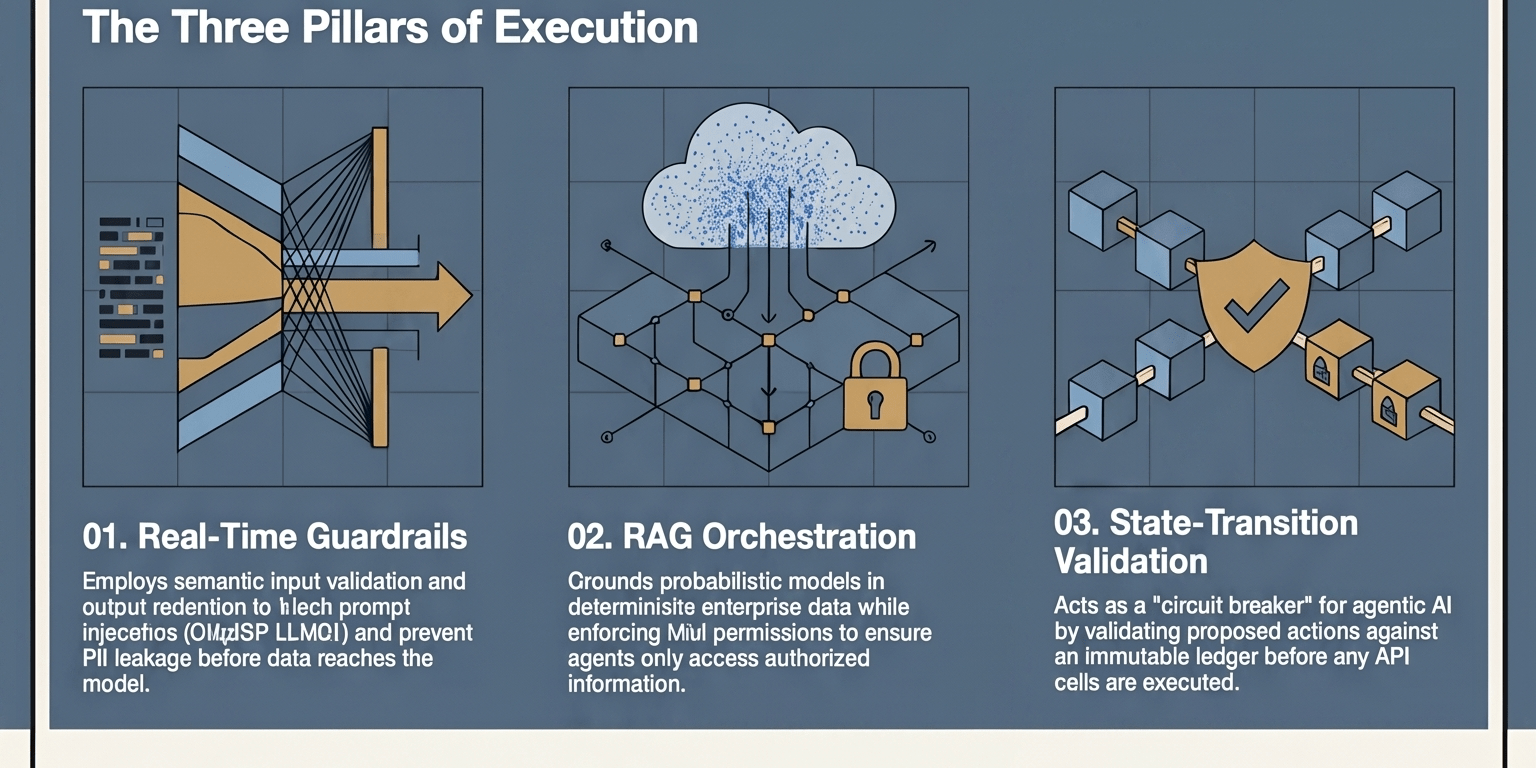
The operationalization of GaC relies on three distinct technical pillars that secure the model from adversarial manipulation, ground it in factual reality, and bound its autonomous capabilities.
3.2.1 Real-Time Prompt Filtering and Input/Output Guardrails
LLMs process system instructions and user data within the exact same context window, creating a fundamental architectural vulnerability known as prompt injection (classified as OWASP LLM01)15. Adversaries—or confused employees—can input commands that override system instructions, leading to data exfiltration, toxicity, or unauthorized actions.
Furthermore, advanced threats like Logic-layer Prompt Control Injection (LPCI) exploit persistent memory stores. LPCI payloads can be embedded in vector databases, remaining dormant across multiple sessions until conditionally activated, effectively bypassing conventional perimeter firewalls and SIEM platforms15.
Effective prompt filtering utilizes layered, continuous defenses:
- Pattern Matching & Regex: Fast, lightweight screening for known injection patterns (e.g., “ignore previous instructions”). While computationally inexpensive, regex is easily bypassed by sophisticated semantic attacks and often suffers from high false-positive rates that block legitimate user queries19.
- Semantic Input Validation: Utilizing smaller, specialized classifier models to analyze the semantic intent of a prompt. If the prompt attempts to force the model into a disallowed persona (e.g., a “jailbreak” or “DAN mode”), the gateway intercepts the payload and deterministically blocks it before it reaches the foundation model16.
- Output Validation & Redaction: Guardrails applied after generation but before the user receives the response. This includes hallucination detection, toxicity filtering, and PII redaction. For example, systems like Microsoft Presidio or Tonic Textual can identify and scrub sensitive data (like Social Security Numbers) to maintain HIPAA or PCI compliance before the data ever enters a vector database or is sent to a third-party LLM2.
3.2.2 RAG Orchestration and Grounding
Retrieval-Augmented Generation (RAG) grounds probabilistic language models in verified, deterministic enterprise data. Traditional RAG limits the LLM’s context to retrieved documents, drastically reducing hallucinations and improving factual consistency for use cases like financial research or medical clinical guidelines17.
However, as organizations scale, RAG has evolved into RAG Orchestration. This involves complex, multi-step pipelines where dynamic queries are rewritten, routed to specific vector databases based on strict user access controls, and ranked for semantic relevance using re-rankers18. GaC ensures that “shift-left” data governance is respected throughout this orchestration: an AI agent cannot retrieve, embed, or synthesize information from a highly classified document if the end-user initiating the prompt lacks the Identity and Access Management (IAM) permissions to view that original source2.
3.2.3 Automated State-Transition Validation
As enterprises deploy Agentic AI—systems capable of multi-step planning, tool usage, and workflow execution—the risk profile scales from erroneous text generation to autonomous, systemic action35. Probabilistic guardrails evaluating text outputs are wholly insufficient for autonomous agents operating enterprise software.
State-transition validation introduces a rigorous architectural “circuit breaker.” Solutions like the Exogram Action Admissibility Protocol (EAAP) treat the AI agent as fundamentally untrusted3. When an agent proposes an action (e.g., updating a patient record, issuing a refund, modifying a firewall rule), it must format its intent into a standardized payload. The GaC infrastructure layer validates this proposed state transition against an immutable set of operational constraints (an append-only ledger) before authorizing execution3. If the action violates policy or creates a state conflict, it is deterministically rejected, completely neutralizing the LLM’s probabilistic ability to make unwarranted inferences3.
3.3 Best Practices for Medium-to-Large Regulated Organizations
To successfully introduce GaC practices, regulated organizations must avoid bolting governance onto existing systems as an afterthought.
- Establish an AI Center of Excellence (CoE) & Steering Committee: Separate the roles of AI development and AI authorization. A cross-functional CoE—comprising legal, compliance, data engineering, and risk management personnel—must define the enterprise risk appetite, maintain the unified governance pipeline, and establish clear definitions of ownership for every deployed model38.
- Centralize Model Access via Gateways: Immediately ban decentralized, “shadow AI” usage. Route all enterprise AI traffic through centralized LLM gateways (e.g., LiteLLM, OpenAI Guardrails Registry) to ensure universal application of logging, PII redaction, and access controls, thereby maintaining audit visibility2.
- Adopt a “Shift-Left” Approach to Metadata: Ensure that the data feeding RAG systems is classified, scrubbed, and tagged for privacy regulations (GDPR, CCPA, HIPAA) before it is chunked and embedded into vector databases, preventing toxic or sensitive data from irrevocably poisoning the retrieval infrastructure20.
- Implement Token-Level Cost Tracking: For financial viability, LLMOps pipelines must track cost attribution per feature or team. A traditional ML model runs on fixed infrastructure, whereas LLM inference costs scale with token volume. A single inefficient prompt modification can double a monthly cloud bill overnight. Implementing state transitions like budget_paused ensures economic governance21.
3.4 Future Evolution: Theories and Experiments
The trajectory of GaC points toward highly decentralized, mathematically verifiable models, shifting away from heuristic approximations.
- Bayesian RAG for Epistemic Uncertainty: Current RAG systems provide point-estimate answers, meaning they cannot quantify their own uncertainty. In sectors like finance and healthcare, overconfident but incorrect answers carry massive liability. Theoretical frameworks like Bayesian RAG introduce probabilistic reasoning via Monte Carlo Dropout. This allows the system to quantify its epistemic uncertainty and deterministically decline to answer when statistical confidence thresholds are not met, reducing hallucinations in complex financial queries by up to 27.8%10.
- Cryptographic Agent-to-Agent (A2A) Protocols: As multiple AI agents begin interacting across organizational boundaries, centralized trust models will fail. Frameworks like BlockA2A propose using Decentralized Identifiers (DIDs) and Smart Contracts to cryptographically authenticate agent identities and validate task hand-offs on immutable ledgers, ensuring non-repudiation36.
- Deterministic SQL-Based Workflow Verification: Researchers are moving away from probabilistic evaluation of agent success (e.g., asking an LLM-as-a-judge if a task was completed) toward deterministic state validation. Testbeds like EntWorld use SQL queries to verify exact database state changes against enterprise schema constraints, enforcing rigorous, noise-free evaluation of agentic actions41.
- Compliance-as-Code Architectures (OSCAL for AI): To meet the demands of global regulations, organizations will adapt cybersecurity frameworks like the Open Security Controls Assessment Language (OSCAL) for AI. This allows for the automated generation of AI-Bill of Materials (AIBOMs) and transparency logs directly from the build pipeline, turning compliance into a machine-readable byproduct of model training5.
4. Hypothesis Testing and Research Findings
4.1 Hypothesis 1: Regional Popularity and Differing Strategic Benefits
- Hypothesis: “Governance as Code” practices are equally popular in North America and Europe, but likely for a different reason / set of benefits.
- Analysis: This hypothesis is partially supported with critical nuance.
- Findings: The overall implementation rate is comparable between the regions, but the depth, focus, and underlying catalysts are distinctly different. In Europe, the primary driver is existential legal and financial threat. The EU AI Act enforces its high-risk system obligations (Annex III) beginning August 2, 20266. This compels organizations to adopt Compliance as Code architecture to automate transparency logs, record-keeping, and conformity assessments under threat of maximum fines reaching €35 million or 7% of global turnover13. The estimated annual compliance cost per high-risk AI system is approximately €29,277, making manual compliance financially unsustainable13. The European focus is deeply rooted in systemic auditability, fundamental human rights, and data provenance4.
Conversely, North America operates in a highly fragmented regulatory landscape. While federal mandates like the NIST AI RMF provide excellent guidelines, they are generally voluntary or applied strictly to federal agency procurements24. Therefore, North American enterprises utilize GaC primarily for strategic market advantages: optimizing cloud computing costs, protecting intellectual property from extraction, mitigating cybersecurity risks (such as prompt injection and lateral movement), and defending brand reputation against hallucinated outputs4. Canada’s proposed Artificial Intelligence and Data Act (AIDA) represents a middle path, attempting to bridge US innovation velocity with EU regulatory stringency, though the lack of finalized legislation keeps Canadian organizations in a state of preparatory limbo1. The resulting transatlantic divergence means Europe excels in auditable logging and compliance workflows, while North America leads in performance optimization, cost-routing, and security-centric guardrails.
4.2 Hypothesis 2: Concentration in High-AI-Maturity Organizations
- Hypothesis: Some of these practices are only present in high-AI-maturity organizations.
- Analysis: This hypothesis is strongly supported by empirical data across multiple global benchmarking reports.
- Findings: Global benchmarking reveals a severe “proof gap.” While 60% of enterprises are attempting to scale AI across multiple departments, only 4% possess governance mechanisms mature enough to support that scale securely14. The fundamental differentiator of a high-maturity organization is the transition from manual, document-driven oversight to automated, CI/CD-integrated GaC. Organizations attempting to scale AI using manual ethics committees and ad-hoc risk assessments experience severe operational bottlenecks, leading to unauthorized “Shadow AI” adoption and stalled pilot programs40.
High-maturity organizations treat GaC as a scaling mechanism rather than a speed bump. They build reusable, permanent technical infrastructure—such as centralized model registries, automated LLM evaluation pipelines, and deterministic state-validation—which allows them to maintain AI projects in production for three years or more at twice the rate of low-maturity peers11. Furthermore, Grant Thornton data indicates that organizations with fully integrated, code-level governance are nearly four times more likely to report tangible AI-driven revenue growth (58% vs 15%), and 74% are highly confident they could pass an independent AI audit, compared to 0% of early-stage explorers12. McKinsey further corroborates this, noting that organizations assigning clear ownership to AI governance teams and investing heavily in Responsible AI (RAI) exhibit the highest maturity levels and EBIT impact39.
4.3 Hypothesis 3: The Correlation Between Adoption and AI Capability Debt
- Hypothesis: Adoption of these “Governance as Code” practices is highly related to organizational AI Capability Debt.
- Analysis: This hypothesis is strongly supported. The absence of Governance as Code is the primary accelerant of AI Capability Debt, and its adoption is the only sustainable remediation strategy.
- Findings: AI Technical Debt (or AI Capability Debt) differs fundamentally from traditional software debt. It compounds non-linearly because AI systems generate massive volumes of code, autonomous actions, and interrelated data pipelines that lack inherent architectural discipline7. A Forrester survey found that 75% of technology decision-makers expect their organizations to reach a severe technical debt burden by 2026, driven directly by ungoverned AI adoption7.
Without programmatic GaC guardrails, organizations rapidly accumulate several distinct, compounding forms of debt:
- Observability Debt: A lack of semantic tracing and runtime validation in the pipeline leaves IT teams completely blind. When an AI agent fails or an LLM degrades over time, teams cannot trace the context assembly or tool call sequence to explain why it made a specific decision7.
- Prompt Debt: Relying on undocumented, unversioned prompt engineering rather than treating prompts as version-controlled code artifacts leads to highly fragile systems. A prompt that works today may fail silently when a cloud provider updates their foundation model7.
- Consistency & GIST Debt (Generated, Inferred, Stored, and Transferred): AI coding assistants accelerate development speed but introduce subtle flaws. Analysis of over 300,000 AI-authored commits shows they introduce 1.7x more issues than human-written code, with 89.3% classified as long-term “code smells”7. Furthermore, 43% of AI-generated code requires manual debugging in production8.
GaC acts as a vital forcing function to arrest the accumulation of AI Technical Debt. By requiring strict modularity, automated evaluation gates in the CI/CD pipeline, and deterministic execution boundaries, GaC ensures that AI speed does not come at the expense of system reliability or long-term architectural stability45.
5. Strategic Actions for Progressive Organizations
For senior leaders in high-maturity organizations seeking to maintain a competitive advantage, future-proof their architecture against emerging regulations, and safely deploy multi-agent systems, the following actions are imperative:
- Transition from Output Moderation to “Execution Governance”: Evolve beyond simple input/output prompt filtering. Implement infrastructure-level interception protocols (such as the Exogram EAAP) that validate proposed agentic state transitions against a deterministic, append-only ledger. Adopt a strict “No Log = No Action” interlock for all autonomous operations to guarantee forensic auditability3.
- Deploy Bayesian Frameworks for High-Stakes RAG Systems: In finance, legal, and healthcare applications, upgrade traditional RAG orchestration to Bayesian RAG. By quantifying the epistemic uncertainty of the retrieved information, the system can dynamically trigger human-in-the-loop workflows when statistical confidence falls below acceptable thresholds, drastically reducing regulatory liability10.
- Implement Advanced Agent-to-Agent (A2A) Telemetry: Prepare for an ecosystem of interacting, cross-domain agents by standardizing task states (e.g., input_required, budget_paused, delegated). Ensure that cancellation requests cascade deterministically through delegation chains to prevent orphaned sub-agents from consuming cloud compute or executing unauthorized workflows37.
- Operationalize the “Compliance as Code” Architecture: Anticipate global regulatory convergence by adopting standardized, machine-readable compliance schemas (like OSCAL adapted for AI). Automate the generation of AI-Bill of Materials (AIBOMs), transparency logs, and continuous conformity assessments directly from the deployment pipeline, transforming compliance from a manual burden into an engineering byproduct5.
6. Remediation Actions for Organizations Falling Behind
For leaders whose organizations are trapped in continuous pilot phases, suffocating under manual governance constraints, or blindly accumulating compounding AI technical debt, immediate and aggressive remediation is required:
- Eradicate “Shadow AI” via Centralized Gateways: Employees utilizing unapproved, consumer-grade AI tools or embedding third-party APIs into workflows pose a massive cybersecurity, privacy, and intellectual property threat23. Immediately deploy an enterprise API gateway or proxy layer to centralize, monitor, and filter all outbound prompts and inbound responses across the entire organization2.
- Establish a Cross-Functional AI Center of Excellence (CoE): Move AI governance out of siloed IT or legal departments. Form a lean, operational CoE to standardize prompt versioning, mandate strict input validation (preventing OWASP LLM01 Prompt Injections), and establish clear definitions of ownership and accountability for every deployed model15.
- Shift from Policy Documents to Pipeline Constraints: Stop attempting to manage AI risk via static PDFs and ethics statements. Begin translating data privacy rules (e.g., GDPR, CCPA, HIPAA) into executable code that actively redacts PII before it hits the vector database or foundation model, ensuring privacy by design2.
- Audit for Imminent Regulatory Deadlines: For any entity interacting with or serving the European market, conduct an immediate risk classification audit against Annex III of the EU AI Act. Determine which internal systems qualify as “high-risk” (e.g., HR screening, credit scoring, critical infrastructure management) and rapidly build the required Quality Management Systems (QMS) and logging infrastructure ahead of the strict August 2026 enforcement cliff6.
- Institute Token and Cost Telemetry: Implement strict, token-level cost tracking within your CI/CD and deployment pipelines. Treat infrastructure cost as a primary evaluation metric for any LLM deployment to prevent non-linear budget explosions driven by inefficient prompts, runaway agentic loops, or unmonitored vendor dependencies8.
7. Complete List of Sources
Works cited
- Frontiers – Information Matters, https://informationmatters.org/category/frontiers/
- Compliance as Code: Why the EU AI Act Will Force Runtime Enforcement in 2026, https://dev.to/ottoplane/compliance-as-code-why-the-eu-ai-act-will-force-runtime-enforcement-in-2026-io6
- AI Governance FAQ | Common Questions Answered – Exogram AI, https://exogram.ai/answers
- Global AI Governance Frameworks A Comparative Study, https://ai.gov.eg/SynchedFiles/en/Resources/Global%20AI%20Governance%20Frameworks%20A%20Comparative%20Study.pdf
- Making AI Compliance Evidence Machine-Readable – arXiv, https://arxiv.org/html/2604.13767v1
- The EU AI Act: What Energy Executives Should Know Before August 2026 – Baker Botts, https://www.bakerbotts.com/thought-leadership/publications/2026/march/the-eu-ai-act
- AI Technical Debt: What It Is. Why It Compounds. How to Control It. – Coderio, https://www.coderio.com/blog/software-development/ai-technical-debt-what-is-why-compounds-how-control/
- AI Technical Debt: The Hidden Cost, Can You Feel it? – STEP Software, https://www.stepsoftware.com/ai-technical-debt-the-hidden-cost-can-you-feel-it/
- Debt Behind the AI Boom: A Large-Scale Empirical Study of AI-Generated Code in the Wild, https://arxiv.org/html/2603.28592v2
- Bayesian RAG: uncertainty-aware retrieval for reliable financial question answering – PMC, https://pmc.ncbi.nlm.nih.gov/articles/PMC12886353/
- The first AI use case: Infrastructure or technical debt? | Deloitte Luxembourg, https://www.deloitte.com/lu/en/our-thinking/future-of-advice/first-ai-use-case.html
- 2026 AI Impact Survey Report | Grant Thornton, https://www.grantthornton.com/services/advisory-services/artificial-intelligence/2026-ai-impact-survey
- EU AI Act Compliance Readiness: 2024 Statistics | FluxForce, https://www.fluxforce.ai/statistics/ai-act-compliance-readiness
- The State of AI Governance Report 2026 – Credo AI, https://www.credo.ai/downloadsopen/the-state-of-ai-governance
- Detecting Prompt Injection Attacks in Generative AI Systems: A Hybrid SIEM and One-Class SVM Framework – MDPI, https://www.mdpi.com/2079-9292/15/11/2242
- What Is Prompt Injection? – PurpleSec, https://purplesec.us/resources/ai-security-glossary/prompt-injection/
- From RAG to multi-agent systems: how enterprise AI is evolving beyond better answers, https://www.selectgroup.com/blog/from-rag-to-multi-agent-systems-how-enterprise-ai-is-evolving-beyond-better-answers
- RAG Orchestration Services Guide | 2026 Guide – Leanware, https://leanware.co/insights/rag-orchestration-services
- From Prompt to Policy: How LLM Guardrails Work in Practice – Lumenova AI, https://www.lumenova.ai/blog/llm-guardrails-prompt-to-policy/
- Tonic Textual + Haystack Integration: PII-Safe RAG Pipelines | Blog, https://www.tonic.ai/blog/tonic-textual-haystack-integration
- The Roadmap for Mastering LLMOps in 2026 – MachineLearningMastery.com, https://machinelearningmastery.com/the-roadmap-for-mastering-llmops-in-2026/
- LLMOps vs MLOps: What CTOs Need to Compare – KGT Solutions, https://kgt.solutions/resources/blog/llmops-vs-mlops-what-ctos-need-to-compare
- 9 Key Risks of AI Adoption in State & Local Government – MGO CPA, https://www.mgocpa.com/perspective/ai-adoption-state-local-government-risks-controls-compliance/
- PASTA: A Scalable Framework for Multi-Policy AI Compliance Evaluation – arXiv, https://arxiv.org/html/2601.11702v2
- Adopting and governing AI in government: Digital Government Outlook 2026 – OECD, https://www.oecd.org/en/publications/digital-government-outlook_0496b2bc-en/full-report/adopting-and-governing-ai-in-government_7ef312a9.html
- The EU AI Act compliance readiness: evidence on organisational preparedness, cost drivers and regulatory uncertainty – ResearchGate, https://www.researchgate.net/publication/404731975_The_EU_AI_Act_compliance_readiness_evidence_on_organisational_preparedness_cost_drivers_and_regulatory_uncertainty
- EU AI Act High-Risk Deadline: Enterprise Readiness Gap – Lab Space, https://labs.cloudsecurityalliance.org/research/csa-research-note-eu-ai-act-high-risk-compliance-deadline-20/
- Integration of the Automated AI-Act Compliance & Reporting Framework (ACRF) #1097, https://github.com/ossf/wg-best-practices-os-developers/issues/1097
- EU AI Act Compliance & Readiness | Elevate Consult, https://elevateconsult.com/solutions/cyber-security-compliance/eu-ai-act-compliance-readiness/
- Computational Governance: Metadata-Powered Automation for Data & AI Teams in 2025, https://atlan.com/know/data-governance/computational-governance/
- LLMOps — CI/CD, Eval Gates & LLM Deployment (2026) | MyEngineeringPath, https://myengineeringpath.dev/genai-engineer/llmops/
- Logic-layer Prompt Control Injection (LPCI): A Novel Security Vulnerability Class in Agentic Systems – arXiv, https://arxiv.org/html/2507.10457v1
- LLM Guardrails in Production: Input, Output, and Runtime Checks That Actually Work, https://www.kalviumlabs.ai/blog/guardrails-for-llm-applications/
- Guardrails for LLMs | Comprehensive Guide to Safe and Responsible AI Deployment, https://medium.com/@nisarg.nargund/guardrails-for-llms-comprehensive-guide-to-safe-and-responsible-ai-deployment-7b12e8790fc5
- Is Your AI Governance Framework 2026 Ready For New Standards – Samta.ai, https://samta.ai/blogs/ai-governance-framework-2026
- BlockA2A: Towards Secure and Verifiable Agent-to-Agent Interoperability – arXiv, https://arxiv.org/pdf/2508.01332
- [FEATURE] Support for Full A2A Task Lifecycle States (especially input_required) · Issue #1371 · strands-agents/harness-sdk – GitHub, https://github.com/strands-agents/sdk-python/issues/1371
- AI Governance Framework: Build AI Oversight in 2026 | The Thinking Company, https://thinking.inc/en/pillar-pages/ai-governance-framework/
- State of AI trust in 2026: Shifting to the agentic era – McKinsey, https://www.mckinsey.com/capabilities/tech-and-ai/our-insights/tech-forward/state-of-ai-trust-in-2026-shifting-to-the-agentic-era
- The New Legal Risk Isn’t AI Adoption—It’s AI Without Governance | Brownstein, https://www.bhfs.com/insight/the-new-legal-risk-isnt-ai-adoption-its-ai-without-governance/
- EntWorld: A Holistic Environment and Benchmark for Verifiable Enterprise GUI Agents, https://arxiv.org/html/2601.17722v1
- AI Governance for GenAI Risk Management 2026 – Samta.ai, https://samta.ai/blogs/ai-governance-for-genai
- New Global Report: Executive Insights on AI Strategy, Risks, and Readiness, https://erm.ncsu.edu/resource-center/new-global-report-executive-insights-on-ai-strategy-risks-and-readiness/
- AI Governance – Information Matters, https://informationmatters.org/tag/ai-governance/
- The hidden technical debt of AI: Why manual governance is slowing down your AI scale, https://www.collibra.com/blog/the-hidden-technical-debt-of-ai-why-manual-governance-is-slowing-down-your-ai-scale
- AI Productivity vs. Technical Debt: An Engineering View | Vention, https://ventionteams.com/blog/ai-productivity-vs-technical-debt
- AI technical debt: What it is — and why it matters | RL Blog – Reversing Labs, https://www.reversinglabs.com/blog/ai-technical-debt
- Best LLMOps Platforms for Scaling Generative AI – Galileo AI, https://galileo.ai/blog/best-agent-observability-platforms-scaling-generative-ai
- AI fuels a new wave of technical debt – InformationWeek, https://www.informationweek.com/it-strategy/ai-fuels-a-new-wave-of-technical-debt
- Why We Built a Moral Blockchain: The TML Architecture Overview. – Medium, https://medium.com/@leogouk/why-we-built-a-moral-blockchain-the-tml-architecture-overview-60569110d798
The idea, research hypotheses, and focus for this article/research are all original and mine. This article was written with my brain and two hands with the assistance of Google Gemini, Notebook LM, Claude, and other wondrous toys.

