Executive Summary
The rapid integration of artificial intelligence (AI) into the core operational architectures of regulated organizations across North America and Europe has precipitated a fundamental transformation in enterprise risk management. The transition from deterministic software systems to probabilistic, autonomous machine learning models renders legacy governance frameworks obsolete. Based on a comprehensive analysis of cross-industry practices, financial impacts, and evolving regulatory regimes—encompassing the financial, insurance, healthcare, pharmaceutical, education, legal, government, and nonprofit sectors—this report evaluates the imperative shift from traditional compliance methodologies to progressive, integrated AI governance strategies.
Key Insights:
First, a pronounced bifurcation has emerged in the global market between organizations treating AI governance as a defensive, reactive compliance exercise and those leveraging it as a proactive catalyst for business reinvention. Governance is no longer viewed by market leaders solely as a peripheral legal function; it is the foundational infrastructure required to safely scale AI initiatives, manage compounding model risks, and realize compounding financial returns.
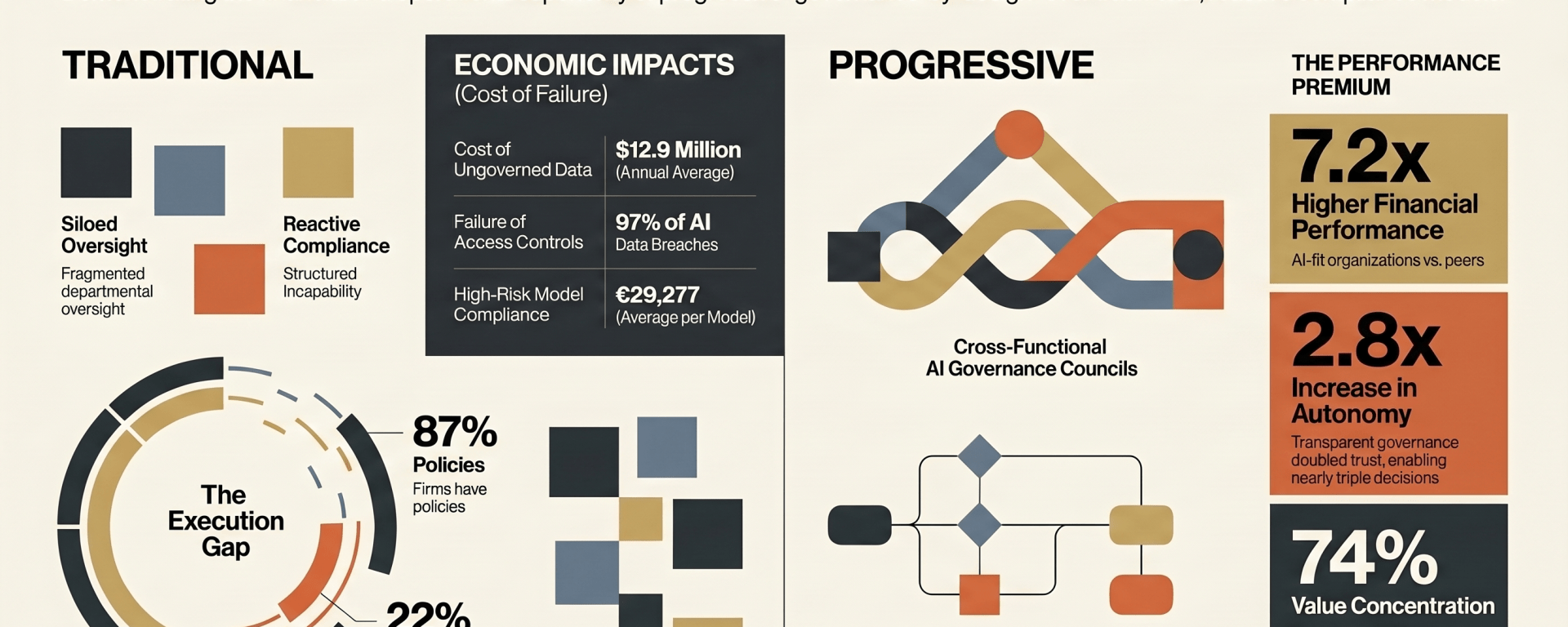
Second, traditional governance frameworks—characterized by highly siloed departmental oversight, reactive risk management, and post-hoc point-in-time auditing—are structurally incapable of managing the dynamic nature of generative and agentic AI. Progressive organizations have rapidly shifted toward “governance-by-design,” embedding cross-functional AI councils, continuous algorithmic testing, and automated compliance directly into the machine learning lifecycle (LLMOps).
Third, an alarming accumulation of “compliance debt” is occurring across resource-constrained regulated sectors, most notably within education and nonprofit organizations. A profound chasm exists between the theoretical demands of global standards (such as ISO/IEC 42001) and the practical realities of implementation, forcing organizations to adopt superficial policy documents that will invariably fail under strict regulatory scrutiny or algorithmic audits.
Fourth, international regulatory focus has explicitly shifted away from merely evaluating AI tool accuracy to forensically evaluating the lifecycle governance of the tool itself. Regulatory bodies—including the United States Food and Drug Administration (FDA), the European Medicines Agency (EMA), Canada’s Office of the Superintendent of Financial Institutions (OSFI), and the European Union—are increasingly holding executive leadership and corporate boards legally accountable for algorithmic traceability, outcome fairness, data provenance, and continuous human oversight.
Fifth, while the foundational principles of trustworthy AI—transparency, accountability, and safety—remain consistent globally, the operational execution of progressive governance is highly divergent based on industry sector and geographic jurisdiction. Frameworks range from the strict, risk-tiered conformity assessments mandated by the European Union Artificial Intelligence Act to the flexible, dialogue-driven compliance pathways favored by North American federal regulators.
Key Statistics and Metrics:
- Value Concentration: Approximately 74% of the economic value generated by enterprise artificial intelligence is currently captured by just 20% of organizations, revealing a widening financial divide between AI leaders and laggards.1
- The Performance Premium: Organizations recognized as “AI-fit”—defined as those possessing robust governance, strategic alignment, and data foundations—achieve AI-driven financial performance 7.2 times higher than their industry peers.1
- The Execution Gap: While 87% of regulated organizations claim to have formal AI governance policies in place, a mere 22% report that these systems operate effectively in practice, and only 33% possess defined escalation pathways for algorithmic misbehavior.2
- Compliance Overhead Economics: The total annual compliance cost for a single high-risk AI model under the EU AI Act averages €29,277. Robustness and accuracy requirements represent the largest single expense category at €10,733 per model, with human oversight obligations adding an additional €7,764.4
- The Cost of Inaction: The baseline cost of ungoverned data and failed technological processes averages $12.9 million annually for large enterprises. This figure excludes data breach costs, which average $9.36 million per incident in the United States.5
- Resource and Certification Disparity: Achieving formal ISO/IEC 42001 certification for AI governance costs between $30,000 and $108,000. This creates an insurmountable barrier for public sectors such as education, where certification costs significantly exceed the national average annual salary of a teacher ($74,177).6
- Trust and Output Utilization: Employees operating under progressive, transparent governance frameworks are twice as likely to trust AI outputs, enabling their organizations to increase the volume of fully autonomous decisions by 2.8 times.1
- Access Control Failures: A staggering 97% of organizations that have fallen victim to AI-related data breaches lacked proper access controls, highlighting that enforcement—not mere policy creation—remains the most significant vulnerability in enterprise AI.8
2. Quantitative Summary: Cost, Impact, and Value
Evaluating the financial dynamics of artificial intelligence governance requires a holistic calculus that incorporates the upfront costs of progressive practices, the avoidance of catastrophic regulatory risks, and the compounding value generated by scalable, trustworthy AI systems. The empirical data strongly indicates that organizations attempting to bypass or minimize governance costs ultimately incur vastly higher expenses through unmanaged technical debt, abandoned pilot programs, severe regulatory fines, and missed strategic market opportunities. The highest financial returns accrue exclusively to entities that integrate responsible AI practices deeply into their core enterprise architecture.
To contextualize these financial and operational dynamics, the following tables quantify the implementation costs, risk avoidance impacts, and strategic value creation metrics associated with progressive AI governance across North America and Europe.
Table 1: North America – Cost, Impact, and Value of Progressive AI Governance
| Regulated Industry | Progressive Governance Implementation Costs | Risk Avoidance & Traditional Failure Costs | ROI & Strategic Value Creation |
| Financial Services & Fintech | Significant operational investment is required to implement Canada’s OSFI Guideline E-23 by 2027, necessitating multi-disciplinary teams and enterprise-wide AI model inventories.9 | Mitigates the $12.9M average annual cost of ungoverned data and prevents regulatory lock-out from algorithmic credit scoring.5 | “AI-fit” financial institutions achieve up to a 7.2x performance premium; enables safe, scaled deployment of autonomous underwriting.1 |
| Healthcare & Pharma | Building mission-ready enterprise AI platforms ranges from $500,000 to $2M+. AI software demands a 3x implementation and 6x five-year operational budget multiplier.11 | Avoids catastrophic $9.36M average US breach costs and severe medical malpractice liability stemming from undocumented AI diagnostic errors.5 | Governed oncology data foundations generate over $50M in new value potential; centralized AI hubs drive a 7% increase in patient satisfaction.1 |
| Insurance | High ongoing costs to establish board-level AI oversight, inventory AI systems, and conduct third-party algorithmic auditing per NAIC Model Bulletin standards.14 | Eliminates the risk of systemic underwriting bias, preventing costly class-action discrimination litigation and state-level regulatory sanctions.14 | Progressive governance allows insurers to accelerate claims processing safely; leaders are 2.6x more likely to successfully reinvent core business models.1 |
| Education | Formal ISO/IEC 42001 certification is highly cost-prohibitive ($30,000 to $108,000). Implementing “ISO-aligned readiness” requires internal staff reallocation.6 | Prevents the accumulation of severe “compliance debt” and undocumented liability under FERPA when deploying automated proctoring or admissions AI.6 | Transparent governance builds community trust, enabling the safe integration of generative AI for personalized student learning without full certification costs.6 |
| Government | Heavy financial requirements to secure sovereign AI infrastructure, achieve FedRAMP authorizations, and mandate continuous monitoring controls.9 | Prevents the deployment of biased automated decision-making tools, protecting fundamental rights and avoiding the catastrophic loss of civic trust.18 | Drives massive administrative efficiency gains in public service delivery; redirects operating spending toward domestic technological innovation.9 |
| Legal | Investment required for secure SOC 2/ISO 27001 verified AI tools, continuous CLE training for attorneys, and purpose-built legal LLMOps frameworks.20 | Protects against ABA confidentiality violations, the waiver of attorney-client privilege, and judicial sanctions resulting from unverified AI hallucinations.20 | Firms demonstrating robust AI governance negotiate superior cyber liability insurance rates and secure trust from high-value corporate clients.21 |
| Nonprofit | Extremely limited IT budgets restrict the procurement of enterprise-grade AI governance software, necessitating manual policy enforcement and literacy training.6 | Prevents the accidental exposure of highly sensitive donor data and avoids generating “hallucinated” fundraising materials that damage organizational credibility.23 | Ethical AI frameworks enable nonprofits to safely automate routine data entry and grant reporting, redirecting limited human capital toward mission impact.24 |
Table 2: Europe – Cost, Impact, and Value of Progressive AI Governance
| Regulated Industry | Progressive Governance Implementation Costs | Risk Avoidance & Traditional Failure Costs | ROI & Strategic Value Creation |
| Financial Services & Fintech | EU AI Act compliance for a high-risk system averages €52,000 annually. Quality Management Systems (QMS) require a €20k-€80k initial build cost.4 | Directly mitigates exposure to EU AI Act fines of up to €35M or 7% of global turnover; prevents total regulatory market exclusion.4 | Standardized governance accelerates cross-border EU product launches; progressive banks are twice as likely to re-engineer workflows around trusted AI.1 |
| Healthcare & Pharma | Strict clinical validation and conformity assessments drive healthcare AI compliance costs 20% to 30% higher than baseline industrial averages.4 | Avoids EMA regulatory market delays; mitigates catastrophic patient safety risks associated with unregulated “black-box” clinical algorithms.12 | The EMA’s risk-tiered structure provides a highly predictable path to market, accelerating clinical trials while ensuring robust post-market surveillance.12 |
| Insurance | Significant investment is necessary to align with EIOPA guidelines, focusing heavily on data lineage, bias detection, and rigorous vendor data management.27 | Prevents downgrades in Fitch Ratings for enterprise risk governance; avoids uninsurable liabilities stemming from unregulated algorithmic pricing.28 | Insurers with mature AI governance absorb incoming regulatory demands with minimal operational disruption, strengthening balance sheets and competitive positioning.28 |
| Education | High costs associated with systemic compliance testing and documentation; external audits contribute up to 25% of recurring compliance overhead.4 | Educational AI systems face strict August 2026 EU AI Act enforcement deadlines; failure to comply results in complete removal from the market.4 | Human-in-the-loop governance fosters parent and student trust, ensuring that algorithmic pathways maintain equitable access to educational resources.6 |
| Government | Bureaucratic costs associated with establishing independent public oversight bodies and mandating pre-deployment certifications for public sector AI systems.18 | Avoids systemic algorithmic discrimination in judicial, migration, and public service delivery systems, protecting European fundamental human rights.18 | European standardized governance frameworks often become the global regulatory baseline (the “Brussels Effect”), creating distinct local economic and trade advantages.18 |
| Legal | Substantial operational workload increases (estimated at 15% to 20% annually) to maintain continuous risk assessments and update algorithmic documentation.4 | Protects strict European data privacy standards (GDPR) against the unauthorized scraping and external processing of highly sensitive client information.20 | Robust governance enables law firms to safely scale multi-language document review and complex cross-border regulatory analysis across EU member states.20 |
| Nonprofit | SMEs and smaller charities face proportionally higher financial burdens, frequently requiring 1-2 full-time employees solely dedicated to compliance efforts.4 | Protects highly vulnerable beneficiary populations from data exploitation; ensures algorithmic outputs align strictly with ethical charters.25 | Demonstrated ethical AI use enhances organizational credibility, facilitating access to institutional donors and EU funding bodies that mandate responsible tech development.25 |
The quantitative reality highlighted across these sectors is that AI governance is fundamentally a capital investment rather than a compliance tax. While the absolute cost of progressive governance is significant—particularly the continuous operational expenses of conformity assessments and documentation—it is eclipsed by the direct penalties of failure. Global enterprise spending on AI governance and compliance is projected to reach $2.54 billion by 2026 and surge to $8.23 billion by 2034.32 This trajectory underscores a resolute market consensus: the financial mechanics of artificial intelligence unequivocally favor organizations that treat governance as an integrated, strategic enabler.
3. Specific AI Governance and Regulatory Management Best Practices
To translate high-level governance theories into operational realities, progressive organizations adopt specialized, industry-specific frameworks. While mechanisms such as cross-functional AI councils and unified enterprise model inventories are universally required, the specific emphasis of governance controls shifts drastically depending on the regulatory environment, geographic jurisdiction, and the societal impact of the industry in question.
Table 3: North America – Progressive AI Governance Best Practices by Industry
| Regulated Industry | Specific Progressive AI Governance Best Practices |
| Financial Services | Enterprise Model Risk Management (MRM): Full implementation of Canada’s OSFI Guideline E-23, requiring multi-disciplinary governance teams, enterprise model inventories tracking third-party AI, and proportional risk-tiering.9 Algorithmic Bias Testing: Rigorous screening for discriminatory outcomes when using alternative data for credit scoring.10 |
| Healthcare & Pharma | Lifecycle FDA Alignment: Shifting oversight from point-in-time accuracy metrics to continuous lifecycle management, tracking model performance across diverse populations.33 Minimum Viable Data Gates: Restricting AI inputs strictly to essential health information to minimize HIPAA exposure. Clinical Human-in-the-Loop (HITL): Mandating physician override capabilities.17 |
| Insurance | NAIC Model Bulletin Alignment: Establishing board-level accountability for AI across utilization management, claims, and underwriting.14 Vendor Contract Auditing: Demanding strict audit rights, data provenance tracking, and regulatory cooperation obligations in all third-party AI vendor agreements.14 |
| Education | ISO-Aligned Readiness: Adopting the core deployer-relevant controls of ISO/IEC 42001 (documented human oversight, vendor risk management) without incurring the prohibitive costs of formal third-party certification.6 AI Sandboxing: Designing stringent data access controls to protect student privacy under FERPA and COPPA.6 |
| Government | Directive on Automated Decision-Making: Implementing algorithmic impact assessments, providing plain-language explanations of AI-driven administrative decisions, and ensuring procedural fairness.19 Sovereign Infrastructure Procurement: Deploying secure, made-in-Canada or FedRAMP-authorized AI tools to ensure strict national data sovereignty.9 |
| Legal | Zero-Trust Architecture & SOC 2 Mandates: Enforcing strict technological vetting of AI vendors, verifying data retention policies, and ensuring client data is not utilized for external LLM training.21 Output Verification Protocols: Establishing rigid internal policies that demand independent attorney verification of all AI-generated case law.20 |
| Nonprofit | AI Ethics Committees: Forming dedicated oversight groups to ensure AI implementations directly align with the organizational mission.25 Continuous AI Literacy Training: Providing staff training on responsible AI use, hallucination detection, and the ethical implications of automated donor outreach.24 |
Table 4: Europe – Progressive AI Governance Best Practices by Industry
| Regulated Industry | Specific Progressive AI Governance Best Practices |
| Financial Services | EU AI Act Quality Management Systems (QMS): Building comprehensive infrastructures that include documented risk management systems, ongoing conformity assessments, and rigorous training data quality checks to prevent high-risk bias.4 Proactive ESMA Alignment: Monitoring AI-driven conflicts of interest in investor-facing applications.10 |
| Healthcare & Pharma | EMA Risk-Tiered Development: Utilizing highly structured, regulated pathways for AI drug discovery and clinical trial ‘digital twins’.12 High-Risk Conformity Assessments: Conducting mandatory third-party audits before deploying AI in diagnostic settings, ensuring maximum patient safety, robustness, and cybersecurity.4 |
| Insurance | EIOPA Governance Frameworks: Establishing transparent, traceable processes for underwriting algorithms, emphasizing data lineage documentation and the management of vendor-provided data sets.28 Explainability Engineering: Building AI systems capable of mathematically justifying pricing and claims decisions to regulators.15 |
| Education | High-Risk Categorization Management: Implementing strict systemic controls for educational AI systems (used for assessment or admissions pathways) as mandated by the EU AI Act.6 Ethical Usage Guidelines: Deploying the European Commission’s practical guidelines for teachers to ensure critical AI literacy and GDPR-compliant integration.29 |
| Government | Pre-Deployment Certification: Establishing independent public oversight bodies to issue mandatory certifications for high-risk governmental AI deployments (e.g., biometrics, border migration).18 Incident Reporting Frameworks: Aligning with OECD common reporting frameworks to standardize the tracking of public sector AI incidents.37 |
| Legal | Runtime Guardrails: Implementing continuous, real-time enforcement mechanisms that restrict AI tool permissions, filter policy-violating outputs, and redact sensitive client data before it interacts with external language models.34 Algorithmic Transparency Registers: Maintaining detailed logs of how and when AI is utilized to support legal arguments.38 |
| Nonprofit | Interoperable Compliance Mapping: Aligning organizational AI use with the Partnership on AI’s best practices, ensuring limited resources are focused on high-impact ethical controls.25 Human-Centric Design Principles: Mandating human review of both AI inputs and outputs to safeguard vulnerable beneficiary populations.39 |
4. Traditional Governance vs. Progressive Regulatory Management: A Structural Analysis
The evolution from traditional to progressive governance is fundamentally a shift in how organizations conceptualize and manage technological risk. Traditional regulatory management practices were architected during the era of deterministic software systems. In a deterministic environment, software code is static; specific data inputs reliably produce predictable, hard-coded outputs. Governance within this paradigm naturally relies on point-in-time auditing, static compliance checklists, and highly siloed departmental oversight. Information technology teams manage system deployments, legal teams review vendor contracts, and compliance teams assess regulatory alignment only prior to major software releases. This fragmented approach treats governance as a rigid gatekeeping function, often implemented at the very end of the technology lifecycle.
When applied to artificial intelligence—specifically generative large language models (LLMs) and autonomous agentic AI—traditional governance models fail catastrophically. Artificial intelligence systems are fundamentally probabilistic; they continuously learn, experience data drift, and generate novel outputs based on evolving data inputs and environmental interactions. A static, post-hoc audit cannot capture the continuous behavioral shifts of a machine learning model interacting with live enterprise data.
Furthermore, traditional governance treats data privacy, cybersecurity, and algorithmic bias as distinct, separate domains. In AI systems, these risks intersect simultaneously. For example, a healthcare AI analyzing unstructured clinical records could simultaneously hallucinate a false diagnosis (an accuracy and safety risk), inadvertently memorize and expose sensitive patient data in its output (a privacy and security risk), and recommend treatments based on skewed historical demographics (a bias and ethical risk). Managing these intersecting, continuous risks through siloed departments results in either operational paralysis or massive undocumented corporate liability.40
Progressive AI governance represents a paradigm shift toward “governance-by-design.” Instead of retrofitting compliance onto deployed systems, progressive practices embed oversight mechanisms directly into the continuous integration and continuous deployment (CI/CD) pipelines of machine learning models—a practice broadly defined as LLMOps or MLOps. This modern approach relies heavily on the establishment of Cross-functional AI Governance Councils. These councils unify technical engineering, legal, compliance, ethics, and business leadership into a single, cohesive oversight body, ensuring that risk identification aligns seamlessly with strategic business objectives from the point of ideation.31
A hallmark of progressive governance is the implementation of Tiered Risk Frameworks. Rather than applying uniform, burdensome controls to every AI initiative, progressive organizations classify AI use cases based on their potential to cause harm. Low-risk applications, such as internal document summarization or generic code generation, are allowed to scale rapidly with minimal friction. Conversely, high-risk systems, such as automated credit scoring, border control biometrics, or clinical diagnostic tools, trigger rigorous testing, mandatory Human-in-the-Loop (HITL) oversight, and extensive documentation requirements.43 This proportionality prevents governance from stifling innovation while fiercely protecting the organization from catastrophic regulatory failures.
Furthermore, progressive models recognize that AI governance extends beyond technical control into core data strategy. The concept of the “minimum viable data” gate is increasingly adopted by leading organizations. Rather than indiscriminately feeding an AI model the maximum available enterprise data, this practice strictly limits data inputs to only what is absolutely necessary to achieve the desired output. This fundamentally reduces the attack surface for data breaches, limits the model’s ability to memorize proprietary information, and drastically reduces privacy violations.35 Coupled with continuous monitoring systems that automatically detect model drift and flag statistical anomalies in real-time, progressive governance transforms compliance from a static defense mechanism into an agile, strategic enabler of autonomous decision-making.
The differences between these paradigms dictate an organization’s ability to survive the impending wave of global regulation. Frameworks such as the European Union’s Artificial Intelligence Act, Canada’s upcoming Artificial Intelligence and Data Act (AIDA) successor, and the evolving guidelines from the United States Food and Drug Administration explicitly demand continuous lifecycle management, data provenance tracking, and systemic accountability. Traditional governance cannot provide the requisite auditability or traceability, leaving organizations exposed to fines that, under the EU AI Act, can reach up to €35 million or 7% of global annual turnover.4 Conversely, progressive governance naturally generates the artifacts, logs, and oversight required to satisfy regulators, thereby converting compliance from an overhead cost into a competitive moat.
5. Hypothesis Testing and Research Findings
This report evaluates four central hypotheses regarding the state of AI governance, utilizing empirical data, regulatory guidelines, and enterprise case studies to determine their validity and strategic implications.
Hypothesis 1: Using progressive AI governance and regulatory management practices results in significantly higher effectiveness, lower costs, and lower risks.
Finding: Strongly Supported. The research unequivocally supports the hypothesis that progressive AI governance yields superior operational and financial outcomes compared to traditional methods. Organizations that invest heavily in robust governance foundations are not merely protecting themselves from regulatory fines; they are unlocking exponential enterprise value. According to PwC’s 2026 AI Performance Study, AI leaders who combine advanced automation with strong governance and trust architectures generate an AI-driven financial performance premium that is 7.2 times higher than their industry peers.1 By establishing clear, transparent guardrails, employees in these progressive organizations are twice as likely to trust AI outputs, allowing the enterprise to confidently increase the volume of autonomous decision-making by 2.8 times.1
From a cost perspective, the initial capital investment required to implement progressive governance software, quality management systems, and cross-functional teams is entirely offset by the dramatic reduction in traditional failure costs. The baseline cost of ungoverned data and failed processes averages $12.9 million annually for large enterprises, a figure that is severely exacerbated by potential data breach costs averaging $9.36 million in the United States.5 Furthermore, organizations utilizing progressive, automated audit tools reduce manual compliance assessment costs by 30% to 50%.32 By integrating risk management early in the development lifecycle (shifting left), progressive companies identify and terminate low-value or high-risk pilot programs before they consume extensive capital, optimizing the overall ROI of the corporate AI portfolio.1
Hypothesis 2: Which progressive AI governance and regulatory management practice is most effective, may differ by industry.
Finding: Strongly Supported.
While the foundational pillars of trustworthy AI governance—accountability, transparency, and traceability—are universal, the most effective practical execution is highly sector-dependent. The research highlights striking divergences based on the unique operational risks, regulatory environments, and economic realities of different industries.
In the pharmaceutical sector, effectiveness is entirely driven by navigating diverging international regulatory philosophies. The US FDA prefers a flexible, dialogue-driven approach that encourages innovation through individualized assessments, whereas the European EMA utilizes a highly structured, risk-tiered approach that slows early adoption but provides a predictable, formal path to market.12 Consequently, pharmaceutical governance must be highly adaptable to geographic regulatory nuances, focusing heavily on continuous clinical validation.
In stark contrast, the education sector faces a massive “market accessibility gap.” Formal ISO/IEC 42001 certification costs between $30,000 and $108,000, making it entirely prohibitive for public school districts operating on minimal technology budgets.6 Therefore, the most effective progressive practice in education is not formal certification, but rather “ISO-aligned readiness”—the internal adoption of human-in-the-loop controls, strict student data privacy sandboxes, and rigorous vendor auditing without the financial burden of a formal external audit.6 Conversely, in the financial sector, formal enterprise-wide Model Risk Management (MRM) frameworks, such as Canada’s OSFI Guideline E-23, are strictly mandatory and require massive, formalized structural investments to monitor both internal and third-party AI models.9
Hypothesis 3: Progressive AI governance and regulatory management practices need to be rolled out together. They have limited impact when implemented by themselves.
Finding: Strongly Supported. The failure of siloed, piecemeal governance is a recurring and dominant theme across the research material. AI governance cannot exist in isolation; it fails rapidly and predictably when disconnected from business priorities, security risks, or day-to-day engineering workflows.40 Traditional risk domains—such as data privacy, legal compliance, and information security—oversee data flows and software applications independently. However, the fundamental unit of oversight in AI governance is the “use case,” which encompasses the business context, underlying algorithms, data inputs, and real-world societal impact simultaneously.46
If an organization implements advanced LLMOps (technical governance) without involving legal counsel (regulatory governance), it risks engineering highly efficient models that blatantly violate external privacy regulations or intellectual property laws. Conversely, creating robust corporate AI usage policies without implementing technical enforcement mechanisms results in a hollow framework that staff will inevitably bypass for convenience. The data shows that 97% of organizations victimized by AI-related data breaches lacked proper access controls, proving that written policy without technical enforcement is functionally useless.8 Therefore, holistic adoption—characterized by the establishment of cross-functional AI governance boards that unify technical, legal, compliance, and ethical perspectives into a single operational workflow—is an absolute prerequisite for meaningful risk mitigation and impact.31
Hypothesis 4: Regulated organizations have a hard time bridging the gap between regulatory theory and reality – struggle to provide the required traceability and accountability that regulators expect in AI tools.
Finding: Strongly Supported. There is a profound and dangerous disconnect between the high-level ethical principles established by executives and the operational reality of AI systems deployed on the ground. A benchmark survey of 500 senior legal and executive leaders across large North American organizations revealed that while 87% of organizations possess some form of AI governance policy, only 22% believe their systems actually operate effectively in practice.2
This execution gap is driven by a systemic inability to operationalize traceability and accountability. Only 33% of organizations have defined escalation pathways for when AI systems exhibit biased or rogue behavior, leaving them entirely unable to manage risk in real time.3 Furthermore, only 22% of leaders are confident they could produce the necessary evidence of governance decisions for regulators or auditors if legally required.3 This widespread failure stems from a reliance on superficial measures—such as downloading generic AI policy templates, purchasing basic awareness workshops, or circulating one-page ethical principles—rather than investing in the complex engineering required to maintain unalterable audit logs, track data provenance, and enforce runtime guardrails.6 As a result, regulated organizations across all sectors are accumulating massive, undocumented “compliance debt” that will inevitably be exposed during regulatory audits, cyber breaches, or systemic algorithmic failures.6
6. Key Actions for Senior Leaders of Progressive Organizations
To maintain their competitive advantage, navigate impending regulatory deadlines, and maximize the financial opportunities presented by trusted artificial intelligence, progressive senior leaders must execute the following strategic imperatives:
- Elevate AI Governance to the Board Level: Do not relegate AI oversight exclusively to the IT, cybersecurity, or compliance departments. Progressive leaders must establish a dedicated, cross-functional AI Governance Council with direct reporting lines to the Chief Executive Officer and the Board of Directors. This structural elevation ensures that enterprise risk appetite aligns perfectly with business strategy, and that sufficient capital is allocated to continuous oversight.31
- Operationalize Governance-by-Design and Runtime Guardrails: Transition entirely from post-hoc auditing to proactive, continuous runtime enforcement. Implement automated guardrails that continuously test models for bias, prompt injection vulnerabilities, and data leakage during the CI/CD pipeline and continuously while in production.34
- Mandate Vendor Transparency and Continuous Audit Rights: Acknowledge that enterprise risk inherently includes third-party risk. Demand strict, documented audit rights, data provenance tracking, and SOC 2 / ISO 27001 certifications from all AI vendors. Ensure vendor contracts explicitly prohibit the use of proprietary corporate data for external model training.9
- Implement Comprehensive, Automated AI Inventories: You cannot govern what you cannot see. Establish a dynamic, automated enterprise model inventory that tracks every internal and third-party AI system in use, classifying each by its risk tier, business owner, data dependencies, and regulatory exposure.9
- Focus on the Financial Mechanics of Governance (Pillar 4): Treat compliance not as a sunken operational cost, but as a lever for portfolio efficiency. Implement “Pillar 4” financial governance tools that track AI compute costs, API usage, and compliance expenditures by department, ensuring that every AI initiative is delivering tangible, measurable ROI.49
7. Complete List of Sources
The analysis, statistics, and strategic recommendations provided in this report are synthesized from the following industry research, regulatory publications, and enterprise data sources:
- 5 EW Solutions: The Real ROI of Data Governance (https://www.ewsolutions.com/the-real-roi-of-data-governance/)
- 26 Deloitte: EU AI Act and AI Governance (https://www.deloitte.com/us/en/services/consulting/articles/eu-ai-act-ai-governance.html)
- 2 American Arbitration Association (AAA): From Principles to Practice – A Benchmark Study in AI Governance (https://www.adr.org/press-releases/aaa-ai-governance-survey/, https://www.prnewswire.com/news-releases/most-organizations-have-ai-governance-few-say-it-works-in-practice-new-american-arbitration-association-survey-finds-302772652.html)
- 1 PwC: 2026 AI Performance Study (https://www.pwc.com/bm/en/press-releases/ai-performance-study.html, https://www.pwc.com/gx/en/news-room/press-releases/2026/pwc-2026-ai-performance-study.html)
- 4 SQ Magazine: EU AI Act Compliance Cost Statistics (https://sqmagazine.co.uk/eu-ai-act-compliance-cost-statistics/)
- 31 Mirantis: AI Governance Best Practices and Guide (https://www.mirantis.com/blog/ai-governance-best-practices-and-guide/)
- 43 Diligent: AI Governance Frameworks (https://www.diligent.com/resources/blog/ai-governance)
- 13 Becker’s Hospital Review: Mount Sinai Estimates $50M ROI from AI Portfolio (https://www.beckershospitalreview.com/healthcare-information-technology/ai/mount-sinai-estimates-50m-roi-from-ai-portfolio/)
- 33 JD Supra: Why the FDA Wants Your Input on AI Clinical Trials (https://www.jdsupra.com/legalnews/ai-do-why-the-fda-wants-your-input-on-3465699/)
- 12 National Center for Biotechnology Information (NCBI): Transatlantic divergence in AI drug development regulation (https://pmc.ncbi.nlm.nih.gov/articles/PMC12598624/)
- 14 Crowell / CBH: NAIC AI Regulatory Focus and Compliant Governance Frameworks (https://www.crowell.com/en/insights/client-alerts/naic-intensifies-ai-regulatory-focus-what-health-insurance-payors-need-to-know, https://www.cbh.com/insights/articles/ai-in-insurance-how-to-build-a-compliant-governance-framework/)
- 9 Borden Ladner Gervais (BLG): A Turning Point for AI in Canada in 2026 / OSFI Guideline E-23 Updates (https://www.blg.com/en/insights/2026/03/a-turning-point-for-ai-in-canada-in-2026)
- 29 European Commission: Ethical Guidelines for Educators on Using Artificial Intelligence (https://education.ec.europa.eu/focus-topics/digital-education/actions/plan/ethical-guidelines-for-educators-on-using-artificial-intelligence)
- 6 Medium (Ryan James Purdy): $108,000 to Prove You’re Responsible. Most Schools Can’t Afford It. (https://medium.com/@purdyhouse/108-000-to-prove-youre-responsible-most-schools-can-t-afford-it-0d351c610f4a)
- 16 UAB Institute for Human Rights: Guidelines for AI Use in Education (https://sites.uab.edu/humanrights/2025/11/13/rights-and-regulations-a-case-study-on-guidelines-for-ai-use-in-education/)
- 25 HBE CPA / Hedgeman Law: Nonprofit AI Implementation and Policy Development (https://hbecpa.com/a-guide-to-nonprofit-ai-implementation-for-nonprofit-leaders-and-staff/, https://hedgemanlaw.com/how-nonprofits-can-develop-an-ai-policy-a-step-by-step-guide/)
- 23 BoardEffect / Orr Group: Regulations for AI in Nonprofits and Embrace Strategies (https://www.boardeffect.com/blog/regulations-ai-nonprofits/, https://orrgroup.com/5-strategies-for-nonprofits-to-embrace-ai/)
- 20 Clio / US Legal Support / LeanLaw: AI Legal Compliance and Data Security Evaluation (https://www.clio.com/blog/ai-legal-compliance/, https://www.uslegalsupport.com/blog/ai-safeguards/, https://www.leanlaw.co/blog/the-law-firms-guide-to-evaluating-data-security-and-confidentiality-features-of-legal-ai-software/)
- 22 American Bar Association (ABA): How to Protect Law Firm Data in the Era of GenAI (https://www.americanbar.org/groups/business_law/resources/business-law-today/2024-december/how-protect-law-firm-data-era-gen-ai/)
- 18 UNU CPR: US Executive Order AI Takeaways and Global Governance (https://unu.edu/cpr/blog-post/us-executive-order-ai-takeaways-global-ai-governance)
- 19 OECD: Directive on Automated Decision-Making (Canada) (https://stip.oecd.org/stip/interactive-dashboards/policy-initiatives/2025%2Fdata%2FpolicyInitiatives%2F24240)
- 10 Holistic AI / Sigma360 / InnReg: AI Governance in Financial Services and Regulatory Best Practices (https://www.holisticai.com/blog/ai-governance-in-financial-services, https://www.sigma360.com/ai-governance-frameworks-in-financial-compliance/, https://www.innreg.com/blog/ai-in-financial-services)
- 40 Cycode / Workday / LogicGate: Holistic Governance vs Siloed Management (https://cycode.com/blog/what-is-ai-governance/, https://blog.workday.com/en-us/one-workforce-one-strategy-why-siloed-management-endangers-ai-transformation.html, https://www.logicgate.com/blog/embracing-the-inevitable-the-surge-of-ai-adoption-and-the-imperative-of-holistic-governance/)
- 32 SQ Magazine: AI Compliance Cost Statistics (https://sqmagazine.co.uk/ai-compliance-cost-statistics/)
- 11 Taction Software / CriticalAn: Cost of AI in Healthcare and Federal AI Compliance Architecture (https://www.tactionsoft.com/blog/cost-of-ai-in-healthcare-2026-complete-budget-guide-roi-analysis/, https://www.criticalan.com/white-papers/ai-healthcare-platforms-ai-for-america-federal-impact-2026)
- 49 CloudZero: AI Governance Tools and Cost Visibility (https://www.cloudzero.com/blog/ai-governance-tools/)
- 30 White & Case / OECD: Global Regulatory Tracker and Instruments on Artificial Intelligence (https://www.whitecase.com/insight-our-thinking/ai-watch-global-regulatory-tracker-oecd, https://legalinstruments.oecd.org/en/instruments/oecd-legal-0449)
- 38 C&F / Dataiku: Accountability, Transparency, Traceability and Regulatory Readiness (https://candf.com/our-insights/articles/ai-governance-accountability-transparency-traceability-eu-ai-act/, https://www.dataiku.com/stories/blog/ai-governance-risk-compliance)
- 34 Holistic AI / Credo AI: AI Risk Management for Modern Enterprise and Standalone Governance Imperatives (https://www.holisticai.com/blog/ai-risk-management-for-modern-enterprise, https://www.credo.ai/blog/the-case-for-treating-ai-governance-as-a-standalone-imperative)
- 8 Knostic AI: AI Governance Statistics (https://www.knostic.ai/blog/ai-governance-statistics)
- 27 EIOPA / Fitch Ratings: Impact Assessment on AI Governance and Risk Management / European Insurers Emerging Standards (https://www.eiopa.europa.eu/document/download/197892cf-5100-4cba-9f10-143b5e893559_en?filename=EIOPA-BoS-25-008%20-%20AI%20Opinion%20-%20Impact%20Assessment.pdf&prefLang=bg, https://www.fitchratings.com/research/insurance/european-insurers-face-emerging-ai-governance-standards-05-11-2025)
Works cited
- Three-quarters of AI’s economic gains are being captured by just 20 …, accessed May 27, 2026, https://www.pwc.com/gx/en/news-room/press-releases/2026/pwc-2026-ai-performance-study.html
- Most Organizations Have AI Governance; Few Say It Works in …, accessed May 27, 2026, https://www.adr.org/press-releases/aaa-ai-governance-survey/
- Most Organizations Have AI Governance; Few Say It Works in Practice, New American Arbitration Association® Survey Finds – PR Newswire, accessed May 27, 2026, https://www.prnewswire.com/news-releases/most-organizations-have-ai-governance-few-say-it-works-in-practice-new-american-arbitration-association-survey-finds-302772652.html
- EU AI Act Compliance Cost Statistics 2026: Key Trends Now • SQ …, accessed May 27, 2026, https://sqmagazine.co.uk/eu-ai-act-compliance-cost-statistics/
- The Real ROI of Data Governance: What the Numbers Say and How to Make the Case, accessed May 27, 2026, https://www.ewsolutions.com/the-real-roi-of-data-governance/
- $108,000 to Prove You’re Responsible. Most Schools Can’t Afford It …, accessed May 27, 2026, https://medium.com/@purdyhouse/108-000-to-prove-youre-responsible-most-schools-can-t-afford-it-0d351c610f4a
- PwC’s AI performance study, accessed May 27, 2026, https://www.pwc.com/bm/en/press-releases/ai-performance-study.html
- The 20 Biggest AI Governance Statistics and Trends of 2025 – Knostic, accessed May 27, 2026, https://www.knostic.ai/blog/ai-governance-statistics
- A turning point for AI in Canada in 2026? – BLG, accessed May 27, 2026, https://www.blg.com/en/insights/2026/03/a-turning-point-for-ai-in-canada-in-2026
- AI in Financial Services: Use Cases and Regulatory Compliance – InnReg, accessed May 27, 2026, https://www.innreg.com/blog/ai-in-financial-services
- Cost of AI in Healthcare 2026: Complete Budget Guide & ROI Analysis | Taction Software®, accessed May 27, 2026, https://www.tactionsoft.com/blog/cost-of-ai-in-healthcare-2026-complete-budget-guide-roi-analysis/
- The future of AI regulation in drug development: a comparative analysis – PMC, accessed May 27, 2026, https://pmc.ncbi.nlm.nih.gov/articles/PMC12598624/
- Mount Sinai estimates $50M ROI from AI portfolio, accessed May 27, 2026, https://www.beckershospitalreview.com/healthcare-information-technology/ai/mount-sinai-estimates-50m-roi-from-ai-portfolio/
- NAIC Intensifies AI Regulatory Focus: What Health Insurance Payors Need to Know, accessed May 27, 2026, https://www.crowell.com/en/insights/client-alerts/naic-intensifies-ai-regulatory-focus-what-health-insurance-payors-need-to-know
- AI in Insurance: How To Build a Compliant Governance Framework – Cherry Bekaert, accessed May 27, 2026, https://www.cbh.com/insights/articles/ai-in-insurance-how-to-build-a-compliant-governance-framework/
- Rights and Regulations: A Case Study on Guidelines for AI Use in Education – UAB, accessed May 27, 2026, https://sites.uab.edu/humanrights/2025/11/13/rights-and-regulations-a-case-study-on-guidelines-for-ai-use-in-education/
- AI Healthcare Platforms & AI for America 2026 | Federal AI Impact – Critical Access Network, accessed May 27, 2026, https://www.criticalan.com/white-papers/ai-healthcare-platforms-ai-for-america-federal-impact-2026
- US Executive Order on AI: Takeaways for Global AI Governance | United Nations University, accessed May 27, 2026, https://unu.edu/cpr/blog-post/us-executive-order-ai-takeaways-global-ai-governance
- Directive on Automated Decision-Making | STIP Compass – OECD, accessed May 27, 2026, https://stip.oecd.org/stip/interactive-dashboards/policy-initiatives/2025%2Fdata%2FpolicyInitiatives%2F24240
- AI Legal Compliance for Law Firms: What Lawyers Need to Know in 2026 – Clio, accessed May 27, 2026, https://www.clio.com/blog/ai-legal-compliance/
- The Law Firm’s Guide to Evaluating Data Security and Confidentiality Features of Legal AI Software – LeanLaw, accessed May 27, 2026, https://www.leanlaw.co/blog/the-law-firms-guide-to-evaluating-data-security-and-confidentiality-features-of-legal-ai-software/
- How to Protect Your Law Firm’s Data in the Era of GenAI – American Bar Association, accessed May 27, 2026, https://www.americanbar.org/groups/business_law/resources/business-law-today/2024-december/how-protect-law-firm-data-era-gen-ai/
- AI regulations: what nonprofit boards need to know – BoardEffect, accessed May 27, 2026, https://www.boardeffect.com/blog/regulations-ai-nonprofits/
- 5 Cost And Time-Efficient Strategies For Nonprofits To Embrace AI – Orr Group, accessed May 27, 2026, https://orrgroup.com/5-strategies-for-nonprofits-to-embrace-ai/
- How Nonprofits Can Develop an AI Policy: A Step-by-Step Guide – Hedgeman Law Firm, accessed May 27, 2026, https://hedgemanlaw.com/how-nonprofits-can-develop-an-ai-policy-a-step-by-step-guide/
- Unpacking the EU AI Act: The Future of AI Governance | Deloitte US, accessed May 27, 2026, https://www.deloitte.com/us/en/services/consulting/articles/eu-ai-act-ai-governance.html
- Impact Assessment of EIOPA’s Opinion on AI governance and risk management, accessed May 27, 2026, https://www.eiopa.europa.eu/document/download/197892cf-5100-4cba-9f10-143b5e893559_en?filename=EIOPA-BoS-25-008%20-%20AI%20Opinion%20-%20Impact%20Assessment.pdf&prefLang=bg
- European Insurers Face Emerging AI Governance Standards – Fitch Ratings, accessed May 27, 2026, https://www.fitchratings.com/research/insurance/european-insurers-face-emerging-ai-governance-standards-05-11-2025
- Guidelines on the ethical use of artificial intelligence and data in teaching and learning, accessed May 27, 2026, https://education.ec.europa.eu/focus-topics/digital-education/actions/plan/ethical-guidelines-for-educators-on-using-artificial-intelligence
- Recommendation of the Council on Artificial Intelligence – OECD Legal Instruments, accessed May 27, 2026, https://legalinstruments.oecd.org/en/instruments/oecd-legal-0449
- AI Governance: Best Practices and Guide – Mirantis, accessed May 27, 2026, https://www.mirantis.com/blog/ai-governance-best-practices-and-guide/
- AI Compliance Cost Statistics 2026: How to Cut Costs Without Risk …, accessed May 27, 2026, https://sqmagazine.co.uk/ai-compliance-cost-statistics/
- AI Do: Why the FDA Wants Your Input on AI in Clinical Trials (and Why You Should Give It), accessed May 27, 2026, https://www.jdsupra.com/legalnews/ai-do-why-the-fda-wants-your-input-on-3465699/
- AI Risk Management: A Strategic Imperative for the Modern Enterprise – Holistic AI, accessed May 27, 2026, https://www.holisticai.com/blog/ai-risk-management-for-modern-enterprise
- Law Firm AI Safeguards & Best Practices – U.S. Legal Support, accessed May 27, 2026, https://www.uslegalsupport.com/blog/ai-safeguards/
- AI Governance Frameworks in Financial Compliance: Why They Matter Now – Sigma360, accessed May 27, 2026, https://www.sigma360.com/ai-governance-frameworks-in-financial-compliance/
- AI Watch: Global regulatory tracker – OECD | White & Case LLP, accessed May 27, 2026, https://www.whitecase.com/insight-our-thinking/ai-watch-global-regulatory-tracker-oecd
- AI Governance: Accountability, Transparency & Traceability [EU AI Act] – C&F, accessed May 27, 2026, https://candf.com/our-insights/articles/ai-governance-accountability-transparency-traceability-eu-ai-act/
- A Guide to Nonprofit AI Implementation for Nonprofit Leaders and Staff – HBE LLP, accessed May 27, 2026, https://hbecpa.com/a-guide-to-nonprofit-ai-implementation-for-nonprofit-leaders-and-staff/
- What Is AI Governance? – Cycode, accessed May 27, 2026, https://cycode.com/blog/what-is-ai-governance/
- One Workforce, One Strategy: Why Siloed Management Endangers AI Transformation, accessed May 27, 2026, https://blog.workday.com/en-us/one-workforce-one-strategy-why-siloed-management-endangers-ai-transformation.html
- AI Governance: Pulling the Pieces Together | xLab | Case Western Reserve University, accessed May 27, 2026, https://case.edu/weatherhead/xlab/about/news/ai-governance-pulling-pieces-together
- AI governance: A guide to responsible AI for boards – Diligent, accessed May 27, 2026, https://www.diligent.com/resources/blog/ai-governance
- AI Governance in Financial Services – Holistic AI, accessed May 27, 2026, https://www.holisticai.com/blog/ai-governance-in-financial-services
- Modernizing Financial Risk Management: OSFI’s Draft Guideline on AI Model Risk Management | Blakes, accessed May 27, 2026, https://www.blakes.com/insights/modernizing-financial-risk-management-osfi-s-draft-guideline-on-ai-model-risk-management/
- The Case for Treating AI Governance as a Standalone Imperative – Credo AI Company Blog, accessed May 27, 2026, https://www.credo.ai/blog/the-case-for-treating-ai-governance-as-a-standalone-imperative
- Embracing the Inevitable: The Surge of AI Adoption and the Imperative of Holistic Governance – LogicGate Risk Cloud, accessed May 27, 2026, https://www.logicgate.com/blog/embracing-the-inevitable-the-surge-of-ai-adoption-and-the-imperative-of-holistic-governance/
- AI governance for risk, audit, and regulatory readiness – Dataiku, accessed May 27, 2026, https://www.dataiku.com/stories/blog/ai-governance-risk-compliance
- Best AI Governance Tools In 2026: Compliance, Security, and Cost – CloudZero, accessed May 27, 2026, https://www.cloudzero.com/blog/ai-governance-tools/

