Executive Summary
As artificial intelligence rapidly transitions from experimental pilots to core enterprise workflows, regulated organizations across North America and Europe face an unprecedented governance mandate. The integration of large language models (LLMs) and autonomous agentic AI systems into financial, healthcare, government, and legal operations has structurally altered the enterprise risk landscape. In response, two distinct but complementary disciplines have emerged as foundational to safe AI deployment: Large Language Model Operations (LLMOps) and Cross-Functional AI Governance Councils.
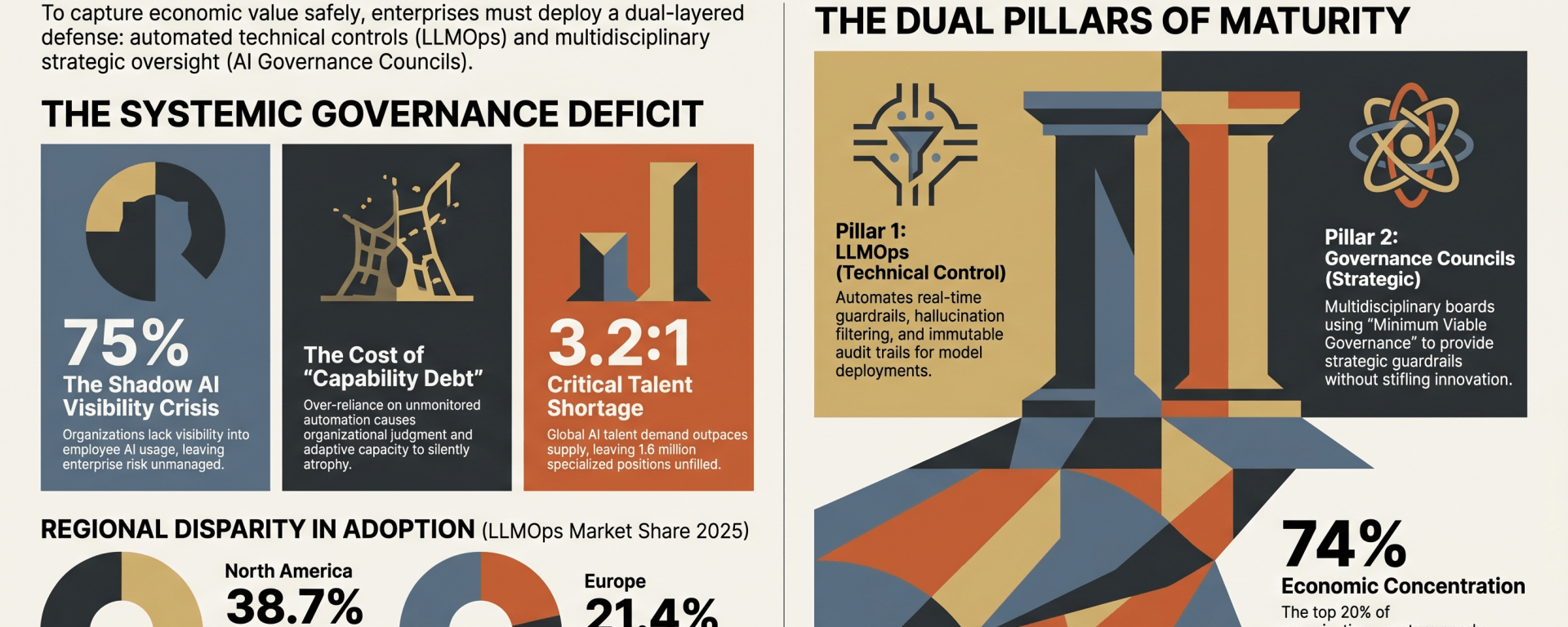
The ensuing analysis indicates a widening and critical disparity between AI ambition and structural maturity. While enterprise AI adoption has scaled aggressively across global markets, governance controls have severely lagged, creating systemic vulnerabilities categorized as “governance debt” and “capability debt”1. The organizations capturing the highest economic value from AI are those that successfully merge the automated, technical controls of LLMOps with the strategic, multidisciplinary oversight of AI Governance Councils, treating compliance not as a barrier, but as a strategic differentiator that engenders stakeholder trust.
Key Insights
| Insight Theme | Strategic Implication |
| The Systemic Governance Deficit | While AI is integrated into the core operations of most enterprises, the governance infrastructure required to manage it remains nascent. Organizations are deploying advanced agentic systems without the corresponding observability or risk management frameworks, leading to rampant “Shadow AI” and exposing firms to severe legal, financial, and reputational liabilities1. |
| LLMOps as the Bridge to Production | Traditional Machine Learning Operations (MLOps) frameworks are fundamentally insufficient for non-deterministic generative models. LLMOps introduces mandatory technical controls for prompt versioning, retrieval-augmented generation (RAG) oversight, hallucination filtering, and granular token cost management, enabling scalable and reliable enterprise deployment6. |
| Councils Must Act as Guardrails, Not Gates | Effective AI Governance Councils utilize “Minimum Viable Governance” (MVG) and agile risk-tiering (e.g., pre-contract scorecards) to enable safe innovation. Councils that act as bureaucratic bottlenecks inadvertently drive employees toward unauthorized AI use, circumventing security perimeters entirely10. |
| Shadow AI Exacerbates Capability Debt | Pervasive unauthorized AI use bypasses traditional data loss prevention (DLP) systems and contributes heavily to “Capability Debt”—a phenomenon where organizational judgment, novelty detection, and adaptive capacity silently atrophy due to over-reliance on unmonitored automation3. |
| Regulatory Pressures Force Technological Solutions | Frameworks such as the EU AI Act, the NIST AI Risk Management Framework (RMF), and Canada’s Office of the Superintendent of Financial Institutions (OSFI) guidelines are transforming AI governance platforms from discretionary software into mandatory, audit-ready compliance infrastructure14. |
| The Talent Scarcity is a Critical Bottleneck | A severe global shortage of specialized AI governance, ethics, and LLMOps professionals threatens to stall compliance and deployment efforts across all regulated sectors. Enterprises cannot rely solely on lateral hiring and must invest in internal upskilling and managed platforms18. |
Key Statistics and Metrics
| Metric / Statistic | Context & Source Data |
| 38.7% vs. 21.4% Market Share | North America dominates the global LLMOps platform market with a 38.7% share ($1.24 billion in 2025). Europe holds 21.4% but is forecast to grow rapidly at a 22.6% CAGR, driven directly by EU AI Act compliance mandates20. |
| 25% Visibility Threshold | Only 25% of organizations report comprehensive visibility into employee AI usage, leaving the remaining 75% managing enterprise AI risk completely blind. Consequently, 35% of organizations describe shadow AI as pervasive1. |
| 74% Economic Concentration | Approximately 74% of all AI-generated economic value is currently captured by just 20% of organizations. These “AI leaders” share a common trait: they invest heavily in cross-functional governance boards and LLMOps infrastructure at rates significantly higher than market averages4. |
| 78% Regulatory Unpreparedness | 78% of enterprises remain unprepared for their obligations under the EU AI Act. An analysis of European AI companies revealed that while 74% are classified as high-risk, 96% lack a public position on compliance, and 83% lack a formal inventory of deployed AI systems1. |
| $670,000 Shadow AI Penalty | Data breaches that involve shadow AI cost organizations an average of $670,000 more than traditional security incidents, driven by the absence of access controls and the exposure of sensitive intellectual property1. |
| 3.2:1 Talent Deficit Ratio | The global demand for AI talent outpaces supply by 3.2 to 1, representing 1.6 million open positions against a qualified pool of only 518,000 candidates. For specialized AI Ethics & Governance roles, the shortage is critical, at a ratio of 1:3.818. |
2. Quantitative Summary: Prevalence and Effectiveness of AI Governance Practices
The adoption and effectiveness of LLMOps and AI Governance Councils vary significantly across regions and industries. The data reveals that while technical adoption (LLMOps) is heavily concentrated in North America due to the presence of hyperscalers and a culture of aggressive commercialization, Europe is rapidly advancing its policy-as-code and compliance capabilities to meet stringent legislative timelines.
Table 1: North America (United States & Canada)
| Regulated Industry | LLMOps Prevalence | AI Gov. Council Prevalence | Effectiveness of Joint Practices | Key Regulatory & Industry Drivers |
| Banking & Financial Services | High (50-60%) | Medium-High (45-55%) | High: Leaders utilizing joint practices capture 30% higher operating profit. Proven ROI in fraud detection and smart routing22. | OSFI Guideline E-23 (Canada), SEC, FINRA, FCAC oversight, GLBA17. |
| Healthcare & Life Sciences | Medium (35-45%) | Medium (30-40%) | Medium-High: Significantly accelerates R&D (e.g., target discovery), but clinical workflow adoption remains cautious due to bias and privacy risks26. | FDA Software as Medical Device (SaMD), HIPAA, GxP Compliance, Pan-Canadian AI principles20. |
| Insurance | Medium (40%) | Low-Medium (25-35%) | Medium: High efficacy in claims automation and policy processing, but algorithmic bias remains a critical unmitigated risk29. | State-level algorithmic regulations (US), OSFI directives (Canada)17. |
| Government & Public Sector | Low (15-20%) | Medium (35%) | Low-Medium: Stalled by systemic technical debt and legacy infrastructure limitations, despite aggressive high-level mandates33. | US Executive Order 14110, OMB Guidelines, Canada’s National AI Strategy34. |
| Legal & Professional Services | Low-Medium (20-30%) | Low (15%) | Low: Characterized by high shadow AI usage and widespread fragmentation of governance ownership37. | Client confidentiality mandates, emerging State Bar association ethical guidelines. |
| Education (Higher Ed) | Low (10-15%) | Low-Medium (20%) | Low: 80% of institutions are experimenting, but fewer than half have formal governance frameworks, leading to high data risk39. | FERPA, Institutional data privacy policies, Title IX compliance39. |
Table 2: Europe (United Kingdom, Germany, France)
| Regulated Industry | LLMOps Prevalence | AI Gov. Council Prevalence | Effectiveness of Joint Practices | Key Regulatory & Industry Drivers |
| Banking & Financial Services | Medium-High (45%) | High (55-60%) | Medium-High: Strong focus on transparency limits rapid deployment but ensures high stability and consumer trust41. | EU AI Act, UK FCA (SM&CR), PRA directives, DORA42. |
| Healthcare & Life Sciences | Medium (30-40%) | Medium-High (45%) | Medium: The EU AI Act categorizes medical AI as high-risk, demanding rigorous, audit-ready technical documentation prior to deployment1. | EU AI Act (Annex III), GDPR, EMA guidelines1. |
| Insurance | Medium (35%) | Medium (35%) | Medium: Adoption is constrained by strict automated decision-making laws under GDPR42. | GDPR Article 22, EU AI Act, EIOPA governance rules. |
| Government & Public Sector | Low-Medium (25%) | Medium (30%) | Low-Medium: High focus on citizen data sovereignty and sovereign cloud AI models over pure operational efficiency48. | EU AI Act, National AI Strategies (e.g., France’s CNIL guidelines). |
| Legal & Professional Services | Low (15%) | Low (10-15%) | Unavailable: An estimated 96% of high-risk EU AI companies lack public compliance positions, indicating severe lag1. | GDPR, EU AI Act transparency obligations1. |
| Education (Higher Ed) | Low (10%) | Low (10%) | Low: Significant regulatory hesitation and extreme fragmentation in compliance approaches across jurisdictions1. | GDPR, National education data protection statutes. |
3. Defining the New AI Governance Paradigms
The rapid transition from traditional, deterministic machine learning models to non-deterministic, generative systems has rendered legacy IT governance structures obsolete. To safely operationalize large language models and mitigate exponential risk, progressive organizations are deploying a dual-layered approach: the robust technical infrastructure of LLMOps paired with the strategic, human-centric oversight of Cross-Functional AI Governance Councils.
3.1 LLMOps: Operationalizing Large Language Models
Definition and Scope Large Language Model Operations (LLMOps) encompasses the specialized practices, methodologies, and technological platforms required to develop, deploy, monitor, fine-tune, and govern large language models in production environments. While traditional MLOps focuses on the lifecycle of predictive algorithms utilizing metrics like precision and recall, LLMOps is tailored to the unique complexities of foundation models, generative architectures, and autonomous agentic systems7.
Core Mechanisms and Technical Functionality LLMOps functions as the operational backbone that transitions experimental, fragile LLM pilots into robust, enterprise-grade applications. It relies on several highly specialized components that do not exist in traditional software development or MLOps:
- Prompt Engineering, Versioning, and Chaining: Because prompts serve as the primary programming interface for LLMs, LLMOps platforms treat system instructions, user prompts, and few-shot examples as first-class artifacts. They provide version control and A/B testing for complex prompt chains (e.g., LangChain frameworks), ensuring that outputs remain consistent across frequent model updates and deprecations7.
- Retrieval-Augmented Generation (RAG) Orchestration: To mitigate the severe risk of hallucinations and ground model responses in factual, proprietary enterprise data, LLMOps integrates with vector databases and semantic search capabilities. This integration requires strict identity and access management (IAM) to ensure that an LLM only retrieves documents the specific end-user is authorized to view, preventing lateral data leakage29.
- Real-Time Guardrails and Vulnerability Filtering: Unlike deterministic algorithms, LLMs can generate toxic, biased, or non-compliant text, or fall victim to adversarial prompt injections. LLMOps introduces real-time interception layers—often leveraging smaller, specialized models—to evaluate inputs against the OWASP Top 10 for LLMs. These guardrails dynamically filter outputs for personally identifiable information (PII) leakage, copyright infringement, or off-topic responses9.
- Multidimensional Evaluation and “LLM-as-a-Judge”: Traditional evaluation metrics are inadequate for generative text. LLMOps utilizes multi-tiered evaluation frameworks, combining automated screenings (BLEU/BERTScore) with “LLM-as-a-Judge” mechanisms. In this paradigm, a superior model (e.g., GPT-4) evaluates a deployed model’s outputs against strict, domain-specific rubrics covering accuracy, tone, coherence, and safety9.
- Token-Level Cost and Latency Management: Inference for frontier models is prohibitively expensive, often running tens of thousands of dollars per month for enterprise workloads. LLMOps provides granular, token-level telemetry to track computational spend by department, route workloads dynamically based on latency requirements, and manage expanding context windows efficiently9.
Best Practices for Regulated Organizations For entities in finance, healthcare, and government, LLMOps is not merely an efficiency tool; it is a regulatory necessity. Best practices dictate the implementation of immutable audit trails that capture every prompt-completion pair, alongside the specific version of the model and the guardrail policies active at the exact time of inference15. Regulated deployments must establish continuous feedback loops—such as Reinforcement Learning from Human Feedback (RLHF)—to recalibrate models against algorithmic drift and bias over time47. Furthermore, deploying LLMOps within sovereign cloud or on-premises environments guarantees data localization, satisfying critical requirements under the EU AI Act, GDPR, and defense procurement standards35.
3.2 Cross-Functional AI Governance Councils
Definition and Scope An AI Governance Council is a formal, multidisciplinary oversight body responsible for establishing the ethical, legal, and operational parameters of AI use within an enterprise. It functions as the translation layer between abstract AI ethics, stringent regulatory mandates, and enforceable corporate policies. The council ensures that AI investments align with the organization’s risk appetite, fiduciary duties, and strategic objectives55.
Structure and Composition Because AI risk permeates the entire enterprise—affecting product, legal, human resources, and cybersecurity—traditional IT-siloed governance routinely fails. A mature AI Governance Council integrates diverse perspectives to eliminate blind spots11. Typical membership includes:
- Chief AI Officer (CAIO) or Chief Data Officer (CDO): Serves as the executive sponsor, aligning technical capabilities with overarching business strategy. The presence of a CAIO has surged, with 76% of surveyed organizations establishing the role by 20261.
- Legal, Compliance, and Privacy Officers: Evaluate models against emerging frameworks (e.g., EU AI Act, NIST AI RMF, ISO 42001, OSFI E-23) and oversee intellectual property, data sovereignty, and algorithmic fairness risks16.
- Chief Information Security Officer (CISO): Assesses the expanded attack surfaces introduced by agentic AI, mitigating novel risks such as data poisoning, model inversion, and automated social engineering57.
- Business Line Leaders and HR: Ensure use cases drive genuine ROI, manage change fatigue, and assess the impact of AI on workforce dynamics, job restructuring, and talent upskilling11.
Function and Best Practices for Regulated Organizations To avoid becoming bureaucratic bottlenecks that stifle innovation, progressive councils adopt an ethos of “guardrails, not gates”12. Best practices include:
- Minimum Viable Governance (MVG): Rather than attempting a comprehensive, multi-year NIST or ISO implementation before deploying any models, successful councils utilize a 90-day sprint to establish a functional baseline. This MVG approach creates a centralized AI inventory, assigns named accountability for each model, and implements fundamental deployment gates to halt egregious risks immediately10.
- Pre-Contract Scorecards (The Mastercard Approach): In highly regulated sectors like banking, leaders like Mastercard utilize comprehensive scorecards before a single line of code is written or a vendor contract is signed. Product owners must declare data lineage, model agency (the degree of autonomous financial decision-making), and bias potential. If high risk is identified, automated mitigation workflows and rigorous documentation trails are triggered, transforming compliance into a sales asset for cautious B2B partners11.
- Risk Tiering and Lifecycle Management: Councils map all AI systems to defined risk categories (e.g., minimal, limited, high, unacceptable), aligning internal controls with external regulatory structures like the EU AI Act. Low-risk applications (e.g., internal document summarization) receive lightweight oversight, while high-risk systems (e.g., algorithmic credit scoring, clinical diagnostics) require rigorous auditability, bias testing, and human-in-the-loop interventions1.
- Managing Shadow AI through Enablement: Recognizing that blanket bans are ineffective against the proliferation of consumer AI, councils authorize “secure sandboxes.” By providing employees with governed, enterprise-grade alternatives to public generative AI tools, the council contains data leakage while fostering internal innovation and AI literacy5.
Pioneering Case Studies in Governance Industry leaders demonstrate that rigorous governance accelerates, rather than impedes, innovation:
- GSK (GlaxoSmithKline): GSK established an AI Governance Council to oversee its massive investments in R&D AI. By separating data engineering from machine learning, GSK built the Onyx platform and Cogito Forge, an agentic AI scientist capable of writing analytical code and synthesizing literature. The council ensures these autonomous systems adhere to a strict Responsible AI framework prioritizing patient safety, transparency, and equitability, demonstrating how high-risk pharma operations can safely leverage agentic workflows26.
- USPTO (United States Patent and Trademark Office): To handle the influx of intellectual property data, the USPTO formed an AI Governance Council and an AI Policy Council. They implemented a structured approval process and risk management framework to deploy generative AI tools for patent and trademark examiners. The council measures success against specific KPIs, including pendency reduction and fraud prevention, ensuring AI serves the public interest securely65.
4. Evaluation of Hypotheses
The initial hypotheses regarding the geographic distribution, structural effectiveness, and talent dynamics of AI governance practices require rigorous evaluation against current macroeconomic data, regulatory analyses, and industry surveys.
4.1 First Hypothesis: LLMOps is more common in Europe than North America.
Finding: False. The data conclusively refutes this hypothesis. North America is the dominant force in the global LLMOps market, holding a 38.7% revenue share (valued at approximately $1.24 billion in 2025), compared to Europe’s 21.4% share20. The North American market’s supremacy is propelled by a dense concentration of technology hyperscalers, leading AI research institutions, and the aggressive scaling of generative AI beyond experimental pilots into production environments20. The United States houses the headquarters for the vast majority of premier LLMOps vendors, granting domestic enterprises a significant early-adopter advantage20.
However, the nature of adoption differs fundamentally by region. While North American adoption is driven by the pursuit of operational efficiency, multi-model deployment, and massive scale20, European adoption is heavily compliance-led. Anticipation of the EU AI Act—which mandates exhaustive technical documentation, audit trails, and conformity assessments for high-risk systems—is driving European LLMOps platforms to record a highly aggressive 22.6% to 37.1% expected growth rate20. Despite Europe’s rapid acceleration in policy-as-code automation and compliance workflows, North America currently maintains undisputed leadership in overall LLMOps prevalence and capital expenditure.
4.2 Second Hypothesis: AI Governance Councils may be common in some regulated industries, but they are not commonly effective in preventing issues due to larger systemic issues like organizational AI Capability Debt.
Finding: True. The research strongly validates this hypothesis. The presence of an AI Governance Council, while necessary, is structurally insufficient to secure an enterprise if it relies solely on manual, periodic oversight. A critical phenomenon undermining council effectiveness across all sectors is AI Capability Debt (also referred to as AI Technical Debt)3.
As organizations deploy “contiguous AI chains”—workflows where automated processes run sequentially with human verification occurring only at the final output—they achieve rapid, highly visible efficiency gains3. However, this surface efficiency masks a systemic, invisible erosion of organizational judgment, novelty detection, and adaptive capacity. Researchers from MIT, including JoAnna Vanderhoef, define Capability Debt as the growing gap between an organization’s apparent efficiency and its actual ability to adapt to edge cases or system failures3. Because AI systems ingest exponentially more data and change at a velocity that far exceeds traditional software, manual governance reviews simply cannot keep pace2.
This dynamic results in a severe “Visibility Crisis.” Currently, only 25% of organizations report comprehensive visibility into employee AI use, and 35% describe unauthorized “Shadow AI” as pervasive1. When a council sets policy but lacks the automated, real-time enforcement layers provided by an LLMOps platform, governance fails at the execution layer69. This is evidenced by the fact that 58% of leaders believe their governance is adequate, yet only 18% have active mitigation covering identified risks, and nearly 60% rate their AI incident response capabilities as satisfactory or negative1. Councils are highly effective when integrated with automated telemetry and CI/CD pipelines, but inherently ineffective when decoupled from underlying technical infrastructure.
4.3 Third Hypothesis: There is a significant shortage of AI Governance experts and consultants that know how to implement and lead these two progressive AI governance practices.
Finding: True. The global technology labor market is experiencing an acute, structural deficit of specialized AI governance, LLMOps, and ethics talent. While generalist IT hiring has begun to cool and normalize, the demand for specialized GenAI, LLMOps, and AI governance roles commands exceptional salary premiums (ranging from 25% to over 60%) and experiences severe, sustained shortages19.
The global AI talent demand outpaces supply by a staggering ratio of 3.2:1, representing approximately 1.6 million open positions against a qualified pool of only 518,000 candidates18. The specific sub-discipline of “AI Ethics & Governance Specialists” faces an even more critical shortage level of 1:3.8, with 34,000 open roles globally and a mere 8,900 qualified candidates19. Furthermore, year-over-year demand for these governance specialists has surged by 289%, highlighting the desperate need for compliance expertise as regulatory deadlines loom19.
This scarcity is exacerbated because effective AI governance requires a rare, hybrid multidisciplinary skill set. Professionals must possess a deep technical understanding of complex machine learning architectures and vector databases (LLMOps) while simultaneously navigating dense, evolving legal frameworks (EU AI Act, GDPR, NIST RMF) and translating them into organizational ethics16. With 90% of enterprises projected to face critical AI skill shortages by 2026, the lack of human capital stands as the primary bottleneck to the implementation of safe, governed AI in regulated industries, costing the global economy trillions in unrealized productivity18.
5. Strategic Actions for Progressive Leaders
For senior leaders at organizations that have already initiated LLMOps and established an AI Governance Council, the objective shifts from foundational control to maximizing ROI, scaling autonomously, and continuously fortifying against emerging risks—particularly the deployment of agentic AI.
- Integrate Governance as Code: The most mature organizations eliminate the friction between governance and engineering by embedding compliance directly into the CI/CD pipeline54. Progressive leaders must mandate that LLMOps platforms automatically generate the model cards, audit trails, and risk documentation required by the NIST AI RMF and ISO/IEC 4200115. If an AI agent’s configuration breaches a predetermined risk or bias threshold during evaluation, deployment must be automatically halted.
- Manage Agentic AI with Granular Entitlements: As organizations shift from “assistive” chatbots to “agentic” systems that execute multi-step workflows autonomously, risk escalates exponentially1. Leaders must ensure that AI agents operate on the principle of least privilege, treating them as non-human identities (NHIs) with continuous, policy-driven authorization that adapts in real-time, rather than relying on static, one-time role grants61.
- Establish a “Paved Road” to Combat Shadow AI: Shadow AI is rarely malicious; it is a symptom of high procurement friction and employees seeking efficiency5. Rather than relying on rigid, easily bypassed blocking, leaders must provide internal, highly secure, and governed LLM sandboxes. By enabling a fast, safe route for experimentation, organizations capture innovation while preventing sensitive proprietary data from leaking into public model training sets37.
- Measure “Debt-Adjusted ROI”: To actively combat AI Capability Debt, financial metrics must be recalibrated. Leaders should require dashboards that measure not just the immediate productivity gains of an AI deployment, but also the compounding costs of model drift, architectural remediation, and incident response over a 90-to-120-day window76.
- Deploy Sovereign AI Infrastructure: For highly regulated entities (especially government, defense, and healthcare), relying on multi-tenant public APIs introduces unacceptable sovereignty risks. Progressive leaders are investing in sovereign cloud models and on-premises LLM deployments, ensuring complete control over data residency, cybersecurity, and regulatory compliance35.
6. Remediation Strategies for Lagging Leaders
For organizations struggling to advance beyond “pilot purgatory,” or those paralyzed by regulatory uncertainty and shadow AI, attempting to deploy a comprehensive governance framework overnight will fail. Leaders must adopt an iterative, risk-based approach to rapidly close the oversight gap.
- Execute a 90-Day Minimum Viable Governance (MVG) Sprint: Discard the ambition for immediate perfection, which leads to the “Documentation Trap”10. Initiate an MVG sprint focused on answering three fundamental questions: What AI systems are currently in use? What are the three most consequential failure modes for each? Who is the named individual authorized to shut them down?10. This rapid triage establishes an immediate, functioning baseline.
- Convene an Agile, Cross-Functional Council: Do not build a massive, permanent bureaucracy. Establish a lean, agile council comprising IT, Legal, HR, and key business stakeholders11. The immediate mandate of this group is to define a clear, acceptable-use policy for generative AI, identify one or two low-risk, high-reward administrative workflows to pilot, and unblock stalled initiatives12.
- Implement Comprehensive AI Asset Inventories: It is impossible to govern what is invisible. Lagging organizations must deploy automated discovery tools to detect all unauthorized AI application signups, third-party SaaS AI integrations, and internal Python scripts operating where firewalls are blind61. This centralized registry must map every asset to its business owner and data lineage1.
- Invest in Turnkey LLMOps Platforms: Organizations lacking deep technical talent cannot afford to build customized evaluation and monitoring infrastructure from scratch. Lagging organizations should procure established, end-to-end enterprise LLMOps platforms (e.g., Databricks, Microsoft Azure AI, or TrueFoundry) that offer out-of-the-box guardrails, prompt versioning, and compliance reporting9.
- Adopt “Fast-Follower” Regulatory Alignment: Instead of guessing future regulatory requirements or waiting for local laws to finalize, align immediately with international gold standards like ISO/IEC 42001 and the NIST AI RMF16. Because global regulations (like the EU AI Act) borrow heavily from these foundational frameworks, adopting them provides immediate operational resilience and future-proofs the organization against cross-jurisdictional compliance shifts1.
7. Complete List of Sources
The following sources were synthesized to produce this research report:
- Tredence – LLMOps Best Practices
- Databricks – What is LLMOps
- IBM – LLMOps Overview
- Google Cloud – Discover LLMOps
- TrueFoundry – AI Governance
- AskAjay – Minimum Viable Governance
- Department of Commerce OIG – USPTO AI Governance
- Deloitte – AI Governance Councils
- WICHE – AI Literacies
- Optro – AI Governance Stats
- PwC Strategy& – AI Driven Change
- Evolvance Market Research – AI Governance Statistics
- Nemko – Gartner AI Governance Market
- PwC – AI Performance Study
- Medium – The AI Governance Crisis
- Management Solutions – Trends in AI People
- Dimension Market Research – AI Governance Market
- Economic Times – AI Talent Market
- Fortune Business Insights – MLOps Market
- Technavio – MLOps Market Analysis
- Dataintelo – LLMOps Platform Market
- Virtue Market Research – Enterprise LLMOps Platforms
- Growth Market Reports – LLMOps Market
- StateTech Magazine – Technical Debt in AI Era
- CIO.com – 7 Sources of AI Debt
- Collibra – Hidden Technical Debt of AI
- Ability AI – Ungoverned AI Agents
- Software Improvement Group – AI Code Governance
- Iternal AI – AI Skills Gap
- Kore1 – AI in Workplace 2026
- Second Talent – Global AI Talent Shortage
- The Network Installers – AI Workplace Statistics
- Acuity Analytics – AI Skills Gap and Talent Shortage
- SEC Edgar – AI Steering Committee Data 1
- Stanford HAI – AI Index Report 2025
- SEC Edgar – AI Risks Data 2
- CT General Assembly – AI Working Group Report
- GSK – Annual Report 2025
- GSK AI – AI Ethics
- Raise Summit – AI Leadership Guide
- GSK – Position on Responsible AI
- IMD – GSK AI Maturity 2025
- CIO.inc – GSK AI Driven Science
- IMD – Mastercard AI Governance
- The CFO – Mastercard Finance AI Governance
- Domo – AI Governance Glossary
- EY – AI in Payments
- Mastercard – Driving Responsible AI
- ReversingLabs – AI Technical Debt
- Exceeds AI – AI Technical Debt Workflow
- InformationWeek – AI Technical Debt Wave
- ICSE – Technical Debt Panels
- Gartner – Managing AI Technical Debt
- Fortune Business Insights – MLOps Market
- Technavio – MLOps Analysis
- Dataintelo – LLMOps Market Data
- AI Multiple – LLM Market Share
- Markets and Markets – LLM Market
- Emerald Insight – EU AI Financial Sector
- Fortune Business Insights – Explainable AI Market
- DataM Intelligence – Enterprise AI Agent Adoption
- Future Market Insights – Enterprise AI Governance Market
- Databricks – Responsible AI Governance
- Intuition Labs – AI Policy Governance Guide
- Global Market Insights – AI in Government
- GS Consulting – AI Governance Framework
- America First Policy – US Government AI Readiness
- Ocean Tomo – AI Washing and Board Governance
- Dataintelo – LLMOps Market Update
- Virtue Market Research – LLMOps Update
- Avasant – LLMOps Platforms RadarView
- Sigmoid – Industrializing GenAI with LLMOps
- Growth Market Reports – LLMOps Growth
- Grid Dynamics – LLMOps Platform Solutions
- Aisera – LLMOps Blog
- Pluralsight – What is LLMOps
- Persistent – LLMOps Framework
- Microsoft Azure – Unlock Value with LLMOps
- Arxiv – Unified Agent Lifecycle Management
- Intuition Labs – Pharma AI Governance
- Preprints.org – State Level AI Adoption Framework
- GSK – Public Policy Responsible AI
- KPMG – Responsible AI Life Sciences
- Project Manager Template – AI Governance Maturity
- HSO – AI Governance Foundation
- Voltage Control – The New Friction
- Charter TS – IT Strategy Insights
- AskAjay – Trust Premium Framework
- TrueFoundry – AI Security Frameworks
- DevOps School – EU AI Act Tools
- Revelsi – AI Services
- ITSecNow – AI Security Testing
- Optro – Best AI Governance Software
- Fortune Business Insights – Fintech LLMOps Update
- Dataintelo – Fintech LLMOps Regional Update
- Paul Okhrem – AI in Finance
- Omovera – AI Trends Fintech 2026
- ZenML – LLMOps Database
- SWLaw – USPTO AI Rollout
- SentinelOne – Shadow AI
- Agile Brand Guide – Dataiku AI Governance
- OECD AI – AI Technology Action Plan
- Unio Digital – ChatGPT Sensitive Data
- TrueFoundry – LLMOps Tools
- MLOps World – Summit 2025
- N-iX – What is LLMOps
- Medium – MLOps/LLMOps Roadmap 2026
- KGT Solutions – LLMOps vs MLOps
- Government of Canada – National AI Strategy
- IRPP Policy Options – AI Contribution Policy
- Royal Society Publishing – Federated AI Healthcare Canada
- CD Howe – Data Supply Chains
- Public Health Ontario – Health Equity AI
- The CFO – Mastercard Detailed Structure
- Second Talent – Detailed Shortage Stats
- AskAjay – MVG Framework Detail
- Optro – AI Governance Detailed Stats
- CrowdStrike – Why AI Projects Stall
- Dataintelo – Legal Sector LLMOps Update
- KX – LLMOps Glossary
- Reddit ExperiencedDevs – AI Governance Ownership
- Preprints.org – NJ Ecosystem Framework
- Management Solutions – AI People Higher Ed Update
- LearnWise AI – Higher Ed Readiness
- Digital Commons Kennesaw – AI Governance HE
- ZenML – Policy Search Higher Ed
- HSO – Nonprofit AI Governance Update
- GovTech Webinars – IT AI Finance
- Salesforce – AI Governance Overview
- Nallas – AI for Nonprofits
- Arxiv – LLMOps Recommendation Systems
- Arxiv – AI Capability Debt
- Voltage Control – The New Friction Context
- Voltage Control – Capability Debt Deep Dive
- Voltage Control – Leadership Perception Gap
- OSFI Canada – FIFAI II Report
- Osler – OSFI Regulations Update
- Global Risk Institute – FIFAI II
- Baker McKenzie – OSFI FCAC AI Report
- OSFI Canada – Risk Report
- UK Parliament – FCA AI Regulation
- Kennedys Law – Deploying AI in Financial Services UK
- Global Policy Watch – UK Financial Regulators 2026
- FCA UK – Smarter Regulation
- Hogan Lovells – New Developments UK Financial Services
Works cited
- AI governance stats for 2026: Adoption, risk, and the oversight gap defining the year – Optro, https://optro.ai/blog/ai-governance-stats
- The hidden technical debt of AI: Why manual governance is slowing down your AI scale, https://www.collibra.com/blog/the-hidden-technical-debt-of-ai-why-manual-governance-is-slowing-down-your-ai-scale
- The New Friction – Voltage Control, https://voltagecontrol.com/blog/the-new-friction/
- AI Governance Statistics 2026: Key Data & Insights – Evolvance Market Research, https://evolvancemarketresearch.com/statistics/ai-governance-statistics/
- What Is Shadow AI? Definition, Risks & Governance Strategies – SentinelOne, https://www.sentinelone.com/cybersecurity-101/cybersecurity/what-is-shadow-ai/
- LLMOps Guide: How it Works, Benefits and Best Practices – Tredence, https://www.tredence.com/llmops
- What is LLMOps? – Databricks, https://www.databricks.com/blog/what-is-llmops
- What is LLMops: The complete guide to Large Language Model operations, https://www.n-ix.com/what-is-llmops/
- LLMOps vs MLOps: What CTOs Need to Compare – KGT Solutions, https://kgt.solutions/resources/blog/llmops-vs-mlops-what-ctos-need-to-compare
- AI Governance: Start With Minimum Viable Governance – AskAjay.ai, https://askajay.ai/thinking/ai-governance-framework-minimum-viable-governance
- How Mastercard’s finance engine operationalized AI governance – The CFO, https://the-cfo.io/2026/05/11/how-mastercards-finance-engine-operationalized-ai-governance/
- AI Governance: The Foundation Your AI Program Cannot Afford to Skip | HSO, https://www.hso.com/blog/ai-governance-the-foundation-your-ai-program-cannot-afford-to-skip/
- Short-Term Gain, Long-Term Fragility: AI Labor Substitution and the Erosion of Sustainable Capability – arXiv, https://arxiv.org/html/2605.27399v1
- AI Governance Platforms Market to Surpass $1 Billion by 2030, Gartner Reports, https://digital.nemko.com/news/ai-governance-platforms-market-to-surpass-1-billion-by-2030
- Responsible AI Governance: A Practical Framework for Business Leaders | Databricks Blog, https://www.databricks.com/blog/responsible-ai-governance
- AI Security Frameworks: Enterprise Guide for 2026 – Truefoundry, https://www.truefoundry.com/blog/ai-security-frameworks
- From AML to AI: regulatory developments in the financial services landscape, https://www.osler.com/en/insights/reports/2025-legal-outlook/from-aml-to-ai-regulatory-developments-in-canadas-financial-services-landscape/
- AI Skills Gap 2026: Statistics, Causes & How to Close It – Iternal Technologies, https://iternal.ai/ai-skills-gap
- Top 50+ Global AI Talent Shortage Statistics 2026, https://www.secondtalent.com/resources/global-ai-talent-shortage-statistics/
- LLMOps Platform Market Research Report 2034 – Dataintelo, https://dataintelo.com/report/llmops-platform-market
- Three-quarters of AI’s economic gains are being captured by just 20% of companies – PwC, https://www.pwc.com/gx/en/news-room/press-releases/2026/pwc-2026-ai-performance-study.html
- The Trust Premium: Why Trusted AI Is Worth More | AskAjay.ai, https://askajay.ai/thinking/trust-premium-framework-why-trusted-ai-worth-more
- AI Skills Gap & Talent Shortage: Rethinking Workforce Models for an AI-Centric Future, https://www.acuityanalytics.com/blog/ai-skills-gap-and-talent-shortage/
- How to use AI in payments to optimize, protect and grow – EY, https://www.ey.com/en_us/insights/payments/how-ai-is-transforming-payments
- Canada: Amplified risks for financial institutions from AI, OSFI and FCAC Report, https://insightplus.bakermckenzie.com/bm/banking-finance_1/canada-amplified-risks-for-financial-institutions-from-ai-osfi-and-fcac-report
- GSK: The AI-Driven Science Factory – CIO.inc, https://www.cio.inc/blogs/gsk-ai-driven-science-factory-p-4121
- Enterprise AI Governance in Pharma: GxP & Compliance – IntuitionLabs, https://intuitionlabs.ai/articles/pharma-ai-governance-gxp-compliance
- Review of “Integrating Health Equity in Artificial Intelligence for Public Health in Canada: A Rapid Narrative Review”, https://www.publichealthontario.ca/-/media/Documents/I/25/integrating-health-equity-ai-public-health.pdf?rev=55fab78b41254bba88d81fce7e06dddf&sc_lang=en
- LLMOps platform for robust enterprise AI workflows – Grid Dynamics, https://www.griddynamics.com/solutions/llmops-platform
- Top 7 Key AI Trends Shaping Fintech in 2026 (US/UK) – Omovera, https://www.omovera.com/top-7-key-ai-trends-shaping-fintech-in-2026-us-uk/
- NDUS: Policy Search and Response System Using LLMs in Higher Education – ZenML, https://www.zenml.io/llmops-database/policy-search-and-response-system-using-llms-in-higher-education
- AI Washing and the Imperative for Board Governance – Ocean Tomo, https://oceantomo.com/insights/ai-washing-and-the-imperative-for-board-governance/
- Q&A: Why State and Local Agencies Must Address Technical Debt as the AI Era Accelerates, https://statetechmagazine.com/article/2026/06/qa-why-state-and-local-agencies-must-address-technical-debt-ai-era-accelerates
- Building AI Readiness in the U.S. Government | Issue Brief – America First Policy Institute, https://www.americafirstpolicy.com/issues/building-ai-readiness-in-the-u.s-government
- Canada’s National Artificial Intelligence Strategy: AI for All, https://ised-isde.canada.ca/site/ised/en/canadas-national-artificial-intelligence-strategy-ai-all
- Artificial Intelligence Adoption and Governance in New Jersey: A Comprehensive Framework for Public Sector Innovation, Ethical Implementation, and Economic Development – Preprints.org, https://www.preprints.org/manuscript/202602.1908
- Why AI Projects Stall and How CIOs Can Respond | CrowdStrike, https://www.crowdstrike.com/en-us/blog/why-ai-projects-stall-and-how-cios-can-respond/
- Who owns AI governance at your company? : r/ExperiencedDevs – Reddit, https://www.reddit.com/r/ExperiencedDevs/comments/1rtlyww/who_owns_ai_governance_at_your_company/
- AI Readiness: A Strategic Playbook for Higher Education Leaders | Guides | LearnWise, https://www.learnwise.ai/guides/ai-readiness-a-strategic-playbook-for-higher-education-leaders
- Information Technology decision makers’ readiness for artificial intelligence governance in institutions of higher education in South Africa, https://digitalcommons.kennesaw.edu/cgi/viewcontent.cgi?article=1115&context=acist
- Artificial intelligence (AI) and European Union’s financial sector: navigating accountability, challenges and regulation | The Journal of Risk Finance – Emerald Insight, https://www.emerald.com/jrf/article/doi/10.1108/JRF-09-2025-0424/1364668/Artificial-intelligence-AI-and-European-Union-s
- Deploying AI in financial services in the UK: FCA and data protection considerations (UK), https://www.kennedyslaw.com/en/thought-leadership/article/2026/deploying-ai-in-financial-services-in-the-uk-fca-and-data-protection-considerations/
- UK Financial Services Regulators’ Approach to Artificial Intelligence in 2026, https://www.globalpolicywatch.com/2026/04/uk-financial-services-regulators-approach-to-artificial-intelligence-in-2026/
- Artificial Intelligence – RevelSI, https://www.revelsi.com/services/ai
- Artificial intelligence in financial services – Parliament UK, https://publications.parliament.uk/pa/cm5901/cmselect/cmtreasy/684/report.html
- Top 10 AI Compliance Management EU AI Act Tools: Features, Pros, Cons & Comparison, https://www.devopsschool.com/blog/top-10-ai-compliance-management-eu-ai-act-tools-features-pros-cons-comparison/
- Industrializing GenAI at enterprise scale with LLMOps – Sigmoid, https://www.sigmoid.com/blogs/industrializing-genai-at-enterprise-scale-with-llmops/
- AI in Government and Public Services Market Size & Share 2026-2035, https://www.gminsights.com/industry-analysis/ai-in-government-and-public-services-market
- AI Technology Action Plan 2026–2030 – OECD AI Policy Observatory, https://oecd.ai/en/dashboards/policy-initiatives/ai-technology-action-plan-2026-2030
- What Are Large Language Model Operations (LLMOps)? – IBM, https://www.ibm.com/think/topics/llmops
- What is LLMOps Compared to MLOps | Pluralsight, https://www.pluralsight.com/resources/blog/ai-and-data/what-is-llmops
- 10 Best LLMOps Tools in 2026 – Truefoundry, https://www.truefoundry.com/blog/llmops-tools
- The Complete MLOps/LLMOps Roadmap for 2026: Building Production-Grade AI Systems, https://medium.com/@sanjeebmeister/the-complete-mlops-llmops-roadmap-for-2026-building-production-grade-ai-systems-bdcca5ed2771
- Mlops Market Growth Analysis – Size and Forecast 2026-2030 – Technavio, https://www.technavio.com/report/mlops-market-industry-analysis
- AI and a Proactive Path to (Projected) Prosperity | Deloitte Global, https://www.deloitte.com/na/en/what-we-do/case-studies-collection/ai-proactive-path-to-prosperity.html
- AI ethics, https://www.gsk.ai/ai-ethics/
- What is AI Governance? A guide to trust & ethics – Salesforce, https://www.salesforce.com/artificial-intelligence/ai-governance/
- AI technical debt: What it is — and why it matters | RL Blog – Reversing Labs, https://www.reversinglabs.com/blog/ai-technical-debt
- OSFI-FCAC Risk Report – AI Uses and Risks at Federally Regulated Financial Institutions, https://www.osfi-bsif.gc.ca/en/about-osfi/reports-publications/osfi-fcac-risk-report-ai-uses-risks-federally-regulated-financial-institutions
- Mastercard’s ethical approach to governing AI – IMD business school for management and leadership courses, https://www.imd.org/research-knowledge/digital/case-studies/mastercard-s-ethical-approach-to-governing-ai/
- The AI Governance Crisis: When Innovation Outpaces Control | by AgenticAnts.ai | Medium, https://medium.com/@agenticants/the-ai-governance-crisis-when-innovation-outpaces-control-0ba973e12d11
- Annual Report 2025 | GSK, https://www.gsk.com/media/kn0bknmd/annual-report-2025.pdf
- Our Position on Responsible Artificial Intelligence (AI) – GSK, https://www.gsk.com/media/m41d30ad/gsk-position-on-responsible-ai.pdf
- GSK – IMD business school for management and leadership courses, https://www.imd.org/entity-profile/gsk-ai-maturity-2025/
- USPTO Should Improve Governance to Promote Effective Oversight of Its Artificial Intelligence Tools – DOC OIG, https://www.oig.doc.gov/wp-content/OIGPublications/OIG-25-018-A_SECURED.pdf
- Inside the USPTO’s AI Rollout: What IP Stakeholders Need to Know – Snell & Wilmer, https://www.swlaw.com/publication/inside-the-usptos-ai-rollout-what-ip-stakeholders-need-to-know/
- MLOps Market Size, Share, Trends | Growth Forecast [2034] – Fortune Business Insights, https://www.fortunebusinessinsights.com/mlops-market-108986
- 7 sources of AI debt and how to avoid them – CIO, https://www.cio.com/article/4178324/7-sources-of-ai-debt-and-how-to-avoid-them.html
- AI Governance Maturity Model: The 5 Stages of Evolution – Project Management Templates, https://www.projectmanagertemplate.com/post/ai-governance-maturity-model-the-5-stages-of-evolution
- IT talent market cools but demand for specialised AI roles remains high, https://enterpriseai.economictimes.indiatimes.com/news/industry/it-talent-market-cools-but-demand-for-specialised-ai-roles-remains-high/125768211
- AI Governance Market – Dimension Market Research, https://dimensionmarketresearch.com/report/ai-governance-market/
- AI in the Workplace Statistics & Trends in 2026 – The Network Installers, https://thenetworkinstallers.com/blog/ai-in-the-workplace-statistics/
- AI & LLM Security Testing UAE | Red Teaming – itsec, https://itsecnow.com/solutions/ai-security-testing
- Best AI governance software in 2026 – Optro, https://optro.ai/blog/best-ai-governance-software
- Agentic AI Governance and Lifecycle Management in Healthcare – arXiv, https://arxiv.org/html/2601.15630v2
- How to Track AI Technical Debt: A 30-Day Workflow, https://blog.exceeds.ai/ai-technical-debt-tracking-workflow/
- AI fuels a new wave of technical debt – InformationWeek, https://www.informationweek.com/it-strategy/ai-fuels-a-new-wave-of-technical-debt
- AI Governance Framework for Regulated Organizations | GS Consulting, https://gsconsultingllc.com/insights/ai-governance-framework-regulated-organizations
- The new AI imperative: Unlock repeatable value for your organization with LLMOps, https://azure.microsoft.com/en-us/blog/the-new-ai-imperative-unlock-repeatable-value-for-your-organization-with-llmops/
The idea, research hypotheses, and focus for this article/research are all original and mine. This article was written with my brain and two hands with the assistance of Google Gemini, Notebook LM, Claude, and other wondrous toys.

