Executive Summary
In June 2026, the Canadian federal government fundamentally realigned its industrial technology policy with the introduction of the “AI for All” national strategy, a comprehensive framework committing over $2.3 billion to accelerate artificial intelligence adoption, strengthen sovereign infrastructure, and build public trust1. Initiated by Prime Minister Mark Carney and Artificial Intelligence Minister Evan Solomon, this strategy marks a strategic pivot. Historically, Canada functioned as a premier incubator for fundamental AI research—producing foundational advancements in deep learning—yet struggled to translate this intellectual capital into widespread industrial utilization3. The new strategy seeks to bridge this commercialization gap, particularly for small and medium-sized enterprises (SMEs) and highly regulated industries, by targeting a massive increase in enterprise AI adoption2.
For senior organizational leaders operating within regulated sectors across North America and Europe—encompassing financial services, insurance, healthcare, and the public sector—the “AI for All” strategy introduces a complex matrix of funding opportunities, sovereign infrastructure investments, and persistent regulatory ambiguities1. An exhaustive analysis of the strategy, supplemented by third-party expert commentaries, domestic legislative developments, and international regulatory frameworks, reveals several critical insights that must inform corporate strategy over the next decade.
Key Insights
First, the strategy exposes a profound “Adoption Paradox” rooted in human capital deficits. While the federal government is injecting massive capital to generate an estimated $200 billion in economic growth by 20313, the underlying workforce remains critically unprepared. Canada currently ranks 44th out of 47 nations globally in AI literacy and training1. This creates a severe barrier to enterprise-wide integration, indicating that capital deployment without concurrent, massive internal workforce upskilling will fail to yield projected productivity gains.
Second, a dangerous “Regulatory Vacuum” persists at the federal level. Following the legislative death of the Artificial Intelligence and Data Act (AIDA) under Bill C-27 in 2025, the Carney administration elected not to introduce a comprehensive, standalone AI bill, favoring innovation speed over statutory safeguards6. Consequently, regulated entities are forced to navigate a fragmented patchwork of provincial laws, such as Quebec’s Law 25 and Ontario’s Bill 194, creating jurisdictional friction and heightening compliance costs7.
Third, the strategy relies heavily on voluntary governance, notably the proposed “Canada Trusted AI Certification” program, which diverges significantly from global best practices1. Unlike the European Union’s AI Act, which imposes mandatory, risk-tiered statutory obligations with strict extraterritorial enforcement, Canada’s approach relies on voluntary compliance13. This deliberate legislative gap shifts the burden of risk management entirely onto the private sector, requiring organizations to adopt international standards like ISO/IEC 42001 to ensure auditable governance16.
Fourth, an intense “Infrastructure-Environment Conflict” threatens the public relations and ESG (Environmental, Social, and Governance) commitments of organizations utilizing Canadian compute. The federal push for “sovereign compute” to reduce reliance on foreign hyperscalers includes the development of massive data centers9. However, projects like the 7.5-gigawatt Wonder Valley AI Data Centre in Alberta—projected to be powered predominantly by natural gas and exempted from provincial environmental impact assessments—highlight a sharp contradiction between clean energy rhetoric and the ecological toll of AI infrastructure13.
Fifth, the strategy positions healthcare as the vanguard for public sector and regulated AI adoption. Supported by a targeted $200 million AI Missions program, the strategy allocates $100 million to expand the VITAL health data platform22. By utilizing federated analytics to connect 160 hospitals across multiple provinces, VITAL establishes a sovereign, privacy-compliant ecosystem for training medical AI on data representing 20 million Canadians, revolutionizing how regulated health data can be ethically utilized for commercial and clinical breakthroughs23.
Sixth, financial services face stringent, pre-emptive governance mechanisms that outpace federal law. The Office of the Superintendent of Financial Institutions (OSFI) Guideline E-23, taking effect in May 2027, implements rigorous model risk management protocols that broadly capture generative and agentic AI systems27. Financial and insurance institutions must enforce strict developmental oversight, independent review, and continuous monitoring, rendering the federal government’s voluntary frameworks insufficient for financial compliance28.
Seventh, the “Sovereign Compute Imperative” is rapidly emerging as a core procurement criterion. Geopolitical pressures, alongside the extraterritorial reach of foreign data laws (such as the US CLOUD Act), are driving demand for domestic AI infrastructure to mitigate operational and security risks31. The strategy’s allocation of $700 million to the AI Compute Access Fund signals that data residency, vendor dependency, and localized governance will become primary competitive differentiators for regulated enterprises5.
Eighth, third-party expert commentary reveals a profound disconnect between the strategy’s desired outcomes and its structural design. Critics argue the strategy prioritizes corporate incumbency over democratic oversight, treating public skepticism as a mere “literacy deficit” rather than a valid demand for robust, rights-based protections13. This indicates that consumer trust will not be legislated; it must be actively earned and maintained by the deploying organizations.
Key Statistics and Metrics
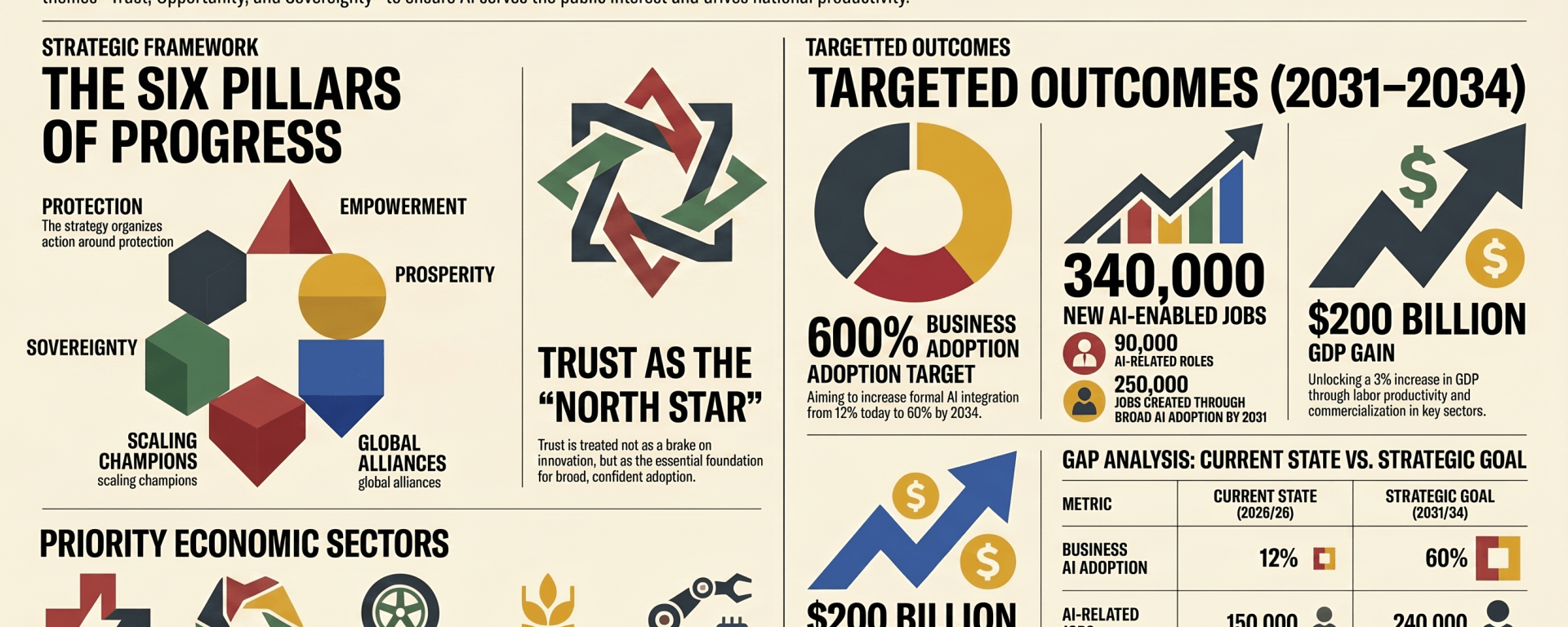
The quantitative foundations of the strategy outline ambitious economic, workforce, and adoption goals, juxtaposed against significant existing deficits.
| Metric / Objective | Current Baseline (2026) | Target / Projection | Timeframe |
| Total Federal AI Investment | Existing operational budgets | $2.3+ Billion CAD | 2026–20311 |
| Business AI Adoption Rate | ~12% of Canadian businesses | 60% across all sectors | 20342 |
| GDP Growth Contribution | Baseline | +$200 Billion (+3% GDP) | 20311 |
| Total AI-Related Job Creation | 150,000 existing jobs | +250,000 new jobs | 20314 |
| Youth AI Job Placements | N/A | 90,000 supported placements | 20313 |
| Global AI Literacy Ranking | 44th out of 47 globally | Top Tier (Targeted) | 20311 |
| Sovereign Compute Capacity | Baseline | 850 Megawatts | 20309 |
| Healthcare AI Integration | Localized academic pilots | 160 hospitals connected via VITAL | 2026–203022 |
2. Quantitative Summary of the “AI for All” Strategy
The “AI for All” framework represents the most aggressive industrial policy intervention in the Canadian technology sector to date. Recognizing that historic investments in foundational research failed to translate into broad industrial utilization, the administration structured the strategy across multiple funding mechanisms aimed directly at commercialization, sovereign infrastructure, and targeted sectoral adoption1. The total committed and near-term investment aggregates to well over $3.5 billion when factoring in overlapping programs announced in recent federal budgets9.
Core Funding Allocations and Strategic Vehicles
The strategy mobilizes capital through direct federal funding, crown corporation financing, and strategic co-investments, shifting the focus from academic grants to enterprise deployment.
| Initiative / Program | Budget Allocation | Strategic Purpose and Implementation Details |
| AI Compute Access Fund | $700 Million (Total $1B) | Expands domestic compute capacity, subsidizing access for SMEs and researchers to build sovereign infrastructure independent of foreign hyperscalers5. |
| Canadian Tech Growth Fund | $500 Million | Provides scale-up capital for national AI champions, allowing the federal government to potentially take equity stakes to prevent foreign acquisition1. |
| Regional AI Initiative | $500 Million | Distributed via Regional Development Agencies (e.g., Western Economic Diversification) to fund SME adoption projects, advisory services, and pilot deployments9. |
| BDC LIFT Program | $500 Million | Debt financing and adoption incentives deployed through the Business Development Bank of Canada to lower the upfront capital barriers of AI integration for SMEs1. |
| AI Missions (Healthcare) | $200 Million | A flagship mission to accelerate AI deployment in clinical diagnostics, patient care, and hospital system efficiency, serving as a template for public sector AI use9. |
| National AI Institutes | $130 Million | Dedicated commercialization programs and Founders-in-Residence support distributed across Mila (Montreal), Amii (Edmonton), and Vector Institute (Toronto)1. |
| VITAL Health Data Platform | $100 Million | Funding to expand sovereign, federated clinical data infrastructure across 160 Canadian hospitals, representing a total combined investment of over $210 million22. |
| Canadian AI Safety Institute | $50 Million | Capital to advance technical research, track systemic risks, and conduct transparent evaluations and red-teaming of frontier AI models1. |
| Creative Technology Program | $50 Million | Support for Canadian creators and intellectual property owners to leverage AI safely on their own terms4. |
These specific line items are further bolstered by broader macroeconomic mechanisms, such as the newly established $25 billion Canada Strong Fund, a sovereign wealth vehicle that may be leveraged to back national AI champions in priority sectors5. Additionally, specialized initiatives like the Venture Scientist Fund—launched in partnership with Inovia Capital to raise $100 million USD to back AI-native startups incubated at the national institutes—demonstrate a highly coordinated effort to fuse public policy with private venture capital37.
Priority Sectors for AI Integration
The federal government has targeted five critical sectors where Canada possesses existing structural advantages, deep data reservoirs, and acute productivity needs1.
| Priority Sector | Focus Area and Expected AI Integration |
| Health and Life Sciences | Accelerating drug discovery, deploying predictive analytics for patient outcomes, optimizing emergency room triage, and establishing sovereign health data platforms like VITAL4. |
| Energy & Natural Resources | Optimizing critical mineral extraction, managing clean energy grid transitions, retraining energy workers (via programs like Amii’s AI Pathways), and protecting allied supply chains1. |
| Financial Services / Fintech | Enhancing algorithmic trading, fraud detection, automated lending, and model risk management, operating under the strict compliance mandates of OSFI Guideline E-2327. |
| Transportation & Logistics | Developing predictive infrastructure maintenance, intelligent routing, and smarter traffic management systems across Canada’s expansive geographic footprint2. |
| Manufacturing & Agriculture | Scaling precision farming, mapping soil for optimal fertilizer application, and deploying dual-use industrial robotics to solve chronic labor shortages2. |
3. Research Details, Commentary, Key Insights, and Examples
The strategic transition mandated by the “AI for All” initiative acknowledges a fundamental vulnerability in Canada’s digital economy. For over a decade, Canada served as a premier incubator for fundamental AI research, cultivating the early advancements of machine learning through researchers like Geoffrey Hinton, Richard Sutton, and Yoshua Bengio3. However, this intellectual capital frequently migrated to American hyperscalers and foreign venture capital ecosystems, leaving Canadian industries as passive consumers of imported technology5. The new strategy attempts to arrest this intellectual property leakage through targeted commercialization, asserting a “build-partner-buy” doctrine that prioritizes building sovereign capabilities domestically4.
3.1 The Mechanics of the Strategy: The Six Pillars
The framework organizes its strategic interventions into six interconnected pillars, categorized under three overarching themes: Trust, Opportunity, and Sovereignty3.
- Protecting Canadians and Safeguarding Democracy (Trust): This pillar focuses on establishing modern privacy and online safety laws, combating deepfakes, and creating a “Canada Trusted AI Certification” program. It relies heavily on expanding the capabilities of the Canadian AI Safety Institute3.
- Ensuring AI Empowers Canadians (Opportunity): Addressing the critical literacy gap, the strategy pledges free AI literacy training to 1 million post-secondary students, training for over 3,000 K-12 educators, and the creation of 90,000 AI-related youth job placements3.
- Powering Shared Prosperity (Opportunity): Concentrating on SME adoption, this pillar deploys significant capital via the BDC LIFT program and Regional AI Initiatives to push enterprise adoption to 60% by 2034, utilizing the federal government as a strategic anchor customer3.
- Building the Sovereign AI Foundation (Sovereignty): Recognizing compute as a strategic national asset, the government aims to scale resilient compute infrastructure to 850 MW by 2030, build a public supercomputer, and increase Canada CIFAR AI Chairs from 130 to nearly 2003.
- Scaling Canadian Champions (Sovereignty): Through the $500M Tech Growth Fund and the expanded $700M Compute Access Fund, the strategy seeks to unlock growth capital to keep top-tier AI firms domiciled in Canada3.
- Building Trusted Partnerships (Trust & Sovereignty): This involves aligning with reliable democratic allies to develop shared standards. Initiatives like the Canada-Germany Sovereign Technology Alliance aim to pool research and procurement power to create credible alternatives to foreign platforms3.
3.2 The Healthcare Vanguard and Sovereign Data: The VITAL Platform
A critical insight from the strategy is the explicit focus on “digital sovereignty”—the principle that a nation must retain meaningful control over its digital infrastructure, data residency, and algorithmic governance5. This is most visibly manifested in the federal government’s $100 million investment into the VITAL health data platform9.
Led by researchers Dr. Fahad Razak and Dr. Amol Verma at Unity Health Toronto, VITAL expands upon the highly successful GEMINI infrastructure—which previously amassed over 30 billion data points, saving an estimated 50,000 bed days and $51 million across Ontario hospitals23. VITAL connects 160 hospitals across Ontario, Alberta, and Quebec23. Crucially, VITAL operationalizes the concept of “federated analytics,” wherein AI models are trained on clinical data without extracting or centralizing the personal health information (PHI) from the host province23.
This architectural choice resolves strict provincial privacy requirements while providing AI developers access to highly diverse, multi-jurisdictional clinical data representing 20 million Canadians24. For pharmaceutical companies, insurers, and medical device manufacturers, VITAL represents a highly regulated, sovereign “living laboratory.” It bridges the gap between academic discovery and commercial deployment, effectively safeguarding national data sovereignty while driving clinical innovation, and establishing a global template for privacy-compliant AI healthcare research23. Furthermore, the platform prioritizes Indigenous data sovereignty, ensuring that health data representing First Nations, Inuit, and Métis communities is governed by Indigenous health service organizations23.
3.3 Expert Commentary: The “Gap” Between Strategy and Outcomes
Despite the profound economic optimism, the strategy has faced severe, systemic criticism from policy analysts, legal scholars, and civil society. Experts indicate a massive gap between the specific approaches described in the strategy and the desired outcomes of a safe, trusted, and equitable technological transformation.
The Environmental Paradox
The strategy’s pursuit of “sovereign compute” highlights a stark environmental paradox. The federal government points to Canada’s clean grid (83% renewable/low-emission) and cold climate as natural advantages for operating energy-hungry data centers9. However, this narrative is directly contradicted by the proposed Wonder Valley AI Data Centre in Alberta. Spearheaded by celebrity investor Kevin O’Leary, the planned 7.5-gigawatt hyperscale facility is projected to be powered predominantly by natural gas13. Furthermore, the Alberta provincial government exempted the Wonder Valley project from a formal environmental impact assessment, triggering fierce opposition from local and Indigenous communities20.
Environmental organizations, such as Stand.earth, argue that hyperscale AI data centers consume unsustainable amounts of fresh water for cooling and threaten to heavily strain regional power grids, driving up residential energy costs and greenhouse gas emissions13. Analyst Maroussia Lévesque notes that replicating the American hyperscaler model is “doomed to take us closer to climate-change tipping points,” suggesting the strategy should instead adopt a “Small Is Beautiful” mindset, focusing on smaller, purpose-specific models powered by hyperlocal, genuinely green data centers13.
Governance, Trust, and Democracy
Experts heavily critique the strategy’s socio-political orientation, particularly its assumption that public skepticism is merely an educational deficit. Danica Pawlick-Potts emphasizes that “literacy is not consent,” arguing that citizens who understand AI should be fully empowered to refuse engagement with it, a right the strategy functionally ignores13. Academic Fenwick McKelvey asserts that the strategy capitulates to corporate “AI boosterism” rather than protecting democratic institutions from the systemic risks of technology13.
Cynthia Khoo notes the glaring omission of the term “human rights” from the strategy document. She argues the government focuses on pushing transparency to force citizens to protect themselves, rather than imposing strict corporate accountability on the “AI industrial complex”13. Vass Bednar highlights a specific regulatory gap: while the strategy acknowledges the harms of “surveillance pricing”—where AI analyzes consumer data to maximize individual price gouging—it fails to introduce any immediate statutory prohibitions against the practice13. Ultimately, experts like Blair Attard-Frost conclude that the strategy offers a “loose, inconsistent, and opaque regulatory regime” where protections will be determined by market forces and closed-door deals with US tech giants, rather than democratic law13.
3.4 The Regulated Industries Landscape: Bridging the Governance Void
The most pressing challenge for senior leaders in regulated industries is navigating the fragmented regulatory environment that the strategy endorses by default. Following the collapse of the Artificial Intelligence and Data Act (AIDA) in 2025, the Carney administration elected not to introduce a comprehensive, standalone AI bill6. Consequently, regulated organizations must comply with an increasingly complex patchwork of existing and emerging regional laws7.
In Quebec, Law 25 imposes strict transparency requirements on organizations utilizing automated decision-making systems involving personal data, mandating the right to human review11. In Ontario, Bill 194 (The Enhancing Digital Security and Trust Act, 2024) enforces rigorous cybersecurity and AI accountability frameworks on public sector entities, requiring public disclosure of AI use, mandatory Privacy Impact Assessments (PIAs), and documented human oversight mechanisms12. Federal privacy laws, such as PIPEDA and the proposed Consumer Privacy Protection Act (CPPA), continue to be stretched to cover generative AI use cases, focusing on strict consent and data minimization7.
For the financial sector, this provincial patchwork is superseded by the Office of the Superintendent of Financial Institutions (OSFI), which introduced Guideline E-23 on Enterprise-Wide Model Risk Management28. Taking effect in May 2027, E-23 casts an expansive net, defining a “model” broadly enough to encompass everything from traditional credit scoring algorithms to generative AI, large language models (LLMs), and autonomous agentic AI27.
Financial institutions must meticulously document data provenance, developmental testing, algorithmic fairness, and human oversight controls for any model impacting risk profiles27. Crucially, E-23 mandates that independent validation teams—completely separated from the model developers—must review and approve these models prior to deployment27. This places a massive governance burden on financial institutions and their third-party software vendors, who must provide unprecedented transparency into their proprietary models to secure enterprise contracts27.
4. Hypothesis Testing
The premise of this analysis rests on testing two critical hypotheses regarding the strategic direction of Canadian AI policy. Analyzing these hypotheses against the empirical data, international legal frameworks, and expert commentaries provides vital clarity for organizational leaders.
Hypothesis 1: Strategy is great but we are still missing Canadian AI Policy to make this real. The last Canadian AI Policy was rejected. Without this policy, progress will be limited.
Finding: Validated with Nuance.
The collapse of the Artificial Intelligence and Data Act (AIDA) under the broader Bill C-27 omnibus package in early 2025 created a profound vacuum in Canadian federal policy6. AIDA was intended to establish baseline legal obligations for “high-impact” AI systems, including mandatory risk mitigation, bias testing, and public transparency10. Without AIDA, the “AI for All” strategy relies heavily on funding incentives and future, undefined legislative promises regarding privacy and online harms1.
This absence of a unifying national policy severely limits progress for both citizens and enterprises. For citizens, as highlighted by experts like Blair Attard-Frost and Cynthia Khoo, the lack of statutory rights means that protections against algorithmic discrimination, deepfakes, and surveillance pricing remain theoretical13. The government’s reliance on “proactive engagement” lacks the enforcement mechanisms necessary to build public trust, which the strategy itself acknowledges is the crucial “North Star” required for mass adoption13.
For enterprises, particularly in regulated sectors, the absence of a federal standard creates immense friction. Instead of a single, coherent framework, organizations must navigate a rapidly fracturing jurisdictional landscape. A company deploying an AI system nationally must reconcile Quebec’s Law 25, Ontario’s Bill 194, federal human rights codes, and shifting OSFI mandates7. This regulatory fragmentation increases compliance costs, deters foreign investment, and delays enterprise deployment as legal teams struggle to define the operational boundaries of acceptable AI use11. Furthermore, without a comprehensive national law, Canadian companies lack a distinct mechanism to ensure immediate legal interoperability with the EU AI Act. Therefore, while the capital injection of the strategy is robust, the lack of a foundational national policy significantly throttles sustainable, scalable progress.
Hypothesis 2: AI Government Certification (proposed in the strategy) is not a best practice in North America or Europe. Its not a replacement for the much needed policy.
Finding: Validated.
The “AI for All” strategy proposes the creation of a “Canada Trusted AI Certification program” to help consumers identify trustworthy products1. However, global regulatory trends strongly indicate that voluntary certification is not a substitute for statutory enforcement, nor does it align with best practices emerging in the European Union and the United States.
In the European Union, the AI Act establishes a rigid, risk-based legal framework that completely bans “unacceptable risk” systems (e.g., social scoring, emotion recognition in workplaces) and imposes exhaustive, mandatory compliance obligations on “high-risk” systems (e.g., healthcare diagnostics, automated employment screening, biometric identification, critical infrastructure)14. Providers of high-risk systems must complete rigorous conformity assessments, maintain deep technical documentation, guarantee human oversight, and affix a CE mark before entering the market15. Crucially, the EU AI Act is extraterritorial; any North American company whose AI output impacts EU citizens must comply, facing fines of up to €35 million or 7% of global turnover for violations14. Even minimal risk systems are subject to mandatory transparency rules under Article 50 (e.g., users must be informed they are interacting with an AI) and organizations must meet AI literacy standards under Article 414.
While the EU does utilize voluntary mechanisms, such as the AI Pact and the Code of Practice for general-purpose AI (GPAI), these act strictly as transitional bridges to legal compliance or operational guidance for systemic risks, not as replacements for the law52. Similarly, in the United States, while federal legislation remains fragmented, Executive Orders and frameworks like the NIST AI Risk Management Framework, alongside state-level laws (such as Colorado’s AI Act), mandate strict algorithmic impact assessments, bias auditing, and consumer opt-out rights55.
Canada’s proposed voluntary certification is fundamentally inadequate for protecting fundamental rights or managing systemic enterprise risk. As noted by legal analysts, without statutory teeth, companies have no legal obligation to submit to audits, comply with watermarking standards, or disclose safety failures13. Government certification allows non-compliant actors to bypass safety measures while placing the burden of due diligence entirely on the consumer. Thus, government certification is a supplementary tool, but entirely insufficient as a replacement for comprehensive policy.
5. Key Actions for Senior Leaders of Progressive Organizations
For senior leaders in progressive, heavily regulated organizations across North America and Europe, the “AI for All” strategy presents a lucrative landscape of funding and sovereign infrastructure, provided the organization can navigate the accompanying governance complexities. To maximize opportunities and avoid common pitfalls, leaders should execute the following strategic imperatives:
Pre-empt Regulation by Institutionalizing ISO/IEC 42001
Progressive organizations must not wait for the Canadian government to finalize its fractured legislative framework. Instead, they should adopt internationally recognized standards, specifically ISO/IEC 42001, to establish a defensible, auditable Artificial Intelligence Management System (AIMS)17. Implementing ISO 42001 ensures that the organization systematically manages data quality, bias mitigation, human oversight, and algorithmic transparency throughout the AI lifecycle16. Achieving this certification, through bodies accredited by the Standards Council of Canada (SCC), serves a dual purpose: it acts as a competitive differentiator in B2B procurement and pre-aligns the organization with the stringent documentation and risk management requirements of the EU AI Act, safeguarding access to European markets16.
Capitalize on Sovereign Infrastructure and Sector-Specific Funding
The strategy signals a massive shift toward domestic data residency and sovereign compute9. Progressive leaders should aggressively pursue funding through the $500 million Business Development Bank of Canada (BDC) LIFT program and the Compute Access Fund to subsidize the integration of AI into their core operations9. Healthcare and life sciences leaders must actively partner with the VITAL health data platform23. By participating in this federated data ecosystem, organizations can gain secure access to a massive demographic cross-section for training diagnostic and predictive models, positioning themselves at the forefront of global medical AI commercialization without violating patient privacy laws23.
Operationalize OSFI Guideline E-23 for Enterprise Agility
For financial and insurance institutions, OSFI Guideline E-23 is not merely a compliance exercise; it is an architectural mandate28. Progressive financial leaders must immediately overhaul their Model Risk Management (MRM) frameworks. This requires constructing centralized model registries that track all AI deployments, from generative AI copilots to algorithmic trading models and agentic workflows28. Leaders must enforce strict separation of duties, ensuring that independent validation teams possess the technical acumen and authority to challenge, audit, and reject models proposed by development teams27. By treating robust governance as an enabler rather than a bottleneck, institutions can deploy advanced AI faster and more securely than their laggard competitors58.
Embed AI Governance in Third-Party Procurement
The proliferation of Software-as-a-Service (SaaS) embedded with generative AI means that organizations are inheriting third-party algorithmic risk14. Progressive leaders must update procurement protocols to require vendors to provide exhaustive documentation regarding data provenance, model lineage, bias testing, and intellectual property indemnification27. Vendors who cannot produce transparency reports or fail to align with NIST AI RMF or ISO 42001 standards must be disqualified from supplying critical enterprise systems28.
6. Key Actions for Senior Leaders Falling Behind
For organizations that have treated AI merely as a theoretical disruption or have stalled in the experimental pilot phase, the “AI for All” strategy serves as a critical warning. The competitive gap is widening rapidly. To catch up and mitigate existential operational risks, laggard leaders must take immediate, foundational actions:
Establish Baseline AI Literacy and Eradicate “Shadow AI”
The most acute vulnerability for trailing organizations is workforce unpreparedness, reflecting Canada’s low global ranking in AI literacy1. Employees attempting to leverage AI without organizational guidance inevitably utilize unsanctioned, public consumer tools, resulting in catastrophic data leakage and intellectual property exposure. Leaders must immediately deploy enterprise-grade, secure AI environments and initiate comprehensive, role-specific AI literacy training1. Concurrently, IT and security teams must conduct extensive “Shadow AI” audits, particularly targeting mobile devices where traditional endpoint controls frequently fail to detect unauthorized AI usage, bypassing secure web gateways44.
Develop a Comprehensive AI Risk Inventory
Organizations cannot govern what they cannot see. Laggard leaders must immediately mandate the creation of a centralized AI inventory15. This inventory must catalog every instance of AI utilized within the enterprise, documenting the business function, the data sources consumed (specifically highlighting any Personally Identifiable Information or Protected Health Information), the level of autonomous decision-making, and the designated internal owner55. Once cataloged, these systems must be classified by risk level, allowing the organization to triage its compliance efforts and immediately suspend any applications that violate existing provincial laws, such as Quebec’s Law 25, or fall into the EU AI Act’s “unacceptable” or “high risk” categories11.
Implement Mandatory “Human-in-the-Loop” Safeguards
Until mature governance frameworks are established, trailing organizations must strictly prohibit fully autonomous AI decision-making in any high-stakes context (e.g., hiring, lending, medical triage, legal analysis)7. All AI outputs must be treated as augmentative drafts requiring mandatory human review and authorization7. This “human-in-the-loop” policy mitigates the risk of algorithmic hallucinations, limits legal liability, and satisfies the baseline transparency and accountability requirements expected by existing human rights tribunals, privacy commissioners, and the Ontario Bill 194 public sector directives16.
Secure Executive and Board-Level Accountability
The era of delegating AI responsibility exclusively to the IT department has ended. Corporate boards and C-suite executives hold fiduciary responsibility for AI-induced failures, including regulatory fines, discriminatory outcomes, and operational disruptions43. Laggard leaders must establish a cross-functional AI governance committee comprising legal, compliance, risk, human resources, and technology executives50. This committee must actively define the organization’s AI risk appetite, align deployment strategies with ethical standards, and oversee the immediate remediation of compliance gaps30.
7. Complete List of Sources
Below is the complete list of URLs referenced in the research material used to construct this analysis:
- https://kpmg.com/ca/en/insights/2026/06/canadian-national-ai-strategy-ai-for-all.html
- https://www.ised-isde.canada.ca/site/ised/en/artificial-intelligence-ecosystem/overview-canadas-national-artificial-intelligence-strategy
- https://codetocloud.io/blog/canada-ai-for-all
- https://ised-isde.canada.ca/site/ised/en/canadas-national-artificial-intelligence-strategy-ai-all
- https://www.cbc.ca/news/politics/carney-ai-strategy-9.7223236
- https://www.youtube.com/watch?v=vLP1qKuF4ms
- https://www.newswire.ca/news-releases/prime-minister-carney-launches-ai-for-all-canada-s-new-national-artificial-intelligence-strategy-868749966.html
- https://www.canada.ca/en/innovation-science-economic-development/news/2026/06/minister-solomon-highlights-canadas-national-artificial-intelligence.html
- https://www.financialexpress.com/world-news/canada-unveils-ai-strategy-targeting-250000-jobs-stronger-safeguards-and-200-billion-growth/4260363/
- https://www.youtube.com/watch?v=axAUo4f7C8Q
- https://www.parl.ca/legisinfo/en/bill/44-1/c-27
- https://ised-isde.canada.ca/site/innovation-better-canada/en/artificial-intelligence-and-data-act-aida-companion-document
- https://securityboulevard.com/2026/06/magnifica-humanitas-pope-leos-take-on-intelligence-artificial-and-otherwise/
- https://www.canadianlawyermag.com/news/general/artificial-intelligence-and-data-act-replacement-unlikely-under-new-national-ai-strategy-lawyers/394177
- https://www.policyalternatives.ca/news-research/canada-still-has-no-meaningful-ai-regulation/
- https://cookie-script.com/privacy-laws/bill-c27
- https://www.pm.gc.ca/en/news/news-releases/2026/06/04/prime-minister-carney-launches-ai-all-canadas-new-national-artificial
- https://iapp.org/news/a/canada-launches-ai-strategy-to-advance-digital-sovereignty-adoption
- https://thewalrus.ca/canada-ai-plan/
- https://thewalrus.ca/canada-ai-plan/#Blair
- https://thewalrus.ca/canada-ai-plan/#Maroussia
- https://thewalrus.ca/author/sheldon-fernandez/
- https://thewalrus.ca/canada-ai-plan/#Danica
- https://thewalrus.ca/canada-ai-plan/#Vass
- https://thewalrus.ca/canada-ai-plan/#Fenwick
- https://thewalrus.ca/canada-ai-plan/#Alissa
- https://thewalrus.ca/canada-ai-plan/#Cynthia
- https://www.dataguidance.com/news/canada-government-publishes-national-ai-strategy-major
- https://letsdatascience.com/news/canada-releases-ai-for-all-national-ai-strategy-e0801da6
- https://www.mltaikins.com/insights/canadas-new-ai-strategy-and-opc-annual-report-what-organizations-need-to-know/
- https://gowlingwlg.com/en/insights-resources/articles/2026/canada-launches-ai-for-all-national-artificial-intelligence-strategy
- https://www.ckom.com/2026/06/04/5-things-you-need-to-know-about-canadas-new-ai-strategy/
- https://www.workstreet.com/blog/eu-ai-act-compliance
- https://www.computing.co.uk/news/2026/government/eu-proposes-shutting-out-us-tech-providers
- https://www.protiviti.com/us-en/resource-guide/eu-ai-act-regulations-compliance-and-best-practices
- https://cset.georgetown.edu/article/eu-ai-code-safety/
- https://defined.ai/blog/ai-governance-best-practices
- https://www.harvey.ai/blog/governance-iso-42001
- https://digital-strategy.ec.europa.eu/en/policies/regulatory-framework-ai
- https://gdprlocal.com/europe-ai-act-summary/
- https://www.jdsupra.com/legalnews/trump-s-ai-cybersecurity-order-a-8796602/
- https://verifywise.ai/ai-governance-library/regulations-and-laws/eu-ai-act-first-regulation-on-artificial-intelligence
- https://www.modelop.com/ai-governance/ai-regulations-standards/eu-ai-act-vs-iso-42001
- https://www.whitecase.com/insight-our-thinking/ai-watch-global-regulatory-tracker-european-union
- https://unpublished.ca/news-feed-item/2026-06-05/canada-finally-has-a-national-ai-strategy-experts-hate-it
- https://stand.earth/press-releases/canadas-ai-strategy-falls-short-on-protecting-communities/
- https://www.youtube.com/watch?v=xtQkHl6H3TE
- https://betakit.com/canadas-ai-strategy-promises-to-protect-citizens-critics-say-it-still-lacks-teeth/
- https://betakit.com/canadas-ai-strategy-draws-mixed-reviews-from-across-the-tech-ecosystem/
- https://practiceguides.chambers.com/practice-guides/artificial-intelligence-2026/canada/trends-and-developments
- https://www.salesforce.com/news/stories/call-to-leaders-regulated-industries-ai/
- https://www.linuxfoundation.org/blog/navigating-the-agentic-ai-guardrails-why-open-source-is-the-key-to-ai-in-regulated-industries
- https://www.calian.com/resources/blogs/sovereign-ai-in-financial-services-managing-risk-compliance-and-competitive-pressure/
- https://kpmg.com/ca/en/insights/unlocking-productivity/the-role-of-ai-literacy-on-the-path-to-productivity.html
- https://kpmg.com/ca/en/insights/2025/06/canada-lagging-global-peers-in-ai-trust-and-literacy.html
- https://kpmg.com/ca/en/insights/2026/02/execution-imperatives-for-canadian-tech-leaders.html
- https://kpmg.com/ca/en/services/digital/ai-services.html
- https://uhnfoundation.ca/stories/federal-government-launches-ai-strategy-with-focus-on-health-care-innovation/
- https://briefglance.com/articles/canadas-ai-health-strategy-a-high-stakes-bet-on-innovation-and-trust
- https://www.lookout.com/blog/mobile-ai-governance-can-no-longer-be-ignored
- https://www.mltaikins.com/insights/ai-governance-what-organizations-need-to-know/
- https://www.osler.com/en/insights/updates/finding-the-balance-how-canada-should-approach-ai-regulation/?pdf=1
- https://www.hubinternational.com/en-CA/products/proex/the-advocate/2026/03/canadian-ai-corporate-governance-guide-for-directors-and-officers/
- https://www.friggp2c.com/ai-governance-canada-aida-readiness-guide/
- https://unityhealth.to/2026/06/vital-health-data-platform-ai-for-all/
- https://verifywise.ai/blog/osfi-e-23-ai-model-risk-management-canada
- https://www.mccarthy.ca/en/insights/blogs/techlex/osfi-e-23-guideline-and-its-impact-on-financial-institutions
- https://empoweredsystems.com/blog/enhancing-model-risk-management-with-osfi-guideline-e-23-a-comprehensive-overview/
- https://safetyculture.com/topics/risk-management/model-risk-management
- https://kpmg.com/ca/en/insights/2025/08/are-you-ready-for-guideline-e23.html
- https://www.ola.org/en/legislative-business/bills/parliament-43/session-1/bill-194
- https://www.ontario.ca/laws/statute/s24024
- https://www.ohrc.on.ca/en/bill-194-strengthening-cyber-security-and-building-trust-public-sector-act-2024
- https://oba.org/bill-194-how-public-sector-institutions-should-prepare-for-it/
- https://www.weirfoulds.com/bill-194-how-public-sector-institutions-should-prepare-for-it
- https://hi3.utoronto.ca/vital/
- https://geminimedicine.ca/VITAL/
- https://unityhealth.to/2026/06/vital-announced-as-key-pillar-in-canadas-ai-strategy/
- https://geminimedicine.ca/about-us/
- https://www.canhealth.com/2026/06/03/st-mikes-research-platform-to-expand-across-canada/
- https://www.ourcommons.ca/petitions/en/Petition/Details?Petition=e-7427
- https://www.reddit.com/r/Edmonton/comments/1tnc83o/sign_the_petition_pause_approvals_and/
- https://www.cbc.ca/news/world/kevin-oleary-data-centre-utah-9.7207716
- https://www.cbc.ca/news/canada/edmonton/wonder-valley-data-centre-environmental-impact-assessment-9.7158526
- https://www.mhmcpa.ca/iso-42001
- https://www.sgs.com/en-us/webinars/2026/05/how-to-build-your-ai-governance-guardrails
- https://www.globalrelay.com/resources/the-compliance-hub/rules-and-regulations/aida-patchworking-ai-risk-management-for-canadian-federal-regulators-while-the-act-is-on-pause/
- https://aictglobalservices.com/
- https://www.credo.ai/blog/ai-standards-deep-dive-decoding-different-ai-standards-and-the-eus-approach
- https://iapp.org/news/a/notes-from-the-iapp-canada-privacy-and-trust-take-center-stage-in-canadas-ai-agenda
- https://globalnews.ca/news/11889388/canada-ai-strategy-release/
- https://www.publicnow.com/view/C2E4ACE8902521AAD86F95BF11861AADD27A292C
- https://letsdatascience.com/news/canada-boosts-national-ai-institutes-with-funding-33ecbab9
- https://ised-isde.canada.ca/site/planning-performance-reporting/en/departmental-plans/2026-27-departmental-plan
- https://budget.canada.ca/update-miseajour/2026/report-rapport/chap1-en.html
- https://utppublishing.com/doi/full/10.3138/cpp.2025-036
- https://budget.canada.ca/update-miseajour/2026/report-rapport/pdf/update-miseajour2026-eng.pdf
- https://briefglance.com/articles/canadas-23b-ai-for-all-strategy-aims-to-close-the-adoption-gap
- https://consumerchoicecenter.org/canadas-ai-for-all-plan-means-ai-approved-by-ottawa/
- https://universityaffairs.ca/news/new-federal-ai-strategy-invests-heavily-in-university-research-training-and-commercialization/
Works cited
- Canada’s national artificial intelligence strategy: AI for All – KPMG International, https://kpmg.com/ca/en/insights/2026/06/canadian-national-ai-strategy-ai-for-all.html
- Prime Minister Carney launches AI for All: Canada’s new national artificial intelligence strategy – Newswire.ca, https://www.newswire.ca/news-releases/prime-minister-carney-launches-ai-for-all-canada-s-new-national-artificial-intelligence-strategy-868749966.html
- Overview of Canada’s National Artificial Intelligence Strategy: AI for All, https://www.ised-isde.canada.ca/site/ised/en/artificial-intelligence-ecosystem/overview-canadas-national-artificial-intelligence-strategy
- https://ised-isde.canada.ca/site/ised/en/canadas-national-artificial-intelligence-strategy-ai-all
- Canada’s $2.3B ‘AI for All’ Strategy Aims to Close the Adoption Gap – BriefGlance.com, https://briefglance.com/articles/canadas-23b-ai-for-all-strategy-aims-to-close-the-adoption-gap
- https://www.canadianlawyermag.com/news/general/artificial-intelligence-and-data-act-replacement-unlikely-under-new-national-ai-strategy-lawyers/394177
- AI governance: What organizations need to know in 2026 | Insights – MLT Aikins, https://www.mltaikins.com/insights/ai-governance-what-organizations-need-to-know/
- Canada unveils AI strategy targeting 250,000 jobs, stronger safeguards and $200 billion growth, https://www.financialexpress.com/world-news/canada-unveils-ai-strategy-targeting-250000-jobs-stronger-safeguards-and-200-billion-growth/4260363/
- Canada’s National AI Strategy Explained: What AI for All Means for Canadian Businesses | Code To Cloud, https://codetocloud.io/blog/canada-ai-for-all
- Bill C-27: The Future of Canadian Privacy Law – Cookie Script, https://cookie-script.com/privacy-laws/bill-c27
- Finding the balance: how Canada should approach AI regulation, https://www.osler.com/en/insights/updates/finding-the-balance-how-canada-should-approach-ai-regulation/?pdf=1
- Bill 194, Strengthening Cyber Security and Building Trust in the Public Sector Act, 2024 – Legislative Assembly of Ontario, https://www.ola.org/en/legislative-business/bills/parliament-43/session-1/bill-194
- Canada Finally Has a National AI Strategy. Experts Hate It | The Walrus, https://thewalrus.ca/canada-ai-plan/
- EU AI Act Compliance: What US SaaS Companies Need to Know | Workstreet, https://www.workstreet.com/blog/eu-ai-act-compliance
- Europe AI Act Summary: EU Artificial Intelligence Regulations – GDPR Local, https://gdprlocal.com/europe-ai-act-summary/
- AI Governance at :Harvey:: Announcing our ISO 42001 Certification, https://www.harvey.ai/blog/governance-iso-42001
- EU AI Act vs ISO 42001 – ModelOp, https://www.modelop.com/ai-governance/ai-regulations-standards/eu-ai-act-vs-iso-42001
- MHM ISO 42001 AI Management System (AIMS) Audit Certification Services, https://www.mhmcpa.ca/iso-42001
- Sovereign AI in financial services: managing risk, compliance and competitive pressure, https://www.calian.com/resources/blogs/sovereign-ai-in-financial-services-managing-risk-compliance-and-competitive-pressure/
- Kevin O’Leary wants to build a massive AI data centre in Utah. Some residents aren’t happy, https://www.cbc.ca/news/world/kevin-oleary-data-centre-utah-9.7207716
- Wonder Valley AI Data Centre exempt from provincial environmental impact assessment, still needs permits | CBC News, https://www.cbc.ca/news/canada/edmonton/wonder-valley-data-centre-environmental-impact-assessment-9.7158526
- Canada’s AI Health Strategy: A High-Stakes Bet on Innovation and Trust – BriefGlance.com, https://briefglance.com/articles/canadas-ai-health-strategy-a-high-stakes-bet-on-innovation-and-trust
- $100-million awarded to health data platform founded by St. Michael’s Hospital physicians in Canada’s new AI strategy, https://unityhealth.to/2026/06/vital-health-data-platform-ai-for-all/
- VITAL – GEMINI, https://geminimedicine.ca/VITAL/
- VITAL – HI³ – The Canadian Hub for Health Intelligence & Innovation in Infectious Diseases – University of Toronto, https://hi3.utoronto.ca/vital/
- St. Mike’s research platform to expand across Canada | Canadian Healthcare Technology, https://www.canhealth.com/2026/06/03/st-mikes-research-platform-to-expand-across-canada/
- OSFI Guideline E-23: how AI and ML models fit the new model risk rules – VerifyWise, https://verifywise.ai/blog/osfi-e-23-ai-model-risk-management-canada
- OSFI E-23 Guideline and Its Impact on Financial Institutions – McCarthy Tétrault LLP, https://www.mccarthy.ca/en/insights/blogs/techlex/osfi-e-23-guideline-and-its-impact-on-financial-institutions
- Are you ready for Guideline E-23? – KPMG International, https://kpmg.com/ca/en/insights/2025/08/are-you-ready-for-guideline-e23.html
- What Is Model Risk Management? A Complete Guide – Safety Culture, https://safetyculture.com/topics/risk-management/model-risk-management
- EU looks to go it alone as it proposes shutting out US tech providers, https://www.computing.co.uk/news/2026/government/eu-proposes-shutting-out-us-tech-providers
- Navigating the Agentic AI Guardrails: Why Open Source is the Key to AI in Regulated Industries – Linux Foundation, https://www.linuxfoundation.org/blog/navigating-the-agentic-ai-guardrails-why-open-source-is-the-key-to-ai-in-regulated-industries
- Carney’s AI strategy promises over $2B in funding, aims to create 250000 jobs by 2031, https://www.cbc.ca/news/politics/carney-ai-strategy-9.7223236
- Canada launches “AI for All” national artificial intelligence strategy – Gowling WLG, https://gowlingwlg.com/en/insights-resources/articles/2026/canada-launches-ai-for-all-national-artificial-intelligence-strategy
- Canada’s “AI for All” Plan Means AI Approved by Ottawa – Consumer Choice Center, https://consumerchoicecenter.org/canadas-ai-for-all-plan-means-ai-approved-by-ottawa/
- Prime Minister Carney launches AI for All: Canada’s new national artificial intelligence strategy, https://www.pm.gc.ca/en/news/news-releases/2026/06/04/prime-minister-carney-launches-ai-all-canadas-new-national-artificial
- Canada boosts national AI institutes with funding | Let’s Data Science, https://letsdatascience.com/news/canada-boosts-national-ai-institutes-with-funding-33ecbab9
- TECHNATION Response to Canada’s National AI Strategy – Public Technologies (PUBT), https://www.publicnow.com/view/C2E4ACE8902521AAD86F95BF11861AADD27A292C
- Canada unveils AI strategy with plans for widespread adoption, data centres – Global News, https://globalnews.ca/news/11889388/canada-ai-strategy-release/
- Artificial Intelligence 2026 – Canada | Global Practice Guides | Chambers and Partners, https://practiceguides.chambers.com/practice-guides/artificial-intelligence-2026/canada/trends-and-developments
- Canada’s AI strategy falls short on protecting communities – Stand.earth, https://stand.earth/press-releases/canadas-ai-strategy-falls-short-on-protecting-communities/
- Sign the Petition – Pause Approvals and Construction of AI Data Centres in Alberta! : r/Edmonton – Reddit, https://www.reddit.com/r/Edmonton/comments/1tnc83o/sign_the_petition_pause_approvals_and/
- Canadian AI Corporate Governance Guide for Directors & Officers | HUB International, https://www.hubinternational.com/en-CA/products/proex/the-advocate/2026/03/canadian-ai-corporate-governance-guide-for-directors-and-officers/
- Canada’s Emerging AI Regulations Are Sending a Clear Signal: Mobile AI Governance Can No Longer Be Ignored – Lookout, Inc., https://www.lookout.com/blog/mobile-ai-governance-can-no-longer-be-ignored
- Bill 194 – How Public Sector Institutions Should Prepare For It – WeirFoulds LLP, https://www.weirfoulds.com/bill-194-how-public-sector-institutions-should-prepare-for-it
- Canada’s new AI strategy and OPC Annual Report: What organizations need to know, https://www.mltaikins.com/insights/canadas-new-ai-strategy-and-opc-annual-report-what-organizations-need-to-know/
- The Artificial Intelligence and Data Act (AIDA) – Companion document – Innovation, Science and Economic Development Canada, https://ised-isde.canada.ca/site/innovation-better-canada/en/artificial-intelligence-and-data-act-aida-companion-document
- Canada Finally Has a National AI Strategy. Experts Hate It, https://unpublished.ca/news-feed-item/2026-06-05/canada-finally-has-a-national-ai-strategy-experts-hate-it
- 5 things you need to know about Canada’s new AI strategy – 650 CKOM, https://www.ckom.com/2026/06/04/5-things-you-need-to-know-about-canadas-new-ai-strategy/
- A guide to the EU AI Act: Regulations, compliance and best practices – Protiviti, https://www.protiviti.com/us-en/resource-guide/eu-ai-act-regulations-compliance-and-best-practices
- EU AI Act explained: risk categories, compliance deadlines, and penalties up to 7% of revenue – VerifyWise, https://verifywise.ai/ai-governance-library/regulations-and-laws/eu-ai-act-first-regulation-on-artificial-intelligence
- AI Safety under the EU AI Code of Practice — A New Global Standard? | Center for Security and Emerging Technology, https://cset.georgetown.edu/article/eu-ai-code-safety/
- AI Act | Shaping Europe’s digital future – European Union, https://digital-strategy.ec.europa.eu/en/policies/regulatory-framework-ai
- AI Standards Deep-Dive: Decoding Different AI Standards and the EU’s Approach – Credo AI, https://www.credo.ai/blog/ai-standards-deep-dive-decoding-different-ai-standards-and-the-eus-approach
- AI Governance Best Practices: The Enterprise Checklist – Defined.ai, https://defined.ai/blog/ai-governance-best-practices
- Trump’s AI Cybersecurity Order: A Voluntary Framework with Mandatory Implications, https://www.jdsupra.com/legalnews/trump-s-ai-cybersecurity-order-a-8796602/
- AIDA AI Risk Management in Canada: What Regulators Must Know – Global Relay, https://www.globalrelay.com/resources/the-compliance-hub/rules-and-regulations/aida-patchworking-ai-risk-management-for-canadian-federal-regulators-while-the-act-is-on-pause/
- Enhancing Model Risk Management with OSFI Guideline E-23: A Comprehensive Overview, https://empoweredsystems.com/blog/enhancing-model-risk-management-with-osfi-guideline-e-23-a-comprehensive-overview/
- How to Build AI Governance in Canada: AIDA Compliance Guide – Frigg Business Solutions, https://www.friggp2c.com/ai-governance-canada-aida-readiness-guide/
- Regulated Industries Imperative: Agentic Era Demands Leadership – Salesforce, https://www.salesforce.com/news/stories/call-to-leaders-regulated-industries-ai/
- Bill 194, Strengthening Cyber Security and Building Trust in the Public Sector Act, 2024 | Ontario Human Rights Commission, https://www.ohrc.on.ca/en/bill-194-strengthening-cyber-security-and-building-trust-public-sector-act-2024
The idea, research hypotheses, and focus for this article/research are all original and mine. This article was written with my brain and two hands with the assistance of Google Gemini, Notebook LM, Claude, and other wondrous toys.

