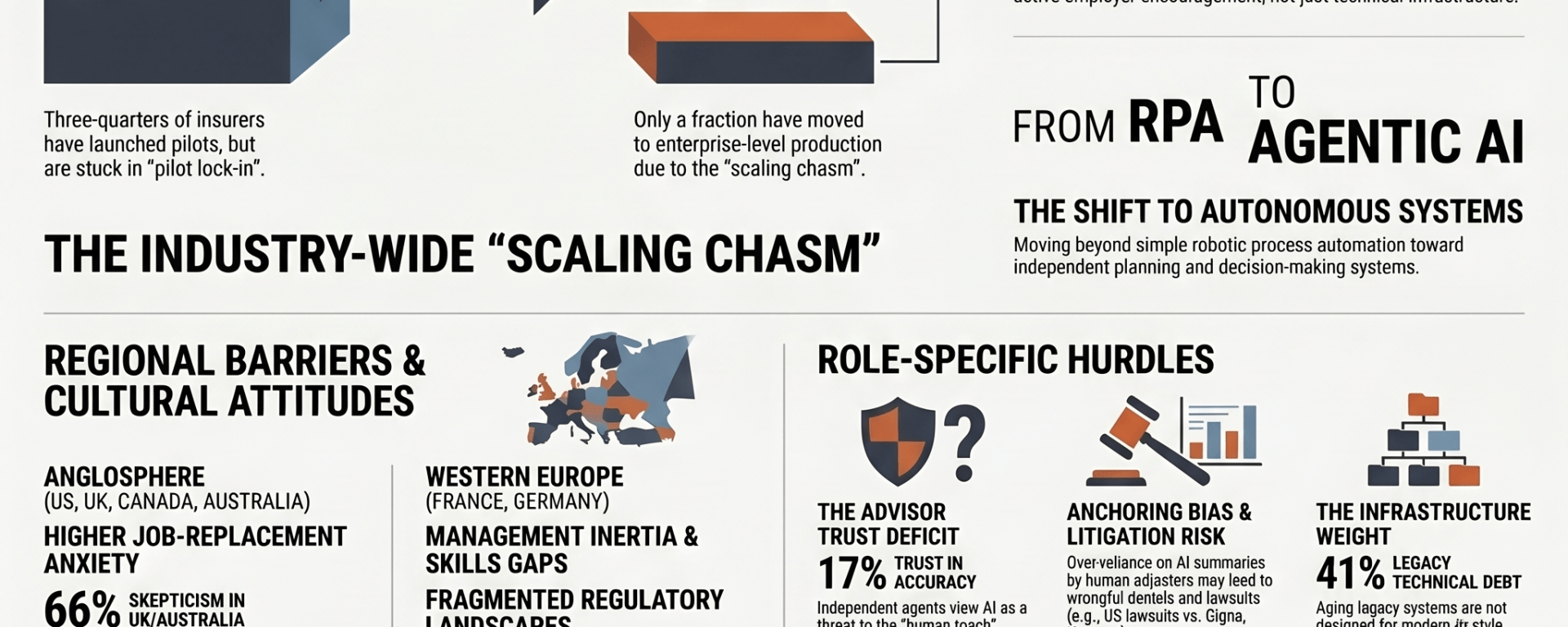
Executive Summary
The global insurance industry is currently undergoing a structural pivot as artificial intelligence transitions from isolated experimental pilots into the core fabric of organizational strategy. While high-level adoption statistics suggest a rapid uptake—with 76% of insurers implementing generative AI in at least one function by mid-2024—the reality reveals a significant “scaling chasm” where only 7% of organizations have successfully deployed AI systems at an enterprise level.1 This report, prepared from the perspective of senior AI strategic counsel, identifies the psychological, structural, and regulatory barriers preventing the industry from realizing the full $9 billion in projected market value by 2029.2
Strategic analysis across North America, Europe, and Australia indicates that the “Anglosphere” nations exhibit higher levels of professional skepticism and job-replacement anxiety, while Western European nations like France and Germany are increasingly viewing AI as a necessary lever for management modernization.3 The industry’s primary challenge is not the technology itself, but a “management quality gap” that correlates strongly (0.83) with successful production-level adoption.6 Key insights for senior leadership include:
- The Scalability Paradox: Most insurers are “locked into pilots,” with fewer than 22% advancing projects to production. The primary hurdles are 70% people-oriented, including cultural resistance to the probabilistic nature of AI compared to deterministic actuarial traditions.1
- The Trust Deficit in Sales: Only 17% of independent agents trust AI, with nearly a third viewing it as a direct threat to their livelihood. This is most pronounced in complex commercial lines where the “human touch” remains the primary competitive moat.8
- Adjudication Oversight Risks: A critical “automation paradox” has emerged in claims adjudication. AI tools designed to assist reviewers may inadvertently trigger anchoring bias, where human adjusters rely too heavily on AI-generated summaries, leading to litigation risks for wrongful denials.11
- Agentic AI as the New Frontier: The industry is shifting from Robotic Process Automation (RPA) to agentic AI—autonomous systems capable of planning and decision-making. Claims management is leading this shift, with deployments quadrupling in the last year.13
- The Management Quality Anchor: AI adoption is not an infrastructure problem but a management one. Companies with merit-based promotion and active employer encouragement see significantly higher adoption rates regardless of geography.6
- Role Reshaping over Replacement: Despite public anxiety, employment in the high-adoption finance and insurance sectors grew by 8% alongside a 20% increase in AI usage, suggesting role evolution into higher-skilled “AI-augmented” positions.16
Quantitative Summary of Adoption Barriers and Regional Trends
The following quantitative analysis categorizes the primary inhibitors of AI integration across the insurance value chain, segmented by professional role and geographic jurisdiction.
Table 1: Common AI Adoption Barriers for Insurance Advisors by Line of Business
The frequency and intensity of barriers vary significantly based on the complexity of the risk being advised.8
| Barrier Category | Home Insurance Advisors | Auto Insurance Advisors | Business/Commercial Advisors |
| Lack of Trust in Accuracy | High | Medium | High |
| Data Privacy Concerns | High | High | Medium |
| Legacy System Integration | Medium | High | High |
| Customer Touchpoint Anxiety | High | Medium | Low |
| Skills/Technical Literacy | Medium | Medium | High |
| Complexity of Risk Assessment | Low | Low | High |
| Cost of Implementation | Medium | Medium | High |
| Unclear ROI for Small Agencies | High | Medium | Medium |
Table 2: Regional Variation in Advisor Adoption Barriers
Barriers are influenced by national digital infrastructure and cultural attitudes toward automation.3
| Country | Primary Barrier | Secondary Barrier | National Trust Index in AI |
| United States | Trust & Accuracy 18 | Legacy Tech Debt 20 | 32% Trust 18 |
| Canada | Access to Finance 17 | Skills/Talent Gap 17 | 40% Optimistic 4 |
| United Kingdom | Job Replacement Fear 3 | Regulatory Uncertainty 21 | 25% Positive 3 |
| France | Management Inertia 6 | Skills Gap (23% skilled) 19 | 28% Positive 3 |
| Germany | Management Inertia 6 | Skills Gap (17% skilled) 19 | 34% Positive 3 |
| Australia | Workforce Resistance 22 | Infrastructure Cost 23 | 28% Positive 3 |
Table 3: AI Adoption Barriers for Insurance Companies (Carriers)
Carrier-level hurdles are often dictated by the “weight” of technical debt and the nature of the policy lifecycle.1
| Barrier Category | Life Insurance Companies | Non-Life (P&C) Companies | Large Global Carriers | Mid-Market/Regional |
| Technical Debt | High | Medium | High | High |
| Data Silos/Quality | High | High | High | Medium |
| Regulatory Compliance | Medium | High | High | Medium |
| Cultural Resistance | High | Medium | High | Low |
| Talent Scarcity | High | High | Medium | High |
| ROI Measurement | High | Medium | Medium | High |
| Supplier Lock-in Risk | Medium | Medium | High | High |
Table 4: Regional Comparison of Carrier Adoption Hurdles
Regional variations reflect the divergence between prescriptive (EU) and principles-based (UK/US) regulatory frameworks.6
| Country | Governance Maturity | Principal Technical Hurdle | Regulatory Approach |
| USA | High (NAIC Principles) 28 | Fragmented Data 9 | State-level/Principles 21 |
| Canada | Emerging (AIDA) 27 | Infrastructure Costs 17 | Pro-innovation/Federal 17 |
| UK | High (5 AI Principles) 21 | Legacy Integration 1 | Outcomes-based/Light 21 |
| France | High (EU AI Act) 26 | Management Quality 6 | Prescriptive/Risk-based 21 |
| Germany | High (EU AI Act) 29 | Employee Training 29 | Prescriptive/Risk-based 21 |
| Australia | Developing 27 | Core System Overhaul 23 | Voluntary/Sectoral 27 |
Table 5: AI Adoption Barriers for Insurance Adjudicators
Adjudicators face barriers related to the ethical implications of automated decision-making.11
| Barrier Category | Internal Adjudicators | Third-Party (TPAs) | Fully Automated Engines |
| Anchoring Bias Risk | High | Medium | N/A |
| Litigation Liability | High | Medium | High |
| Explainability Gap | High | High | Critical |
| Ethical/Bias Concerns | Medium | Medium | High |
| Technical Integration | Medium | High | Medium |
| Data Inconsistency | High | High | High |
| Audit/Transparency | High | High | High |
Table 6: Regional Comparison of Adjudicator Adoption Hurdles
Adjudication barriers are increasingly defined by the fear of “black-box” litigation and national health/safety infrastructures.11
| Country | Top Adjudication Risk | Oversight Mechanism | Adjudicator Sentiment |
| USA | Litigation (Denials) 12 | State Regulators 11 | Cautious 1 |
| Canada | Privacy Residency 37 | Health Canada 35 | Nervous 17 |
| UK | Workforce Capacity 35 | FCA/PRA Principles 21 | Optimistic 5 |
| France | Social Scoring Ban 21 | EU AI Act/GDPR 21 | Mixed 19 |
| Germany | Explainability 36 | EU AI Act 21 | Mixed 19 |
| Australia | Safety Reporting 35 | TGA Guardrails 35 | Disruption Anxiety 22 |
Deep Dive into Advisor Barriers: Trust, Expertise, and the Digital Moat
The insurance advisor’s journey with AI is marked by a fundamental tension between operational efficiency and the perceived erosion of professional judgment. In independent agencies, the adoption rate remains remarkably low, with only 6% of principals reporting full implementation of AI solutions.8 This sluggishness is not due to a lack of interest—64% express curiosity—but a profound trust deficit. Only 17% of agents trust the accuracy of AI outputs, and 27% view the technology as a direct threat to their livelihood.8
For home and auto advisors, the primary barrier is the “human touch” paradox. Consumers increasingly expect hyper-personalized, on-demand interactions, yet the core value of an advisor is often realized during the “moments of truth”—claims and complex life transitions—where automated chatbots often fail to deliver empathy.38 In the Anglosphere (USA, UK, Canada, Australia), this is exacerbated by a cultural negativity toward AI; for instance, 66% of Britons and Australians believe AI will destroy more jobs than it creates.3 This psychological barrier leads to “Shadow AI” resistance, where frontline advisors avoid using corporate-mandated tools in favor of traditional manual processes.
Business and commercial advisors face a structural moat that AI has yet to cross: complexity. While AI agents can easily generate real-time quotes for simple personal lines by asking natural language questions, they struggle with the multi-carrier placement expertise required for a restaurant needing a Business Owners Policy (BOP), commercial auto, and umbrella coverage simultaneously.9 The fragmentation of data prevents AI from understanding the nuances of a five-year relationship between a broker and a growing contractor, where renewal data and claims history are structurally superior to the “cold lead” data processed by most AI platforms.9 Consequently, the barrier for business advisors is not just trust, but the current technical inability of AI to handle the “product breadth” and “market relationships” that define high-value brokerage.9
Corporate Barriers: The Scaling Chasm and Management Quality
At the enterprise level, the barrier to AI adoption is rarely the lack of a pilot program; rather, it is the inability to “scale the chasm.” Approximately two-thirds of insurers are currently “locked into pilots,” focused on siloed or exploratory use cases with annual investments under $5 million.1 The transition to “Strategic Deployment,” requiring investments of $50 million to $100 million, is hindered by 70% people and process issues.1
A major structural barrier is the “actuarial culture clash.” Insurance companies are traditionally built on deterministic models that strive for near-perfect accuracy. AI, by contrast, is probabilistic; it seeks the “most likely” solution.1 This inherent ambiguity challenges the risk-averse nature of insurance boards, who often demand a guaranteed ROI that is elusive in the early stages of generative AI implementation.1
Furthermore, research from the St. Louis Fed identifies a “management quality” gap as the hidden anchor of AI adoption. There is a 0.83 correlation between a country’s management quality score and its AI adoption rate.6 In many European firms, particularly in Germany and France, a large share of the adoption gap remains “unexplained” by workforce demographics alone, pointing to a lack of active “employer encouragement”.6 In these environments, workers are not provided with clear incentives or the “psychological safety” to experiment with AI, leading to a stagnation of pilots that never reach the production line.
Technical debt also remains a critical inhibitor. 41% of insurers cite legacy system integration as their biggest technical hurdle.20 Many legacy systems, particularly those in life insurance, were not built for the “AI-style data integration” required for modern agentic systems, creating a high “future cost” for infrastructure compatibility.20
Adjudicator Barriers: The Automation Paradox and Litigation Risk
Adjudicators—the professionals responsible for determining the validity of claims—face the most significant ethical and legal barriers. A major emerging worry is “Toothless Humans in the Loop”.11 While insurers consistently affirm that AI recommendations are reviewed by human professionals, the thoroughness of these reviews is under intense scrutiny. AI tools often assemble information for reviewers by generating a summary and pointing them toward evidence that supports the tool’s determination.11 This mechanism triggers “anchoring bias,” where the human reviewer relies too heavily on the initial AI impression, undermining the legal and ethical requirement for independent review.11
In the United States, this has already manifested in lawsuits against UnitedHealth, Cigna, and Humana, alleging that AI tools denied claims by over-relying on statistical predictions rather than individual medical necessity.12 This litigation risk is a primary barrier for adjudicators who fear that AI-driven decisions could trigger charges of negligence or breach of contract.
Furthermore, there is a “polarization of skills” occurring in the adjudication domain. As AI handles routine triage, the middle-office is moving toward a “hybrid human-AI operating model” that requires claim specialists to evolve into “Claims Concierges”.40 However, 56% of respondents in recent surveys disagree that their employees currently possess the sufficient AI-related skills to handle this shift, creating a “talent gap” that slows adoption.20
Successful AI Adoption Examples and Case Studies
The following success stories demonstrate how diverse organizations have overcome barriers across the six focus countries.
Canada: Farm Credit Canada and Westland Insurance
Use Case: Workforce Productivity and Broker Empowerment. Farm Credit Canada implemented Microsoft 365 Copilot, focusing on the “horizontal” layer of workflow AI. By providing 78% of its users with significant time savings on routine tasks, they built internal confidence before moving to “higher-reg” diagnostic tools.41 Impact: Accelerated onboarding and decision consistency. Westland Insurance, a leading brokerage, developed a thoughtful AI roadmap that treats AI as a “strategic enabler” for brokers.42 By automating document comparison and data entry, they lowered the risk of Errors and Omissions (E&O) and allowed advisors to focus on “relationship-building—the human strengths that remain central”.42 Source: {https://www.westlandinsurance.ca/news/ai-in-the-canadian-insurance-industry-opportunity-and-impact/} 42
USA: Allstate Corporation
Use Case: Generative AI for Customer Communications (ALLIE). Allstate used the “Transformative Growth” framework to implement a generative AI system based on Azure OpenAI GPT-4. This system automates daily claim-related email communications for 23,000 representatives.28 Adoption Strategy: They focused on “closeness to the customer,” ensuring AI-generated messages were less jargon-filled and more empathetic than human-written drafts.28 Impact: 70% reduction in email drafting time; 38-40% containment rate for the virtual assistant (handling 400,000 chats end-to-end); and a 30% reduction in jargon-related complaints.28 Source: {https://www.aiusecasehub.com/company/Allstate} 43
United Kingdom: Aviva PLC
Use Case: Domain-Wide Claims Transformation. Aviva “rewired” its entire claims operation using the McKinsey Rewired framework, building and embedding 80+ AI models across the claims function.44 Adoption Strategy: They invested in 40,000 hours of training to build a “digital-first culture” and empowered claims teams to be part of the design process from the outset.45 Impact: Reduced liability assessment time for complex cases by 23 days; improved routing accuracy by 30%; 65% reduction in customer complaints; and a 7x improvement in Net Promoter Scores.44 Source: {https://brand-studio.fortune.com/mckinsey/avivas-ai-driven-transformation-a-blueprint-for-insurances-future/} 44
France: AXA France
Use Case: SmartInAXA and NADiA Program. AXA launched the NADiA (New Ambition for Data & AI) program, culminating in the rollout of the SmartInAXA chat agent to assist agents in daily advising.46 Adoption Strategy: AXA utilized its “deep pockets” to massively invest in agentic AI and recruited over 900 data scientists to ensure internal technical sovereignty.46 Impact: AXA’s distribution channels have become more efficient and productive, focusing on “front line” customer needs while AI handles the back-end complexity.46 Source: {https://www.axa.com/en/about-us/2025-integrated-report-innovating-with-confidence} 47
Germany: Allianz Group
Use Case: Agentic AI (Project Nemo) and Fraud Detection (Incognito). Allianz launched “Project Nemo,” which uses agentic AI to independently plan and decide on multi-step claims workflows.14 Adoption Strategy: They established principles for responsible AI years before the EU AI Act required them, building “trust” as a precondition for scale.48 Impact: 80% reduction in processing time for eligible food spoilage claims (down to hours); 10% increase in overall claim fraud detection through the “Incognito” triage system.14 Source: {https://emerj.com/artificial-intelligence-at-allianz-two-use-cases/} 14
Australia: Suncorp Group
Use Case: SunGPT and Policy Administration Overhaul. Suncorp is replacing legacy on-premises systems with the cloud-native Duck Creek platform, embedding GenAI across the value chain.23 Adoption Strategy: Suncorp’s “Digital Insurer” business plan treats AI as a “net opportunity” to address insurance affordability for those currently “priced out”.23 Impact: Handled 2.8 million digital interactions in FY25 (a 22% increase); 78% of sales and 59% of servicing now conducted digitally; natural hazard claims 65% online.22 Source: {https://www.suncorpgroup.com.au/news/news/fy25-tech-milestones-suncorp} 50
Research Findings for Hypothesis Tests
Hypothesis 1: Most insurance advisors have very low adoption of AI, focusing on workflow automation.
Findings: This hypothesis is Strongly Confirmed. Research shows that only 6% of agency principals have implemented an AI solution, with the vast majority (47%) stating that AI is either not a priority or that they are just starting to learn about opportunities.8 Usage is primarily focused on “low-reg” workflow AI: ambient scribes, inbox automation, and coding support.35 60% of survey respondents identify “workflow automation” as the key driver of value, whereas trust for more advanced diagnostic or advice-based roles remains at only 17%.7 Source: {https://www.agentforthefuture.com/topics/technology/benchmarking-ai-insurance/} 8
Hypothesis 2: Most insurance companies are experimenting with advanced solutions but remain focused on workflow automation.
Findings: This hypothesis is Confirmed. 76% of insurance companies have implemented generative AI in at least one function as of mid-2024.2 However, only 7% have successfully brought these systems to scale.1 The majority (approximately two-thirds) are in the “piloting stage,” where the focus is on “siloed or exploratory use cases” like automating claims applications and fraud checks.1 While 81% of executives believe AI will be transformational, the current production focus remains on “processing unstructured data” (64%) and “workflow automation” (60%).2 Source: {https://www.bcg.com/publications/2025/insurance-leads-ai-adoption-now-time-to-scale} 1
Hypothesis 3: Adjudicators are experimenting with AI to help analyze and adjudicate, but adoption varies by country.
Findings: This hypothesis is Strongly Confirmed. Adjudication is a primary area of focus, with “Claims Management” use cases doubling in Q4 2025 to 37% of all insurance AI deployments.15 However, adoption strategies vary:
- USA: Driven by liability and billing adjudication in a market-based model.35
- UK: Driven by the NHS workforce crisis and capacity issues.35
- Canada: Driven by “safe procurement” and federal AI strategies.17
- Europe (France/Germany): Driven by the prescriptive “EU AI Act” which mandates transparency for “high-risk” systems.21 Source: {https://evidentinsights.com/insights/use-case-trends-insurance-q4-2025/} 15
Key Actions for Senior Leaders of Progressive Organizations
For organizations that are already leading in AI experimentation and wish to maximize opportunities while avoiding common challenges in claims and adjudication:
- Cultivate ‘Convergent Leaders’: Performance data shows that organizations led by “Convergent Leaders”—those who combine technical AI skills with inclusive leadership and a flexible mindset—report 93% higher team productivity compared to 34% for non-convergent peers.19
- Mitigate Anchoring Bias in Adjudication: To prevent the “Toothless Human in the Loop” failure, ensure that adjudication workflows present the human reviewer with the raw file before the AI summary or provide a balanced summary that highlights evidence both for and against the recommendation.11
- Prioritize Explainable AI (XAI): As demonstrated in PwC’s vehicle damage assessment study, implementing XAI techniques is critical for building trust with internal adjusters and external regulators, effectively moving AI from “black-box” to “augmentation tool”.52
- Adopt a ‘Domain-Wide Rewiring’ Approach: Avoid the “death by a thousand pilots.” Like Aviva and AXA, focus on transforming an entire functional domain (e.g., claims) end-to-end, integrating technology, talent, and data simultaneously to capture synergies.39
- Invest in ‘AI Sovereignty’ and Data Residency: For those operating in Canada or Europe, investing in local data centers or regional cloud providers is necessary to comply with evolving data residency and “sovereign AI” requirements.37
Key Actions for Organizations Falling Behind
For insurers, agencies, and adjudicators that are currently lagging and need to catch up with industry leaders:
- Modernize Legacy Infrastructure Immediately: 41% of laggards are held back by brittle legacy systems. The first step is to shift to cloud-native policy administration and CRM systems that allow for “API-driven integration” with AI agents.23
- Focus on ‘High-Confidence’ Workflow AI First: Instead of attempting complex risk-bearing AI, begin with “Workflow AI” (ambient scribes, inbox automation) which has a low regulatory threshold and provides immediate GP/administrative time savings.35
- Bridge the Skills Gap through Strategic Partnerships: 52% of insurers cite resource and skills constraints. Forge partnerships with external experts who can provide “necessary resources, guidance, and support for effective AI integration” while you upskill your internal talent.7
- Implement a Formal AI Governance Policy: 63% of leaders already have a formal policy in place. Even if you are not yet using advanced AI, having a framework for “responsible and compliant use” is necessary to avoid future litigation and regulatory penalties.20
- Promote a Culture of ‘Active Encouragement’: The St. Louis Fed research shows that the primary differentiator in adoption is not worker skill, but whether the employer actively encourages the use of AI tools. Leaders must move beyond “monitoring” and begin “incentivizing” experimentation.6
The insurance industry stands at a threshold where the “standard” operating model is shifting from reactive risk transfer to proactive, AI-enabled prevention and real-time adaptation.9 Organizations that fail to address the management and structural barriers identified in this report risk not only a loss of efficiency but ultimate obsolescence in a hyper-personalized, data-driven market.13
Works cited
- Insurance Leads AI Adoption. It’s Time to Scale | BCG, accessed May 1, 2026, https://www.bcg.com/publications/2025/insurance-leads-ai-adoption-now-time-to-scale
- 42 AI Agent Statistics for Insurance (Adoption + Impact) – Datagrid, accessed May 1, 2026, https://datagrid.com/blog/ai-agent-for-insurance-statistics
- English-speaking Western countries more negative about AI than Western Europeans – YouGov, accessed May 1, 2026, https://yougov.com/en-gb/articles/53654-english-speaking-western-countries-more-negative-about-ai-than-western-europeans
- Artificial Intelligence Index Report 2025 – AWS, accessed May 1, 2026, https://hai-production.s3.amazonaws.com/files/hai_ai_index_report_2025.pdf
- GenAI and AI readiness for work improvement | ADP UK, accessed May 1, 2026, https://uk.adp.com/about-adp/press-centre/genai-and-ai-readiness-for-work-improvement.aspx
- Why Does AI Adoption Differ So Much across Countries? | St. Louis Fed, accessed May 1, 2026, https://www.stlouisfed.org/on-the-economy/2026/apr/why-does-ai-adoption-differ-so-much-countries
- Roots – State of AI Adoption in Insurance 2025, accessed May 1, 2026, https://www.roots.ai/hubfs/Reports%20and%20Whitepapers/Roots%20-%20State%20of%20AI%20Adoption%20in%20Insurance%202025.pdf
- AI in insurance agencies: Benchmarking agent attitudes | Agent for …, accessed May 1, 2026, https://www.agentforthefuture.com/topics/technology/benchmarking-ai-insurance/
- The AI Threat to Insurance Brokers, accessed May 1, 2026, https://www.insurancethoughtleadership.com/agent-broker/ai-threat-insurance-brokers
- The 2025 Attitudes to AI Adoption and Risk Benchmarking Survey – Gallagher, accessed May 1, 2026, https://www.ajg.com/news-and-insights/features/2025-attitudes-to-ai-adoption-and-risk-benchmarking-survey/
- The AI Arms Race In Health Insurance Utilization Review: Promises Of Efficiency And Risks Of Supercharged Flaws, accessed May 1, 2026, https://www.healthaffairs.org/doi/10.1377/hlthaff.2025.00897
- AI in Insurance: Innovation, Exposure, and the New Frontier of …, accessed May 1, 2026, https://www.jsheld.com/insights/articles/ai-in-insurance-innovation-exposure-and-the-new-frontier-of-claims-and-liability
- AI in Insurance: 2025 Predictions, accessed May 1, 2026, https://www.insurancethoughtleadership.com/ai-machine-learning/ai-insurance-2025-predictions
- Artificial Intelligence at Allianz Two Use Cases, accessed May 1, 2026, https://emerj.com/artificial-intelligence-at-allianz-two-use-cases/
- AI Use Case Trends in Insurance | Q4 2025 – Evident Insights, accessed May 1, 2026, https://evidentinsights.com/insights/use-case-trends-insurance-q4-2025/
- AI adoption has dramatically changed insurance landscape, expert says, accessed May 1, 2026, https://insurancenewsnet.com/innarticle/ai-adoption-has-dramatically-changed-insurance-landscape-expert-says
- Report: Canadian insurers lead on AI uptake as overall business …, accessed May 1, 2026, https://www.insurancebusinessmag.com/ca/news/technology/report-canadian-insurers-lead-on-ai-uptake-as-overall-business-adoption-lags-564971.aspx
- Mapped: AI Adoption Rates by Country – Visual Capitalist, accessed May 1, 2026, https://www.visualcapitalist.com/ai-adoption-rates-by-country/
- Business leaders in the UK, France and Germany are not ready to lead in the AI age, accessed May 1, 2026, https://www.catalyst.org/about/newsroom/2026/media-release-convergent-leader-report
- Most Insurers Expect AI to Transform Their Business but Remain in Early Stages of Adoption, accessed May 1, 2026, https://riskandinsurance.com/most-insurers-expect-ai-to-transform-their-business-but-remain-in-early-stages-of-adoption/
- Europe’s Regulatory Approach to AI in the Insurance Industry | 05 | 2025 – Debevoise, accessed May 1, 2026, https://www.debevoise.com/insights/publications/2025/05/europes-regulatory-approach-to-ai-in-the-insurance
- AI fears are hitting insurance stocks IAG, SUN and QBE — but is the market overreacting?, accessed May 1, 2026, https://www.marketindex.com.au/news/ai-fears-are-hitting-insurance-stocks-iag-sun-and-qbe-but-is-the-market
- Suncorp eyes AI, platform overhaul – Insurance Business, accessed May 1, 2026, https://www.insurancebusinessmag.com/nz/news/technology/suncorp-eyes-ai-platform-overhaul-565915.aspx
- A blueprint for creating value through AI-driven transformation, accessed May 1, 2026, https://assets.kpmg.com/content/dam/kpmg/ng/pdf/2025/intelligent-industries/Intelligent%20insurance%20-%20Report.pdf
- Artificial intelligence policy worldwide: a comparative analysis | Royal Society Open Science, accessed May 1, 2026, https://royalsocietypublishing.org/rsos/article/13/2/242234/480264/Artificial-intelligence-policy-worldwide-a
- The AI Race: A Few Take-Away From the 2025 French AI Summit and the Need to Develop AI Policies – Rimon Law, accessed May 1, 2026, https://www.rimonlaw.com/the-ai-race-a-few-take-away-from-the-2025-french-ai-summit-and-the-need-to-develop-ai-policies/
- AI Watch: Global regulatory tracker – United Kingdom | White & Case LLP, accessed May 1, 2026, https://www.whitecase.com/insight-our-thinking/ai-watch-global-regulatory-tracker-united-kingdom
- Artificial Intelligence at Allstate – Two Use Cases, accessed May 1, 2026, https://emerj.com/artificial-intelligence-at-allstate-two-use-cases/
- AI Skills Transforming Insurance Services – Allianz.com, accessed May 1, 2026, https://www.allianz.com/en/mediacenter/news/articles/260327-ai-at-work-how-human-and-ai-skills-make-insurance-better.html
- Predict, prevent, perform: The AI evolution of denials management – HFMA, accessed May 1, 2026, https://www.hfma.org/ai/predict-prevent-perform-the-ai-evolution-of-denials-management/
- Artificial Intelligence Governance for Insurers – Wilson Elser, accessed May 1, 2026, https://www.wilsonelser.com/publications/artificial-intelligence-governance-for-insurers
- Challenges and Barriers to AI Adoption in the Insurance Sector – IGI Global, accessed May 1, 2026, https://www.igi-global.com/viewtitle.aspx?TitleId=391889&isxn=9798337328225
- OCI Bulletin, March 18, 2025, The Use of Artificial Intelligence Systems in Insurance – Office of the Commissioner of Insurance – Wisconsin.gov, accessed May 1, 2026, https://oci.wi.gov/Pages/Regulation/Bulletin20250318AI.aspx
- More Than an Administrator: An Investor’s Guide to TPA Value Capture in 2025, accessed May 1, 2026, https://www.alvarezandmarsal.com/insights/more-administrator-investors-guide-tpa-value-capture-2025
- AI in Healthcare 2026: 4 Countries, 4 Approaches – Trends in UK, US, Canada, & Australia, accessed May 1, 2026, https://www.iatrox.com/blog/ai-in-healthcare-2026-trends-uk-us-canada-australia
- AI revolution in insurance: bridging research and reality – PMC, accessed May 1, 2026, https://pmc.ncbi.nlm.nih.gov/articles/PMC12014612/
- AI trends 2025: Adoption barriers and updated predictions – Deloitte, accessed May 1, 2026, https://www.deloitte.com/us/en/what-we-do/capabilities/applied-artificial-intelligence/blogs/pulse-check-series-latest-ai-developments/ai-adoption-challenges-ai-trends.html
- Gen AI in the Insurance Customer Journey | The Geneva Association, accessed May 1, 2026, https://www.genevaassociation.org/sites/default/files/2025-11/ai_journey_report_211125_final.pdf
- The future of AI for the insurance industry – McKinsey, accessed May 1, 2026, https://www.mckinsey.com/industries/financial-services/our-insights/the-future-of-ai-in-the-insurance-industry
- AI is reshaping the insurance workforce | EY – Canada, accessed May 1, 2026, https://www.ey.com/en_ca/insights/financial-services/ai-is-reshaping-the-insurance-workforce
- AI-powered success—with more than 1,000 stories of customer transformation and innovation | The Microsoft Cloud Blog, accessed May 1, 2026, https://www.microsoft.com/en-us/microsoft-cloud/blog/2025/07/24/ai-powered-success-with-1000-stories-of-customer-transformation-and-innovation/
- AI in the Canadian insurance industry: opportunity and impact, accessed May 1, 2026, https://www.westlandinsurance.ca/news/ai-in-the-canadian-insurance-industry-opportunity-and-impact/
- Allstate – AI Use Case Hub, accessed May 1, 2026, https://www.aiusecasehub.com/company/Allstate
- Aviva’s AI-driven transformation: A blueprint for insurance’s future, accessed May 1, 2026, https://brand-studio.fortune.com/mckinsey/avivas-ai-driven-transformation-a-blueprint-for-insurances-future/?prx_t=rbkJAAAAAAovEQA
- Aviva: Rewiring the insurance claims journey with AI – McKinsey, accessed May 1, 2026, https://www.mckinsey.com/capabilities/tech-and-ai/how-we-help-clients/rewired-in-action/aviva-rewiring-the-insurance-claims-journey-with-ai
- Historic opportunity to use AI to transform insurance, say AXA execs – Reinsurance News, accessed May 1, 2026, https://www.reinsurancene.ws/historic-opportunity-to-use-ai-to-transform-insurance-say-axa-execs/
- 2025 Integrated Report – Innovating with confidence – AXA.com, accessed May 1, 2026, https://www.axa.com/en/about-us/2025-integrated-report-innovating-with-confidence
- Responsible AI: Building Trust in Insurance – Allianz.com, accessed May 1, 2026, https://www.allianz.com/en/mediacenter/news/articles/260318-responsible-use-of-ai-at-allianz.html
- Suncorp leans on AI to reshape insurance – iStart, accessed May 1, 2026, https://istart.com.au/news-items/suncorp-leans-on-ai-to-reshape-insurance/
- FY25 tech milestones: Platform modernisation and AI accelerate Suncorp transformation, accessed May 1, 2026, https://www.suncorpgroup.com.au/news/news/fy25-tech-milestones-suncorp
- Government AI Readiness Index 2025 – Oxford Insights, accessed May 1, 2026, https://oxfordinsights.com/ai-readiness/government-ai-readiness-index-2025/
- Insurance claims estimator uses AI for efficiency case study – PwC, accessed May 1, 2026, https://www.pwc.com/us/en/library/case-studies/auto-insurance-ai-analytics.html
- AI in insurance – How to overcome challenges and drive impact – Insights – FIS, accessed May 1, 2026, https://www.fisglobal.com/insights/overcoming-barriers-to-ai-powered-insurance-risk-management
The idea, research hypotheses, and focus for this article/research are all original and mine. This article was written with my brain and two hands with the assistance of Google Gemini, Notebook LM, Claude, and other wondrous toys.

