Executive Summary
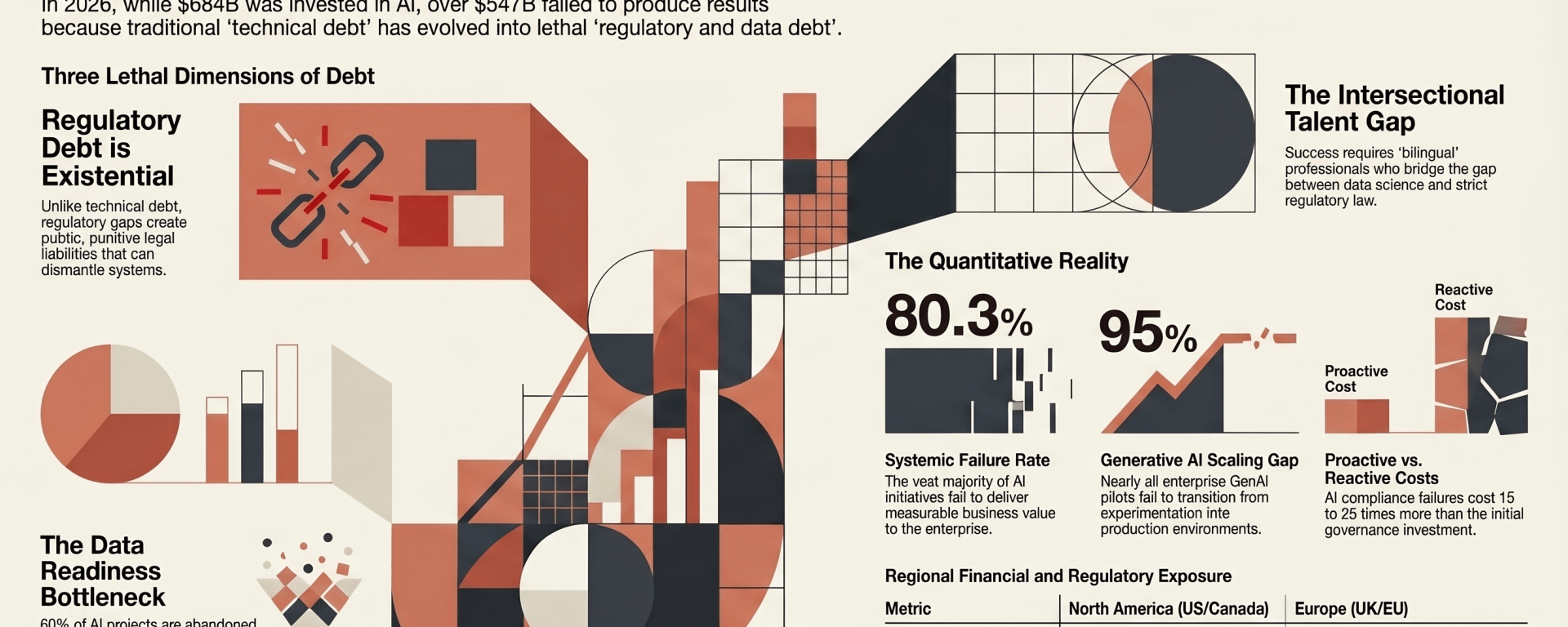
As artificial intelligence (AI) transitions from a phase of speculative experimentation to a period of rigorous enterprise expectation, regulated organizations across North America and Europe are confronting an escalating, systemic crisis: Capability Debt. In the year 2026, the global enterprise market invested an estimated $684 billion in AI initiatives, yet a staggering proportion of these investments—more than $547 billion—produced no measurable business results.1 This catastrophic failure rate is not driven by algorithmic limitations or computational boundaries; rather, it is the direct consequence of organizations modernizing their technological infrastructure significantly faster than they are modernizing their internal capabilities. When governance frameworks, talent architectures, data pipelines, and leadership mentalities lag behind technological procurement, organizations accumulate Capability Debt. In highly regulated sectors such as financial services, healthcare, pharmaceuticals, and the public sector, this debt transcends traditional software engineering challenges, manifesting instead as compounding regulatory, operational, and reputational risks.
This exhaustive analysis evaluates the state of Capability Debt in AI adoption, testing core hypotheses regarding the realities of regulatory compliance, data readiness, domain-specific talent shortages, and the friction between regulatory theory and operational reality. The findings indicate that without immediate, structural intervention, Capability Debt will critically undermine the competitive viability of regulated enterprises.
Key Strategic Insights
The research reveals several foundational insights regarding the trajectory of AI adoption and the accumulation of Capability Debt in regulated environments:
The Primacy and Lethality of Regulatory Debt: Traditional technical debt acts as an internal friction point that slows software development cycles, but “regulatory debt”—the widening gap between AI deployment and compliant, auditable governance—threatens organizational survival. Building autonomous or generative AI systems without embedding “Compliance by Design” transforms a technological asset into a compounding legal liability. Under emerging frameworks in 2026, regulatory debt fails publicly and irreversibly, resulting in punitive fines and the forced dismantling of production systems.2
The Illusion of AI-Ready Data: The single greatest bottleneck to enterprise AI scaling is not algorithmic sophistication, but data readiness. Organizations are rushing to deploy advanced generative AI and large language models (LLMs) on top of fragmented, siloed, and ungoverned data ecosystems. This leads to a phenomenon where sophisticated models confidently produce non-compliant, biased, or inaccurate outputs. The failure to secure clean, legally permissible, and traceable data before deployment is rendering the vast majority of AI pilot programs unusable in production environments.4
The Intersectional Talent Crisis: The AI talent gap is no longer defined merely by a shortage of data scientists or machine learning engineers. The critical shortage currently paralyzing regulated industries lies in intersectional professionals—domain experts, legal specialists, and compliance officers who possess algorithmic literacy and can bridge the gap between complex data science and strict regulatory frameworks. Effective AI deployment requires teams that can seamlessly translate regulatory constraints into mathematical parameters.6
The “Great Toil Shift” in Engineering: Generative AI is fundamentally reshaping developer productivity, generating an average 35% productivity boost in code generation. However, this creates a dangerous bottleneck in code verification. AI systems embed unstated assumptions into massive code volumes, amplifying existing technical debt. Consequently, engineering toil has not been eliminated; it has simply shifted from code authoring to code auditing, requiring rigorous “spec-driven development” to maintain system integrity.9
The Punitive Cost of Inaction: Organizations failing to implement proactive AI risk assessments and robust governance frameworks face downstream costs that are exponentially higher than the cost of initial compliance investments. Regulatory penalties, combined with mandatory system redesigns, litigation, and operational paralysis, render reactive compliance financially unsustainable. Proactive governance is no longer an administrative overhead; it is a foundational economic imperative.11
Geographic Divergence in Regulatory Pressures: Europe’s AI adoption strategy is heavily dictated by the overarching, risk-based EU AI Act, which demands extensive conformity assessments, third-party audits, and formal Quality Management Systems (QMS). Conversely, North America operates on a fragmented patchwork of stringent sectoral regulations (such as FDA rules and OSFI Guideline E-23) alongside emerging regional laws (such as Quebec Law 25 and BIPA). This divergence requires multinational organizations to build highly localized, adaptable governance architectures.12
Traceability as a Non-Negotiable Imperative: Regulators globally are shifting from accepting “black box” machine learning models to demanding complete explainability and auditability. AI systems deployed in regulated environments must now provide timestamped audit logs, comprehensive version histories, and clear human-in-the-loop decision pathways. Without these mechanisms, AI outputs are deemed legally indefensible during regulatory reviews.12
The Executive Sponsorship Cliff: Leadership debt is a primary, yet often overlooked, failure point. In the majority of failed AI initiatives, visible executive sponsorship evaporates within the first six months of the program. This abandonment stems from a systemic failure to treat AI integration as a holistic organizational transformation, with leaders incorrectly viewing AI as a standalone IT procurement project that can be delegated entirely to technology teams.1
Critical Industry Metrics
The following structured data highlights the quantifiable impact of Capability Debt on AI adoption, project failure rates, and financial exposure across regulated global markets.
| Metric / Indicator | Statistical Value | Contextual Implication | Source Reference |
| Systemic Project Failure Rate | 80.3% | The percentage of all AI projects that fail to deliver their intended business value, with 33.8% abandoned before reaching production. | 18 |
| Generative AI Scaling Failure | 95.0% | The proportion of enterprise Generative AI pilot programs that fail to scale into production or show measurable financial returns. | 18 |
| Data-Driven Abandonment Rate | 60.0% | The projected percentage of AI projects that will be entirely abandoned by 2026 specifically due to a lack of AI-ready data and poor data governance. | 19 |
| High-Risk Compliance Cost (EU) | €29,277 | The average total annual compliance cost for a single high-risk AI model under the EU AI Act, including robustness and human oversight costs. | 13 |
| Maximum Regulatory Penalties | Up to €35M or 7% | The maximum fine under the EU AI Act for severe violations (e.g., banned AI practices), calculated against global annual turnover. | 3 |
| Financial Sector Incident Cost | $42M – $65M | The average financial impact per AI failure or compliance breach in the financial services sector, encompassing fines, litigation, and remediation. | 11 |
| Data Utilization Deficit | 65.0% | The percentage of organizations utilizing only 21% to 50% of their available data in AI models, stunting accuracy and potential return on investment. | 21 |
| Talent Capability Deficit | 60.0% | The percentage of organizations reporting that their existing cybersecurity and IT teams lack the specialized capabilities required to secure AI systems. | 22 |
2. Defining “Capability Debt” in the Context of AI Adoption
The concept of “Capability Debt” represents a critical evolution of the traditional software engineering paradigm of “technical debt.” As organizations race to harness the transformative potential of artificial intelligence, they frequently procure and deploy advanced machine learning models, autonomous agents, and generative systems without cultivating the foundational competencies required to manage them. Capability Debt is the aggregate deficit incurred when technological modernization outpaces organizational, operational, and regulatory modernization.17
In regulated industries—where operations are inextricably linked to public trust, financial stability, patient safety, and legal accountability—this debt does not simply result in inefficient code. It manifests as a compounding matrix of risks that can paralyze an organization. To effectively manage and mitigate this phenomenon, executive leadership must understand the distinct dimensions through which Capability Debt materializes.
Technical and Systems Debt
In the era of AI, technical debt extends far beyond monolithic codebases or outdated legacy servers. It represents the structural inability of an organization’s existing systems to support probabilistic, data-hungry, and highly integrated AI models. AI fundamentally changes the economics of software development; it acts as a multiplier of the underlying system’s state.23 If an organization’s codebase is meticulously architected, AI accelerates innovation. Conversely, if the system is burdened by poor interfaces and undocumented integrations, AI amplifies the chaos.23
Furthermore, the proliferation of AI coding assistants has introduced a new vector of technical debt. While these tools rapidly generate massive volumes of code, they often embed unstated assumptions that are invisible to standard human code review.9 Approximately 53% of developers report that AI generates code that appears superficially correct but introduces hidden defects and false security confidence.10 This dynamic creates a “trust gap,” forcing engineering teams to spend disproportionate amounts of time verifying rather than innovating—a systemic friction that heavily taxes organizational resources.
Data Readiness Debt
Data Readiness Debt is perhaps the most pervasive barrier to successful AI adoption. It is defined as the chasm between an organization’s ambition to utilize cutting-edge Generative AI and the actual state of its enterprise data architecture. AI models are intrinsically dependent on the quality of their ingestion data; deploying a sophisticated algorithm on top of fragmented, biased, or unstructured data produces confident, authoritative-sounding hallucinations.4
Despite widespread AI experimentation, fewer than 20% of organizations possess high maturity in data readiness.4 Data Readiness Debt encompasses unresolved data silos, lack of strict data lineage, poor metadata tagging, and the absence of clear data service level agreements (SLAs).25 In regulated sectors, where data privacy (e.g., HIPAA, GDPR) is paramount, the inability to systematically de-identify, secure, and govern data before it interacts with an AI model constitutes a critical organizational failure.
Regulatory and Policy Debt (Compliance Debt)
While technical debt generally degrades internal efficiency, regulatory debt poses an existential external threat. Regulatory debt accumulates when organizations prioritize speed-to-market over robust compliance protocols, deploying AI systems without embedding “Compliance by Design”.3 This dimension includes the failure to implement automated audit logs, the inability to explain model outputs (the “black box” problem), and the absence of continuous monitoring frameworks.12
In 2026, global regulators have transitioned from issuing abstract guidelines to enforcing punitive, binding legislation. Operating AI without rigorous ethical reviews, bias mitigation, and clear human-in-the-loop oversight creates a liability that compounds with every automated transaction.26 As noted by legal experts, building an autonomous agent today without integrating compliance is not building a product; it is building a lawsuit waiting to happen.2
Process and Ways of Working Debt
This dimension reflects the friction caused by attempting to govern dynamic AI systems using static, legacy processes. Traditional agile software development methodologies are often insufficient for AI, which requires continuous lifecycle management, post-deployment monitoring, and rigorous “spec-driven development”.9 Process debt emerges when manual compliance workflows create bottlenecks that stifle innovation. For instance, relying on human teams to manually cross-check AI-generated outputs against vast regulatory frameworks is unsustainable and highly error-prone.28 Organizations carrying process debt have not integrated automated testing, continuous integration/continuous deployment (CI/CD) for machine learning (MLOps), or automated conformity assessment tools.
Organizational and Operational Debt
Organizational debt arises from structural misalignments within the enterprise. It is characterized by disconnected business priorities, episodic modernization efforts, and a lack of cross-functional alignment.29 When IT departments, data science teams, legal counsel, and compliance officers operate in isolated silos, AI deployments lack strategic cohesion. This fragmentation often leads to the proliferation of “shadow AI”—where individual departments adopt unsanctioned AI tools without enterprise oversight—drastically expanding the organization’s attack surface and compliance exposure.30 The absence of an enterprise-wide AI Governance Council acting as a central control tower is a primary indicator of severe organizational debt.31
People and Talent Debt
The discourse surrounding the “AI talent gap” has evolved. People and talent debt in 2026 is not solely defined by a lack of machine learning engineers or software developers. Rather, it is characterized by a critical shortage of intersectional professionals who possess both algorithmic literacy and deep domain-specific regulatory expertise.6 Effective AI deployment in regulated sectors requires professionals who can evaluate algorithmic bias, ensure ethical decision-making, and navigate sector-specific legal frameworks.32 Organizations accumulate talent debt when they rely exclusively on external vendors or centralized IT departments without upskilling their internal domain experts—such as compliance officers and clinicians—to understand and manage AI systems.8
Culture and Leadership Mindset Debt
Ultimately, all dimensions of Capability Debt are downstream of culture and leadership mindset debt. This debt materializes when executive leadership approaches AI as a discrete software procurement rather than a profound organizational transformation.17 Leadership debt is characterized by reactive communication, an overemphasis on immediate efficiency gains, and a failure to address workforce anxieties regarding technological displacement. A stark manifestation of this debt is the rapid evaporation of executive sponsorship; in 56% of failed AI initiatives, visible C-suite engagement disappears within the first six months, leaving projects functionally orphaned and doomed to fail.1
3. Quantitative Summary: Dimensions and Impact Across Regulated Industries
The manifestation, severity, and financial impact of Capability Debt vary significantly depending on the specific regulatory environment and the operational realities of a given industry. North America (characterized by sectoral and provincial frameworks) and Europe (dominated by centralized, risk-based frameworks) present distinctly different landscapes for AI adoption.
Capability Debt in North America (United States and Canada)
In North America, organizations must navigate a complex, fragmented web of federal guidelines, state-level privacy laws, and strict sectoral oversight. Regulatory bodies such as the Office of the Superintendent of Financial Institutions (OSFI) in Canada, the Food and Drug Administration (FDA) in the US, and emerging provincial mandates like Quebec’s Law 25 create intense, highly specific compliance burdens.
Table 1: Most Common Dimensions of Capability Debt by Regulated Industry (North America)
| Regulated Industry | Primary Dimension of Debt | Secondary Dimension | Tertiary Dimension | Key Regional Drivers and Context |
| Financial Services, Fintech & Insurance | Regulatory/Policy Debt | Technical/Systems Debt | Organizational Debt | Canada’s OSFI Guideline E-23 mandates formal model risk management and validation for all algorithmic tools (effective May 2027).35 US regulators enforce strict fair lending and AML explainability. |
| Healthcare & Pharmaceuticals | Data Readiness Debt | Regulatory/Policy Debt | Process/Ways of Working | Intense reliance on HIPAA (US) and GxP standards. The requirement for 21 CFR Part 11 compliant audit trails severely restricts agile Generative AI adoption.12 |
| Public Sector & Government | Technical/Systems Debt | Culture/Leadership Debt | People/Talent Debt | Massive legacy infrastructure constraints. Heavy reliance on FedRAMP compliance and lengthy Authority to Operate (ATO) processes stalls cloud and AI adoption.12 |
| Legal, Education & Real Estate | Process/Ways of Working | Data Readiness Debt | Regulatory/Policy Debt | High concern over data sovereignty and client privilege. Quebec Law 25 enforces strict transparency requirements for automated decision-making.14 |
| Nonprofit Sector | Culture/Leadership Debt | Technical/Systems Debt | People/Talent Debt | Paradoxical environment: 92% AI adoption rate, but only 7% report major impact. Severe resource constraints lead to unsustainable, ad-hoc AI usage.39 |
Table 2: Financial and Organizational Impact of Capability Debt (North America)
| Regulated Industry | Average Financial Impact per Failure/Breach | Top Organizational Impact | Key Metrics and Data Points |
| Financial Services, Fintech & Insurance | $42M – $65M per incident | Intense regulatory scrutiny, forced operational pauses | An estimated 40% of security debt is driven by legacy systems; unaddressed technical debt directly invites regulatory audits.11 |
| Healthcare & Pharmaceuticals | ~$10.22M per breach | Patient safety risks, delayed clinical trials | “Black Box” models face 30% higher costs in legal assessments. Lack of traceability halts clinical deployments and risks FDA rejection.11 |
| Public Sector & Government | Unavailable (Systemic Cost) | Loss of public trust, widespread service delays | Only 12% of public sector organizations have adopted Generative AI due to massive integration costs and rigid policy constraints.37 |
| Legal, Education & Real Estate | $4.2M – $8.4M (Avg project fail) | Shadow AI proliferation, massive class-action risk | BIPA (Illinois) fines up to $5,000 per intentional violation. Failure to explain AI decisions violates regional privacy laws.11 |
| Nonprofit Sector | Severe budget depletion | Abandonment of digital initiatives | Inability to prove ROI leads to evaporated donor funding; massive capability disparities exist between large and small non-profits.39 |
Capability Debt in Europe (United Kingdom, Germany, France)
Europe’s regulatory environment is decisively shaped by the European Union’s AI Act, which imposes a horizontal, risk-based classification system across all member states. This framework, combined with the stringent data minimization principles of the General Data Protection Regulation (GDPR), forces organizations to prioritize upfront compliance, conformity assessments, and exhaustive documentation over rapid deployment.
Table 3: Most Common Dimensions of Capability Debt by Regulated Industry (Europe)
| Regulated Industry | Primary Dimension of Debt | Secondary Dimension | Tertiary Dimension | Key Regional Drivers and Context |
| Financial Services, Fintech & Insurance | Regulatory/Policy Debt | Data Readiness Debt | Process/Ways of Working | Immediate pressure to align with the EU AI Act’s High-Risk categories. The UK’s FCA and PRA aggressively push for strict algorithmic accountability.13 |
| Healthcare & Pharmaceuticals | Regulatory/Policy Debt | Technical/Systems Debt | People/Talent Debt | Mandatory conformity assessments are required for all AI diagnostic tools. High demand for establishing formal Quality Management Systems (QMS).13 |
| Public Sector & Government | Culture/Leadership Debt | Technical/Systems Debt | Data Readiness Debt | Strong institutional risk aversion. The focus on protecting fundamental human rights prevents agile deployment; strict GDPR data minimization applies.46 |
| Legal & Education | Regulatory/Policy Debt | Process/Ways of Working | Data Readiness Debt | The EU AI Act’s transparency obligations for even limited-risk systems force massive overhauls in documentation and workflow management.46 |
Table 4: Financial and Organizational Impact of Capability Debt (Europe)
| Regulated Industry | Average Financial Impact per Failure/Breach | Top Organizational Impact | Key Metrics and Data Points |
| Financial Services, Fintech & Insurance | Up to €35M or 7% Turnover | Extreme legal liability, loss of market access | €29,277 annual compliance cost per individual AI model. 60–70% of compliance spending is forced into high-risk validations.11 |
| Healthcare & Pharmaceuticals | Up to €35M or 7% Turnover | Withdrawn medical devices, R&D paralysis | Conformity assessments cost €10k–€40k per high-risk system. AI Act documentation increases development time by 15%–25%.13 |
| Public Sector & Government | Unavailable (Systemic Cost) | Bureaucratic paralysis, permanently stalled pilots | Public sector AI remains trapped in early pilot phases due to inflexible regulatory environments and highly uncertain scaling costs.47 |
| Legal & Education | Up to €15M or 3% Turnover | Reputational damage, workflow halts | The total regional AI compliance market is projected to reach €17B–€38B by 2030, draining resources from pure innovation.11 |
4. Research Details, Commentary, Key Insights, and Examples
The statistical overview demonstrates that Capability Debt is not a uniform technical glitch, but a multifaceted organizational crisis. To fully grasp the magnitude of this debt, it is essential to examine the specific regulatory pressures, operational bottlenecks, and technological realities defining the landscape in 2026.
The Financial Services and Insurance Landscape: A Crisis of Algorithmic Accountability
In both North America and Europe, traditional financial institutions and insurance carriers face an existential mandate to modernize. Aging legacy platforms inflate operating costs, slow product launches, and fundamentally constrain the use of advanced data analytics and agentic AI.29 However, technical debt in the financial sector directly correlates with massive regulatory exposure. The transition from older model governance frameworks to newer, principles-based models—such as the US Federal Reserve’s SR 26-2 and Canada’s OSFI Guideline E-23—demands rigorous, enterprise-wide model risk management.12
OSFI’s Guideline E-23, taking full effect in May 2027, is particularly expansive. It explicitly captures any tool utilizing statistical techniques or machine learning that influences financial decisions, including wealth management portfolio optimizers, retirement calculators, and robo-advisors.35 Wealth advisors and institutions are now legally required to formally validate these tools, actively monitor them for drift, and clearly document their theoretical assumptions and limitations.35 Failure to pay down this “compliance debt” results in severe consequences; financial sector AI failures cost an average of $42 million to $65 million per incident, compounded by massive regulatory fines, intense legal scrutiny, and halted operations.11
Furthermore, the insurance sector is attempting to leverage “Agentic AI” to reduce underwriting cycle times by up to 75% and drive marginal operational costs toward zero.49 Yet, deploying autonomous agents atop legacy technology, disconnected data silos, and fragmented governance structures creates a massive capability debt. Without modernizing infrastructure with orchestration layers and APIs, insurers risk widening the performance gap between themselves and digital-native competitors, ultimately accumulating regulatory debt that will inevitably come due during financial audits.50
The Healthcare and Pharmaceutical Paradox: Innovation Constrained by Traceability
The healthcare and life sciences sectors are caught in a profound paradox. They stand to gain immense operational efficiencies from AI—ranging from accelerated molecular drug discovery to predictive patient diagnostics and automated clinical documentation.52 However, they operate under the most stringent traceability and privacy requirements globally. AI models in these sectors must comply with the Health Insurance Portability and Accountability Act (HIPAA), Good x Practice (GxP) standards, and FDA 21 CFR Part 11 regulations.12
These regulations require immutable audit logs, reliable electronic signatures, and proven model reproducibility.12 The implementation of Generative AI for regulatory compliance—such as automatically drafting Standard Operating Procedures (SOPs) or answering complex audit inquiries—must be supported by rigorous “human-in-the-loop” governance.16 AI systems cannot operate as opaque mechanisms. According to industry data, 60% of current healthcare AI systems lack the necessary transparency to meet emerging standards, and organizations utilizing “Black Box” models face 30% higher costs in regulatory audits and legal assessments.42
In Europe, the situation is even more acute. Under the EU AI Act, AI diagnostic tools and medical software are heavily categorized as “high-risk.” This classification requires formal conformity assessments that cost between €10,000 and €40,000 per system, pushing the average initial compliance cost above €50,000.13 The strict documentation and continuous risk management requirements increase development time by 15% to 25%, forcing pharmaceutical companies and hospitals to weigh the cost of innovation against the immense burden of compliance.13
Regulatory Disparities: The European Union vs. North America
A critical insight from the research is the structural divergence in how Capability Debt is generated across geographies. Europe’s approach, solidified by the EU AI Act, imposes a horizontal, risk-based classification system across all industries. The focus is strictly preventative. Organizations must establish comprehensive Quality Management Systems (QMS), maintain exhaustive technical documentation, and ensure continuous human oversight before high-risk deployment is legally permissible.13 Non-compliance invites catastrophic fines of up to €35 million or 7% of global annual turnover, creating an environment where regulatory debt is the primary concern for any technology executive.11
Conversely, North America relies on a vertical, sectoral approach mixed with rapidly emerging local legislation. While the US federal government issues overarching guidance (e.g., Executive Orders) and relies on agencies like the SEC and FDA, individual states and provinces are enacting stringent, localized privacy laws. A prime example is Quebec’s Law 25, which mirrors the GDPR by enforcing mandatory Privacy Impact Assessments (PIAs) and demanding total transparency regarding automated decision-making processes.14 If a Canadian financial institution uses an AI system to deny a loan, Law 25 legally requires the institution to explain exactly how the decision was made and provide the consumer the right to have the decision reviewed by a human.14 Organizations operating across these borders are forced to reconcile disparate regimes, driving up the cost and complexity of AI governance and exponentially increasing their regulatory debt.12
The Non-Profit and Government Sectors: High Ambition, Low Capability
The public sector and non-profit organizations face unique manifestations of Capability Debt. In the non-profit sector, AI adoption has hit an astonishing 92%, yet only 7% of organizations report seeing a major strategic impact.39 This discrepancy is the hallmark of organizational and talent debt. Non-profits are adopting accessible generative AI tools to alleviate administrative burdens, but severe budget constraints prevent them from building the secure data architectures or hiring the intersectional talent required to scale AI safely. They remain stuck on an “efficiency plateau,” highly vulnerable to data security risks.40
Similarly, the public sector is paralyzed by legacy systems and a deeply entrenched culture of risk aversion. Only 12% of public sector organizations have successfully adopted Generative AI.37 The requirement to adhere to rigorous security baselines, such as FedRAMP in the United States, and the inability to quickly navigate Authority to Operate (ATO) approvals, traps government AI initiatives in perpetual pilot phases.12 The debt here is foundational; without modernizing the underlying information technology infrastructure, AI adoption is practically impossible.
5. Testing the Core Hypotheses
The initial inquiry posed four distinct hypotheses regarding the nature of Capability Debt in regulated organizations. Evaluating these hypotheses against the aggregated 2026 data provides a clear validation of the strategic challenges facing senior leadership.
Hypothesis 1: Regulatory / Compliance Debt is more severe and compounds faster than Technical / System Debt.
Finding: Confirmed.
The research emphatically supports the premise that regulatory debt is the most severe and rapidly compounding vulnerability in the AI era. Traditional technical debt—such as monolithic codebases, unoptimized databases, or poor API interfaces—acts as an internal friction point. It slows time-to-market, frustrates engineering teams, and inflates operational costs, but it remains a known, manageable quantity that generally fails quietly within the confines of the IT department.2
Regulatory and compliance debt, however, is external, punitive, and intensely public. When an organization prioritizes speed over thoroughness—deploying unversioned models, utilizing unvetted training data, or failing to establish immutable audit trails—it creates a legal liability that multiplies with every automated decision.26 The financial implications validate this severity: AI compliance failures cost businesses 15 to 25 times more than the cost of initial, proactive governance investments.11 Under frameworks like the EU AI Act or Illinois’ Biometric Information Privacy Act (BIPA), a single foundational oversight can result in fines ranging from millions to tens of millions of dollars, the complete halting of commercial operations, and irreversible reputational damage.3 As the data suggests, building an AI system in 2026 without “Compliance by Design” is functionally equivalent to building a massive corporate liability.3
Hypothesis 2: For regulated organizations, one of the biggest debts is the gap between wanting to use cutting-edge Generative AI and actually having clean, legally compliant, and traceable data.
Finding: Confirmed.
The ambition to rapidly deploy Generative AI has exposed a massive, systemic deficit in enterprise data architecture. The research clearly indicates that the primary reason enterprise AI projects fail is not a lack of algorithmic sophistication, but the absolute absence of “AI-ready data”—data that is clean, integrated, secure, and legally permissible to process.4
The failure statistics are sobering: 95% of enterprise Generative AI pilots fail to scale into production, and Gartner projects that 60% of all AI projects will be completely abandoned by 2026 specifically due to data quality and governance issues.18 Currently, 65% of organizations utilize only a fraction (21% to 50%) of their data in AI models because the remainder is trapped in silos, undocumented, or non-compliant.21 In regulated industries, deploying an advanced LLM on fragmented or biased data does not merely yield inaccurate results; it produces highly confident hallucinations that violate privacy laws, corrupt financial models, and skew medical diagnostics. The organizations that will succeed in the AI era are not those moving fastest into experimentation, but those prioritizing the unglamorous, foundational work of data governance, metadata tagging, and strict data lineage.5
Hypothesis 3: For regulated organizations, the talent gap is not about AI development. Rather, it is the lack of professionals who understand both data science and the specific domain regulatory framework.
Finding: Confirmed.
While a general shortage of software engineers persists globally, the acute “talent gap” disrupting AI adoption in 2026 is fundamentally interdisciplinary. The workforce crisis has shifted from pure headcount shortages to severe capability shortages.22 Highly regulated sectors do not merely need individuals who can code neural networks; they require professionals who can navigate the complex intersection of machine learning operations, algorithmic accountability, and domain-specific law (e.g., GxP, HIPAA, OSFI SR 26-2).34
Effective AI scaling requires a diverse, cross-functional coalition: AI architects, MLOps engineers, Chief Compliance Officers who understand LLM behavior, and specialized domain experts.6 The failure to align technical execution with business and regulatory reality is profound; 68% of AI projects fail due to poor alignment between AI initiatives and business requirements.33 Furthermore, a lack of cross-disciplinary communication leads directly to misconfigured tools and incomplete validation documentation.34 Consequently, organizations are increasingly turning to specialized, vetted domain experts to evaluate models, recognizing that in high-stakes environments, domain expertise is an absolute prerequisite for building trustworthy AI.7
Hypothesis 4: Regulated organizations struggle to bridge the gap between regulatory theory and reality, finding it difficult to provide the required traceability and accountability that regulators expect in AI tools.
Finding: Confirmed.
The chasm between conceptual AI regulations and operational reality is a primary driver of Capability Debt. Modern AI systems, particularly Generative AI and deep learning networks, are inherently complex and frequently function as “black boxes”.12 However, regulators universally demand transparency, explainability, and traceability. They require concrete proof of how an AI system reached a specific decision, what specific training data it utilized, who internally approved the model, and how its performance has drifted over time.12
Translating these theoretical requirements into technical reality is a massive logistical and architectural challenge. It requires automated audit trails, immutable version control for both code and data, continuous monitoring pipelines, and sophisticated “human-in-the-loop” approval chains.12 The manual documentation processes that compliance teams relied upon in the past simply cannot scale with iterative, self-updating AI models.28 Because organizations struggle to build this integrated observability into their platforms, they are forced to either pause deployments entirely or proceed at immense legal risk. The operational reality is that 60% of current healthcare AI systems lack the necessary transparency to meet emerging standards, leaving organizations defenseless during rigorous regulatory audits.42
6. Strategic Action Plans for Senior Leaders
Addressing Capability Debt requires decisive, structural intervention from the highest levels of the organization. The approach differs based on an organization’s current maturity and existing debt load.
Key Actions for Progressive Organizations to Maximize Opportunities
Organizations that have successfully navigated early pilot phases and possess strong digital foundations must shift their focus to building resilient, scalable, and provably compliant enterprise architectures.
- Implement “Compliance by Design” at the Architecture Level: Move aggressively away from the practice of retrofitting compliance onto finished models. Integrate automated audit logging, data lineage tracking, and bias testing directly into the MLOps and LLMOps pipelines. Ensure that model development environments are strictly isolated and policy-driven to maintain continuous compliance with frameworks like the EU AI Act and OSFI E-23.12
- Transition to Spec-Driven Development: To combat the compounding technical debt generated by AI coding assistants, transition engineering teams to “spec-driven development.” Require developers to make system assumptions explicit and define rigid contracts before any AI code generation begins. Cultivate a “vibe, then verify” engineering culture backed by rigorous static code analysis and automated testing.9
- Elevate Data Readiness to a Board-Level Mandate: Cease viewing data quality as a back-office IT function. Treat AI-ready data as a strategic, board-level priority. Invest heavily in data unification, metadata management, and continuous data observability tools to ensure that AI models are fed clean, compliant, and highly traceable inputs.4
- Establish a Cross-Functional AI Governance Council: Create a centralized command structure comprised of lead data scientists, the Chief Compliance Officer, legal domain experts, and senior business leaders. Empower this council to oversee the entire AI lifecycle, dictate enterprise risk tolerances, define acceptable use cases, and enforce standardized accountability across all departments.31
- Develop Intersectional Talent Pipelines: Address the capability gap by investing in the upskilling of existing domain experts (e.g., legal counsel, clinical researchers, compliance officers) in algorithmic literacy. Simultaneously, train data scientists in the nuances of industry-specific regulations. Bridging this communication gap is essential for compliant, rapid deployment.8
Key Actions for Organizations Falling Behind to Catch Up
Organizations trapped in “pilot purgatory,” or those paralyzed by massive legacy technical and regulatory debt, must execute immediate triage to halt the accumulation of toxic liabilities.
- Conduct an Unsparing Capability Debt Audit: Immediately halt all unstructured “shadow AI” deployments across the enterprise. Conduct a comprehensive, unvarnished assessment quantifying existing technical, data, and regulatory debt. Categorize this debt into “strategic” (acceptable for rapid learning) and “toxic” (creating immediate compliance or security liabilities). Allocate emergency resources to eliminate toxic debt before deploying any new AI capabilities.31
- Anchor AI Strategy to Rigidly Defined Business Outcomes: Stop building AI for the sake of AI. The primary warning sign of a failing initiative is a lack of defined success metrics before the build begins.18 Require every AI project to prove a distinct financial ROI and identify exactly how it aligns with core organizational priorities before granting funding or engineering resources.
- Prioritize the Foundation Over the Application: Do not attempt to layer sophisticated Generative AI over fragmented, legacy data architectures. Redirect AI budgets toward modernizing core infrastructure, breaking down legacy data silos, and establishing basic, functional data governance frameworks. A strong, adaptable digital core is the absolute prerequisite for any future AI capability.5
- Leverage Pre-Packaged, Compliant AI Infrastructure: If internal talent and infrastructure are severely lacking, avoid the temptation to build custom LLMs or complex neural networks from scratch. Procure enterprise-grade, ready-made AI platforms and managed services that come with built-in regulatory compliance, API-enabled integrations, and vendor-backed audit trails to accelerate safe adoption.30
- Secure and Sustain Executive Sponsorship: Recognize that AI adoption is a fundamental organizational transformation, not an IT software update. Ensure that the C-suite maintains visible, continuous engagement beyond the initial hype phase. Tie executive key performance indicators (KPIs) directly to the safe, compliant, and effective integration of AI across the enterprise to prevent the evaporation of leadership support, which is the leading cause of AI project failure.1
Works cited
- Enterprise AI Program Failure Signs 2026 | When It Looks Like It’s Working But It Isn’t, accessed May 23, 2026, https://www.clarityarc.com/insights/ai-program-failure-warning-signs-enterprise
- Is Your AI a Silent Lawsuit Waiting to Happen? – LLInformatics, accessed May 23, 2026, https://www.llinformatics.com/sins-of-software-houses/is-your-ai-a-silent-lawsuit-waiting-to-happen
- The 2026 Compliance Frontier: A Technical Blueprint for AI Developers under the EU AI Act Phase 2 | by Adeptiv AI – Medium, accessed May 23, 2026, https://medium.com/@Adeptiv_AI/the-2026-compliance-frontier-a-technical-blueprint-for-ai-developers-under-the-eu-ai-act-phase-2-b0c1ac26b785
- Why data readiness is a strategic imperative for businesses | World Economic Forum, accessed May 23, 2026, https://www.weforum.org/stories/2026/01/why-data-readiness-is-now-a-strategic-imperative-for-businesses/
- Why 95% of AI Projects Fail — And the Operating System Approach That Fixes It, accessed May 23, 2026, https://yourrender.ai/en/blog/why-ai-projects-fail-mid-market-guide
- The AI Talent Gap: Why Technology Is Moving Faster Than the Workforce – Phison Blog, accessed May 23, 2026, https://phisonblog.com/the-ai-talent-gap-why-technology-is-moving-faster-than-the-workforce/
- Use pre-verified domain experts on Prolific, accessed May 23, 2026, https://www.prolific.com/resources/introducing-domain-experts-evaluate-and-annotate-your-ai-with-verified-experts
- Reskilling the Workforce for AI: Domain Expertise and Algorithmic Literacy – PubsOnLine, accessed May 23, 2026, https://pubsonline.informs.org/doi/10.1287/mnsc.2022.03968
- What Happens When AI Technical Debt Compounds (And How Spec-Driven Dev Prevents It) | Augment Code, accessed May 23, 2026, https://www.augmentcode.com/guides/ai-technical-debt-compounds-spec-driven-development
- The great toil shift: How AI is redefining technical debt – Sonar, accessed May 23, 2026, https://www.sonarsource.com/blog/how-ai-is-redefining-technical-debt
- The Cost of Inaction: AI Risk Assessment vs. Fines – Elevate Consult, accessed May 23, 2026, https://elevateconsult.com/insights/the-cost-of-inaction-budgeting-for-ai-risk-assessment-vs-fines/
- AI Automation Challenges in Regulated Industries | Domino.ai, accessed May 23, 2026, https://domino.ai/blog/ai-automation-regulated-industries
- EU AI Act Compliance Cost Statistics 2026: Key Trends Now • SQ …, accessed May 23, 2026, https://sqmagazine.co.uk/eu-ai-act-compliance-cost-statistics/
- Quebec’s Law 25: Everything you need to know – Didomi, accessed May 23, 2026, https://www.didomi.io/blog/quebec-data-privacy-law
- AI Compliance FAQ – What Businesses and Developers Need to Know | Knowledge | Fasken, accessed May 23, 2026, https://www.fasken.com/en/knowledge/2025/12/ai-compliance-faq-what-businesses-and-developers-need-to-know
- Generative AI for Regulatory Compliance in Healthcare, accessed May 23, 2026, https://emorphis.health/blogs/generative-ai-for-regulatory-compliance-healthcare/
- The Leadership Gap No One Talks About in AI Transformation, accessed May 23, 2026, https://aijourn.com/the-leadership-gap-no-one-talks-about-in-ai-transformation/
- AI Project Failure Rate 2026: 80% Fail | Pertama Partners, accessed May 23, 2026, https://www.pertamapartners.com/insights/ai-project-failure-statistics-2026
- Why 95% of AI Projects Fail and How Data Fixes It – SR analytics, accessed May 23, 2026, https://sranalytics.io/blog/why-95-of-ai-projects-fail/
- Why Most Enterprise AI Apps Fail in 2026 (And How to Fix Them) – Wizr AI, accessed May 23, 2026, https://wizr.ai/blog/why-enterprise-ai-apps-fail-and-how-to-fix-them/
- Bridging the AI Data Gap: How to Optimize Underutilized Data – Strategy, accessed May 23, 2026, https://www.strategy.com/software/blog/bridging-the-ai-data-gap-how-to-optimize-underutilized-data
- SANS 2026 report flags cybersecurity skills crisis, putting critical infrastructure and OT sectors at measurable breach risk – Industrial Cyber, accessed May 23, 2026, https://industrialcyber.co/reports/sans-2026-report-flags-cybersecurity-skills-crisis-putting-critical-infrastructure-and-ot-sectors-at-measurable-breach-risk/
- Frustrated with Slow AI Adoption? Here’s why. – Innolitics, accessed May 23, 2026, https://innolitics.com/articles/ai-native-engineering-transformation/
- How Technical Debt Compounds in PropTech Platforms – DO OK, accessed May 23, 2026, https://dook.pro/blog/technology/proptech-technical-debt/
- What Is AI-Ready Data? – IBM, accessed May 23, 2026, https://www.ibm.com/think/topics/ai-ready-data
- AI technical debt: Impact on compliance – ITLawCo, accessed May 23, 2026, https://itlawco.com/ai-technical-debt-impact-on-compliance/
- AI Debt – The Hidden Cost of Moving Fast and How to Manage It Strategically | FPT Software, accessed May 23, 2026, https://fptsoftware.com/resource-center/blogs/ai-debt-the-hidden-cost-of-moving-fast-and-how-to-manage-it-strategically
- AI’s Race to Regulatory Compliance: Will You Lead or Risk Falling Behind? – Arcondis, accessed May 23, 2026, https://www.arcondis.com/wp-content/uploads/2024/11/ai-regulatory-compliance-2.pdf
- Why agentic AI-led modernisation is emerging as a competitive divider in financial services, accessed May 23, 2026, https://thedigitalbanker.com/why-agentic-ai-led-modernisation-is-emerging-as-a-competitive-divider-in-financial-services/
- Top 10 AI Governance Solutions for Regulated Industries in 2026 – Kiteworks, accessed May 23, 2026, https://www.kiteworks.com/cybersecurity-risk-management/ai-governance-solutions-regulated-industries/
- How AI can help reduce tech debt in M&A – KPMG International, accessed May 23, 2026, https://kpmg.com/kpmg-us/content/dam/kpmg/pdf/2026/how-ai-can-help-reduce-tech-debt-in-ma.pdf
- The AI Talent Gap: The Underestimated Challenge in Scaling : r/LLMDevs – Reddit, accessed May 23, 2026, https://www.reddit.com/r/LLMDevs/comments/1k9pasj/the_ai_talent_gap_the_underestimated_challenge_in/
- Top 50+ Global AI Talent Shortage Statistics 2026, accessed May 23, 2026, https://www.secondtalent.com/resources/global-ai-talent-shortage-statistics/
- GxP Compliant AI: A Strategic Guide to Modernize Quality Management – Sware, accessed May 23, 2026, https://www.sware.com/whitepaper-gxp-compliant-ai-a-strategic-guide
- OSFI introduces new validation rules for planning tools you use – Wealth Professional, accessed May 23, 2026, https://www.wealthprofessional.ca/news/regulators/osfi-introduces-new-validation-rules-for-planning-tools-you-use/391348
- Are you ready for Guideline E-23? – KPMG International, accessed May 23, 2026, https://kpmg.com/ca/en/insights/2025/08/are-you-ready-for-guideline-e23.html
- The AI Adoption Gap: Preparing the US Government for Advanced AI – Forethought, accessed May 23, 2026, https://www.forethought.org/research/the-ai-adoption-gap
- Quebec Law 25: What Canada’s New Privacy Law Requires – BigID, accessed May 23, 2026, https://bigid.com/blog/quebec-law-25-canada-new-privacy-law-requirements/
- Enhancing Transparency and Accountability in Federally Funded Nonprofits: A Convergent Framework Integrating Artificial Intelligence Analytics and Blockchain Technology – BYU ScholarsArchive, accessed May 23, 2026, https://scholarsarchive.byu.edu/cgi/viewcontent.cgi?article=1192&context=joni
- Nonprofit AI Adoption Report 2026, accessed May 23, 2026, https://www.nonprofitpro.com/article/nonprofit-ai-adoption-hits-92-but-only-7-see-major-impact/
- The Hidden Cost of AI Security Debt – Recorded Future, accessed May 23, 2026, https://www.recordedfuture.com/research/the-hidden-cost-of-ai-security-debt
- Effectiveness of AI in Healthcare: Costs vs. Impact, accessed May 23, 2026, https://aihealthcarecompliance.com/effectiveness-of-ai-in-healthcare-costs-vs-impact/
- From Principles to Practice: Governing AI in the Corporation, accessed May 23, 2026, https://corpgov.law.harvard.edu/2026/05/11/from-principles-to-practice-governing-ai-in-the-corporation/
- Compliance Automation AI Market Research Report 2034 – Dataintelo, accessed May 23, 2026, https://dataintelo.com/report/compliance-automation-ai-market
- Balancing Innovation and Control: The European Union AI Act in an Era of Global Uncertainty – PMC, accessed May 23, 2026, https://pmc.ncbi.nlm.nih.gov/articles/PMC12574960/
- EU AI act and data privacy certification: anchoring trust in Europe’s AI and data governance, accessed May 23, 2026, https://www.ey.com/en_lu/insights/ai/eu-ai-act-and-data-privacy-certification-anchoring-trust-in-europe-ai-and-data-governance
- Implementation challenges that hinder the strategic use of AI in government – OECD, accessed May 23, 2026, https://www.oecd.org/en/publications/2025/06/governing-with-artificial-intelligence_398fa287/full-report/implementation-challenges-that-hinder-the-strategic-use-of-ai-in-government_05cfe2bb.html
- Unpacking the EU AI Act: The Future of AI Governance | Deloitte US, accessed May 23, 2026, https://www.deloitte.com/us/en/services/consulting/articles/eu-ai-act-ai-governance.html
- Unlocking the Power of Agentic AI in insurance – DXC Technology, accessed May 23, 2026, https://dxc.com/insights/knowledge-base/agentic-ai-in-insurance
- 8. A practical roadmap for AI and Insurance Claims, Mike Daly – InsurTech World, accessed May 23, 2026, https://www.insurtechworld.org/post/102mpl4/8-a-practical-roadmap-for-ai-and-insurance-claims
- Unlocking the Power of Agentic AI in Insurance, accessed May 23, 2026, https://www.insurancethoughtleadership.com/ai-machine-learning/unlocking-power-agentic-ai-insurance
- Regulating the Use of AI in Drug Development: Legal Challenges and Compliance Strategies, accessed May 23, 2026, https://www.fdli.org/2025/07/regulating-the-use-of-ai-in-drug-development-legal-challenges-and-compliance-strategies/
- AI in Healthcare and What It Means for CIOs and CTOs – GAP – Growth Acceleration Partners, accessed May 23, 2026, https://www.growthaccelerationpartners.com/blog/the-growing-role-of-ai-in-healthcare-and-what-it-means-for-cios-and-ctos
- Quebec’s Law 25: What Is It and What Do You Need to Know? | Blog – OneTrust, accessed May 23, 2026, https://www.onetrust.com/blog/quebecs-law-25-what-is-it-and-what-do-you-need-to-know/
- AI Readiness vs. Reality: Data and Skills Gaps Threaten Enterprise AI Success – Precisely, accessed May 23, 2026, https://www.precisely.com/blog/data-integrity/ai-readiness-vs-reality-data-and-skills-gaps-threaten-enterprise-ai-success/
- Needed AI skills facing unknown regulations and advancements – Thomson Reuters Institute, accessed May 23, 2026, https://www.thomsonreuters.com/en-us/posts/technology/needed-ai-skills/
- The AI Governance Tools Landscape: Platforms & Capabilities – Elevate Consult, accessed May 23, 2026, https://elevateconsult.com/insights/ai-governance-tools-landscape-platforms-capabilities/
- Trends in AI – Management Solutions, accessed May 23, 2026, https://www.managementsolutions.com/sites/default/files/minisite/static/d3e48686-af6f-44f4-9989-d8a6f047f017/personas-ia/pdf/trends-in-ai.pdf
- How to Build an Adaptive Roadmap to Secure and Enable the Use of AI, accessed May 23, 2026, https://nationalcioreview.com/articles-insights/how-to-build-an-adaptive-roadmap-to-secure-and-enable-the-use-of-ai/
- Strategies for Mitigating Tech Debt in the Age of AI – Atlantic International University, accessed May 23, 2026, https://www.aiu.edu/innovative/strategies-for-mitigating-tech-debt-in-the-age-of-ai/
- SAS ready-made AI models, accessed May 23, 2026, https://www.sas.com/en/solution-briefs/ready-made-ai-models.html
The idea, research hypotheses, and focus for this article/research are all original and mine. This article was written with my brain and two hands with the assistance of Google Gemini, Notebook LM, Claude, and other wondrous toys.

