Executive Summary
The global healthcare landscape in 2026 is defined by a critical transition from the experimental pilot phase of artificial intelligence to its integration as a core component of medical infrastructure. This report provides a high-level strategic evaluation of the current landscape, identifying the pivotal shifts in practitioner sentiment, patient-facing risks, and the regulatory environment across North America and Europe. The analysis indicates that while AI adoption has doubled since 2023, the nature of this integration has shifted from diagnostic-centric to workflow-centric strategies.1 Clinicians are increasingly prioritizing administrative relief and documentation efficiency over high-stakes clinical decision support, largely due to unresolved liability concerns and the inherent “black box” nature of many diagnostic algorithms.1 Trust remains the primary currency of adoption; however, it is no longer just a measure of technological accuracy, but a reflection of “human-in-the-loop” governance and the reliability of patient-generated data.4
Key insights derived from this research include:
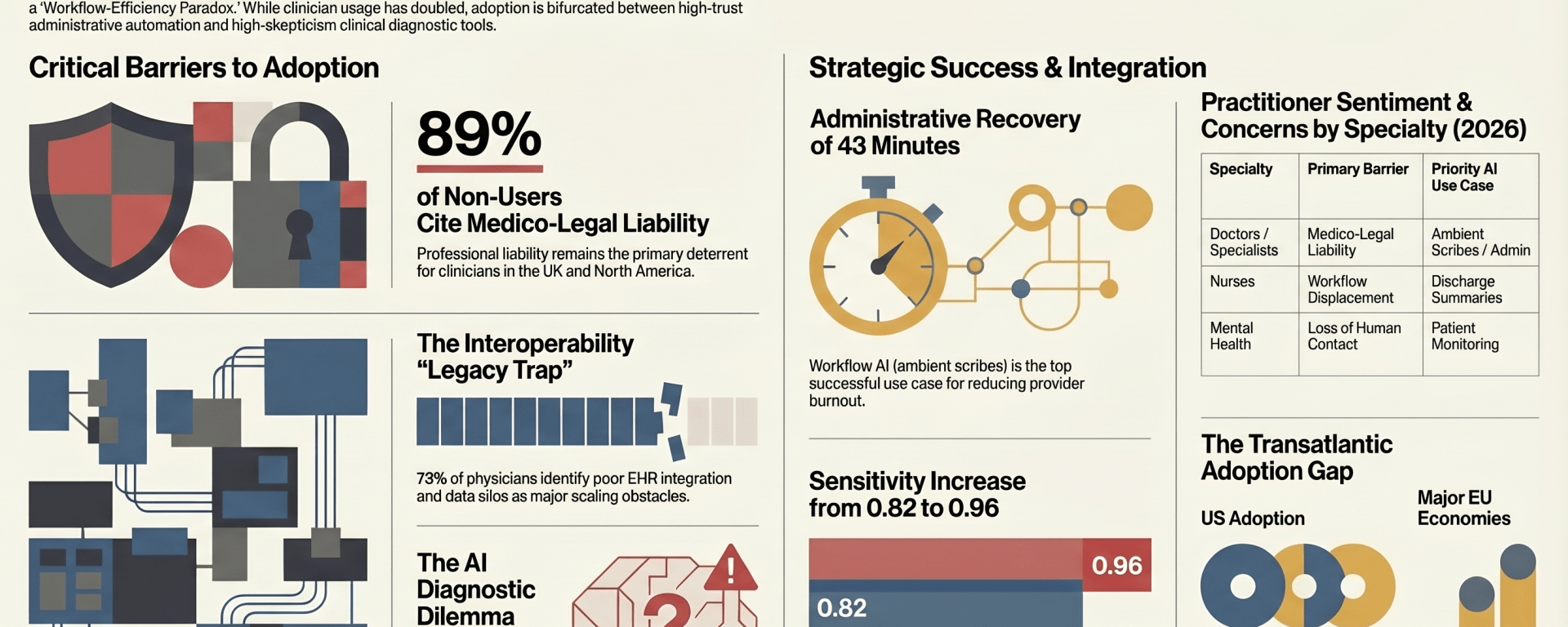
- The workflow-efficiency paradox indicates that while 81% of physicians now utilize AI, the most significant impact is observed in “Workflow AI” (ambient scribes and documentation), which saves up to 43 minutes per day per staff member.2 This shift highlights a growing divide where clinicians trust AI for administrative support but remain deeply skeptical of its diagnostic autonomy.1
- The “AI Diagnostic Dilemma” has been identified as the top patient safety threat for 2026.5 The risk is multifaceted, involving clinicians over-relying on imperfect models and patients using generative AI for self-diagnosis, which often leads to “AI hallucinations” and mismanaged care trajectories.10
- A significant transatlantic adoption gap exists, with United States adoption rates (43%) approximately double those of France, Germany, and Italy.13 This is driven by a market-led approach and a prioritization of innovation dominance over the rigid horizontal regulation seen in Europe.14
- There is a near-perfect correlation between AI education and perceived risk; practitioners with formal AI training report significantly lower barriers.16 The “innovation trap” is as much an educational deficit as it is a technological or financial one.18
- Governance is emerging as a competitive advantage. Compliance with the EU AI Act and Canada’s Artificial Intelligence and Data Act (AIDA) is being reframed as a framework for building the patient trust necessary for long-term scalability rather than a mere regulatory hurdle.18
- In mental healthcare, both patients and therapists identify the “loss of human contact” as a critical barrier, indicating that AI’s role in sensitive fields must remain auxiliary and supportive rather than substitutional.18
- Interoperability remains a silent but pervasive barrier, with nearly 73% of physicians citing poor system integration or unconnected data silos as major challenges to scaling AI solutions effectively.24
Quantitative Summary of AI Adoption Barriers
The clinical adoption of artificial intelligence is currently constrained by a complex interplay of technical, ethical, and organizational factors. The following tables categorize these barriers across different practitioner roles and geographical regions, reflecting the diverse sociotechnical challenges encountered in the 2024-2026 period.
Table 1: Prevalence of AI Adoption Barriers by Healthcare Practitioner Type (2026)
| Barrier Category | Doctors/Specialists | Nurses | Mental Health Therapists | Pharmacists |
| Medico-Legal Liability | Very High 3 | High 20 | Medium 23 | High 8 |
| Workflow Displacement | High 28 | Very High 20 | Medium 23 | High 27 |
| Trust / Black Box Issues | Very High 7 | Medium 20 | High 18 | High 27 |
| Data Privacy/Security | High 3 | Medium 19 | Very High 19 | High 19 |
| Lack of Formal Training | High 2 | High 4 | High 23 | Very High 27 |
| Infrastructure/Cost | Medium 25 | High 20 | Medium 23 | Medium 34 |
| Human Contact Loss | Medium 3 | High 20 | Very High 18 | Low 40 |
Table 2: Comparative Analysis of Regional Adoption Barriers and Maturity (2026)
| Country | Primary Regulatory Barrier | Adoption Maturity | Workforce Readiness | Governance Approach |
| United States | Fragmented Liability Standards 5 | High (Market-Driven) 1 | High (Private Initiative) 2 | Sector-Specific/Voluntary 14 |
| Canada | AIDA/Interprovincial Silos 42 | Medium (Safety-First) 26 | Medium (CIFAR-led) 44 | Principles-Based/Agile 21 |
| United Kingdom | Centralized Policy Variability 4 | Medium (Capacity-First) 41 | High (NHS-wide Training) 4 | Decentralized/Pro-Innovation 41 |
| France | EU AI Act Compliance Costs 48 | Medium (Research-Focused) 50 | High (Hub-based Expertise) 51 | Centralized/Hard-Law 48 |
| Germany | Strict Data Protection/GDPR+ 54 | Medium (Smart Hospital) 54 | Medium (Legacy/Security Focus) 55 | Integrated Insurance-led 54 |
Strategic Analysis of Practitioner Adoption Barriers
The transition of artificial intelligence from the research environment to the clinical front lines has revealed a significant gap between technological promise and operational reality. The sector currently recognizes AI’s potential to improve patient care, yet many organizations continue to struggle to translate this potential into measurable, scalable performance.18
The Liability Paradox and Accountability
The most formidable barrier cited across the North American and European healthcare systems is the persistent ambiguity regarding medico-legal liability.4 In the United Kingdom, approximately 89% of healthcare practitioners who do not use AI cite professional liability and medico-legal risk as their primary concerns.4 This sentiment is mirrored in the United States, where the “Paradox of AI Adoption” dictates that if a clinician follows an AI recommendation that deviates from the standard of care and an adverse outcome occurs, the clinician is held legally responsible for that deviation.5 Because AI models are often validated retrospectively on archived data rather than in real-time prospective trials, clinicians remain hesitant to relinquish their final decision-making authority.5 The lack of clear national and international guidance on how errors should be identified, documented, and managed within existing clinical governance frameworks leaves many practitioners navigating a vacuum of accountability.4
Infrastructure, Interoperability, and the Legacy Trap
A significant majority of healthcare IT leaders—approximately 60%—identify data security risks and regulatory uncertainty as primary roadblocks to large-scale implementation.25 Legacy IT systems remain one of the most significant structural obstacles; nearly 66% of organizations struggle to integrate AI tools with existing electronic health record (EHR) platforms.25 In Canada, health data is highly fragmented across jurisdictions, making it nearly impossible to establish the centralized datasets required to train and validate high-quality algorithms.26 In Germany, despite legislative initiatives such as the Digital Care Act, the healthcare system continues to face challenges due to outdated structures and a lack of interoperability between fragmented regional systems.54 Furthermore, while AI adoption requires significant upfront investment in infrastructure and maintenance, over 50% of organizations consider the cost a major barrier, as budget constraints in public systems often prevent the allocation of resources needed to scale beyond small-scale pilots.25
Trust, Explainability, and the “Black Box” Dilemma
Trust remains a critical factor in clinical acceptance, with significant concerns regarding algorithmic bias and the “black box” nature of decision-making models.7 Only 28% of healthcare organizations trust AI outputs as much as the judgment of a human colleague.18 Clinicians are inherently wary of models that cannot explain the rationale behind a recommendation, particularly in high-stakes environments such as oncology or radiology.7 This lack of interpretability is compounded by evidence of model bias; for instance, if an AI was trained primarily on data from urban hospitals, it may underperform in rural settings or for underrepresented ethnic groups.7 Transparency regarding the data used for training and the logic of the algorithm is essential for gaining the confidence of the medical workforce.7
Strategic Analysis of Patient-Related Adoption Barriers
The adoption of AI is not solely dependent on the willingness of clinicians; it is heavily influenced by the attitudes, literacy, and behaviors of the patients themselves. Practitioners are increasingly concerned that the “democratization” of AI through consumer tools may inadvertently compromise patient safety.5
Patient Trust and Governance Oversight
Research indicates that patient trust in medical AI is highly dependent on systemic governance mechanisms.6 A survey of 3,000 adults in the United States revealed that respondents were significantly more likely to trust medical AI when it had FDA approval, national certification, and the presence of a clinician providing human-in-the-loop oversight.6 Trust is also influenced by the quality and representativeness of the data used; patients express concern that AI models may not account for their unique characteristics, leading to a “one-size-fits-all” approach to medicine.6 Without these oversight mechanisms, there is a low baseline of trust in health care systems to use AI responsibly and protect patients from harm.6
The Risk of AI-Enabled Self-Diagnosis
One of the most pressing concerns for modern clinicians is the rise of AI symptom checkers and the potential for “AI hallucinations”.10 Approximately one in six adults now use AI tools at least once a month to check on their health concerns.10 However, clinicians warn that AI often lacks the full context of a patient’s unique medical history, allergies, and family history, which a doctor would naturally consider.10 The result is often a summary that sounds highly authoritative but may be sharing incorrect information as fact.10 This can lead to false assurances or, conversely, heightened anxiety, and in some cases, patients may move forward with incorrect treatments based on inaccurate AI advice.5
Table 3: Practitioner Concerns Regarding Patient AI Adoption Barriers (2026)
| Barrier Category | Commonality Among Practitioners | Strategic Implication |
| Lack of Human Contact | Very High 18 | Essential for therapeutic alliance and emotional connection 23 |
| AI Hallucinations | High 10 | Authoritative but incorrect outputs lead to misdiagnosis 10 |
| Self-Diagnosis Risks | High 5 | Patients bypass clinical judgment, leading to unsafe treatment 10 |
| Data Privacy Anxiety | Medium 6 | Patients may withhold information due to surveillance fears 7 |
| Digital Divide | Medium 6 | Underserved communities lack access to reliable AI tools 6 |
| Skill Atrophy | Medium 2 | Concerns over loss of critical thinking skills in future doctors 2 |
The “Third Element” in Mental Healthcare
In the domain of psychotherapy, AI adoption faces a unique set of challenges related to the “triadic relationship” between the therapist, the patient, and the technology.23 Both groups express a fear that AI acting as a “third element” in therapy could lead to triangulation or confusion, disrupting the emotional connection essential for recovery.23 Patients often lose interest in digital therapeutics if the tools are not as personalized and engaging as a generative AI application, yet there is significant reluctance to use AI for complex mental illnesses, such as psychotic disorders or acute suicidality.23
Success Stories and Use Cases: Clinical and Operational Impact
Despite the significant barriers identified, 2026 has witnessed the emergence of several high-impact success stories that demonstrate how strategic AI implementation can revitalize healthcare delivery.
Hospital Operations and Workflow Optimization
In the United States, 75% of health systems are now using at least one AI application, with 50% using three or more.1 The most successful use cases are those that address provider burnout and the administrative bottom line.1
- UCSF Health (USA): Under the leadership of a Chief Health AI Officer, UCSF has expanded its “Ambient AI Scribe” pilot to over 575 physicians by early 2025.59 This system has reduced the documentation burden, improved note timeliness, and allowed clinicians to recover up to two hours of clinical time per day.51
- Valenciennes Hospital Center (France): This facility deployed an AI solution to predict patient flows in the emergency department.60 By utilizing 32 semi-structured interviews and real-time data analysis, the hospital identified tensions caused by ethical and managerial challenges but ultimately improved organizational performance and individual skills.60
- NHS Federated Data Platform (UK): The NHS has introduced a tool that assists clinicians in drafting discharge summaries using information from patient medical records.61 This AI-generated draft is reviewed and finalized by the clinician, significantly reducing the administrative workload and freeing up staff for direct patient care.46
Diagnostics and Precision Medicine
The application of AI in imaging and disease detection has shown measurable improvements in accuracy and speed, provided they are integrated with human expertise.7
- Radiology Mammogram Trial (Germany): A nationwide cohort study involving over 463,000 screens demonstrated that adding an AI triage tool to a “double-reading” process raised sensitivity from 0.82 to 0.96.7 This resulted in detecting 1.0 additional cancers per 1,000 women (an increase from 5.7 to 6.7) without increasing false positives.7
- C the Signs (UK): This clinical decision-support tool helps GPs detect cancer earlier by analyzing combinations of symptoms and risk factors.61 In practices utilizing the tool, cancer detection rates rose from 58.7% to 66%, representing a significant improvement in patient outcomes.61
- Mayo Clinic (USA): Ranked as the world’s best smart hospital for 2026, the Mayo Clinic has successfully integrated AI across patient safety, robotics, and telemedicine, setting a benchmark for the future of AI-enabled healthcare.62
Pharmacy Practice and Medication Safety
AI is transforming the role of the pharmacist from manual dispensing to clinical verification and personalized patient counseling.27
- UCSF Medical Center Pharmacy: The implementation of robotic technology for the preparation and monitoring of medications resulted in the dispensing of 350,000 doses without a single error.40 This precision outpaces human performance, especially in the preparation of hazardous chemotherapy drugs.40
- Community Pharmacist Refill Coordinator: Large pharmacy chains are using AI adherence platforms to flag patients with delayed refills and predict non-adherence.8 Within three months of implementation, adherence metrics rose by 40%, and missed refills dropped by over half.8
- MiADE at UCLH (UK): The Medical Information AI Data Extractor (MiADE) was successfully deployed to flag high-risk prescriptions and labeling discrepancies before they reached patients, enhancing both safety and workflow efficiency.30
Comprehensive Hypothesis Testing and Research Findings
The strategic assessment of AI adoption in healthcare is built upon three core hypotheses that reflect the current tensions between innovation and risk management.
Hypothesis 1: Trust is the Central Barrier for Both Practitioners and Patients
Test Status: Confirmed. The research indicates that trust is not a binary state but a dynamic influenced by performance, certification, and the presence of human oversight.6 Practitioners demonstrate a “low intention” to use patient-centered tools because they fear the loss of therapeutic alliance and the legal consequences of “black box” decisions.5 Simultaneously, patient trust is fragile; while 54% of the public support AI in patient care when safeguards are present, this confidence collapses in the face of perceived data misuse or a lack of clinician involvement.4 The concern regarding patient “misuse” of AI (self-diagnosis) is a dominant theme in practitioner resistance, as doctors fear having to correct misinformation during already compressed consultation times.5
Hypothesis 2: Regional Differences are Driven by Regulatory and Legislative Penalties
Test Status: Strongly Confirmed. The analysis reveals a stark divergence between the US market-driven approach and the EU’s “hard-law” horizontal regulation.14 The EU AI Act, adopted in 2024, classifies medical AI as “high-risk,” imposing compliance costs of approximately €29,277 per unit and certification burdens between €16,800 and €23,000.49 Furthermore, penalties for non-compliance in the EU can reach €35 million or 7% of worldwide turnover, which acts as a significant deterrent for smaller healthcare providers and startups.29 In contrast, the United States prioritizes “innovation leadership” through Executive Order 14179, which reorients policy to eliminate federal impediments to AI dominance.14 Consequently, US adoption rates are roughly double those of major European economies, as the US regulatory environment currently offers more flexibility for experimentation.13
Hypothesis 3: AI Adoption is Proportional to Professional Knowledge and Education
Test Status: Confirmed. Multiple studies confirm that knowledge level and perceived benefits are the strongest predictors of intention to use AI tools.16 Clinicians with formal AI training report significantly lower perceived barriers and a greater willingness to integrate these technologies into their daily workflows.16 For instance, a study of pharmacy students found a direct correlation (p < 0.001) between AI knowledge and favorable attitudes.36 However, formal training remains limited; only 42% of US clinicians report receiving structured education on generative AI, creating a misalignment between practitioner interest and institutional preparedness.19 This educational deficit directly contributes to the perception of AI as a “threat” rather than a “support system”.19
Strategic Actions for Progressive Healthcare Leaders
For organizations that have already begun the transition to AI-integrated care, the focus must shift from experimentation to industrialization and sustainability.
- Implement a Build-Operate-Transfer Model: Success in 2026 requires moving beyond single pilots. Establish cross-functional “pods” that combine clinicians with experts in data and machine learning.50 Operate these tools in real clinical settings with telemetry-driven iteration, then transfer ownership to frontline staff through structured upskilling.50
- Prioritize Scale and Interoperability: C-suite leaders should consolidate technology portfolios, prioritizing clinical solutions that “speak FHIR” and integrate seamlessly with existing EHRs.20 Focus on tools that deliver exponential value to care workflows rather than isolated features.20
- Establish a “Human-Augmented” AI Strategy: Refuse “black box” systems. Demand transparency from vendors regarding data sources and algorithmic assumptions.20 Ensure that all AI implementations maintain clear human-in-the-loop triggers and manual override authority to preserve clinical judgment and patient safety.7
- Monitor Real-World Efficacy and Bias: Create mandatory quarterly equity reports that review AI performance across different demographic groups.7 Establish “red-flag” thresholds (e.g., a 5% drop in sensitivity for any sub-population) to trigger model retraining or workflow rollbacks.7
- Measure End-to-End Value Beyond Speed: Move from “it’s fast” to “it’s better.” Evaluate AI influence across the entire care pathway using standard KPIs for quality, patient experience, and clinician burnout.20
Strategic Actions for Lagging Healthcare Organizations
Hospitals, clinics, and individual practitioners who find themselves behind the curve must adopt a phased, risk-mitigated approach to catch up without compromising patient safety.
- Adopt a “Workflow-First” Phased Approach: Begin with low-risk, high-impact administrative applications.4 Implement AI for documentation, discharge summaries, and scheduling before moving to clinical decision support or diagnostic tools.1
- Bridge the Literacy Gap Through Formal Training: Prioritize the “AI literacy” of the workforce. Provide structured training programs that focus on understanding the limitations of AI, recognizing “hallucinations,” and knowing when not to rely on automated outputs.2
- Formalize “Shadow AI” Governance: Acknowledge that staff are likely already using unauthorized AI tools to improve efficiency.20 Instead of blanket bans, implement formalized organization-wide frameworks that provide secure, compliant alternatives (e.g., HIPAA-compliant enterprise LLMs).20
- Involve the Workforce in Selection and Rollout: Cultural shifts toward technology adoption succeed when the nursing and clinical workforce are involved in the evaluation of these tools.20 This ensures use cases support real workflow issues and are not seen as top-down mandates.20
- Invest in Digital Foundations First: Before scaling AI, ensure the institution has the right IT resources, cloud access for data sharing, and standardized digital infrastructure in place.28 AI is only as effective as the data environment in which it operates.18
Works cited
- Health system AI adoption surges in 2026 with execs reporting increased ROI: survey, accessed April 13, 2026, https://www.fiercehealthcare.com/ai-and-machine-learning/75-us-healthcare-systems-use-plan-use-ai-platform-2026
- 2026 Physician Survey on Augmented Intelligence – American Medical Association, accessed April 13, 2026, https://www.ama-assn.org/system/files/physician-ai-sentiment-report.pdf
- AMA: AI usage among doctors doubles as confidence in technology grows, accessed April 13, 2026, https://www.ama-assn.org/press-center/ama-press-releases/ama-ai-usage-among-doctors-doubles-confidence-technology-grows
- AI in Healthcare: What clinicians and NHS leaders need to know in 2026 | Skills for Health, accessed April 13, 2026, https://www.skillsforhealth.org.uk/article/ai-in-healthcare-what-you-need-to-know-in-2026/
- Diagnostic AI tops ECRI’s annual patient safety list – Medical Economics, accessed April 13, 2026, https://www.medicaleconomics.com/view/diagnostic-ai-tops-ecri-s-annual-patient-safety-list
- Factors for Patient Trust and Acceptance of Medical Artificial Intelligence – PMC, accessed April 13, 2026, https://pmc.ncbi.nlm.nih.gov/articles/PMC12964161/
- Artificial Intelligence in Healthcare: A Narrative Review of Recent Clinical Applications, Implementation Strategies, and Challenges – PMC, accessed April 13, 2026, https://pmc.ncbi.nlm.nih.gov/articles/PMC12764347/
- AI and medication safety – American Pharmacists Association, accessed April 13, 2026, https://www.pharmacist.com/DesktopModules/EasyDNNNews/DocumentDownload.ashx?portalid=0&moduleid=3675&articleid=3626&documentid=1706
- ‘Navigating the AI diagnostic dilemma’ is healthcare’s No. 1 patient safety concern in 2026, accessed April 13, 2026, https://radiologybusiness.com/topics/artificial-intelligence/navigating-ai-diagnostic-dilemma-healthcares-no-1-patient-safety-concern-2026
- The Dangers Of Diagnosing Yourself With AI | Henry Ford Health, accessed April 13, 2026, https://www.henryford.com/blog/2026/02/the-dangers-of-diagnosing-yourself-with-ai
- AI diagnostic risks top ECRI’s 2026 patient safety concerns, accessed April 13, 2026, https://healthjournalism.org/blog/2026/03/ai-diagnostic-risks-top-ecris-2026-patient-safety-concerns/
- AI use in diagnostic care, rural care access, and surge in preventable diseases top annual report of patient safety concerns – ECRI, accessed April 13, 2026, https://home.ecri.org/blogs/ecri-news/ai-use-in-diagnostic-care-rural-care-access-and-surge-in-preventable-diseases-top-annual-report-of-patient-safety-concerns
- Mind the Gap: AI Adoption in Europe and the U.S. – Federal Reserve Bank of St. Louis, accessed April 13, 2026, https://www.stlouisfed.org/on-the-economy/2026/mar/mind-gap-ai-adoption-europe-us
- AI Regulations in 2025: US, EU, UK, Japan, China & More – Anecdotes AI, accessed April 13, 2026, https://www.anecdotes.ai/learn/ai-regulations-in-2025-us-eu-uk-japan-china-and-more
- AI Regulation Across the Atlantic: EU AI Act vs. U.S. AI Governance | GPI, accessed April 13, 2026, https://globalpi.org/research/ai-regulation-across-the-atlantic-eu-ai-act-vs-u-s-ai-governance/
- Perception of the Adoption of Artificial Intelligence in Healthcare Practices Among Healthcare Professionals in a Tertiary Care Hospital: A Cross-Sectional Study – PMC, accessed April 13, 2026, https://pmc.ncbi.nlm.nih.gov/articles/PMC11495239/
- Factors Influencing the Adoption of Artificial Intelligence in Healthcare: A Study on the Role of Knowledge and Benefits in Clinical and Managerial Decision-Making – MDPI, accessed April 13, 2026, https://www.mdpi.com/2673-7116/5/4/44
- AI In Healthcare: Trends, Strategies, And Barriers Shaping Healthcare In 2026 And Beyond, accessed April 13, 2026, https://xebia.com/blog/ai-in-healthcare-trends-strategies-and-barriers-shaping-healthcare-in-2026-and-beyond/
- Healthcare Providers’ Perspectives on Generative Artificial Intelligence (GenAI) Adoption, Adaptation, Assimilation, and Use in the United States – MDPI, accessed April 13, 2026, https://www.mdpi.com/2227-9032/14/6/775
- 2026 healthcare AI trends: Insights from experts | Wolters Kluwer, accessed April 13, 2026, https://www.wolterskluwer.com/en/expert-insights/2026-healthcare-ai-trends-insights-from-experts
- The Artificial Intelligence and Data Act (AIDA) – Companion document, accessed April 13, 2026, https://ised-isde.canada.ca/site/innovation-better-canada/en/artificial-intelligence-and-data-act-aida-companion-document
- 10 Key Takeaways: Navigating the Future of AI Law: Understanding the EU AI Act and AIDA, accessed April 13, 2026, https://www.mccarthy.ca/en/insights/blogs/techlex/10-key-takeaways-navigating-future-ai-law-understanding-eu-ai-act-and-aida
- Navigating the complexity of AI adoption in psychotherapy by …, accessed April 13, 2026, https://pmc.ncbi.nlm.nih.gov/articles/PMC12967751/
- Overcoming Barriers to Artificial Intelligence Adoption in Healthcare …, accessed April 13, 2026, https://www.preprints.org/manuscript/202603.0316
- The Main Barriers Slowing AI Adoption in Healthcare in 2026 [Based on Research], accessed April 13, 2026, https://pratikmistry.medium.com/the-main-barriers-slowing-ai-adoption-in-healthcare-in-2026-based-on-research-36552cbb9ea9
- AI Health Agents are ready for Canada – League, accessed April 13, 2026, https://league.com/blog/canada-ready-ai-health-agents/
- AI in pharmacy practice: Devolutionary or evolutionary? | Canadian Pharmacists Journal / Revue des Pharmaciens du Canada – University of Toronto Press, accessed April 13, 2026, https://utppublishing.com/doi/full/10.3138/cpj-26-0226
- Navigating the obstacles to AI adoption in healthcare | GE …, accessed April 13, 2026, https://www.gehealthcare.com/en-gb/insights/article/navigating-the-obstacles-to-ai-adoption-in-healthcare
- EU AI Act Compliance Guide for UK Businesses – RMOK Legal, accessed April 13, 2026, https://www.rmoklegal.com/guides/eu-ai-act-compliance-uk
- Full article: The Role of Artificial Intelligence in Reducing Dispensing Errors for Patient Safety and Quality: A Systems Approach – Taylor & Francis, accessed April 13, 2026, https://www.tandfonline.com/doi/full/10.2147/RMHP.S573762
- Factors Influencing Healthcare Professional Adoption of Artificial Intelligence: A Mixed-Methods Systematic Review and Meta-Analysis – InfoScience Trends, accessed April 13, 2026, https://www.isjtrend.com/article_239715.html
- Beyond Willingness: Unpacking Pharmacists’ Adoption of AI-Driven Clinical Decision Support Systems Through an Extended UTAUT Framework – Frontiers, accessed April 13, 2026, https://www.frontiersin.org/journals/public-health/articles/10.3389/fpubh.2026.1728867/full
- Exploring Pharmacist’s Attitude, Perception, Concern, and Practice Regarding Artificial Intelligence in Pharmacy Practice: Cross Sectional Quantitative Analysis – PMC, accessed April 13, 2026, https://pmc.ncbi.nlm.nih.gov/articles/PMC12861419/
- Adoption rates and knowledge of generative artificial intelligence in pharmacy practice: A comparative study in an internet-restricted country – PMC, accessed April 13, 2026, https://pmc.ncbi.nlm.nih.gov/articles/PMC12979924/
- Faculty perspectives on artificial intelligence’s adoption in the health sciences education: a multicentre survey – PMC, accessed April 13, 2026, https://pmc.ncbi.nlm.nih.gov/articles/PMC12515878/
- Perception of Pharmacy Students on the Integration of AI in Clinical-Decision-Making, accessed April 13, 2026, https://www.pharaohacademy.com/4/2/82
- Hospital Trends in the Use, Evaluation, and Governance of Predictive AI, 2023-2024, accessed April 13, 2026, https://healthit.gov/data/data-briefs/hospital-trends-use-evaluation-and-governance-predictive-ai-2023-2024/
- AI in Hospital Operations Market Report 2025-2030, By Offering, Use Case, and Geo, accessed April 13, 2026, https://www.marketsandmarkets.com/Market-Reports/ai-in-hospital-operations-market-98889851.html
- Impact of Artificial Intelligence on Reducing Medication Errors in Pharmacy Settings, accessed April 13, 2026, https://www.researchgate.net/publication/388953659_Impact_of_Artificial_Intelligence_on_Reducing_Medication_Errors_in_Pharmacy_Settings
- Impact of Artificial Intelligence on the Future of Clinical Pharmacy and Hospital Settings, accessed April 13, 2026, https://pmc.ncbi.nlm.nih.gov/articles/PMC12560970/
- AI in Healthcare 2026: 4 Countries, 4 Approaches – Trends in UK, US, Canada, & Australia, accessed April 13, 2026, https://www.iatrox.com/blog/ai-in-healthcare-2026-trends-uk-us-canada-australia
- Artificial Intelligence and Data Act – Government of Canada, accessed April 13, 2026, https://ised-isde.canada.ca/site/innovation-better-canada/en/artificial-intelligence-and-data-act
- Guide to Healthcare AI 2025: Legal framework, trends & developments | Gowling WLG, accessed April 13, 2026, https://gowlingwlg.com/en/insights-resources/guides/2025/guide-to-healthcare-ai-2025
- The State of AI in Canada: Challenges, Opportunities, and Calls to Action – Maxime Cohen, accessed April 13, 2026, https://maxccohen.github.io/State-of-AI-in-Canada.pdf
- The Regulation of Artificial Intelligence in Canada and Abroad: Comparing the Proposed AIDA and EU AI Act | Knowledge | Fasken, accessed April 13, 2026, https://www.fasken.com/en/knowledge/2022/10/18-the-regulation-of-artificial-intelligence-in-canada-and-abroad
- AI and the NHS in 2026-Here’s What to Expect – EBO Healthcare, accessed April 13, 2026, https://healthcare.ebo.ai/2026/01/05/ai-and-the-nhs-in-2026-heres-what-to-expect/
- What is the UK AI Regulation White Paper, and How Does it Compare to the EU AI Act?, accessed April 13, 2026, https://drainpipe.io/knowledge-base/what-is-the-uk-ai-regulation-white-paper-and-how-does-it-compare-to-the-eu-ai-act/
- Global impact of the EU AI Act | Informatica, accessed April 13, 2026, https://www.informatica.com/resources/articles/eu-ai-act-global-impact.html
- Balancing Innovation and Control: The European Union AI Act in an Era of Global Uncertainty – PMC, accessed April 13, 2026, https://pmc.ncbi.nlm.nih.gov/articles/PMC12574960/
- How AI is Helping to Heal Patients and Hospitals | BCG, accessed April 13, 2026, https://www.bcg.com/publications/2026/ai-helping-heal-patients-hospitals
- Tandem Health establishes its clinical AI hub in the Paris Region, accessed April 13, 2026, https://www.chooseparisregion.org/success-stories/tandem-health-establishes-its-clinical-ai-hub-paris-region
- 15 Ways AI is being used in France [2026] – DigitalDefynd Education, accessed April 13, 2026, https://digitaldefynd.com/IQ/ways-ai-is-used-in-france/
- EU AI Act 2026 Updates: Compliance Requirements and Business Risks – Legal Nodes, accessed April 13, 2026, https://www.legalnodes.com/article/eu-ai-act-2026-updates-compliance-requirements-and-business-risks
- Germany Smart Hospitals Market | Digital Healthcare Growth 2033 – DataM Intelligence, accessed April 13, 2026, https://www.datamintelligence.com/research-report/germany-smart-hospitals-market
- International Case Studies to Identify Success Factors and Contextual Conditions in the Digital Transformation of Health Care Systems and Derive Lessons for Germany – PMC, accessed April 13, 2026, https://pmc.ncbi.nlm.nih.gov/articles/PMC12822856/
- International Case Studies to Identify Success Factors and Contextual Conditions in the Digital Transformation of Health Care Systems and Derive Lessons for Germany: Study Protocol for a Mixed Methods Study, accessed April 13, 2026, https://www.researchprotocols.org/2026/1/e80301
- AI in healthcare: Progress in Implementing the European Union …, accessed April 13, 2026, https://www.oecd.org/en/publications/progress-in-implementing-the-european-union-coordinated-plan-on-artificial-intelligence-volume-2_3ac96d41-en/full-report/ai-in-healthcare_7e518d41.html
- AI, neuroscience, and data are fueling personalized mental health care, accessed April 13, 2026, https://www.apa.org/monitor/2026/01-02/trends-personalized-mental-health-care
- 5 Leading Hospitals That Use AI in 2026 for Better Care – Prosper AI, accessed April 13, 2026, https://www.getprosper.ai/blog/top-5-hospitals-that-use-ai-in-2025-for-better-care
- AI in Health from Challenges to Impacts Through the Case Study of the Valenciennes Hospital Center – IDEAS/RePEc, accessed April 13, 2026, https://ideas.repec.org/p/hal/journl/hal-04647876.html
- AI in UK Healthcare: Statistics and Trends – Vention, accessed April 13, 2026, https://ventionteams.com/uk/healthcare/ai/statistics-and-trends
- World’s Best Smart Hospitals 2026 – Newsweek Rankings, accessed April 13, 2026, https://rankings.newsweek.com/worlds-best-smart-hospitals-2026
- CogStack AI Supporting Research & Delivery in 2025, accessed April 13, 2026, https://cogstack.org/cogstack-ai-supporting-research-delivery-in-2025/
- The EU AI Act – what does it mean for UK organisations that use or provide AI systems?, accessed April 13, 2026, https://www.farrer.co.uk/news-and-insights/the-eu-ai-act–what-does-it-mean-for-uk-organisations-that-use-or-provide-ai-systems/
The idea, research hypotheses, and focus for this article / research is original (mine). This article was written with my brain and two hands with the assistance of Google Gemini, Notebook LM, Claude, and other wondrous toys.

