Executive Summary
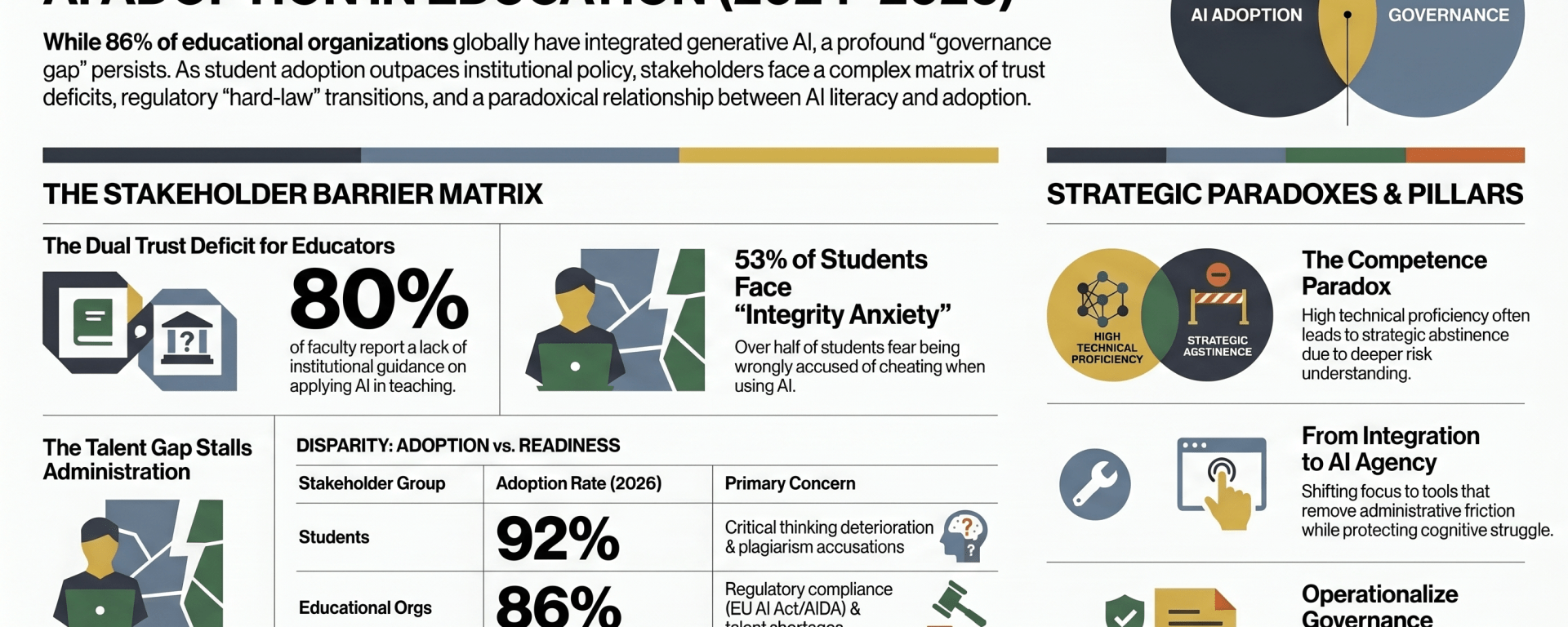
The educational landscape across North America and Europe is currently navigating the most significant technological disruption since the advent of the internet. Between 2024 and 2026, generative artificial intelligence has transitioned from a novel experimental tool to a foundational element of academic infrastructure, with 86% of educational organizations globally now reporting the use of these technologies.1 However, this rapid integration is characterized by a profound “governance gap,” as student adoption (reaching 92% in 2026) and individual faculty experimentation have significantly outpaced the development of institutional policies and professional training frameworks.1
This report identifies a complex matrix of barriers across three primary stakeholder groups. Educators are largely hindered by a “dual trust deficit”—a technological skepticism regarding the reliability of AI outputs (hallucinations) and an institutional anxiety concerning the erosion of academic integrity and student critical thinking.5 Students, while high-frequency users, face a “shadow literacy gap” where socioeconomic status dictates whether AI is used for deep cognitive scaffolding or superficial automation, alongside a pervasive fear of being falsely flagged by unreliable plagiarism detection systems.4 Administrators are stalled by a critical shortage of AI-ready talent and an increasingly complex regulatory environment, particularly the transition from “soft-law” guidelines to “hard-law” compliance regimes such as the European Union’s AI Act and Canada’s Artificial Intelligence and Data Act (AIDA).8
Hypothesis testing within this analysis reveals that educator trust is indeed depressed by perceived student misuse, and administrator trust is similarly cooled by institutional risk.5 Crucially, the research rejects the assumption that adoption is strictly proportional to AI literacy; instead, a “competence paradox” is observed where higher technical proficiency often leads to strategic abstinence due to a deeper understanding of technological risks.6 Strategic success for senior leaders in this era requires a shift from “integration” to “impact,” moving beyond basic literacy toward “AI Agency,” where the technology removes unproductive administrative friction while protecting the “productive friction” essential for authentic human learning.4
Analysis of Barriers to Educator Adoption
The integration of generative AI into teaching practices is currently characterized by a state of “cautious curiosity.” While 86% of faculty members anticipate using AI in their future teaching, only 17% consider themselves to be at an advanced or expert level of proficiency.5 The barriers to adoption are multifaceted, spanning psychological, technical, and institutional dimensions.
The Dual Trust Deficit and the Verification Burden
The primary obstacle for educators is a “dual trust deficit” that encompasses both technological reliability and institutional support. Technologically, the risk of “hallucinations”—the generation of false or misleading results by Large Language Models (LLMs)—remains a significant deterrent, with educators reporting a high level of concern (Mean = 3.70).6 This unreliability necessitates a “verification burden,” where instructors must spend additional time fact-checking AI-generated content, thereby negating the perceived efficiency gains of the technology.6
Institutionally, faculty members report a profound lack of clarity regarding how AI should be applied. 80% of faculty members feel there is an absence of institutional guidance on the application of AI in teaching.5 Only 4% are fully aware of their institution’s AI guidelines and believe them to be comprehensive.5 This creates an “institutional crisis of trust,” where faculty members—particularly those in technical disciplines like IT—choose to abstain from full integration due to the absence of a secure and regulated ecosystem.6
Workload Intensification and Devaluation
Contrary to the promise that AI would reduce administrative burdens, many educators perceive its current implementation as a source of “work intensification.” The rapid rollout of AI tools, often driven by administrative mandates with little faculty input, has added new layers of responsibility, including the management of AI-related academic integrity cases and the need for frequent curriculum revisions to keep pace with technological advances.12 In the United States, 15% of faculty report being required to use AI, yet 81% are mandated to use broader educational technologies (like Learning Management Systems) that have embedded, often opaque, predictive analytics.15 This “uncritical adoption” of untested technologies poses a threat to academic freedom and intellectual property rights, contributing to a sense of professional devaluation.15
Comparative Barriers for Educators by Institution Type and Country
The following tables synthesize the primary barriers to educator adoption, segmented by institution type and the focus countries (US, Canada, UK, France, and Germany).
Table 1: Educator Adoption Barriers by Institution Type (2025–2026)
| Institution Type | Primary Adoption Barrier | Secondary Adoption Barrier | Resource Deficit | Perception of AI |
| K-12 Education | Lack of formal training (71% in US) 17 | Concerns about social/comm skills (61% in Germany) 19 | High workload and chronic time pressure 19 | 25% believe AI does more harm than good 17 |
| Higher Education | Dual trust deficit (Technological & Institutional) 6 | Inadequacy of current assessment models (54%) 5 | Only 6% agree that training resources are sufficient 5 | 65% view as opportunity; 35% as challenge 5 |
Table 2: Educator Adoption Barriers by Country (2025–2026)
| Country | Top Barrier 1 | Top Barrier 2 | Top Barrier 3 | Regulatory Concern |
| United States | Academic Integrity/Plagiarism (31%) 20 | Training Gap (45% receive none) 2 | Misinformation & Security 20 | Intellectual Property & Data Privacy 15 |
| Canada | Critical Thinking Deterioration (48%) 21 | Lack of embedding in learning pathways 21 | Equity and Accessibility 22 | Alignment with AIDA/Bill C-27 23 |
| United Kingdom | Assessment inadequacy 5 | Staff literacy gap (only 42% feel equipped) 17 | Workload intensification 15 | Lack of central monitoring/KPIs 24 |
| France | Lack of training at all levels 25 | Sovereign AI compliance 26 | Fragmented AI governance 25 | GDPR & EU AI Act (High-risk status) 27 |
| Germany | Impact on social/comm skills (61%) 19 | Uncertainty and skepticism (62%) 19 | Regional digital divide (Urban vs. Rural) 28 | Strict Data Protection (BDSG/GDPR) 28 |
Analysis of Barriers to Student Adoption
Student adoption of generative AI is nearly universal, with 92% of university students globally utilizing these tools in 2026, a significant increase from 66% in 2024.1 However, the shift from routine usage to effective, ethical learning remains hindered by significant psychological and structural obstacles.
The Anxiety of Integrity and Plagiarism Concerns
The most pervasive barrier for students is the “anxiety of integrity.” Approximately 53% of students report being afraid to use AI in their studies for fear of being wrongly accused of cheating.4 This fear is grounded in reality, as 33% of students globally have faced accusations related to excessive AI use or plagiarism.17 The psychological toll of these accusations, combined with the unreliability of AI detection tools—which can have false-positive rates that impact hundreds of thousands of students—creates a chilling effect on legitimate use.7
The Crisis of Competence and Dependency
While students recognize the benefits of AI for saving time and improving work quality, 65% express concern that it may make learning too shallow and discourage critical thinking.3 In Canada, nearly half (48%) of students admit that their critical thinking skills have deteriorated since they started using AI.21 This leads to a “crisis of competence,” where the removal of “unproductive friction” (administrative lifting) also inadvertently removes the cognitive struggle necessary for encoding information in the brain.4 OECD research confirms this “dose-response” pattern: students with access to general-purpose chatbots produce higher-quality outputs initially, but this advantage disappears or reverses in exam settings where the tools are removed.1
The Shadow Literacy Gap
A new form of educational inequality, the “shadow literacy gap,” is emerging based on socioeconomic status. Students from higher socioeconomic backgrounds are significantly more likely to use AI for high-level cognitive tasks, such as structuring complex arguments, deep research, and brainstorming.4 In contrast, students from marginalized backgrounds are more frequently using AI for surface-level tasks like basic summaries, which may limit their long-term skill development and future employability.4 Furthermore, neurodivergent students report higher rates of AI use (73% vs. 63%) but also feel more disconnected from their teachers (57% vs. 46%) when using these tools, highlighting a need for more nuanced, inclusive implementation strategies.29
Comparative Barriers for Students by Institution Type and Country
Table 3: Student Adoption Barriers by Institution Type (2025–2026)
| Institution Type | Primary Usage | Primary Barrier | Awareness | Training Status |
| K-12 Education | Homework/Brainstorming (54%) 17 | Fear of cheating accusations 2 | 44% engage in generative AI 17 | 74% of districts to train by Fall 2025 17 |
| Higher Education | Assessments (88%) 17 | Critical thinking deterioration (48%) 21 | 92% active usage 3 | Only 36% received formal training 4 |
Table 4: Student Adoption Barriers by Country (2025–2026)
| Country | Primary Barrier | Dependency Risk | Sentiment | Institutional Support |
| United States | Plagiarism Accusations (33%) 20 | 30% fear dependency 20 | 39% Optimistic 30 | 52% report no training 20 |
| Canada | Skill Deterioration (48%) 21 | 45% first instinct is AI 21 | 40% Optimistic 30 | 77% want formal courses 21 |
| United Kingdom | Fair use for assessments 3 | 45% use for schoolwork 17 | 38% Optimistic 17 | 36% receive support 7 |
| France | Data Privacy & GDPR 31 | Linguistic/Cultural Bias 32 | Growing (+10% since 2022) 30 | PIX AI pathway launch 2025 25 |
| Germany | Lack of AI skill offerings 33 | Social skill erosion (61%) 19 | Growing (+10% since 2022) 30 | Rated 2.7/5 for current skills 33 |
Analysis of Barriers to Administrator Adoption
Institutional leaders, including Deans, Provosts, and Superintendents, face barriers that are structural, financial, and regulatory. While 63% of organizations have fully operationalized AI within their operations, this progress is often fragile and lacks the necessary governance frameworks.8
The Talent Shortage and IT Readiness
The most significant barrier to institutional adoption is the “talent gap.” More than half of businesses and educational organizations report that a shortage of AI-ready talent is the greatest hurdle to implementation.8 This is coupled with a lack of “IT readiness,” cited by 20% of leaders as a primary concern.20 Administrators struggle to find personnel who can not only use the tools but also understand the complex relationship between AI and data-intensive educational technologies.15
Governance, Risk, and Compliance (GRC)
Institutional leaders are increasingly mindful of the risks associated with AI, including misinformation, hallucinations, and data protection violations.8 While 93% of organizations say they understand AI risks, fewer than half have conducted ethical impact assessments or established AI incident response plans.8 The regulatory landscape is shifting from “soft-law” (voluntary guidelines) to “hard-law” (binding regulations), such as the EU AI Act, which classifies many educational uses of AI as “high-risk,” requiring rigorous transparency, data governance, and human oversight.10 Administrators are often “sandwiched” between the need for rapid innovation to maintain competitive advantage and the legal necessity of building rigorous, expensive processes to ensure compliance.23
Data Fragmentation and Financial Constraints
A major operational barrier is “data fragmentation,” where information is scattered across separate platforms or locked behind strict permissions that do not work across AI systems.36 This prevents AI tools from generating a consistent, organization-wide view, thereby limiting their ROI.11 Furthermore, financial constraints remain a critical bottleneck; only 2% of institutions are supporting AI initiatives through new funding sources, while most reallocate existing budgets, often overlooking the significant up-front costs required to realize AI’s benefits.7
Comparative Barriers for Administrators by Institution Type and Country
Table 5: Administrator Adoption Barriers by Institution Type (2025–2026)
| Institution Type | Strategic Priority | Primary Risk | Operational Barrier | Preparedness Gap |
| K-12 Education | Implementation of teacher training 17 | Student misuse & integrity (95%) 12 | Budgetary/Infrastructure 37 | 56% say schools are not ready 12 |
| Higher Education | Governance and policy readiness 16 | Reputational risk & misinformation 16 | Talent shortage & Data silos 8 | 56% say institutions are below average 39 |
Table 6: Administrator Adoption Barriers by Country (2025–2026)
| Country | Primary Focus | Regulatory Strategy | Major Barrier | ROI Perception |
| United States | Infrastructure and Talent 40 | Sector-specific & Guidance 9 | IT Readiness (20%) 20 | High (83% see rev increase) 8 |
| Canada | SME Adoption & Productivity 41 | Horizontal/AIDA (Hard-law) 9 | Lack of computational resources 41 | Focused on talent-first model 22 |
| United Kingdom | Workload reduction 24 | Principles-based (Soft-law) 9 | Governance gap & monitoring 24 | Lags behind European peers 24 |
| France | Sovereign AI & National Strategy 26 | Hard-law (EU AI Act) 9 | Scattered governance coordination 25 | 109B Euro investment commitment 30 |
| Germany | Scale-up and Teacher Training 28 | Hard-law (EU AI Act/BDSG) 28 | Regional digital divide 28 | Projected 30.6% CAGR market growth 28 |
Testing Strategic Hypotheses
The current research landscape allows for the empirical testing of four critical hypotheses regarding AI adoption in education.
Hypothesis 1: Educator trust is low due to student misuse
Findings: Supported. The “dual trust deficit” observed in faculty surveys is heavily influenced by concerns over academic integrity. 95% of education leaders and 83% of faculty express significant concern about students’ ability to critically evaluate AI-generated outputs.5 Over half of faculty (54%) believe current student evaluation methods are no longer adequate, leading to a “revamp needed” sentiment that hinders willingness to adopt AI tools.5 The fear of “cognitive atrophy” in students—where they receive ready-made solutions without effort—is a primary deterrent for 60% of teachers.6
Hypothesis 2: Administrator trust is low due to institutional risk
Findings: Supported. Sentiment toward AI among institutional leaders has cooled as adoption has scaled. Globally, the percentage of leaders viewing AI as a potential risk has doubled to 11% in 2025, up from 5% the previous year.11 The primary driver of this mistrust is the “governance gap”—63% of organizations have implemented AI, but fewer than half have established formal governance frameworks or ethical impact assessments.8 Leaders are particularly wary of legal and reputational risks stemming from AI hallucinations and misinformation, cited by 57% of respondents as a top threat.8
Hypothesis 3: Adoption varies by country due to regulation
Findings: Partially Supported (Management Practices as a Dominant Driver). While regulatory frameworks differ significantly—with the U.S. and UK favoring “soft-law” and Canada and the EU favoring “hard-law”—cross-country adoption differences are more strongly correlated with “firm management practices” and national wealth.9 Research indicates that a country’s average management index is strongly predictive of adoption rates; countries where leaders actively encourage AI use and provide infrastructure see higher adoption regardless of the regulatory regime.42 However, regulation is shaping the type of adoption, with European schools focusing heavily on sovereign AI and GDPR compliance while U.S. institutions prioritize rapid experimentation.9
Hypothesis 4: Adoption is proportional to AI literacy
Findings: Rejected (The “Competence Paradox”). In one of the most significant findings of 2025, researchers identified a “competence paradox” among IT instructors. Despite assessing their own AI skills highly (Mean = 3.86), there was no relationship between their competence levels and their readiness to integrate the technology into teaching (
Global Case Studies in AI Implementation (2024–2026)
These case studies demonstrate successful strategic approaches to overcoming adoption barriers.
Case Study 1: Canada – Mitacs and the University of Waterloo (Productivity and Talent)
Context and Mechanism: Facing a persistent national productivity gap, Canada utilized Mitacs—a national non-profit—to bridge the gap between academic research and commercial implementation. The initiative focused on a “talent-first” model, embedding graduate students from the University of Waterloo and other research hubs directly into enterprises to drive AI adoption.22 Impact: A 2024 study showed that companies partnering with Mitacs saw an average 11% boost in productivity and a 9% growth in revenue. In the higher education context, this model de-risks the adoption journey for SMEs and institutions by providing the necessary “high-qualified personnel” (HQP) who possess both technical skills and domain-specific knowledge.22
Case Study 2: United States – Arizona State University (ASU) AI Innovation Challenge
Context and Mechanism: ASU launched an “AI Innovation Challenge” in February 2024 to foster a community of practice among faculty and staff. The challenge invited proposals for projects that used ChatGPT Edu to boost administrative or pedagogical efficiency.44 Impact: Within two weeks, the challenge attracted 175 proposals. By July 2024, over 200 projects were underway. One standout success was the “Sam” chatbot in the College of Health Solutions, which allowed students to practice patient-provider interactions and receive motivational feedback. ASU leaders found that “building the community is harder, and more important, than building the technology,” emphasizing that institutional culture is a greater driver of adoption than the tool itself.44
Case Study 3: United Kingdom – The University of Oxford (ChatGPT Edu Pilot)
Context and Mechanism: The University of Oxford initiated a pilot of ChatGPT Edu in May 2024, positioning AI as both an “administrative assistant” and a “critical friend” (peer reviewer) for staff and students.46 Impact: Students on the Astrophoria Foundation Year used the tool for note organization and revision assistance. The tool helped students break down complex material and sustain motivation during study sessions. Staff utilized it for drafting newsletters and refining research for policymakers. The pilot demonstrated that framing AI as a “complement to independent thinking” rather than a “shortcut” is essential for maintaining academic standards.46
Case Study 4: France – The PIX AI Pathway (Sovereign Literacy)
Context and Mechanism: In June 2025, the French Ministry of Education launched a framework for generative AI, including a mandatory “AI pathway” for secondary school pupils on the PIX platform.26 Impact: This standardized pathway ensures that all students, regardless of background, gain foundational literacy in how generative AI works and how to manage data ethically. It is compulsory for pupils prior to the end of lower secondary education. By making literacy foundational and sovereign, France aims to counteract “uncritical adoption” and bridge the shadow literacy gap before students enter higher education or the workforce.25
Case Study 5: Germany – Syntea at IU International University of Applied Sciences
Context and Mechanism: IU International University developed “Syntea,” an AI-supported learning assistant designed to personalize student learning and exam preparation. Syntea provides targeted support by identifying prior knowledge gaps.47 Impact: Internal analysis showed that students using Syntea completed their courses up to 27% faster. Furthermore, 57.9% of users reported that their learning or exam results improved significantly. Syntea exemplifies the shift from general-purpose chatbots to “pedagogically-aligned” AI systems that foster individual pacing and flexibility without replacing the instructor.1
Research Commentary and Future Outlook
The data from 2024–2026 suggests that we are moving past the “pilot phase” of AI adoption into a “strategic impact phase.” However, this transition is uneven. While 86% of students globally use AI, only 20% of universities have formal policies, creating a governance vacuum that increases institutional risk.1
The Displacement of Traditional Skills
A recurring theme is the potential for AI to “dehumanize” relations in the classroom. 50% of students report that AI use makes them feel less connected to their teacher.29 This “disconnection” is a critical second-order effect that leaders must address. The future value of an educational institution will lie not in its ability to transmit information (which AI can do faster) but in its ability to provide mentorship, community, and “meaning-making”.2
The ROI Equation in 2026
Institutional leaders must rethink how they measure the value of AI. Traditional metrics like “time saved” are inadequate if they lead to work intensification in other areas. The new ROI of AI in education should be measured by:
- Retention and Student Success: As seen in the IU Syntea case, the ability to personalize learning can lead to faster course completion and better results.47
- Administrative Resiliency: Automating repetitive processes (e.g., IEP preparation, which AI can reduce by 90%) allows staff to focus on high-touch, relational work.44
- Workforce Readiness: With 66% of leaders saying they wouldn’t hire someone without AI literacy skills, the primary “product” of education must now be graduates who are “the boss of agents”—capable of commanding AI teams rather than just using tools.2
Strategic Actions for Organizational Leaders
Based on the exhaustive analysis of barriers and success cases, senior leaders should implement the following strategic pillars.
1. Operationalize Governance and Ethics
- Establish Cross-Functional Task Forces: Governance must involve IT, legal, data privacy, and faculty to ensure that systems are safe, ethical, and compliant.11
- Adopt International Standards: Align institutional frameworks with recognized standards like ISO/IEC 42001 or the NIST AI Risk Management Framework to ensure interoperability and bypass fragmented domestic legal hurdles.10
- Mandate Ethical Impact Assessments: For all high-stakes AI applications (e.g., grading, admissions), institutions must conduct formal assessments of bias and data privacy.8
2. Close the Training and Literacy Gap
- Provide High-Quality, Job-Embedded PD: Faculty and staff require training that is relevant to their specific roles, such as using AI for curriculum design or personalized instruction.2
- Embed AI Literacy in Student Curricula: Following the French PIX model, AI literacy should be a general education learning outcome, ensuring that all students develop “critical AI agency”.26
- Address the Competence Paradox: Do not assume that technical staff are ready to lead adoption. Engagement strategies must address their specific skepticism regarding technological hallucinations and verification burdens.6
3. Redesign Infrastructure and Assessment
- Move Toward Sovereign Data Ecosystems: Invest in systems that ensure data is not stored or cached by third-party vendors, meeting the rigorous compliance standards of the EU AI Act and GDPR.34
- Revamp Academic Integrity Frameworks: Shift away from reliance on detection tools toward “authentic assessment” models that value the process of learning and include AI audit trails.4
- Bridge the Shadow Literacy Gap: Actively provide premium AI resources to low-SES students and neurodivergent learners to ensure equitable outcomes and prevent the emergence of new digital divides.4
By taking these actions, senior educational leaders in North America and Europe can navigate the algorithmic frontier with clarity and purpose, ensuring that AI serves as an enhancer of human intelligence rather than a replacement for it.
Works cited
- 25 AI in Education Statistics to Guide Your Learning Strategy in 2026 – Engageli, accessed April 13, 2026, https://www.engageli.com/blog/ai-in-education-statistics
- 2025 AI in Education: A Microsoft Special Report, accessed April 13, 2026, https://cdn-dynmedia-1.microsoft.com/is/content/microsoftcorp/microsoft/bade/documents/products-and-services/en-us/education/2025-Microsoft-AI-in-Education-Report.pdf
- AI Adoption Is Nearly Universal Among Students, But Confidence Is Not, accessed April 13, 2026, https://www.digitaleducationcouncil.com/post/ai-adoption-is-nearly-universal-among-students-but-confidence-is-not
- How students are using AI in 2026: A shift from AI adoption to AI agency | Genio, accessed April 13, 2026, https://genio.co/blog/-students-using-ai-2026-from-ai-adoption-to-ai-agency
- What Faculty Want: Key Results from the Global AI Faculty Survey …, accessed April 13, 2026, https://www.digitaleducationcouncil.com/post/what-faculty-want-key-results-from-the-global-ai-faculty-survey-2025
- Barriers to artificial intelligence adoption among … – Frontiers, accessed April 13, 2026, https://www.frontiersin.org/journals/education/articles/10.3389/feduc.2026.1804254/full
- AI in Higher Education Statistics: The Complete 2025 Report – Anara, accessed April 13, 2026, https://anara.com/blog/ai-in-education-statistics
- AI Adoption Is Outrunning Governance – GovInfoSecurity, accessed April 13, 2026, https://www.govinfosecurity.com/ai-adoption-outrunning-governance-a-31221
- Steering the AI world: an exploratory comparison of AI Acts in the EU and Canada – Publicera, accessed April 13, 2026, https://publicera.kb.se/ir/article/download/47278/37039/109090
- Global AI Governance Frameworks A Comparative Study, accessed April 13, 2026, https://ai.gov.eg/SynchedFiles/en/Resources/Global%20AI%20Governance%20Frameworks%20A%20Comparative%20Study.pdf
- The 2025 Attitudes to AI Adoption and Risk Benchmarking Survey – Gallagher, accessed April 13, 2026, https://www.ajg.com/news-and-insights/features/2025-attitudes-to-ai-adoption-and-risk-benchmarking-survey/
- Leading Through Disruption: Higher Education Executives Assess AI’s Impacts on Teaching and Learning – Cloudfront.net, accessed April 13, 2026, https://dgmg81phhvh63.cloudfront.net/content/user-photos/AACU_AI_Report_2025.pdf
- 92% of Students and 79% of Faculty Actively Engaging with AI: Findings from AI in Higher Education LATAM Survey 2026, accessed April 13, 2026, https://www.digitaleducationcouncil.com/post/92-of-students-and-79-of-faculty-actively-engaging-with-ai-findings-from-ai-in-higher-education-latam-survey-2026
- AI and education: protecting the rights of learners – UNESCO Digital Library, accessed April 13, 2026, https://unesdoc.unesco.org/ark:/48223/pf0000395373
- Artificial Intelligence and Academic Professions | AAUP, accessed April 13, 2026, https://www.aaup.org/reports-publications/aaup-policies-reports/topical-reports/artificial-intelligence-and-academic
- Leading Institutional Transformation in the Age of AI – UPCEA, accessed April 13, 2026, https://upcea.edu/leading-institutional-transformation-in-the-age-of-ai/
- 77 AI in Education Statistics 2026 (Global Trends & Facts) – DemandSage, accessed April 13, 2026, https://www.demandsage.com/ai-in-education-statistics/
- AI In Education Statistics By Usage, Adoption and Facts (2025) – ElectroIQ, accessed April 13, 2026, https://electroiq.com/stats/ai-in-education-statistics/
- German School Barometer: Concerns About Social Skills in the ChatGPT Generation, accessed April 13, 2026, https://www.bosch-stiftung.de/en/press/2025/06/german-school-barometer-concerns-about-social-skills-chatgpt-generation
- AI in Education Report: Insights to support teaching and learning …, accessed April 13, 2026, https://www.microsoft.com/en-us/education/blog/2025/08/ai-in-education-report-insights-to-support-teaching-and-learning/
- Generative AI boom among Canadian students raises dilemmas – KPMG International, accessed April 13, 2026, https://kpmg.com/ca/en/media/2025/10/generative-ai-boom-among-canadian-students-raises-dilemmas.html
- What Canada’s AI Strategy Needs to Succeed – Mitacs, accessed April 13, 2026, https://www.mitacs.ca/news/what-canadas-ai-strategy-needs-to-succeed/
- AI governance around the world – The Alan Turing Institute, accessed April 13, 2026, https://www.turing.ac.uk/sites/default/files/2025-09/ai_governance_around_the_world_canada.pdf
- European Educational AI Index 2025: Which Country is Best for AI in Education?, accessed April 13, 2026, https://www.gostudent.org/en-gb/blog/which-country-is-best-for-ai-in-education
- [Feature] Back to school 2025: teaching and learning in the age of AI and digital control, accessed April 13, 2026, https://labo.societenumerique.gouv.fr/en/articles/dossier-rentree-scolaire-2025-enseigner-et-apprendre-a-lheure-des-ia-et-de-lencadrement-des-usages-numeriques/
- France: New tools for teaching thanks to artificial intelligence – European Union, accessed April 13, 2026, https://eurydice.eacea.ec.europa.eu/news/france-new-tools-teaching-thanks-artificial-intelligence
- The Complete Guide to Using AI in the Education Industry in France …, accessed April 13, 2026, https://www.nucamp.co/blog/coding-bootcamp-france-fra-education-the-complete-guide-to-using-ai-in-the-education-industry-in-france-in-2025
- The Complete Guide to Using AI in the Education Industry in …, accessed April 13, 2026, https://www.nucamp.co/blog/coding-bootcamp-germany-deu-education-the-complete-guide-to-using-ai-in-the-education-industry-in-germany-in-2025
- AI Risks in K-12 Schools Are Growing Alongside Adoption – Med Kharbach, accessed April 13, 2026, https://medkharbach.com/ai-risks-in-k-12-schools/
- Artificial Intelligence Index Report 2025 – AWS, accessed April 13, 2026, https://hai-production.s3.amazonaws.com/files/hai_ai_index_report_2025.pdf
- exploring the transformative role in french language education, addressing challe, accessed April 13, 2026, https://ijsra.net/sites/default/files/fulltext_pdf/IJSRA-2025-0451.pdf
- AI and the digital divide in education – Frontiers, accessed April 13, 2026, https://www.frontiersin.org/journals/computer-science/articles/10.3389/fcomp.2026.1759027/full
- A quarter of students in Germany use artificial intelligence on a daily basis, accessed April 13, 2026, https://www.che.de/en/2025/a-quarter-of-students-in-germany-use-artificial-intelligence-on-a-daily-basis/
- Artificial intelligence policy worldwide: a comparative analysis | Royal Society Open Science, accessed April 13, 2026, https://royalsocietypublishing.org/rsos/article/13/2/242234/480264/Artificial-intelligence-policy-worldwide-a
- AI Adoption in Research Administration at Emerging Research Institutions – Ithaka S+R, accessed April 13, 2026, https://sr.ithaka.org/publications/ai-adoption-in-research-administration-at-emerging-research-institutions/
- Organizational Barriers to AI Adoption – The Decision Lab, accessed April 13, 2026, https://thedecisionlab.com/reference-guide/management/organizational-barriers-to-ai-adoption
- Uneven Adoption of Artificial Intelligence Tools Among U.S. Teachers and Principals in the 2023-2024 School Year – RAND, accessed April 13, 2026, https://www.rand.org/content/dam/rand/pubs/research_reports/RRA100/RRA134-25/RAND_RRA134-25.pdf
- Full article: Balancing regulation and innovation: the need for agile AI governance in higher education – a cross-country study – Taylor & Francis, accessed April 13, 2026, https://www.tandfonline.com/doi/full/10.1080/03075079.2026.2614986
- Leading Through Disruption: Higher Education Executives Assess AI’s Impacts on Teaching and Learning – AAC&U, accessed April 13, 2026, https://www.aacu.org/research/leading-through-disruption
- The 2025 AI Index Report | Stanford HAI, accessed April 13, 2026, https://hai.stanford.edu/ai-index/2025-ai-index-report
- Bridging the AI Gap in SMEs in Canada – Diversity Institute – Toronto Metropolitan University, accessed April 13, 2026, https://www.torontomu.ca/diversity/reports/bridging-the-ai-gap-in-smes-in-canada/
- Mind the Gap: AI Adoption in Europe and the US – Brookings Institution, accessed April 13, 2026, https://www.brookings.edu/wp-content/uploads/2026/03/6_Bick-et-al_unembargoed.pdf
- Mind the Gap: AI Adoption in Europe and the U.S. – Federal Reserve Bank of St. Louis, accessed April 13, 2026, https://www.stlouisfed.org/on-the-economy/2026/mar/mind-gap-ai-adoption-europe-us
- Top AI Case Studies in Education 2025 – RAISE Summit, accessed April 13, 2026, https://www.raisesummit.com/post/ai-case-studies-education
- How AI Can Help Higher Education Capture a Once-in-a-Generation Opportunity – Boston Consulting Group, accessed April 13, 2026, https://www.bcg.com/publications/2026/how-ai-can-help-universities-capture-opportunity
- Generative AI case studies – University of Oxford, accessed April 13, 2026, https://www.ox.ac.uk/gen-ai/case-studies
- Learning report shows positive experience with AI | IU News, accessed April 13, 2026, https://www.iu.de/news/en/comprehensive-study-reveals-over-half-improve-learning-and-exam-results-with-ai/
- Case study examples of AI use | York St John University, accessed April 13, 2026, https://www.yorksj.ac.uk/policies-and-documents/generative-artificial-intelligence/case-study-examples-of-ai-use/
The idea, research hypotheses, and focus for this article/research are all original (mine). This article was written with my brain and two hands with the assistance of Google Gemini, Notebook LM, Claude, and other wondrous toys.

