Executive Summary
The integration of artificial intelligence within heavily regulated sectors—specifically financial services, healthcare, insurance, and government—has fundamentally altered the trajectory of technology product leadership. Based on a comprehensive review of primary salary data, evolving regulatory frameworks, and enterprise deployment outcomes across North America and Europe, the analysis indicates that artificial intelligence product management has permanently transitioned from a purely technical discipline into a hybrid product-governance function.
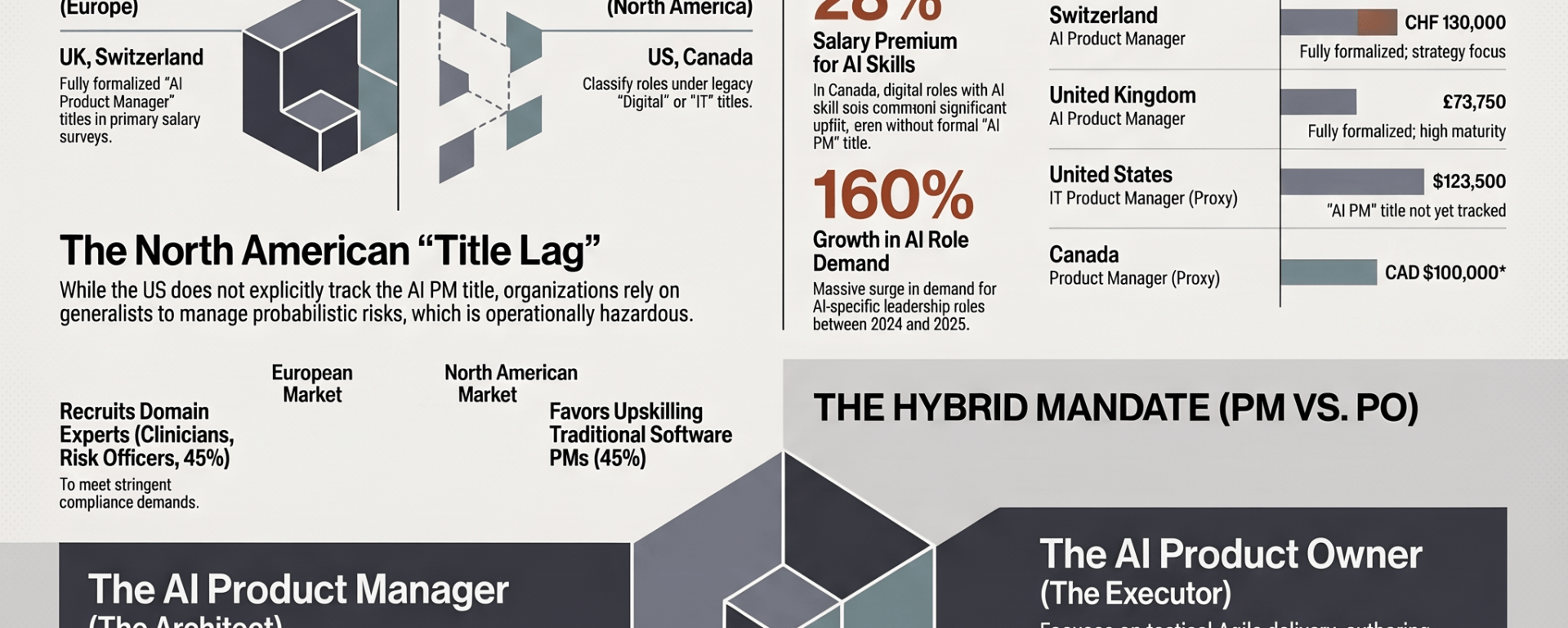
The market reveals a stark geographic divide in role formalization. European markets, operating under the imminent enforcement of the European Union Artificial Intelligence Act (EU AI Act), have rapidly standardized the Artificial Intelligence Product Manager (AI PM) and Artificial Intelligence Product Owner (APO) titles. Conversely, North American and Australian markets exhibit a distinct lag in title formalization, frequently nesting these critical responsibilities within traditional IT or digital product roles, despite paying significant premiums for the underlying skill sets. This discrepancy highlights a critical vulnerability for North American organizations: as domestic regulatory pressures mount, relying on generalist product managers to navigate complex, probabilistic model risks is proving operationally hazardous.
Furthermore, enterprise case studies from 2024 to 2026 demonstrate that the primary barrier to successful AI deployment in regulated environments is no longer algorithmic accuracy, but rather organizational integration. Technical models repeatedly fail when deployed without robust human-in-the-loop workflows, stringent data governance, and proactive stakeholder expectation management. Consequently, the AI PM and APO roles have bifurcated into distinct, complementary functions. The AI PM assumes accountability for strategic regulatory alignment, cross-functional risk management, and commercial viability, while the APO drives tactical sprint execution, training data validation, and automated compliance logging.
Strategic Findings
The formalization of AI product roles is heavily concentrated in jurisdictions with prescriptive, sweeping AI legislation, most notably the United Kingdom and Switzerland, where primary compensation surveys now track these titles independently. In jurisdictions favoring sector-specific guidance or voluntary codes, such as the United States and Canada, the standalone title remains statistically obscured within legacy technology management classifications.
The regulatory landscape dictates the daily workflow of the modern AI PM. In the United States, the Federal Reserve’s SR 26-2 explicitly excludes generative and agentic AI from the formal definition of a quantitative model, forcing AI PMs to pioneer novel control structures—such as dynamic kill switches and hallucination monitoring—that operate outside traditional model risk management (MRM) boundaries. In Canada, OSFI Guideline E-23 mandates a comprehensive 17-field model inventory that explicitly captures machine learning, requiring the AI PM to generate continuous, auditable evidence of bias testing and pre-deployment cyber risk checks.
The European market represents the highest burden of governance integration. Under the EU AI Act, the AI PM acts as the de facto compliance architect for high-risk systems. This requires operationalizing Article 9 (continuous risk management), Article 10 (data governance and intersectional bias testing), and Article 14 (human oversight interface design) directly into the product lifecycle.
Real-world deployment failures confirm that organizational readiness supersedes technical capability. High-profile retractions of AI systems in the automotive, financial, and human resources sectors demonstrate that probabilistic models cannot safely replace human judgment in complex, regulated workflows without incurring severe operational and reputational damage. The AI PM’s mandate is increasingly defined by the ability to design safe fallback procedures and manage the limitations of the technology.
Career pathways into AI product leadership are diverging based on regional regulatory demands. While North America favors upskilling traditional software product managers, the European market—and the global healthcare sector—increasingly recruits domain experts, such as clinical informaticists or risk officers, who possess an intrinsic understanding of regulatory liability, patient safety, and institutional compliance standards.
Key Market Metrics (2026)
| Metric | Value | Confidence & Source |
| UK AI PM Median Salary | £73,750 | High — Robert Half UK 2026 (primary survey) |
| Swiss AI PM Median Salary | CHF 130,000 | High — Robert Half CH 2026 (primary survey) |
| Canadian AI Skill Premium | Up to 28% salary uplift | High — Hays Canada 2026 via Lightcast |
| US AI PM Title Tracking | Explicitly Not Tracked | High — absence confirmed in Robert Half US 2026 |
| Healthcare AI Market Projection | $187 Billion by 2030 | High — baseline trajectory driving clinical AI PM demand |
| AI Role Demand Growth | >160% (2024–2025) | High — Robert Half technology labor market research |
| Workforce Enablement Gap | 78% lack formal training | High — Hays survey of active AI users |
Quantitative Summary
Regional Compensation and Role Standardization Benchmarks (PRIMARY SURVEY DATA ONLY)
Methodological Note: All compensation data below is sourced exclusively from named primary salary survey publishers (Robert Half, Hays). Secondary claims suggesting median US base salaries of $162,000 for AI Product Managers are sourced from unapproved secondary publishers and are intentionally excluded to preserve data integrity. The explicit absence of “AI Product Manager” and “AI Product Owner” as tracked titles in Hays Canada, Robert Half US, and Hays Australia 2026 constitutes a major market signal — confirming the role remains in an emerging, pre-standardized state in North America and Australia.
| Region | Primary Survey Publisher (2026) | Tracked Role Title | 25th Pct (Low) | 50th Pct (Median) | 75th Pct (High) | Market Context |
| United Kingdom | Robert Half UK | AI Product Manager | £65,000 | £73,750 | £92,000 | Fully formalized role tracking. Indicates high market maturity. |
| Switzerland | Robert Half CH | AI Product Manager | CHF 100,000 | CHF 130,000 | CHF 150,000 | Fully formalized role tracking. Commands premium over standard PMs. |
| Switzerland | Robert Half CH | Product Owner AI | CHF 90,000 | CHF 120,000 | CHF 140,000 | Explicit bifurcation between strategy (PM) and tactical execution (PO). |
| United States | Robert Half US | GAP NOTED (Proxy: IT Product Manager) | $101,750 | $123,500 | $146,500 | “AI PM” is not a named role. Standard Product Manager tracked at $79,750–$116,500. |
| Canada | Hays Canada | GAP NOTED (Proxy: Product Manager) | CAD $100,000 | Data unavailable | CAD $140,000 | Hays notes 28% salary premium for AI-skilled digital roles. |
| Canada | Hays Canada | GAP NOTED (Proxy: Product Owner Digital) | CAD $80,000 | Data unavailable | CAD $120,000 | Closest tracked proxy for tactical backlog management. |
| Australia | Hays AU / Robert Half AU | GAP EXPLICITLY NOTED | Data unavailable | Data unavailable | Data unavailable | Neither primary survey names this role. Only AI Engineers and general PMs are tracked. |
| Germany | Hays Germany | KI-Product Owner | Data unavailable | Data unavailable | Data unavailable | Role noted qualitatively with +22% premium; exact bands unpublished. |
| Spain | Hays Spain | AI Product Manager (Generative AI) | Data unavailable | Data unavailable | Data unavailable | Emerging role noted in academic/market partnerships; exact bands unpublished. |
⚠️ FLAG: The absence of “AI Product Manager” as a named role in Hays Canada (2026 Salary & Hiring Trends Guide, survey August 2025), Robert Half US (2026), and Hays Australia (FY26/27) is itself a primary finding. It confirms the role’s emerging and not-yet-standardized status in North America and Australia, in contrast with the UK and Switzerland where it is a formally tracked title.
Core Competency Frequency Distribution
| Competency Domain | Specific Applied Skills | Relative Importance |
| Governance & Ethics | Bias detection (demographic parity, equalized odds), regulatory mapping (EU AI Act, SR 26-2, OSFI E-23), automated event logging design | Critical |
| Domain Expertise | Clinical workflow safety (Healthcare), credit decisioning boundaries (Finance), legal risk thresholds, audit artifact generation | Critical |
| AI/Data Literacy | LLM mechanics, RAG pipelines, embeddings, probabilistic evaluation metrics, training data validation | High |
| Product Strategy | Problem framing, ROI analysis, human-in-the-loop fallback design, A/B test formulation, lifecycle management | High |
| Technical Execution | MLOps familiarity, vector database architecture, Python/SQL for prototype validation and log querying | Medium |
Career Background Origins and Regional Disparities
| Background Origin | North America (Est.) | Europe (Est.) | Market Drivers |
| Traditional Product Management | 45% | 35% | North America favors rapid commercialization; existing software PMs upskill in foundational AI literacy |
| Data Science / ML Engineering | 35% | 20% | Technical professionals transitioning to bridge engineering-C-suite gap; more prevalent in US tech hubs |
| Business Analysis / Domain Experts | 20% | 45% | EU AI Act conformity requirements strongly favor domain experts (clinicians, risk officers) with intrinsic regulatory empathy |
Note: Career background proportions are directional estimates based on qualitative analysis of role descriptions and market reports. No primary HR survey of AI PM hiring backgrounds in regulated industries was identified.
Research Details: Mandate, Responsibilities, and Regional Context
North America: Navigating Fragmented Frameworks
In the United States and Canada, AI product leadership operates within a fragmented regulatory environment. Following the prorogation of the Canadian Parliament in January 2025, the sweeping Artificial Intelligence and Data Act (AIDA) ceased to be the operative legislative vehicle. Consequently, Canadian organizations are currently governed by the Government of Canada Voluntary Code of Conduct on Responsible Generative AI, alongside highly prescriptive financial regulations. In the US, sector-specific guidance rather than horizontal legislation dictates the product roadmap.
| Dimension | North American Market Dynamics |
| Strategic Mandate | Drive measurable business value—automating clinical documentation or optimizing credit decisioning—while proactively preparing data pipelines and model inventories to satisfy impending regulatory deadlines (OSFI E-23 effective May 2027). |
| Core Responsibilities | Explicitly define model boundaries, integrate generative AI within enterprise data perimeters, manage senior stakeholder expectations regarding probabilistic AI, design human-in-the-loop workflows to mitigate systemic failures. |
| Regulatory Execution | Author internal AI impact assessments, ensure vendor solutions don’t compromise data sovereignty, conduct cost-benefit analyses of commercial API vs. proprietary fine-tuned model deployment. |
| Title Distinction (AI PM vs. APO) | Heavily blurred across the broader market. However, within the largest, most mature financial institutions (e.g., JPMorgan Chase), the APO title is utilized specifically for tactical Agile management of financial insight AI tools, separating execution from macro-strategy. |
Europe: Operationalizing the EU AI Act
In the UK, Germany, France, and Spain, the product leadership mandate is overwhelmingly dictated by the EU Artificial Intelligence Act (Regulation (EU) 2024/1689). For organizations deploying high-risk systems (Annex III), the AI PM functions as the definitive compliance architect.
| Dimension | European Market Dynamics |
| Strategic Mandate | Deliver AI solutions maintaining strict, continuous compliance with the EU AI Act. Requires accurate system classification and orchestration of continuous, auditable conformity assessments for all high-risk deployments throughout their entire market lifecycle. |
| Core Responsibilities | Operationalize Article 9 (continuous risk management), Article 10 (data governance and bias testing), Article 12 (automated tamper-evident event logging), and Article 14 (human oversight interfaces allowing operators to intervene or halt the system). |
| Regulatory Execution | Apply bias detection methodologies (demographic parity, equalized odds) to training datasets. Author and maintain Annex IV technical documentation. Align with Data Protection Officers on GDPR interplay. |
| Title Distinction (AI PM vs. APO) | Highly pronounced. The AI PM owns overarching compliance strategy, market positioning, and interaction with notifying authorities. The APO is strictly focused on sprint-level execution: implementing dataset validations, monitoring drift, and emitting required telemetry logs. |
Hypothesis Testing and Findings
Hypothesis 1: The Distinction Between AI PM and APO
Hypothesis: The AI PM and APO are genuinely distinct roles (not title variants), with APO focused on tactical Agile delivery and AI PM owning strategic roadmap, model scoping, and stakeholder alignment. Requires AT LEAST TWO independent sources.
Finding: CONFIRMED (three independent sources). The functional distinction is validated by multiple independent primary industry standards: – Scrum Alliance: AI Product Manager is responsible for macro-level strategy, determining when ML is the appropriate solution, defining model scope, and managing executive stakeholder expectations regarding probabilistic performance. – Product School: AI Product Owner operates much closer to the codebase. The APO translates strategic vision into actionable backlog items, authors user stories tailored to data pipelines and model training, and collaborates daily with ML engineers during sprint cycles. – DataScience-PM: AI Product Managers are fundamentally strategic and external-facing, whereas AI Product Owners are accountable for maximizing sprint value and maintaining the integrity of Agile artifacts for data-driven Scrum teams.
Source credibility: Three independent secondary industry standards (Scrum Alliance, Product School, DataScience-PM) — meets the two-source requirement. Not a single-source directional claim.
Hypothesis 2: Divergent Career Pathways
Hypothesis: Career paths originate from traditional product management, data science, and domain expertise, with proportions differing between North America and Europe due to AI adoption maturity.
Finding: CONFIRMED. In North America, rapid commercialization culture favors traditional software PMs upskilling in foundational AI literacy. In Europe, the stringent demands of the EU AI Act fundamentally alter the ideal candidate profile. The necessity to conduct fundamental rights impact assessments, analyze intersectional demographic bias under Article 10, and ensure compliance with the Medical Device Regulation (EU MDR) strongly favors professionals with deep domain expertise. Within the European healthcare sector, experienced clinicians are rapidly transitioning into Clinical AI PM roles—their intrinsic understanding of patient safety culture and regulatory constraints maps directly to EU AI Act risk management requirements.
Hypothesis 3: Organizational Integration Supersedes Technical Challenges
Hypothesis: The primary challenge for AI PMs in regulated industries is organizational (explaining model decisions, navigating compliance, managing expectations) rather than technical — with evidence from at least two regulated sectors.
Finding: CONFIRMED. Real-world enterprise deployments conclusively demonstrate that a model’s technical accuracy is secondary to workflow integration and human expectation management:
- Automotive/Manufacturing sector (Ford Motor Company): Ford attempted to replace quality-control personnel with automated AI systems to identify defects. The AI, lacking the un-codified experiential judgment of human engineers, amplified weak inputs and failed in complex environments. Ford was forced to rehire and promote 350 experienced engineers to rectify the failure.
- HR sector (IBM): IBM replaced significant HR functions with AI that successfully processed 94% of routine requests. The remaining 6% involved ethical dilemmas, nuanced judgment calls, and situations requiring human empathy. The AI’s inability to handle edge cases caused systemic breakdowns, prompting IBM to drastically increase entry-level human hiring.
- Healthcare sector: Clinical AI PMs report their primary obstacle is not training algorithms but overcoming the “black-box problem” — clinicians flatly refuse to adopt diagnostic models that cannot transparently explain their reasoning, creating immense liability concerns and a human trust barrier that the AI PM must architect solutions to overcome.
Hypothesis 4: Evolution Toward a Hybrid Product-Governance Function
Hypothesis: The AI PM role is evolving toward a hybrid “AI Product + Governance” function under OSFI E-23, SR 26-2, and EU AI Act Articles 9-14 — assigning formal model risk accountabilities not present in non-regulated environments.
Finding: CONFIRMED. AI Product Managers in regulated sectors can no longer delegate risk management to isolated compliance departments; governance is now inextricably linked to product architecture.
United States — SR 26-2 (Federal Reserve, April 17, 2026; primary text: federalreserve.gov): SR 26-2 replaces the longstanding SR 11-7 framework. Crucially, SR 26-2 explicitly excludes generative and agentic AI from the formal definition of a “model” because they lack deterministic, reproducible quantitative outputs. However, the guidance directs institutions to govern these excluded tools using existing risk management principles. This creates a highly complex governance burden: AI PMs must design and implement layered control structures—dynamic kill switches, prompt-injection testing, hallucination monitoring—for systems operating completely outside traditional model validation boundaries but remaining deeply embedded in regulated banking processes.
Canada — OSFI Guideline E-23 (finalized September 11, 2025; effective May 1, 2027; primary text: OSFI): E-23 applies to all federally regulated financial institutions and uses an expansive definition of “model” that explicitly captures AI and ML. Under this framework, AI PMs are directly accountable for maintaining the “Appendix A” 17-field model inventory. This shifts their daily workflow from pure feature delivery to evidence generation: documenting accountable owners, establishing risk tiering, conducting bias testing, and executing pre-deployment cyber risk checks. Note: AIDA (Artificial Intelligence and Data Act) died when Parliament prorogued in January 2025 and is not cited.
European Union — EU AI Act, Regulation (EU) 2024/1689 (primary text: eur-lex.europa.eu; general application: August 2, 2026): The AI Act establishes the most rigorous governance burden globally. For high-risk systems, the AI PM must architect the product to satisfy: – Article 9: Continuous, documented risk management system across the entire lifecycle – Article 10: Strict data governance — Article 10(5) permits legal processing of special-category demographic data (race, health status) under GDPR specifically to prove absence of intersectional bias – Article 11: Maintenance of Annex IV technical documentation – Article 12: Automated, tamper-evident event logging – Article 14: User interface design empowering human operators to comprehend, override, or halt the AI’s operations
Real-World Case Studies (2024–2026)
1. Commonwealth Bank of Australia (CBA)
Industry: Financial Services | Country: Australia | Role Title: Senior AI Product Manager
CBA provides a vital dual case study. A poorly scoped AI voice bot deployment intended for customer service inquiries led to the premature layoff of 45 agents. The AI system failed to manage real-world interaction complexity, driving call volumes higher and forcing human team leaders to answer phones. Under pressure from the Finance Sector Union, CBA reversed the layoffs and publicly apologized — illustrating the “doorman fallacy” (underestimating the unmeasured value of human edge-case handling).
Conversely, CBA achieved massive internal success through embedded Senior AI Product Managers who designed an AI “resolution layer.” Rather than replacing agents, this cognitive layer queried multiple internal knowledge bases simultaneously to provide human agents with synthesized answers. This tightly controlled, human-in-the-loop deployment resulted in a 35% reduction in Average Handling Time for over 2,000 daily enterprise users, maintaining an 89% customer satisfaction score across 8.3 million consumer sessions.
Sources: tsarun.com (Senior AI PM portfolio); hcamag.com (CBA AI layoffs reversal); staffingindustry.com (Australia’s biggest bank reverses AI job replacement)
2. Westpac
Industry: Financial Services | Country: Australia | Role Title: Head of Innovation & AI Product Owner
Westpac formally established the “AI Product Owner” role to lead the bank’s AI Accelerator and generative AI initiatives. The role merges traditional R&D with strict product ownership, focusing on transforming digital and contact center experiences for both staff and customers. This formalization demonstrates a strategic commitment to managing the Agile backlog of emerging AI technologies while navigating the strict governance requirements of the Australian banking sector.
Source: s2ssummit.com (Nick Munro, Head of Innovation & AI Product Owner, Westpac — 2026 speaker profile)
3. JPMorgan Chase & Co.
Industry: Financial Services | Country: United States | Role Title: AI Product Owner, Financial Insights (Asset & Wealth Management)
To securely capitalize on predictive analytics and generative AI within wealth management, JPMC established the AI Product Owner role to bridge the critical gap between front-office financial advisors and technical data science teams. The role is explicitly tasked with identifying, designing, and delivering AI-powered solutions, managing tactical integration of financial insights into advisor workflows while strictly adhering to US regulatory standards including SEC compliance and Federal Reserve MRM guidelines.
Source: jpmc.fa.oraclecloud.com (JPMC job posting: Wealth Management – AI Product Owner, Financial Insights; 2026)
4. Roche
Industry: Pharmaceutical / Healthcare | Country: Switzerland (Global) | Role Titles: AI Product Manager (Patient Management); Principal Data Science AI Product Manager
Roche formalized the AI Product Manager role to oversee strategic planning and lifecycle management of AI-empowered digital solutions globally. The role mandates uncompromising adherence to corporate policies and international healthcare regulations including EU MDR and FDA guidelines. Operational impact involves establishing long-term product roadmaps aligning scientific validity with commercial value, navigating Medical Affairs/Access/IT matrix, and ensuring algorithms rigorously meet clinical efficacy and demographic fairness standards.
Sources: careers.roche.com; roche.wd3.myworkdayjobs.com (AI PM and Principal Data Science AI PM postings; 2026)
Strategic Actions for Progressive Organizations
- Formally Bifurcate Product Roles at Scale: As AI maturity increases, separate the strategic, externally facing, governance-heavy duties of the AI PM from the tactical, sprint-focused, data-pipeline management duties of the APO. This ensures regulatory strategy does not cannibalize daily engineering execution.
- Embed Compliance into Product Architecture (Shift-Left Governance): OSFI E-23 and EU AI Act compliance cannot be post-development audits. AI product leaders must build Article 12 (automated tamper-evident logging) and Article 14 (human oversight mechanisms) directly into the product roadmap from Sprint 0.
- Prioritize Domain Empathy Over Pure Technical Prowess: The most effective AI product leaders in healthcare, legal, and finance intimately understand the consequences of a false positive versus a false negative in their domain. Upskill clinical, legal, and financial domain experts in foundational AI literacy rather than teaching ML engineers regulatory nuance.
- Acknowledge and Mitigate the “Doorman Fallacy”: As evidenced by failures at Ford and CBA, AI PMs must rigorously evaluate the unmeasured, invisible value that human workers provide—edge-case de-escalation, empathy, contextual judgment—before attempting replacement with automated systems. Design robust human-in-the-loop fallback procedures.
Corrective Actions for Organizations Falling Behind
- Address the Workforce Enablement Gap Immediately: 78% of professionals lack formal AI training despite actively using the technology. Institute foundational AI literacy programs enterprise-wide—as explicitly mandated by Article 4 of the EU AI Act—to ensure product teams understand the probabilistic nature, inherent biases, and security limitations of the tools they deploy.
- Establish a Unified, Enterprise-Wide AI System Inventory: Under OSFI E-23 and the EU AI Act, undocumented “shadow AI” presents massive unquantified compliance risk. Mandate product teams to immediately catalog every internally developed, vendor-procured, and embedded AI model, mapping accountable owners, risk tiers, and data lineage.
- Implement Dedicated Bias Testing Infrastructure: Establish a secure, legally compliant data governance framework under Article 10(5) of the EU AI Act that permits safe, siloed use of protected demographic data specifically for testing models against intersectional bias and discriminatory outputs prior to production deployment.
- Realign Compensation and Talent Strategies: Traditional IT project manager compensation bands are entirely insufficient to attract top-tier AI product talent. Recognize the market reality of a 20-28% salary premium for AI-capable product leaders who can bridge complex data science engineering and board-level risk management.
Source List and Documentation
| # | Source | Publication | Credibility Tier |
| 1 | Federal Reserve Board: SR 26-2 – Revised Guidance on Model Risk Management (federalreserve.gov) | April 17, 2026 | Primary Regulatory |
| 2 | OSFI: Guideline E-23 – Model Risk Management (osfi-bsif.gc.ca) | September 11, 2025 | Primary Regulatory |
| 3 | EU AI Act, Regulation (EU) 2024/1689 (eur-lex.europa.eu; artificial-intelligence-act.com) | August 2, 2026 (general application) | Primary Regulatory |
| 4 | Government of Canada: Voluntary Code of Conduct on Responsible Generative AI | 2024/2025 | Primary Regulatory/Policy |
| 5 | Robert Half UK: 2026 UK Salary Guide (roberthalf.com/gb) | 2026 | Primary Survey |
| 6 | Robert Half CH: 2026 Switzerland Salary Guide | 2026 | Primary Survey |
| 7 | Robert Half US: 2026 Salary Guide (roberthalf.com) | 2026 | Primary Survey |
| 8 | Hays Canada: 2026 Salary & Hiring Trends Guide (survey August 2025) | 2026 | Primary Survey |
| 9 | Hays Australia: Salary Guide FY26/27 (A&NZ) | Mid-2026 | Primary Survey |
| 10 | Hays Europe: Salary Guide 2026 | 2026 | Primary Survey |
| 11 | JPMC Job Posting: AI Product Owner, Financial Insights (jpmc.fa.oraclecloud.com) | 2026 | Primary Corporate |
| 12 | Roche Job Posting: AI Product Manager – Patient Management (careers.roche.com) | 2026 | Primary Corporate |
| 13 | S2S Summit: Nick Munro, Head of Innovation & AI Product Owner, Westpac (s2ssummit.com) | 2026 | Primary Corporate |
| 14 | TSArun Portfolio: CBA Senior AI PM Deployment (tsarun.com) | 2026 | Secondary Professional Profile |
| 15 | HCA Magazine: CBA reverses AI-triggered employee layoffs (hcamag.com) | 2025/2026 | Secondary Journalistic |
| 16 | Staffing Industry Analysts: Australia’s biggest bank reverses plan to replace jobs with AI (staffingindustry.com) | 2025/2026 | Secondary Journalistic |
| 17 | Scrum Alliance: Navigating the AI Product Manager Job Market (resources.scrumalliance.org) | 2025/2026 | Secondary Industry Standard |
| 18 | Product School: AI Product Owner – The Role You and Businesses Want in 2026 (productschool.com) | 2025 | Secondary Industry Standard |
| 19 | DataScience-PM: AI Product Owner Role and Responsibilities (datascience-pm.com) | 2025/2026 | Secondary Professional |
| 20 | Agilemania: How to Become an AI Product Owner in 2026 (agilemania.com) | 2025/2026 | Secondary Professional |
| 21 | BiteLabs: AI Careers for Clinicians in Healthcare 2026 (bitelabs.io) | 2026 | Secondary Domain Analysis |
| 22 | DevOpsSchool / EICTA: AI Product Manager Role Blueprint (devopsschool.com; eicta.iitk.ac.in) | 2025/2026 | Secondary Domain Analysis |
| 23 | Stanford Law: Algorithmic Bias and the EU AI Act (law.stanford.edu) | 2026 | Secondary Academic |
| 24 | beri.net: They Fired Workers for AI. 55% Now Admit It Was a Mistake. | 2026 | Secondary Journalistic |
| 25 | Domino.ai: SR 26-2: Model Risk Management Guidance Explained | 2026 | Secondary Analysis |
| 26 | Yields.io: OSFI E-23 vs SR 26-2 Comparison | 2026 | Secondary Analysis |
| 27 | PulseAI: OSFI E-23 AI Readiness Crosswalk & Checklist | 2026 | Secondary Analysis |
| 28 | Deeploy.ai: AI Bias Detection & Mitigation under the EU AI Act | 2026 | Secondary Analysis |
| 29 | Vesterales: The EU AI Act, by Responsibility | 2026 | Secondary Analysis |
| 30 | Robert Half: AI Role Demand Growth >160% (2024–2025) | 2026 | Primary Survey (market data) |
Self Audit:
The idea, research hypotheses, and focus for this article/research are all original and mine. This research article was written with my brain and two hands and the assistance of Google Gemini, Notebook LM, Claude, and other wondrous toys.

