Executive Summary
The transition to AI-assisted software development and agentic coding workflows represents one of the most rapid and disruptive technological shifts in enterprise history. Within a compressed three-year window, artificial intelligence has evolved from an experimental autocomplete novelty into core engineering infrastructure. Across global markets, a vast majority of developers routinely use AI coding tools, while task-specific AI agents are beginning to autonomously orchestrate entire software development lifecycles (SDLC) from architecture and solution design to testing and deployment. However, in highly regulated industries—encompassing financial services, insurance, fintech, healthcare, pharmaceuticals, education, legal, government, and nonprofit sectors—this unprecedented velocity has catalyzed a profound crisis in code quality, regulatory compliance, and architectural integrity.
This comprehensive report examines the state of AI-assisted software development across North America, Europe, and Australia. The analysis tests critical hypotheses regarding adoption rates, geographical risk variations, and best practice implementations. The empirical data reveals that while regulated organizations are eagerly adopting generative AI to drive productivity, a severe paradox has emerged: individual developer output increases, but overall organizational delivery stability, architectural coherence, and security posture simultaneously decline. The industry is shifting from a paradigm of code creation to one of code verification, requiring a fundamental restructuring of engineering governance, pipeline velocity, and regulatory oversight.
Key Insights
| Insight Category | Strategic Observation |
| The Rise of Comprehension Debt | Organizations are accumulating massive “comprehension debt”—the deferred cost of maintaining, debugging, and auditing code that human developers merged but do not fully understand. In regulated environments, the inability to explain code logic or provenance to an auditor poses immediate and severe compliance risks. |
| The Developer Productivity Paradox | While developers perceive significant speed increases, empirical data indicates that a 25% increase in AI adoption correlates with a 7.2% decrease in software delivery stability. In mature environments, senior engineers spend up to 19% longer completing complex tasks due to the overhead of reviewing, debugging, and refactoring suboptimal AI suggestions. |
| Security Degradation as a Baseline | AI coding assistants lack localized threat-model context and optimize for functional completion over security. Consequently, nearly half of all AI-generated code introduces Common Weakness Enumeration (CWE) vulnerabilities, effectively amplifying systemic risks and compressing the time-to-exploitation for threat actors. |
| Regulatory Divergence | The regulatory landscape governing AI software development is highly fragmented. Europe is strictly governed by the EU AI Act (fully enforceable August 2026), Australia by APRA CPS 230 operational resilience mandates, and North America by NIST frameworks, sector-specific guidelines (e.g., FDA SaMD, HIPAA), and intellectual property concerns. |
| Agentic AI Demands Pipeline Governance | The shift from conversational copilots to autonomous agentic systems capable of multi-file edits and iterative workflows dictates that governance must shift from post-generation output moderation to pre-prompt guardrails and deterministic Oversight Classification Models (OCM). |
| The Production-Readiness Gap | Despite widespread grassroots adoption of AI tooling by individual developers, the vast majority of enterprise AI agent pilots fail to reach production. This failure is largely attributed to evaluation gaps, model unreliability, hallucination risks, and insurmountable friction with legacy governance structures. |
| Architectural Decay and Code Churn | The ease of generating new code has caused developers to favor accretion over refactoring. AI-assisted development has led to a near tenfold increase in duplicated code blocks, driving up code churn and actively eroding enterprise software architecture. |
Key Statistics and Metrics
| Metric | Empirical Value | Context and Implication |
| Individual Tooling Adoption | 85% to 92% | The percentage of professional software developers regularly using AI coding assistants as of 2025–2026, indicating near-universal grassroots penetration. |
| Agentic Production Deployment | 31% | The percentage of enterprises that have successfully pushed AI agents into production workflows, highlighting a massive gap between individual experimentation and enterprise scalability. |
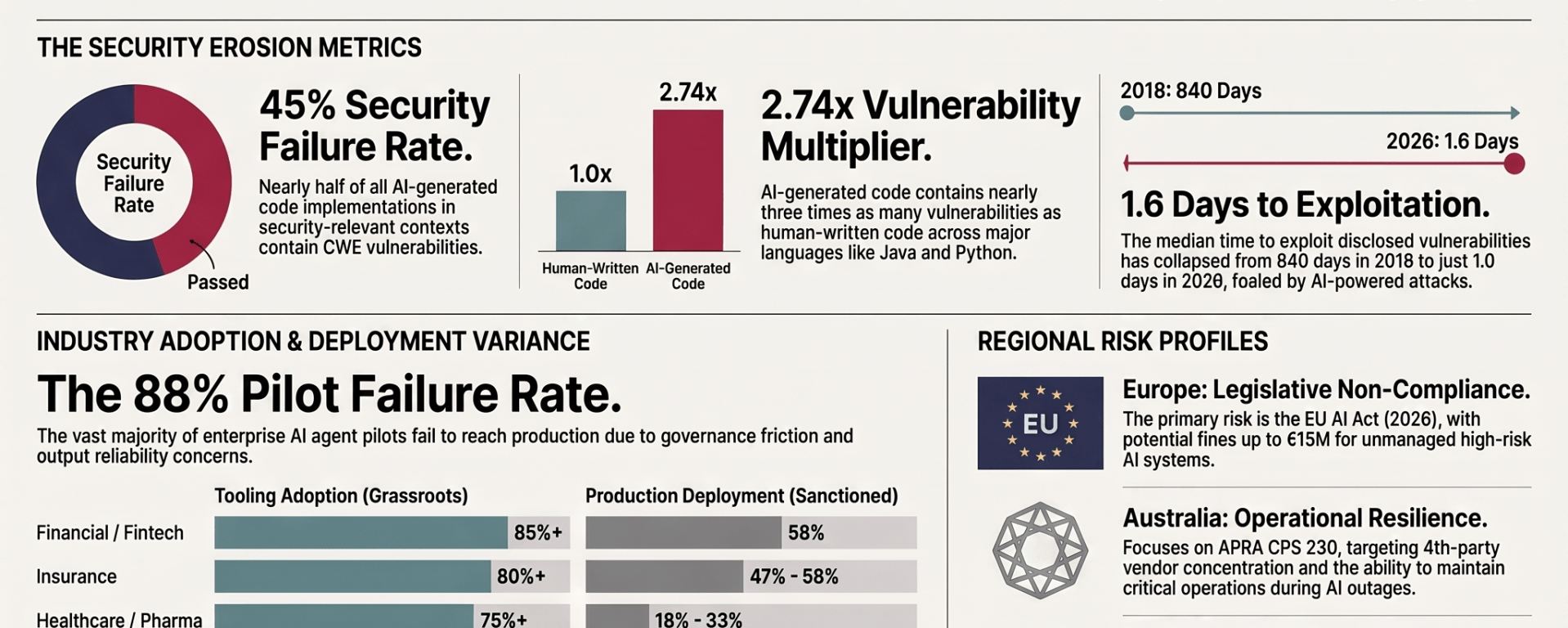
| Security Failure Rate | 45% | The failure rate of AI-generated code in basic security tests, frequently introducing OWASP Top 10 vulnerabilities, including an 86% failure rate specifically for Cross-Site Scripting (XSS). |
| Vulnerability Multiplier | 2.74x | The multiplier for vulnerabilities found in AI-generated code compared to human-written code across controlled benchmarks in languages such as Java, JavaScript, Python, and C#. |
| Time-to-Exploitation Compression | 1.6 Days | The compressed median time-to-exploitation for disclosed CVEs in 2026 (down from 840 days in 2018), driven by attackers utilizing generative AI to instantly weaponize vulnerabilities. |
| Code Churn Increase | 3.1% to 5.7% | The code churn rate (code reverted or updated within two weeks) jumped significantly from 2020 to 2024, signaling a massive rise in premature, low-quality commits entering the SDLC. |
| Pilot Failure Rate | 88% | The percentage of enterprise AI agent pilots that fail to graduate to production environments due to governance friction, evaluation gaps, and output reliability concerns. |
The Mechanics of AI Integration Across the Software Lifecycle
The integration of artificial intelligence into the software engineering lifecycle is not merely a tooling upgrade; it represents a fundamental shift in how regulated organizations must architect, build, and secure digital assets. Between 2024 and 2026, the industry transitioned through distinct maturity phases. Phase 1 involved AI-assisted autocomplete, where tools suggested single lines of code requiring immediate human acceptance. Phase 2 introduced conversational copilots integrated into Integrated Development Environments (IDEs) capable of generating multi-line code blocks based on natural language prompts. Currently, progressive organizations are entering Phase 3, defined by agentic coding. In this phase, autonomous systems decompose high-level architectural requirements, execute multi-step decisions, utilize external APIs, and produce complete implementations with minimal human intervention1.
In the architectural and solution design phases, generative AI presents profound challenges. AI models fundamentally operate via accretion; they are designed to append and generate new code rather than natively comprehend, restructure, or refactor complex legacy architectures2. GitClear’s exhaustive analysis of over 211 million lines of code spanning 2020 to 2024 provides empirical evidence of this architectural decay. The data demonstrates that developers are copying and pasting AI-generated code at unprecedented rates. The percentage of “moved” code, which serves as a primary indicator of healthy system refactoring and architectural maintenance, plummeted from 24.1% in 2020 to a mere 9.5% in 20242. Conversely, code churn rose from 3.1% to 5.7%, indicating that developers are treating AI outputs as authoritative, merging code they do not fully comprehend, and subsequently relying on production environments to reveal systemic flaws2.
This dynamic gives rise to “Comprehension Debt,” a high-interest variant of technical debt. When human engineers use AI to generate complex architectural components—such as database schemas, microservice boundaries, or asynchronous event-handling logic—they frequently fail to grasp the underlying architectural intent or “why” behind the machine’s output4. In highly regulated environments such as banking, government, and healthcare, the inability to clearly explain the provenance, logic, and security posture of deployed code to an external auditor constitutes an immediate and critical compliance failure4. If an AI-generated regulatory reporting module in a financial institution behaves unpredictably, the engineering team cannot simply blame the underlying Large Language Model (LLM); the institution remains legally liable for the outputs.
The development and coding phase is currently defined by the “Developer Productivity Paradox.” Organizations initially adopted AI coding tools based on vendor assertions that they could achieve a 55% reduction in task completion time5. However, longitudinal studies reveal a far more nuanced reality. While junior developers experience genuine throughput gains by relying on AI to overcome knowledge gaps, senior developers working in mature, highly complex codebases frequently experience productivity losses. A rigorous randomized controlled trial conducted by METR in 2025 tracked experienced open-source developers contributing to large repositories. The study documented that developers equipped with AI coding tools actually took an average of 19% longer to complete tasks compared to a control group operating without AI assistance2. Because senior engineers maintain stringent standards for architectural integrity and security, they expended vast amounts of time prompting, reviewing, editing, and ultimately rejecting (over 56% of the time) AI suggestions that were syntactically correct but contextually or architecturally flawed2.
The testing and deployment phases face an acute bottleneck. As AI coding tools allow developers to write code exponentially faster, the volume of pull requests (PRs) has surged. Google’s DORA research indicated that a 25% increase in AI adoption correlates directly with a 7.2% decrease in software delivery stability2. The illusion of velocity is actively masking the reality of system degradation. Furthermore, traditional Static Application Security Testing (SAST) and Software Composition Analysis (SCA) tools are overwhelmed by the sheer volume of AI-generated code. Baseline precision for traditional SAST tools sits at approximately 35.7%, meaning nearly two-thirds of findings are false positives9. When applied to the massive output of AI-assisted development, this produces alert fatigue at a scale that renders human triage mathematically impossible. Security teams are increasingly blind to the code entering production; 2025 survey data indicates that while 100% of surveyed companies have AI-generated code in production, 81% of security teams lack visibility into its provenance or risk profile9.
Quantitative Summary: Adoption by Regulated Industry
The adoption of AI-assisted software development is not uniform. A critical distinction must be drawn between the individual adoption of AI tooling (e.g., a developer independently using GitHub Copilot or Claude 3.7 Sonnet) and the enterprise-sanctioned deployment of AI agents into production workflows. While tooling adoption approaches 90% globally, production deployment of agents lags significantly at 31%, heavily gated by regional regulations and industry-specific compliance requirements6.
North America (United States & Canada)
North America currently leads the global market in the R&D and implementation of generative AI software tools. Lacking the sweeping, centralized federal legislation characteristic of the European Union, AI adoption in North America is gated primarily by industry-specific regulatory bodies (e.g., the FDA, SEC, FINRA) and institutional risk tolerance10. The market is highly dynamic, with pharmaceutical giants like Bristol Myers Squibb and Merck executing enterprise-wide rollouts of AI platforms to accelerate drug discovery, while the financial sector leverages agentic workflows for underwriting and customer service deflection12.
| North America | AI-Assisted Software Development Adoption Rates |
| Regulated Industry | Tooling Adoption / Production Deployment / Primary Adoption Drivers |
| Financial / Fintech | Tooling: High (85%+) / Production: High (~58%) / Drivers: Velocity, cost reduction, customer service deflection, algorithmic trading optimization. |
| Insurance | Tooling: High (80%+) / Production: High (~47%-58%) / Drivers: Automated underwriting, claims processing acceleration, back-office operations. |
| Healthcare / Pharma | Tooling: High (75%+) / Production: Low (~18%-33%) / Drivers: HIPAA constraints, FDA Software as a Medical Device (SaMD) validation requirements severely limit autonomous production agents. |
| Education | Tooling: Medium (60%) / Production: Low / Drivers: Institutional bureaucracy, FERPA compliance, student privacy concerns. |
| Legal | Tooling: Medium (55%) / Production: Low (~12%) / Drivers: High Human-in-the-loop (HITL) requirements (averaging 61%), client confidentiality boundaries. |
| Government | Tooling: Medium (60%) / Production: Low (~14%-29%) / Drivers: FedRAMP constraints, legacy technology bottlenecks, stringent procurement timelines. |
| Nonprofit | Tooling: Unavailable / Production: Unavailable / Drivers: Systemic budget constraints, reliance on legacy SaaS platforms, lack of dedicated AI engineering talent. |
Europe (UK, Germany, France, Spain)
The European landscape is heavily dictated by the impending enforcement of the EU Artificial Intelligence Act, which becomes fully enforceable in August 2026, operating alongside strict GDPR requirements. This regulatory density forces European organizations to prioritize transparency, data provenance, and auditability over pure developmental velocity14. Any AI system utilized for human resources (e.g., ranking developer performance or allocating tasks) or biometric categorization is subject to stringent Annex III high-risk obligations14.
| Europe | AI-Assisted Software Development Adoption Rates |
| Regulated Industry | Tooling Adoption / Production Deployment / Primary Adoption Drivers |
| Financial / Fintech | Tooling: Medium-High (70%) / Production: Medium (~30%) / Drivers: Operational efficiency amidst macroeconomic pressure, heavily gated by EU AI Act Annex III high-risk avoidance. |
| Insurance | Tooling: Medium / Production: Medium / Drivers: Risk modeling, predictive analytics; highly cautious regarding algorithmic bias regulations. |
| Healthcare / Pharma | Tooling: Medium (50%) / Production: Low / Drivers: Strict European Medical Device Regulations (MDR), complex data sovereignty laws. |
| Education | Tooling: Unavailable / Production: Unavailable / Drivers: Cautious adoption due to Article 5 prohibitions on specific biometric tracking in educational institutions. |
| Legal | Tooling: Medium / Production: Low / Drivers: Compliance documentation analysis, strict adherence to GDPR and client data protection. |
| Government | Tooling: Medium (UK leading) / Production: Low / Drivers: UK Plan for Change driving productivity (e.g., UK coders saving 28 days annually), offset by data sovereignty mandates in the EU bloc. |
| Nonprofit | Tooling: Unavailable / Production: Unavailable / Drivers: Digital divide concerns, prioritization of fundamental digital literacy over advanced agentic workflows. |
Australia
Australia is actively shaping its AI environment via robust operational resilience standards, most notably the Australian Prudential Regulation Authority (APRA) CPS 230 standard taking effect for all material contracts between July 2025 and July 2026. This standard fundamentally shifts the focus of AI adoption away from pure capability and toward third-party vendor risk, supply chain concentration, and the continuity of critical operations through disruption16.
| Australia | AI-Assisted Software Development Adoption Rates |
| Regulated Industry | Tooling Adoption / Production Deployment / Primary Adoption Drivers |
| Financial / Fintech | Tooling: High / Production: Medium / Drivers: Cost efficiency, mitigation of chronic regional talent shortages, heavily scrutinized under APRA CPS 230. |
| Insurance | Tooling: High / Production: Medium / Drivers: Automated processing, claims triage; requires strict adherence to APRA impact tolerances. |
| Healthcare / Pharma | Tooling: Medium / Production: Low / Drivers: Closing service gaps in remote regions, managing an aging population, strict privacy laws. |
| Education | Tooling: Medium / Production: Low / Drivers: National AI in Schools Taskforce guidance, ST4S software assessment standards. |
| Legal | Tooling: Medium / Production: Low / Drivers: Process automation, document review; hindered by copyright and IP ownership ambiguities. |
| Government | Tooling: Medium / Production: Low/Medium / Drivers: Public sector efficiency targets, National AI Plan alignment, focus on onshore data processing. |
| Nonprofit | Tooling: Low / Production: Low / Drivers: Focus on digital inclusion and basic upskilling supported by government grants. |
Quantitative Summary: Key Risks by Regulated Industry
The introduction of generative AI into the software supply chain introduces a matrix of novel risks. Chief among these is the degradation of baseline security. Generative models learn by pattern-matching against public code repositories. If insecure patterns appear frequently in training data—such as string-concatenated SQL queries or hardcoded API keys—the model will reproduce them with extreme confidence19. Veracode’s empirical evaluation found that 45% of AI-generated implementations in security-relevant contexts contained CWE vulnerabilities20. The Cloud Security Alliance notes that AI tools generate code without understanding the application’s localized risk model, internal standards, or broader threat landscape19. An AI assistant tasked with building an API endpoint will routinely deliver one that accepts input without validation or authorization simply because the prompt lacked explicit security constraints.
North America
In North America, risks are heavily oriented toward intellectual property leakage, data poisoning, and the systemic introduction of vulnerable code patterns that outpace manual security reviews.
| North America | Key Risks in AI-Assisted Software Development |
| Regulated Industry | Primary Risk 1 / Primary Risk 2 / Primary Risk 3 |
| Financial / Fintech | Comprehension Debt & Architectural Decay4 / Systemic Code Vulnerabilities (OWASP LLM Top 10)20 / IP & Proprietary Algorithmic Leakage21 |
| Insurance | Algorithmic Bias in Underwriting Code21 / PII Leakage in RAG Pipelines22 / Model Unpredictability & Hallucinations21 |
| Healthcare / Pharma | Algorithmic Efficacy & Patient Safety21 / PHI Exposure in Training Data22 / Supply Chain & Training Data Poisoning21 |
| Education | Data Privacy & FERPA Violations23 / Systemic Bias in Allocation Algorithms21 / Unavailable |
| Legal | Hallucinations in Logical Execution24 / Client Confidentiality Breaches21 / Prompt Injection Attacks21 |
| Government | Cyber Espionage & Nation-State Supply Chain Compromise21 / Legacy System Friction25 / Complete Auditability Failures5 |
| Nonprofit | Cybersecurity Vulnerabilities via Lack of QA26 / Resource Misallocation on Failed Pilots3 / Unavailable |
Europe
European risks are inextricably linked to legislative non-compliance. The EU AI Act imposes massive penalties for failing to properly classify, document, and govern AI systems. Engineers must treat EU AI Act compliance as a core functional requirement for safe AI deployments15.
| Europe | Key Risks in AI-Assisted Software Development |
| Regulated Industry | Primary Risk 1 / Primary Risk 2 / Primary Risk 3 |
| Financial / Fintech | EU AI Act Non-Compliance (Fines up to €15M)14 / Comprehension Debt & Audit Failure4 / GDPR & PII Leakage27 |
| Insurance | High-Risk Categorization (Annex III)15 / Algorithmic Bias in Pricing Models15 / Opaque Fourth-Party Dependencies21 |
| Healthcare / Pharma | High-Risk System Reclassification15 / Transparency Failures (Article 50)27 / Supply Chain Vulnerabilities in Medical Software28 |
| Education | Biometric / Emotion Detection Bans (Article 5)27 / Bias in Grading/Resource Allocation15 / Unavailable |
| Legal | Article 50 Disclosure Failures (Deepfakes/Text)27 / Hallucinated Legal Precedents in Automation22 / Unavailable |
| Government | Unauditable Agent Actions in Public Infrastructure1 / Vendor Lock-in & Digital Sovereignty Loss29 / Misinformation Generation27 |
| Nonprofit | Digital Divide & Systemic Exclusion30 / EU AI Act Literacy Failures31 / Unavailable |
Australia
Australian risks are uniquely centered on vendor concentration and operational resilience. The APRA CPS 230 standard mandates that institutions maintain critical operations within specific tolerance levels during disruptions. A single upstream model deprecation, price change, or safety intervention at a primary AI provider (e.g., OpenAI, Anthropic) can simultaneously degrade several apparently independent vendors—a fourth-party concentration risk that is invisible without rigorous supply-chain mapping18.
| Australia | Key Risks in AI-Assisted Software Development |
| Regulated Industry | Primary Risk 1 / Primary Risk 2 / Primary Risk 3 |
| Financial / Fintech | APRA CPS 230 Operational Resilience Breaches16 / 4th-Party Vendor Concentration Risk18 / Unmanaged Operational Disruption17 |
| Insurance | Impact Tolerance Level Breaches (CPS 230)32 / Vendor Lock-in (AI Platforms)18 / Algorithmic Bias21 |
| Healthcare / Pharma | Legacy Systems Integration Failures33 / PII & Health Data Privacy Violations33 / Systemic Code Vulnerabilities19 |
| Education | Student Privacy & Online Safety23 / Academic Integrity Violations23 / Unavailable |
| Legal | Copyright & Intellectual Property Infringement33 / Hallucinations in Legal Tech Software24 / Data Privacy Breaches34 |
| Government | Data Sovereignty & Offshoring Violations35 / Unauditable Agent Actions1 / Public Trust Erosion33 |
| Nonprofit | Systemic Digital Exclusion35 / Cybersecurity Resource Gaps26 / Unavailable |
Quantitative Summary: Critical Best Practices
To mitigate these severe risks, progressive organizations are abandoning the concept of “shadow AI” and moving toward deeply integrated, structural governance. The traditional paradigm of relying on manual code review is obsolete; humans cannot effectively review machine-generated code at the volume and velocity it is currently produced. Instead, the most critical best practice is the implementation of “Guardrails Before the Prompt”36.
This methodology involves applying policy constraints upstream of the LLM. Rather than scanning generated code for vulnerabilities, policy engines intercept the developer’s prompt and block requests that attempt to bypass authentication, disable logging, or implement disallowed architectural patterns36. Furthermore, organizations are adopting deterministic Oversight Classification Models (OCM) to route code generation tasks based on their regulatory risk profile. Low-risk UI boilerplate may require only automated testing, while high-risk algorithmic changes require strict Human-in-the-Loop (HITL) oversight1.
North America
North American best practices focus heavily on securing the pipeline, aligning with NIST frameworks, and protecting intellectual property through architectural isolation.
| North America | Critical Best Practices for Early AI Maturity |
| Regulated Industry | Best Practice 1 / Best Practice 2 / Best Practice 3 |
| Financial / Fintech | Pre-Prompt Guardrails36 / NIST AI RMF Alignment & Mapping37 / Value Stream Management (VSM) Metrics38 |
| Insurance | Automated SAST/SCA Checks for AI Code28 / DORA Metrics Tracking2 / Oversight Classification Model (OCM)1 |
| Healthcare / Pharma | Zero-Retention / No-Training Agreements7 / Human-in-the-Loop (HITL) Mandates13 / AI Centers of Excellence5 |
| Education | Enterprise AI Acceptable Use Policies3 / Ethics & Bias Auditing21 / Unavailable |
| Legal | Robust Data Redaction Pipelines22 / Continuous Red Teaming & Adversarial Testing22 / Bounded Agent Tooling39 |
| Government | Air-gapped / VPC Cloud Deployments7 / Strict Software Bill of Materials (SBOM)16 / Role-Based Access Controls40 |
| Nonprofit | Lightweight Agile Methodologies25 / Employee AI Literacy & Security Training5 / Unavailable |
Europe
European best practices are entirely consumed by proving compliance with the EU AI Act. Organizations must seamlessly integrate compliance evidence generation directly into their CI/CD pipelines to survive audits.
| Europe | Critical Best Practices for Early AI Maturity |
| Regulated Industry | Best Practice 1 / Best Practice 2 / Best Practice 3 |
| Financial / Fintech | Article 11 Technical Documentation Automation14 / Machine-Readable Watermarking27 / EU AI Act Governance Integration31 |
| Insurance | Automated Architectural Logging (Article 12)14 / Explainable AI (XAI) Frameworks40 / Deterministic Oversight Models1 |
| Healthcare / Pharma | Annex III High-Risk Assessments15 / Documented Human Oversight Mechanisms14 / Strict Data Provenance Tracking14 |
| Education | Prohibition Checks (Article 5 Bans)15 / Algorithmic Fairness Audits31 / Unavailable |
| Legal | Article 50 Disclosure User Interfaces27 / Output Grounding & Citation Validation22 / Unavailable |
| Government | Sovereign / Open-Weight Local Models41 / Continuous Dynamic Security Testing22 / Strict Permissions Scoping22 |
| Nonprofit | Mandatory AI Literacy Training31 / Lightweight Transparency UI27 / Unavailable |
Australia
Australian best practices prioritize supply chain mapping and the ability to seamlessly recover software systems if an upstream AI vendor experiences an outage or deprecates a model, aligning with APRA CPS 230 directives.
| Australia | Critical Best Practices for Early AI Maturity |
| Regulated Industry | Best Practice 1 / Best Practice 2 / Best Practice 3 |
| Financial / Fintech | Material Service Provider Registers17 / Impact Tolerance Mapping in BPMN32 / Software Escrow & Proven Recoverability16 |
| Insurance | Continuous Business Continuity Planning32 / Granular Vendor Risk Management17 / DORA Metrics Evaluation25 |
| Healthcare / Pharma | Explainability & Clinical Frameworks18 / Secure Multi-tenant Architecture4 / Human-over-the-loop (HOTL) Validation1 |
| Education | ST4S Security & Privacy Assessments23 / Responsible AI Standard Adoption23 / Unavailable |
| Legal | Continuous Application Security Testing22 / Automated Data Redaction Pipelines22 / Bounded AI Tools39 |
| Government | National AI Plan Strategic Alignment42 / Onshore Data Center Prioritization35 / Severe Scenario Testing18 |
| Nonprofit | Collaborative Tech Purchasing Consortiums26 / Targeted Employee Upskilling42 / Unavailable |
Quantitative Summary: Adoption of Best Practices
Despite the severe risks identified across all regions and industries, the actual adoption of the necessary governance and security best practices remains alarmingly low. The industry is currently experiencing a “Shadow AI” crisis, where executive leadership believes AI use is restricted, but engineering telemetry proves it is ubiquitous9.
| North America | Adoption of Best Practices by Industry |
| Regulated Industry | Guardrails Before Prompt / Automated AI Code Review / AI Governance Frameworks |
| Financial / Fintech | Medium (Emerging rapidly) / Medium / High |
| Insurance | Medium / Medium / Medium |
| Healthcare / Pharma | Medium / Low / Medium |
| Education | Low / Unavailable / Low |
| Legal | Low / Unavailable / Low |
| Government | Low (Siloed by department) / Low / Medium |
| Nonprofit | Unavailable / Unavailable / Unavailable |
| Europe | Adoption of Best Practices by Industry |
| Regulated Industry | EU AI Act Readiness / Automated Logging & Traceability / Human-in-the-Loop Governance |
| Financial / Fintech | Medium (Accelerating toward 2026) / Medium / High |
| Insurance | Medium / Medium / Medium |
| Healthcare / Pharma | Medium / Medium / High |
| Education | Low / Unavailable / Low |
| Legal | Low / Unavailable / High |
| Government | Low/Medium / Low / Medium |
| Nonprofit | Unavailable / Unavailable / Unavailable |
| Australia | Adoption of Best Practices by Industry |
| Regulated Industry | APRA CPS 230 Readiness / Vendor Concentration Mapping / Scenario & BCP Testing for AI |
| Financial / Fintech | Medium (Deadline approaching) / Low/Medium / Medium |
| Insurance | Medium / Low/Medium / Medium |
| Healthcare / Pharma | Low / Low / Low |
| Education | Medium (Policy level guidelines) / Unavailable / Unavailable |
| Legal | Unavailable / Unavailable / Unavailable |
| Government | Medium / Medium / Low |
| Nonprofit | Unavailable / Unavailable / Unavailable |
Hypothesis Testing and Findings
Test of Hypothesis 1: Due to higher risks, regulated industries have lower adoption of AI-Assisted Software Development practices.
Result: Partially False / Highly Nuanced. The empirical data demonstrates a stark dichotomy between grassroots tooling adoption and enterprise-sanctioned agent deployment. The hypothesis is false when evaluating tooling adoption (e.g., developers utilizing GitHub Copilot, Cursor, or web-based LLMs on their local machines). Grassroots adoption is uniformly massive across nearly all sectors, hitting 85% to 92% broadly6. Developers in highly regulated finance and government sectors are actively using these tools to accelerate their personal workflows, frequently bypassing procurement through “shadow AI” practices9.
However, when measuring the production deployment of enterprise-grade, autonomous AI agents, the hypothesis holds true. According to S&P Global Market Intelligence, while 80% of enterprise software applications shipped in 2026 embed agents, only 31% of organizations have agents operating in production10. In heavily regulated sectors, this deployment rate drops significantly: healthcare sits between 18% and 33%, and government between 14% and 29%, explicitly constrained by HIPAA, FDA SaMD regulations, and FedRAMP timelines10. Thus, high risk suppresses production deployment of autonomous systems, but does not suppress individual developer tooling adoption, creating a highly volatile risk environment.
Test of Hypothesis 2: Key Risks vary somewhat by country and industry.
Result: True. While the underlying technical risks—such as SQL injection, cross-site scripting, and architectural code churn—are universal constants, the business, operational, and compliance risks are highly localized due to deeply fragmented regulatory regimes14.
- Geographical Divergence: In Europe, the paramount risk is legal and financial non-compliance with the EU AI Act (enforcing August 2026). Organizations risk catastrophic fines of up to €15 million or 3% of global turnover for deploying undocumented, high-risk AI, making Article 50 transparency and Article 11 technical documentation the absolute priority14. Conversely, in Australia, the focus is squarely on systemic operational resilience. Under APRA CPS 230, banks and insurers face massive risks regarding third-party and fourth-party vendor concentration16. If an AI vendor fails, the regulated entity is strictly held accountable for operational disruptions beyond board-approved tolerances18. In North America, which lacks a unified federal AI law, risks are predominantly driven by intellectual property leakage, adversarial cyber threats, and adherence to voluntary NIST frameworks21.
- Industry Divergence: Healthcare risks center entirely on patient safety, HIPAA violations via PII leakage in Retrieval-Augmented Generation (RAG) pipelines, and FDA Software as a Medical Device (SaMD) validation constraints10. Financial sector risks center on algorithmic bias in credit decisions, the strict auditability of financial modelling, and the inability to explain AI-generated logic to regulators1.
Test of Hypothesis 3: Most regulated industries suffer from low adoption of the Best Practices required to effectively use AI-Assisted software development. This creates significant risks for regulated organizations.
Result: True. The research overwhelmingly supports this hypothesis. The rapid acceleration of AI coding capabilities has vastly outpaced the organizational implementation of adequate governance, testing, and security controls 9.
- The Failure of Traditional Security Scanning: Most organizations still rely on post-generation static scanning. However, once an agent generates insecure code or malicious dependencies, traditional SAST tools are overwhelmed by the volume. With a baseline precision of 35.7%, these tools generate an insurmountable volume of false positives, leading to critical alert fatigue9.
- The Breakdown of Code Review: The DORA report and GitClear data empirically prove that manual code review is breaking down under the weight of AI generation. Developers are merging AI code without deep comprehension2. Organizations are failing to implement AI-specific automated code review mechanisms that are capable of temporal and compositional reasoning9.
- The 81% Visibility Gap: A comprehensive 2025 Cycode survey revealed that while 100% of surveyed companies have AI-generated code in their production environments, 81% of security teams lack visibility into it, and 81% of organizations knowingly ship code with vulnerabilities due to triage overload9. This systemic low adoption of specialized AI application security best practices is the direct catalyst for the 525x compression in time-to-exploitation for cyberattacks46.
Strategic Imperatives for Senior Leaders
Key Actions for Progressive Organizations to Maximize Opportunities
For organizations that have surpassed initial experimentation and are looking to scale AI-assisted development securely and profitably, leaders must implement advanced, structural governance mechanisms that move beyond simple acceptable use policies.
First, engineering leadership must mandate the implementation of Guardrails Before the Prompt. This involves shifting security entirely to the left, acting at the point of developer instruction. Progressive teams implement policy engines that intercept prompts and actively block requests that attempt to bypass authentication, disable logging, or implement disallowed architectural patterns before the LLM consumes compute cycles or generates vulnerable code36. This practice aligns seamlessly with the NIST AI RMF and OWASP Agentic AI guidelines36.
Second, organizations must adopt a deterministic Oversight Classification Model (OCM). Treating all AI-generated code with the same level of scrutiny is inefficient and unscalable. An OCM uses deterministic functions to classify code generation tasks by regulatory impact, data sensitivity, and customer proximity. Low-risk boilerplate generation can be routed to automated testing pipelines, while high-risk algorithmic changes (e.g., credit decisioning, clinical triaging) are strictly routed to rigorous Human-in-the-Loop (HITL) or Human-over-the-loop (HOTL) workflows, ensuring auditable governance1.
Third, leaders must redefine productivity by abandoning volumetric metrics. Measuring productivity by lines of code written, commit volume, or PR frequency is inherently flawed in the AI era, as generative models artificially inflate these metrics without necessarily adding value2. Progressive organizations are adopting Value Stream Management (VSM) and focusing intensely on DORA metrics—specifically deployment stability, change failure rate (CFR), and time-to-restore service3. Furthermore, these organizations are establishing cross-functional AI Centers of Excellence that combine legal, AppSec, and engineering leadership to evaluate vendor tools, train staff, manage vendor concentration risk (crucial for APRA CPS 230 compliance), and mandate Software Escrow and Recoverability Validation to mitigate fourth-party risks5.
Key Actions for Organizations Falling Behind
For leaders in organizations constrained by legacy systems, deep-seated regulatory anxiety, or ad-hoc “shadow AI” usage, immediate triage and baseline implementation are required to prevent systemic risk accumulation.
The immediate priority is to Acknowledge and Audit Shadow AI. Developers are already using AI tools locally to hit deadlines; banning them simply pushes the behavior underground, removing all visibility9. Leaders must deploy AI system discovery tools and network telemetry to map exactly where AI is being used, what sensitive corporate data it accesses, and which vendors exist in the shadow supply chain9.
Following discovery, organizations must rapidly publish and enforce a clear, pragmatic Acceptable Use Policy. This policy must dictate which specific tools are approved, explicitly define what data (e.g., PII, PHI, proprietary trading algorithms) cannot be shared with public LLMs, and firmly establish that human developers retain absolute accountability for the security and logic of the code they merge3.
Simultaneously, AppSec teams must Upgrade SAST and SCA for the AI Era. Traditional static scanning is mathematically insufficient for the volume of AI code being produced. Security budgets must be reallocated toward AI-native Application Protection Platforms (AINAPP) that utilize behavioral telemetry, live usage data, and dependency traceability to filter out false positives and focus exclusively on exploitable, reachable runtime risks50.
Finally, organizations operating globally must Initiate Regulatory Mapping Immediately. For European operations, teams must begin mapping systems against the EU AI Act’s Annex III high-risk definitions, ensure that AI-generated content complies with Article 50 transparency markings, and draft Article 11 technical documentation ahead of the August 2026 deadline14. To combat the rising tide of Comprehension Debt, engineering leaders must mandate that the time saved by rapid AI code generation is not spent writing more features, but rather reinvested directly into rigorous code review, system design, and continuous architectural refactoring3.
Works cited
- Governed AI-Assisted Engineering: Graduated Human Oversight for Agentic Code Generation in Regulated Domains – arXiv, https://arxiv.org/html/2606.22484v2
- The Hidden Cost of Moving Fast: Technical Debt in AI-Assisted Development – Advisable, https://www.advisable.com/insights/hidden-cost-technical-debt-ai-development
- Reality check GenAI in software development: between hype and real value – 7P Group, https://7p-group.com/en/blog/reality-check-genai-software-development/
- True Cost of AI-Generated Code. A Strategic Analysis of “Comprehension… | by Justin Hamade | Medium, https://medium.com/@justhamade/true-cost-of-ai-generated-code-f4362391790c
- AI Code Quality Crisis 2026: Engineering Leader Guide – Of Ash and Fire, https://www.ofashandfire.com/blog/ai-generated-code-quality-crisis
- AI in Software Development: 25+ Trends & Statistics (2026) – Modall, https://modall.ca/blog/ai-in-software-development-trends-statistics
- Key features to compare AI coding assistants vs enterprise context platforms – Glean, https://www.glean.com/perspectives/key-features-to-compare-ai-coding-assistants-vs-enterprise-context-platforms
- Speed Without Stability: How AI Coding Erodes Skills and Security – SmarterArticles, https://smarterarticles.co.uk/speed-without-stability-how-ai-coding-erodes-skills-and-security
- The Agentic SDLC: Why Most of What We Do in Software Security Has to Change – GEICO, https://www.geico.com/techblog/the-agentic-sdlc/
- AI Agent Adoption 2026: 120+ Enterprise Data Points – Digital Applied, https://www.digitalapplied.com/blog/ai-agent-adoption-2026-enterprise-data-points
- Generative AI Coding Assistants Market Size Report 2032 – SNS Insider, https://www.snsinsider.com/reports/generative-ai-coding-assistants-market-6493
- GFF 2026: Why agentic AI is becoming a key theme for financial services, https://m.economictimes.com/default-subsec/spotlight/gff-2026-why-agentic-ai-is-becoming-a-key-theme-for-financial-services/articleshow/133294941.cms
- BMS Agentic AI Rollout: Pharma Change Management – IntuitionLabs, https://intuitionlabs.ai/articles/bms-claude-ai-pharma-rollout-change-management
- The 2026 EU AI Act and AI-Generated Code: What Changes for Dev Teams, https://www.augmentcode.com/guides/eu-ai-act-2026
- Are your UI application development processes compliant with the EU AI Act?, https://www.griddynamics.com/blog/eu-ai-act-compliance
- APRA CPS 230 Software Escrow Australia | Castler SRP | Operational Risk, https://castler.com/regulations/apra-cps-230
- What is APRA CPS 230? An explainer for finance, risk, and AP teams | Eftsure AU, https://www.eftsure.com/en-au/blog/what-is-apra-cps-230-an-explainer-for-finance-risk-and-ap-teams/
- APRA CPS 230 AI: Operational Risk Guide (2026) – Areebi, https://www.areebi.com/compliance/apra-cps-230-ai
- 45% of AI-Generated Code Has Security Flaws. Your Review Process Wasn’t Built for This., https://blog.smbaccelerators.com/post/ai-generated-code-security-flaws-review-process
- SecureCode: A Production-Grade Multi-Turn Dataset for Training Security-Aware Code Generation Models – arXiv, https://arxiv.org/html/2512.18542v3
- AI Risk Reduction: Complete Guide to Mitigation Strategies for 2026 | Blog | Endor Labs, https://www.endorlabs.com/learn/ai-risk-reduction-complete-guide-to-mitigation-strategies-for-2026
- AI Guardrails Explained: Types, Tools and Bypass Risks – Mindgard, https://mindgard.ai/blog/what-are-ai-guardrails
- Australian Government response to the House of Representatives Standing Committee on Employment, Education and Training report o, https://www.education.gov.au/download/20276/study-buddy-or-influencer-inquiry-use-generative-artificial-intelligence-australian-education-system/44382/document/pdf
- The VIBE-HI framework: a conceptual model for evaluating vibe coding appropriateness, quality, and safety in health informatics – PMC, https://pmc.ncbi.nlm.nih.gov/articles/PMC13442437/
- Research: How management practices impact AI maturity – Adam Outside The Box, https://adamkruz.ca/2026/01/20/research-how-management-practices-impact-ai-maturity/
- Mission First: Making Tech Decisions That Stick – Fenix Cyber Solutions, https://fenixcyber.com/resources/mission-first-making-tech-decisions-that-stick
- The EU AI Act’s Transparency Rules: A Practical Guide to Article 50, https://artificialintelligenceact.eu/transparency-rules-article-50/
- AI Code Generation: Code Security & Quality, Benefits, Risks & Top Tools – Snyk, https://snyk.io/blog/ai-code-generation-code-security-quality-benefits-risks-top-tools/
- Generative AI Market Research Report 2034 – Dataintelo, https://dataintelo.com/report/generative-ai-market
- Weekly Digest on AI and Emerging Technologies (4 November 2024), https://pam.int/ar/weekly-digest-on-ai-and-emerging-technologies-4-november-2024/
- A comprehensive EU AI Act Summary [August 2026 update] – SIG, https://www.softwareimprovementgroup.com/blog/eu-ai-act-summary/
- APRA CPS 230 Critical Operations Map (1 July 2026 Deadline) | BA Copilot, https://ba-copilot.com/apra-cps-230
- Safe and Responsible Artificial Intelligence in Health Care – Legislation and Regulation Review, https://www.health.gov.au/sites/default/files/2025-07/safe-and-responsible-artificial-intelligence-in-health-care-legislation-and-regulation-review-final-report.pdf
- AI in professional services: How accountants and lawyers can, https://k3hub.co.uk/insights/ai-in-professional-services-unlocking-greater-value/
- Australian Government response: Senate Select Committee on Adopting Artificial Intelligence (AI) report | Department of Industry Science and Resources, https://www.industry.gov.au/publications/australian-government-response-senate-select-committee-adopting-artificial-intelligence-ai-report
- What Is Guardrails Before the Prompt? Definition & Examples, https://nhimg.org/glossary/guardrails-before-the-prompt/
- Risk Management in AI – IBM, https://www.ibm.com/think/insights/ai-risk-management
- 2025 DORA State of AI-assisted Software Development Report – Google Cloud, https://cloud.google.com/resources/content/2025-dora-ai-assisted-software-development-report
- Risk Tiering AI Use Case – A Practical Guide, https://security.googlecloudcommunity.com/ciso-blog-77/risk-tiering-ai-use-case-a-practical-guide-7597
- Rethinking Autonomy: Preventing Failures in AI-Driven Software Engineering – arXiv, https://arxiv.org/html/2508.11824v1
- AI weekly summary – Scouts by Yutori, https://scouts.yutori.com/fe862d8a-6ac2-4f83-ab78-f3e8dbc519be
- Australian Government response to the Senate Select Committee on Adopting Artificial Intelligence (AI) report, https://www.aph.gov.au/DocumentStore.ashx?id=8b8b1ac5-aa7c-4f64-afc9-3343a5e74e84
- Hire Vibe Coding Developers, Ukraine | AI-Assisted Dev – VA Masters, https://vamasters.com/hire-vibe-coding-developers/
- AI Governance for Healthcare: A Complete Framework for June 2026 – Openlayer, https://www.openlayer.com/blog/ai-governance-healthcare-complete-framework
- The inevitable rise of poor code quality in AI-accelerated codebases – Sonar, https://www.sonarsource.com/blog/the-inevitable-rise-of-poor-code-quality-in-ai-accelerated-codebases/
- The Vulnerabilities Were Always There Now What? – Checkmarx AI, https://checkmarx.ai/wp-content/uploads/2026/06/AppSec-Unleashed-2026-JR_EK_052926_js-FINAL-Copy.pdf
- Securing AI’s Front Lines – Palo Alto Networks, https://www.paloaltonetworks.com/resources/whitepapers/securing-ai-s-front-lines
- Securing AI’s Front Lines – Palo Alto Networks, https://www.paloaltonetworks.ca/resources/whitepapers/securing-ai-s-front-lines
- Government coders using AI to each save 28 days a year and build more tech – GOV.UK, https://www.gov.uk/government/news/government-coders-using-ai-to-each-save-28-days-a-year-and-build-more-tech
- Application Security Trends Every DevSecOps Team Should Watch in 2026, https://www.ox.security/blog/application-security-trends-in-2026/
- Don’t Limit AI in Software Engineering to Coding – Gartner, https://www.gartner.com/en/articles/ai-in-software-engineering
Research accuracy audit:
The idea, research hypotheses, and focus for this article/research are all original and mine. This article was written with my brain and two hands with the assistance of Google Gemini, Notebook LM, Claude, and other wondrous toys.

