The trajectory of artificial intelligence within the high-stakes environments of North America and Europe between 2022 and early 2026 represents a fundamental shift in the philosophy of corporate technology management. The initial era of “DIY AI,” characterized by unmanaged employee experimentation with public large language models (LLMs) and internal attempts to fine-tune open-source architectures, has largely collapsed under the weight of regulatory scrutiny, security vulnerabilities, and a widening “value gap” between experimental potential and operational reality.1 By 2026, the dominant paradigm for regulated industries—including financial services, healthcare, education, legal, nonprofit, and government—has moved toward “Managed AI” and “Sovereign AI” frameworks.4 These solutions prioritize strategic independence, data localization, and robust governance over the “move fast and break things” ethos that defined the immediate post-ChatGPT landscape.5
This research identifies that the root causes of this transition are multi-dimensional, stemming from a rapidly moving regulatory landscape where financial penalties and operational mandates have moved from theoretical discussions to enforceable statutes.9 In the United States, a patchwork of state-level laws, such as the Colorado AI Act and California’s Transparency in Frontier AI Act, has forced organizations to treat AI governance as a core compliance function.9 Simultaneously, the European Union’s prescriptive AI Act and Canada’s renewed emphasis on digital sovereignty have created a global environment where “where AI is built” matters as much as “what it can do”.4
The move toward managed and sovereign systems is further accelerated by the emergence of “Agentic AI”—autonomous systems capable of orchestrating multi-step workflows with minimal human intervention.2 While agentic systems promise to compress decision cycles, they introduce catastrophic risks that DIY frameworks cannot mitigate.2 Consequently, organizations are increasingly turning to specialized AI strategic consultants to bridge the gap between strategic intent and operational execution.15 As of early 2026, the market for AI consulting has surged to approximately $14.1 billion, reflecting a desperate need for leadership that can navigate the intersection of model orchestration, risk management, and workforce transformation.15
The Rise and Fall of the DIY AI Era (2022–2024)
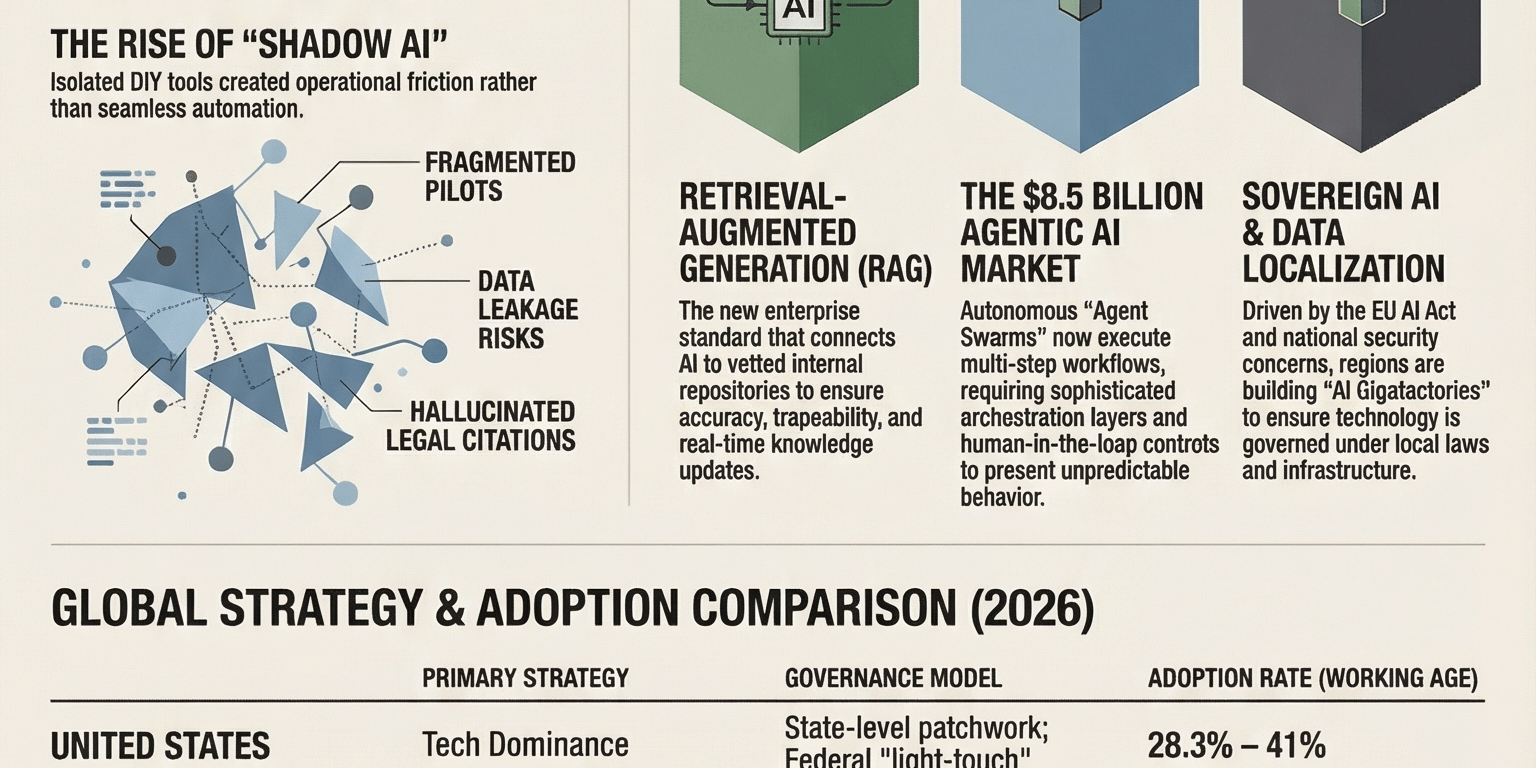
The initial phase of the generative AI boom, beginning in late 2022, was marked by a pervasive “shadow AI” culture.16 Across professional services and regulated sectors, individual employees began utilizing public LLMs to draft emails, summarize documents, and even generate code without formal organizational oversight.17 This “DIY” approach was initially viewed as a grassroots productivity revolution, with early statistics suggesting that AI could improve employee productivity by as much as 40%.18 Business owners were overwhelmingly optimistic; 97% believed that tools like ChatGPT would help their businesses, and 83% cited AI integration as a top priority.18
However, the rapid diffusion of these tools outpaced the development of internal guardrails. In 2023 and 2024, the inherent risks of unmanaged public LLMs became operational crises. Public tools often retain user inputs for model training, leading to massive data leakage risks for legal and financial firms handling sensitive client information.19 Furthermore, the lack of factual precision, known as “hallucinations,” proved catastrophic in regulated environments.20 In the legal sector, instances of attorneys submitting filings with “hallucinated” case citations led to professional sanctions and a broader realization that DIY AI was incompatible with the duty of competence.21
By 2025, the “Value Gap” began to emerge as a defining metric of the DIY failure. A comprehensive study by the Boston Consulting Group revealed that while investment in AI was universal, only 5% of companies were achieving substantial value at scale.3 Fully 60% of organizations reported minimal revenue or cost gains despite significant spending.3 This discrepancy was largely attributed to the fragmentation of DIY efforts—isolated pilots that sat outside day-to-day systems and created operational friction rather than seamless automation.7 Regulated agencies, particularly in state and local government, found that standalone AI tools required parallel processes and manual reconciliation, undermining the very efficiency they were intended to create.7
The Transition to Managed and Sovereign AI Architectures
As organizations realized that internal “lift-and-shift” migrations of generic models were insufficient, the architecture of enterprise intelligence shifted toward managed environments. This transition is characterized by three core technological and strategic pillars: Retrieval-Augmented Generation (RAG), Agentic AI, and Sovereign Infrastructure.2
Retrieval-Augmented Generation (RAG) as the Default Managed Architecture
By 2026, RAG has emerged as the enterprise standard for deploying generative systems responsibly.2 Rather than relying on the static, pre-trained knowledge of a public model, RAG connects AI systems to vetted, internal document repositories at query time.2 This “managed” approach provides several critical advantages for regulated industries. First, it ensures accuracy and traceability; compliance teams can demand lineage records that show exactly which internal source informed a specific AI response.2 Second, it allows for faster iteration; enterprises can update their knowledge stores in real-time without the expensive and slow process of fine-tuning or retraining a large model.2 This has turned knowledge governance into a first-class design requirement in sectors like insurance claims processing and financial reporting.2
The Emergence of Agentic AI and Orchestration
The shift from passive chat interfaces to autonomous agents represents the next wave of technological innovation in 2026.2 Agentic AI systems can plan, execute, and adapt workflows across multiple enterprise functions, resolution IT incidents, or coordinating supply chains with minimal human intervention.2 However, the management of these agents requires sophisticated orchestration layers and Model Context Protocols (MCP) to ensure they do not move beyond their intended scope or interact in ways that create emergent, unpredictable behavior.1
The demand for agentic AI is surging, with the market poised to reach $8.5 billion in 2026.4 Yet, the complexity of managing an “agent swarm” has made DIY solutions nearly impossible to maintain.2 Organizations now require “AI-Ops” teams and specialized managers who can coordinate tasks between humans and machines.20 This operational complexity has fueled the preference for managed service providers who can offer end-to-end authority with built-in human-in-the-loop controls and audit trails.2
Sovereign AI: Strategic Independence and Data Localization
Sovereign AI has become a defining theme for 2026, particularly in Europe and Canada.6 Defined as a nation or region’s ability to develop and control critical AI capabilities, sovereign AI ensures that technology is built and governed under local laws and infrastructure.4 This shift is driven by a desire for strategic independence and a greater appreciation for the transformational impact of AI on national security and economic growth.6
In Europe, the reliance on U.S. cloud services has forced a shift toward establishing data sovereignty, with the European Commission prioritizing “AI made in Europe” through the creation of “AI gigafactories”.8 Similarly, Canada has launched its Sovereign AI Compute Strategy to strengthen its domestic position and ensure Canadian ownership of AI-related intellectual property.13 For multinational organizations, sovereign AI has become a strategic challenge; they must navigate complex, country-specific requirements and often create customized, local-only solutions for different markets.4
Regional Analysis: Comparison of AI Strategy and Adoption (2022–2026)
The global landscape is increasingly multipolar, with North America and Europe adopting divergent but overlapping strategies to manage AI’s risks and opportunities.25
The United States: Infrastructure Leadership and Regulatory Patchwork
The U.S. remains the global leader in AI innovation and infrastructure, housing 44% of global data center capacity.26 However, the federal government’s approach has been characterized as a “light-touch” framework that relies on existing agencies and industry-led standards.27 The 2026 National Policy Framework for AI explicitly opposes the creation of a new federal regulatory body, favoring federal preemption of state AI laws to prevent a “patchwork” of conflicting rules.27
Despite this federal stance, states like California, Colorado, and Texas have moved aggressively to regulate AI.9 This has created a dual-track environment where U.S. firms lead in frontier model development but face significant localized compliance burdens.9 Furthermore, public trust in AI in the U.S. is notably low, at approximately 32%, which has contributed to the U.S. ranking only 24th or 28th globally in terms of consumer and working-age adoption rates.26
Canada: A Renewed Focus on Sovereignty and Productivity
Canada’s AI strategy underwent a significant transformation in 2025 and 2026 following the prorogation of Parliament and the end of the proposed Artificial Intelligence and Data Act (AIDA).13 The new strategy, developed under Prime Minister Mark Carney’s leadership, prioritizes “Canadian AI sovereignty” and the shift from pilots to real-world applications.13
The Canadian government has invested heavily in sovereign compute infrastructure and has developed a digital sovereignty framework that emphasizes autonomy over data and systems.24 There is a strong national consensus on the need to protect Canadian intellectual property and prevent foreign dominance of the domestic market.13 Canada’s approach is notably mission-driven, targeting improved productivity in public services and the scaling of domestic “AI champions”.13
The United Kingdom: The Pro-Innovation “AI Maker”
The UK has positioned itself as an “AI maker, not an AI taker,” aiming to develop national champions at critical layers of the AI stack.34 Unlike the EU’s prescriptive approach, the UK has maintained a flexible, principles-based framework that regulates AI in the context of its use through existing bodies like the FCA and Ofcom.11
Central to the UK’s strategy is the newly established Sovereign AI Unit, an autonomous team empowered to make “concentrated bets” on UK AI companies and remove barriers to growth.34 The UK has also launched a comprehensive “AI for Science Strategy,” directing hundreds of millions in investment toward drug discovery and clean energy breakthroughs.37 By 2026, the UK is a leader among Western economies in AI adoption, with roughly 55% of the population utilizing these tools.26
The European Union: The Ethical AI Leader
The European Union remains the world’s most prescriptive regulator, with the EU AI Act setting the global standard for ethical AI.8 The Act’s “unacceptable-risk” bans and transparency requirements for general-purpose AI began applying in early 2025, forcing firms with an EU footprint to uplift their governance frameworks.11
The EU’s strategy is deeply rooted in the concept of digital sovereignty, aiming to reduce dependence on U.S. tech firms by building high-quality data repositories and sovereign compute resources.8 While adoption rates in some European countries like Italy lag behind the U.S., others like Norway, Ireland, and France lead the pack, buoyed by robust tech ecosystems and sovereign-aligned infrastructure.8
Regional Strategy Comparison Table (2026)
| Region | Primary Strategy | Governance Model | Key Infrastructure Priority | Adoption Rate (Working Age) |
| United States | Technological Dominance 25 | State-level patchwork; Federal “light-touch” 10 | Private Cloud & Data Centers 25 | 28.3% – 41% 26 |
| Canada | Digital Sovereignty 24 | Sector-specific; Focus on IP protection 13 | Sovereign AI Compute Strategy 24 | ~33% (est.) 25 |
| United Kingdom | “AI Maker” Status 34 | Principles-based; Unitary oversight 14 | Sovereign AI Unit; Supercomputing 36 | 38.9% – 55% 26 |
| European Union | Ethical AI Leadership 8 | Prescriptive (EU AI Act) 11 | AI Gigafactories; JUPITER Supercomputer 8 | 30% – 46% (varies) 8 |
Industry Deep-Dive: Regulated Sector Trends (2022–2026)
The move from DIY to managed AI is most pronounced in sectors where the cost of failure is absolute.
Financial Services: From Customer Service to Core Operations
Financial services firms were among the earliest adopters, with adoption rising from 53% in 2022 to 75% in 2026.14 While early efforts focused on AI-supported chatbots and internal productivity tools, the industry has moved toward embedding agentic AI into core functions like financial reconciliation, logistics routing, and cybersecurity remediation.2 The sector continues to lead in “Responsible AI” (RAI) maturity, as leadership realizes that robust governance is a driver of ROI and innovation, not just a defensive measure.43 Large financial institutions are now investing $25 million or more in RAI initiatives, realizing an EBIT impact above 5%.44
Healthcare: Diagnostic Accuracy and the “OneHHS” Model
In healthcare, the shift is defined by a transition from experimental pilots to “mission-critical” operations.7 Fragmented legacy EHR systems and strict HIPAA compliance requirements made DIY efforts unsustainable.45 By 2026, the industry has moved toward managed platforms like the “OneHHS” model, which consolidates data and tools across agencies like the FDA, CDC, and NIH to avoid disjointed infrastructure.22 AI implementation in healthcare now focuses on high-impact areas such as faster lung cancer diagnosis through the UK’s AI Diagnostics fund and the use of AI to fill instructional and staffing gaps in rural health.29
Education: High Adoption and the “DIY” Training Gap
Education has seen an uncharacteristically rapid pace of technology adoption, with 86% of organizations utilizing generative AI by 2025.47 However, this sector faces a significant “DIY” crisis; while 86% of students use AI, 71% of K-12 teachers in the U.S. report having received no formal training.48 This has led to a push for “AI literacy” as a core curriculum component.29 The shift toward managed solutions in education is driven by the need for tools that are safe, ethical, and capable of filling instructional gaps caused by budget cuts, such as the Amira AI reading tool deployed in the Ferndale School District.29
Legal: Privilege, Privacy, and Attorney-Supervised Workflows
The legal sector has moved decisively toward secure enterprise models after early DIY failures.17 Landmark rulings in 2026, such as Warner v. Gilbarco, have established that AI-assisted work is protected under the work-product doctrine only if it is directed and supervised by an attorney within counsel-controlled systems.19 Consequently, law firms have abandoned public LLMs in favor of enterprise-grade versions with robust privacy controls, disabled training, and strict recordkeeping expectations.19
Government: Transparency, Auditability, and Scaling
State and local agencies have shifted from experiments to treating AI as a core operational capability.50 The focus for 2026 is on “scaling responsibly,” which requires AI systems to produce traceable outputs tied to source data and documented human approvals.7 Government CIOs have grown frustrated with standalone tools that create operational friction and are instead layering AI and automation on top of existing systems to support casework, investigations, and provider oversight.7
Nonprofit: The Gap Between Enthusiasm and Expertise
Nonprofits are characterized by a “slow but steady” progress.51 While 85% express interest in generative AI for content marketing and grant writing, only 7.4% have successfully adopted AI to address mission challenges.51 The sector suffers from a severe in-house expertise gap, with 43% of organizations relying on a single staff member for all IT and AI decisions.51 This has created a massive demand for managed services and consultants who can help these organizations navigate the “financial cost” of AI and develop acceptable use policies.51
Industry Maturity and Adoption Comparison (2026)
| Industry | Adoption Maturity | Primary Use Case | Governance Priority |
| Financial | High 44 | Agentic reconciliation & risk 2 | Model oversight & bias 5 |
| Healthcare | Moderate 45 | Diagnostics & public health 22 | Data privacy & HIPAA 46 |
| Education | High (User) / Low (Org) 47 | Personalized instruction 47 | Student safety & literacy 47 |
| Legal | Moderate-High 17 | Research & litigation prep 19 | Attorney-client privilege 19 |
| Nonprofit | Low-Moderate 51 | Marketing & grant writing 51 | Ethical use & cost 51 |
| Government | Moderate 42 | Service triage & casework 7 | Transparency & auditability 7 |
Top 5-6 Pivotal Events and Root Causes (2022–2026)
The transition from DIY to managed AI was not a linear evolution but a series of reactions to pivotal “shocks” in the legal, regulatory, and technological landscape.
1. The Proliferation of “Shadow AI” and Public LLM Data Leaks (2023)
The immediate aftermath of ChatGPT’s release saw a surge in employees uploading confidential data to public models.16 This acted as the primary root cause for the subsequent “lockdown” phase in regulated industries, forcing a move toward enterprise-grade, managed environments where data training is disabled by default.19
2. The EU AI Act Entering into Force (August 2024)
As the world’s first comprehensive AI law, the EU AI Act became the global bellwether for governance.11 It introduced mandatory risk assessments for “high-risk” systems, acting as a catalyst for organizations to abandon unmanaged DIY pilots in favor of platforms that provide built-in compliance documentation.8
3. The $1.5 Billion Anthropic Copyright Settlement (June 2025)
A landmark class action lawsuit against Anthropic over the use of pirated books for model training signaled the end of “training-at-any-cost”.21 This event forced AI developers and enterprise users to prioritize “data provenance” and legally acquired training sets, effectively ending the DIY era of web-scraping for internal models.12
4. The Colorado AI Act (SB 24-205) Operational Deadline (June 2026)
The implementation of Colorado’s AI Act provided the first clear operational anchor for U.S. governance.10 By requiring “reasonable care” to prevent discrimination in consequential decisions (hiring, lending, healthcare), it forced organizations to move from policy-based governance to platform-based enforcement, where every AI decision creates an audit trail.9
5. The Rise of Agentic AI and the Failure of Chatbot-only ROI (2025)
By mid-2025, it became clear that “chatbot” implementations were failing to deliver transformative value, with 60% of firms seeing minimal gains.3 The pivot to Agentic AI—systems that act rather than just talk—required a level of process orchestration and complex infrastructure that was impossible to achieve through DIY methods, cementing the role of managed service providers.2
Hypothesis Testing and Findings
Hypothesis 1: Regulation and Penalties Drive the Move Away from DIY AI
Finding: Strongly Supported. The research shows that regulatory activity has moved from federal agency mandates to concrete, enforceable state and regional laws.1 The Colorado AI Act and California’s SB 53 have introduced civil penalties of up to $1 million per violation, alongside mandatory reporting of “critical safety incidents”.9 Furthermore, federal agencies like the FTC and SEC are utilizing existing consumer protection and securities laws to target “AI washing” and misleading claims about AI capabilities.12 This “regulation-litigation feedback loop” has made DIY AI too risky for regulated firms, who are now shifting budgets toward “Assurance” and “Responsible AI Procurement” to mitigate these liabilities.1
Hypothesis 2: Regulated Industries Prefer Sovereign AI (Comparison of US, Canada, UK, and EU)
Finding: Supported, with Regional Variations. The preference for sovereign AI—strategic independence and technology ownership—is a universal trend across the regions, but the motivations vary.4
- EU & Canada: Preference is driven by a desire to reduce dependence on foreign (primarily U.S.) tech firms and ensure that models reflect local ethical standards and data privacy laws.6
- UK: Preference is driven by the goal of becoming an “AI Maker” and building national champions in critical sectors like science and finance.34
- US: Preference is less about “foreign” dependence and more about “private” vs. “public” sovereignty—highly regulated firms prefer locally-hosted, managed versions of U.S. models (like Azure Government or VPC-hosted LLMs) rather than public endpoints to maintain control.19
Hypothesis 3: AI Leaders’ Inability to Bridge Gaps Increases Consultant Demand
Finding: Strongly Supported. The “AI-driven skills earthquake” is accelerating faster than internal training programs can keep pace.16 Skills required for AI-exposed jobs are changing 66% faster than for other roles.16 While 99.1% of leaders say AI is a priority, 93.2% cite “cultural challenges” and “change management” as the top barriers to success.52 The sheer complexity of navigating “complex Gen AI ecosystems” involving multiple cloud providers and agent frameworks has made independent strategic consulting a necessity for CEOs who now directly own AI decisions.15 This is reflected in the 26.5% CAGR projected for the AI consulting market through 2035.15
AI Leadership: Necessary Skills and the Evolution of the C-Suite
In 2026, the successful AI leader is no longer defined by technical coding ability but by “AI fluency” and “critical thinking”.5
The Role of the Chief AI Officer (CAIO)
The CAIO role has emerged to formalize AI accountability, with 38.5% of large organizations now having a designated leader.52 The CAIO’s remit has shifted from defensive compliance to “offense”—innovation and value creation.52 The role acts as the nerve center for transformation, bridging the gap between tech infrastructure, risk management, and workforce redesign.53
The Skill Set of the Future
While CEOs are “laser-focused” on hiring AI tech expertise, talent leaders in 2026 argue that critical thinking and problem-solving are the skills most needed for successful change.23
- Technological Adaptability: The ability to quickly learn and integrate novel tools into existing practice as the landscape shifts.49
- Human-AI Orchestration: Managing “mixed human-AI workforces,” which includes matching AI agents to tasks and tracking their performance alongside human employees.5
- AI-Ops & Prompt Engineering: Understanding how to shape AI within policy and operational constraints, elevating program leaders from simple operators to “AI super prompters”.7
Leadership Actions and Strategic Recommendations
To navigate the remainder of 2026, AI leaders in regulated industries should take the following actions:
- Shift from Pilots to Operational Scaling: Treat AI not as an experiment but as a core capability. Embed AI directly into governed workflows that define responsibility, authorization, and response.7
- Operationalize Responsible AI Now: Treat RAI as a first-class design requirement. This includes implementing RAG architectures for data lineage and conducting routine, independent bias testing.2
- Invest in “AI-Ops” and Hybrid Teams: Focus on the human side of transformation. Train future leaders to manage both people and AI agents, focusing on cultural resilience and the ability to override AI decisions when necessary.20
- Prioritize Sovereign and Managed Platforms: Evaluate AI solutions based on their country of origin and data residency capabilities. Move away from DIY open-source fine-tuning toward vertical AI platforms that offer sector-specific accuracy and compliance.2
- Bridge the Value Gap through Strategy: Ensure every AI initiative is tied to clear ROI metrics, such as client satisfaction or external revenue generation, rather than just internal efficiency.3
The evidence from 2022 to early 2026 suggests that while the “hype” of AI has passed, its role as a “once-in-a-generation shift” is only now beginning to be fully realized through structured, sovereign, and managed implementation.52 Organizations that align their leadership and operating models fast enough to convert adoption into sustained business value will be the ultimate winners in the AI economy.52
Works cited
- AI Trends and Regulatory Changes Shaping 2026 – Nemko, accessed April 9, 2026, https://www.nemko.com/blog/the-outlook-for-ai-in-2026
- 15 AI Trends That Will Reshape Enterprises in 2026 – SISGAIN, accessed April 9, 2026, https://sisgain.com/blogs/ai-trends
- The Widening AI Value Gap – Boston Consulting Group, accessed April 9, 2026, https://media-publications.bcg.com/The-Widening-AI-Value-Gap-Sept-2025.pdf
- How agentic, physical and sovereign AI are rewriting the rules of enterprise innovation, accessed April 9, 2026, https://www.weforum.org/stories/2026/01/how-agentic-physical-and-sovereign-ai-are-rewriting-the-rules-of-enterprise-innovation/
- The State of AI in the Enterprise – 2026 AI report | Deloitte US, accessed April 9, 2026, https://www.deloitte.com/us/en/what-we-do/capabilities/applied-artificial-intelligence/content/state-of-ai-in-the-enterprise.html
- Accelerating Europe’s AI adoption: The role of sovereign AI capabilities | McKinsey, accessed April 9, 2026, https://www.mckinsey.com/industries/technology-media-and-telecommunications/our-insights/accelerating-europes-ai-adoption-the-role-of-sovereign-ai
- 5 ways state and local governments will operationalize AI in 2026 – Route Fifty, accessed April 9, 2026, https://www.route-fifty.com/artificial-intelligence/2026/04/5-ways-state-and-local-governments-will-operationalize-ai-2026/412638/
- Europe’s 2026 Tech Spend Exceeds €1.5 Trillion Driven By AI …, accessed April 9, 2026, https://www.forrester.com/blogs/europes-2026-tech-spend-exceeds-e1-5-trillion-driven-by-ai-cloud-and-sovereignty/
- Navigating the AI Employment Landscape in 2026: Considerations and Best Practices for Employers – K&L Gates, accessed April 9, 2026, https://www.klgates.com/Navigating-the-AI-Employment-Landscape-in-2026-Considerations-and-Best-Practices-for-Employers-2-2-2026
- How 2026 Will Reshape Technology and AI Law – Founders Legal, accessed April 9, 2026, https://founderslegal.com/how-2026-will-reshape-technology-and-ai-law/
- AI Regulations around the World – 2026 – Mind Foundry, accessed April 9, 2026, https://www.mindfoundry.ai/blog/ai-regulations-around-the-world
- AI Enforcement Accelerates as Federal Policy Stalls and States Step In, accessed April 9, 2026, https://www.morganlewis.com/pubs/2026/04/ai-enforcement-accelerates-as-federal-policy-stalls-and-states-step-in
- Canada: Insights from National AI Strategy Consultation – Baker McKenzie, accessed April 9, 2026, https://www.bakermckenzie.com/en/insight/publications/2026/03/canada-insights-from-national-ai-strategy-consultation
- Evolving plans for AI regulation – KPMG International, accessed April 9, 2026, https://kpmg.com/xx/en/our-insights/regulatory-insights/evolving-plans-for-ai-regulation.html
- AI Strategic Consulting Market Size 2026, accessed April 9, 2026, https://nmsconsulting.com/ai-strategic-consulting-market-size-2026/
- AI Jobs Barometer | PwC, accessed April 9, 2026, https://www.pwc.com/gx/en/services/ai/ai-jobs-barometer.html
- 2026 AI in Professional Services Report: AI adoption has hit critical mass, but now comes the tough business questions – Thomson Reuters Institute, accessed April 9, 2026, https://www.thomsonreuters.com/en-us/posts/technology/ai-in-professional-services-report-2026/
- 131 AI Statistics and Trends for 2026 | National University, accessed April 9, 2026, https://www.nu.edu/blog/ai-statistics-trends/
- Landmark AI Rulings Impacting All – Dentons, accessed April 9, 2026, https://www.dentons.com/en/insights/alerts/2026/march/3/landmark-ai-rulings-impacting-all
- The AI Shift in 2026 That Leaders Can’t Ignore Anymore – Enlighten Designs, accessed April 9, 2026, https://www.enlighten.co.nz/our-blog/articles/the-ai-shift-in-2026-that-leaders-can-t-ignore-anymore
- Class Action Review – 2026 – Class Action Defense – Duane Morris Blogs, accessed April 9, 2026, https://blogs.duanemorris.com/classactiondefense/category/class-action-review-2026/
- The Federal AI Strategy Push and Its Potential Impact on State and Local Public Health, accessed April 9, 2026, https://www.hln.com/federal-ai-impact-on-public-health/
- TA Trends 2026: Human–AI Power Couple | Full Report – Korn Ferry, accessed April 9, 2026, https://www.kornferry.com/insights/featured-topics/talent-recruitment/ai-in-recruitment-trends
- AI Sovereignty: What Canadian Businesses Need to Know | Blakes, accessed April 9, 2026, https://www.blakes.com/insights/ai-sovereignty-what-canadian-businesses-need-to-know/
- Government AI Readiness Index 2025 – Oxford Insights, accessed April 9, 2026, https://oxfordinsights.com/ai-readiness/government-ai-readiness-index-2025/
- AI Adoption By Country 2025 (Report) – Cybernews, accessed April 9, 2026, https://cybernews.com/ai-news/ai-adoption-index-2025-which-countries-use-ai-tools-the-most/
- New National AI Framework: What State and Local Leaders Need to Know – GovTech, accessed April 9, 2026, https://www.govtech.com/voices/new-national-ai-framework-what-state-and-local-leaders-need-to-know
- Examining the Landscape and Limitations of the Federal Push to Override State AI Regulation | Insights, accessed April 9, 2026, https://www.ropesgray.com/en/insights/alerts/2026/03/examining-the-landscape-and-limitations-of-the-federal-push-to-override-state-ai-regulation
- Latest AI in Education News: Policies and Innovations | 2026 – Pursuit.us, accessed April 9, 2026, https://www.pursuit.us/news/ai-in-education-news-policies-innovations
- New California AI Laws Are Here: Is Your Business Ready?, accessed April 9, 2026, https://www.pillsburylaw.com/en/news-and-insights/new-california-ai-laws.html
- Global AI Adoption in 2025 – AI Economy Institute – Microsoft, accessed April 9, 2026, https://www.microsoft.com/en-us/corporate-responsibility/topics/ai-economy-institute/reports/global-ai-adoption-2025/
- Mapped: AI Adoption Rates by Country – Visual Capitalist, accessed April 9, 2026, https://www.visualcapitalist.com/ai-adoption-rates-by-country/
- The next chapter of Canada’s AI leadership – Government of Canada, accessed April 9, 2026, https://ised-isde.canada.ca/site/ised/en/public-consultations/next-chapter-canadas-ai-leadership
- AI Opportunities Action Plan – GOV.UK, accessed April 9, 2026, https://www.gov.uk/government/publications/ai-opportunities-action-plan/ai-opportunities-action-plan
- AI regulation in the UK – Astrid-online.it, accessed April 9, 2026, https://www.astrid-online.it/static/upload/cbp-/cbp-10003.pdf
- Sovereign AI Unit Quarterly Update #1 – James Wise, accessed April 9, 2026, https://www.jameswise.com/sovereign-ai-unit-quarterly-update-1/
- AI for Science Strategy – GOV.UK, accessed April 9, 2026, https://www.gov.uk/government/publications/ai-for-science-strategy/ai-for-science-strategy
- techUK insight: UK Government launches ‘AI for Science Strategy’, accessed April 9, 2026, https://www.techuk.org/resource/techuk-insight-uk-government-launches-ai-for-science-strategy.html
- Mind the Gap: AI Adoption in Europe and the U.S. – Federal Reserve Bank of St. Louis, accessed April 9, 2026, https://www.stlouisfed.org/on-the-economy/2026/mar/mind-gap-ai-adoption-europe-us
- A turning point for AI in Canada in 2026? – BLG, accessed April 9, 2026, https://www.blg.com/en/insights/2026/03/a-turning-point-for-ai-in-canada-in-2026
- Opportunities in the UK’s fast growing AI market | New Zealand Ministry of Foreign Affairs and Trade, accessed April 9, 2026, https://www.mfat.govt.nz/en/trade/mfat-market-reports/opportunities-in-the-uks-fast-growing-ai-market
- Experts Outline 2026 State and Local IT Priorities Amid AI Growth and Fiscal Uncertainty, accessed April 9, 2026, https://statetechmagazine.com/article/2026/02/experts-outline-2026-state-and-local-it-priorities-amid-ai-growth-and-fiscal-uncertainty
- PwC’s 2025 Responsible AI survey: From policy to practice, accessed April 9, 2026, https://www.pwc.com/us/en/tech-effect/ai-analytics/responsible-ai-survey.html
- Responsible AI: Overcoming adoption barriers and risks | McKinsey …, accessed April 9, 2026, https://www.mckinsey.com/capabilities/tech-and-ai/our-insights/tech-forward/state-of-ai-trust-in-2026-shifting-to-the-agentic-era
- The Future of AI Healthcare will be Built in Low-Resource Environments, accessed April 9, 2026, https://www.globalpolicyjournal.com/blog/17/03/2026/future-ai-healthcare-will-be-built-low-resource-environments
- Legal News about HIPAA Compliance, accessed April 9, 2026, https://www.hipaajournal.com/category/legal-news/
- Designing the 2026 Classroom: Emerging Learning Trends in an AI-Powered Education System – Faculty Focus, accessed April 9, 2026, https://www.facultyfocus.com/articles/teaching-with-technology-articles/designing-the-2026-classroom-emerging-learning-trends-in-an-ai-powered-education-system/
- 77 AI in Education Statistics 2026 (Global Trends & Facts) – DemandSage, accessed April 9, 2026, https://www.demandsage.com/ai-in-education-statistics/
- 2026 AI, Automation, and the Future of Secondary Education Degree Careers, accessed April 9, 2026, https://research.com/advice/ai-automation-and-the-future-of-secondary-education-degree-careers
- Tech Trends: Why AI Is a Top Management Priority for State and Local Agencies in 2026, accessed April 9, 2026, https://statetechmagazine.com/article/2026/01/tech-trends-why-ai-top-management-priority-state-and-local-agencies-2026
- The State of AI in Nonprofits: 2025 Benchmark Report on Adoption …, accessed April 9, 2026, https://climateadvocacylab.org/system/files/2025-11/The%20State%20of%20AI%20in%20Nonprofits%202025.pdf
- The State of AI: Key Insights from the 2026 Leadership Survey, accessed April 9, 2026, https://www.dataprivacyandsecurityinsider.com/2026/01/the-state-of-ai-key-insights-from-the-2026-leadership-survey/
- Preparing the C-Suite for the AI Economy in 2025: The Essential Role of the Chief AI Officer as a Catalyst – Boyden, accessed April 9, 2026, https://www.boyden.com/media/preparing-the-c-suite-for-the-ai-economy-in-2025-45024418/
- 2026 Consulting Trends: Turning Uncertainty and AI Disruption into Competitive Advantage, accessed April 9, 2026, https://www.deltek.com/en/blog/10-key-consulting-moves
This article was written with my brain and two hands (primarily) with the help of Google Gemini, Notebook LM, Claude, and other wondrous toys.
 Adam Outside The Box