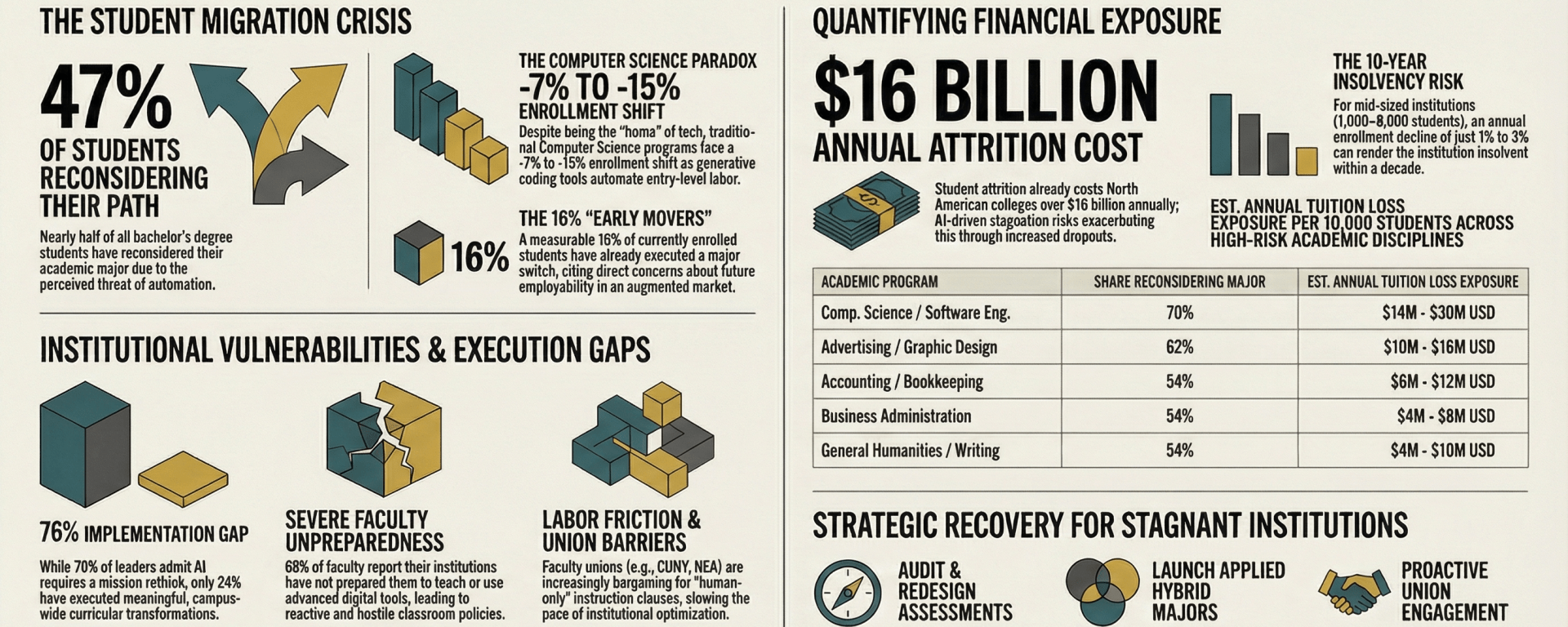
The rapid advancement of artificial intelligence is precipitating an unprecedented structural transformation across the North American higher education landscape. This report synthesizes current labor market shifts, student enrollment behaviors, and institutional adoption patterns to provide senior educational leaders with an exhaustive analysis of the risks and opportunities presented by this profound technological shift. The analysis evaluates how emerging algorithms are dismantling legacy program value propositions and provides strategic recommendations for both progressive institutional leaders and those struggling to adapt.
1. Executive Summary
The analysis of current academic and market conditions reveals several critical insights regarding the intersection of artificial intelligence and higher education:
- Pervasive Student Anxiety Driving Major Migration: Nearly half of all bachelor’s degree students have reconsidered their academic paths due to the perceived threat of automation, with a measurable minority having already executed a change in major to pursue fields viewed as less susceptible to displacement.1
- Computer Science Vulnerability Paradox: Despite its proximity to technological development, traditional computer science and entry-level programming programs are facing unprecedented enrollment declines as generative coding tools automate foundational labor functions.2
- Massive Financial Risk from Program Stagnation: The confluence of student attrition and a failure to embed modern competencies threatens to exacerbate the already looming demographic cliff, potentially causing billions of dollars in lost tuition revenue across the continent.4
- Highly Fragmented Institutional Response: While a large majority of academic leaders acknowledge that algorithmic advancements require a fundamental rethink of their institutional missions, only a small fraction have executed meaningful, campus-wide curricular transformations.7
- Erosion of Faculty Preparedness: The overwhelming majority of college faculty members report that their institutions have not adequately prepared them to utilize or teach advanced digital tools, leading to cognitive friction and reactive assessment policies.9
- The Labor Friction Bottleneck: Organized faculty labor groups are increasingly using the collective bargaining process to establish restrictive barriers against automated instruction, creating a natural tension between management’s desire for operational efficiency and the preservation of human-led teaching models.11
- Early Redesign as a Competitive Shield: A distinct cohort of progressive institutions that have pioneered comprehensive digital literacy models and specialized degree structures are defying national enrollment declines and capturing new net revenue streams.3
2. Quantitative Summary
The following tables synthesize the critical metrics regarding program disruption, student displacement, and the financial returns observed among the institutions currently navigating this crisis across North America.
Table 1: Undergraduate Program Disruption and Projected Tuition Revenue Exposure
This data represents the impact observed across typical high-exposure degrees, synthesized from student survey metrics and national enrollment shifts.2
| Academic Program | Share of Students Reconsidering Major (%) | Share of Students Who Actually Switched (%) | Fall 2025 Enrollment Shift | Estimated Annual Tuition Loss Exposure (Per 10,000 Students) |
| Computer Science / Software Eng. | 70% 2 | 25% 2 | -7% to -15% 2 | $14,000,000 – $30,000,000 USD |
| Accounting / Bookkeeping | 54% 2 | 15% 2 | -3% to -6% | $6,000,000 – $12,000,000 USD |
| Business Administration | 54% 2 | 12% 2 | -2% to -4% | $4,000,000 – $8,000,000 USD |
| Advertising / Graphic Design | 62% | 18% | -5% to -8% | $10,000,000 – $16,000,000 USD |
| General Humanities / Writing | 54% 2 | 10% 2 | -2% to -5% | $4,000,000 – $10,000,000 USD |
Note: Tuition exposure assumes an average net tuition and fees baseline of $20,000 USD per student, applied against the observed enrollment declines or switching rates cited in recent national surveys.2
Table 2: Early Program Adopters and Quantifiable Tuition Opportunity Gained
This table outlines select North American institutions that have successfully integrated automated systems and literacy requirements into their undergraduate portfolios to capture market demand.
| Institution and Program Innovation | Student Target and Reach | Estimated Opportunity Gained (Annual Tuition Revenue) | Logic and Mechanism |
| University of Florida (AI Across the Curriculum) 12 | All undergraduate students across 16 colleges 12 | $20,000,000 – $35,000,000 USD | Retained market share and attracted out-of-state learners by guaranteeing universal baseline literacy.12 |
| University of California, San Diego (Dedicated AI Major) 3 | Specialized undergraduate cohort 3 | $8,000,000 – $12,000,000 USD | Defied a system-wide 6% decline in general computer science by offering specialized tracks.3 |
| (https://completecollege.org/news/new-playbook-shares-case-studies-on-how-colleges-can-embed-ai-into-curriculum-and-instruction/) (System-wide Microcredential) 7 | Over 82,000 students and employees 7 | $5,000,000 – $10,000,000 USD | Positioned the system as the premier destination for adult and continuing education.7 |
| Kogod School of Business (AI-Infused Business Tracks) 13 | Over 50 specialized classes 13 | $4,000,000 – $6,000,000 USD | Increased recruitment yield by heavily marketing Enterprise tool access and hybrid business training.13 |
Table 3: Early Academic Adopters and Projected Profit Margin Gains
This table examines institutions leveraging specialized applications and teaching models to improve the economics of instructional delivery.
| Institution or Tool Origin | Specific Pedagogical Application | Estimated Program Profit Margin Gain (%) | Operational Benefit and Revenue Mechanism |
| Columbia University / UVA (“Caisey” Case Study App) 14 | AI simulates Oxbridge-style Socratic debates with students at home.14 | 12% to 15% profit gain | Reduces reliance on human teaching assistants and deepens engagement prior to lectures.14 |
| Georgia Institute of Technology (“Smart Tutor” for EE) 14 | 24/7 homework guidance without cognitive offloading.14 | 8% to 10% profit gain | Drastically reduces course failure and attrition rates, preserving student credit hour revenue.14 |
| Arizona State University (Innovation Challenge Projects) 7 | Automated transcript reviews and accounts payable.15 | 5% to 7% overall operational gain | Frees up administrative capital to reinvest in student-facing instructional support.15 |
3. Research Details, Commentary, and Strategic Insights
The true nature of the disruption facing North American higher education lies at the intersection of economic survival and the redefinition of learning itself. For centuries, the business model of the modern university has relied on a scarcity of credentialed knowledge.17 When information was difficult to access and synthesize, paying tens of thousands of dollars for direct access to expert lectures and physical libraries was a sound economic investment.17 However, large language models and cognitive assistants have effectively democratized high-order synthesis, forcing a violent reassessment of what students are actually paying for.18
The Scale of Program Disruption and Major Migration
A detailed review of research conducted by organizations like the Lumina Foundation and Gallup reveals that the crisis is no longer a distant theoretical threat but an active driver of student behavior.2 In a comprehensive study of over 3,800 students, an overwhelming 47% reported that they have actively considered changing their major or field of study due to fears surrounding automation.2 More strikingly, 16% of currently enrolled students have already executed a switch, citing direct concerns about their future employability in an augmented job market.2
This migration has caused highly visible enrollment bifurcations. Traditional computer science, long considered the premier engine of upward mobility, is experiencing a sharp correction.2 Fall 2025 data from the National Student Clearinghouse highlighted declines of between 5% and 10% across the discipline nationally, with elite institutions like the University of California, Berkeley seeing drops as severe as 12%.2 Students are realizing that basic coding and standard software engineering tasks can be accomplished by automated agents in a fraction of the time, depressing the historical return on investment associated with standard computing degrees.2
In response, many students are pivoting toward two extremes: specialized disciplines where manual presence and liability are non-negotiable, and disciplines heavily weighted toward human psychology and complex societal decision-making.21 Vocational trades, represented by welding, plumbing, and specialized HVAC technician paths at community colleges, have experienced enrollment surges of up to 20%.2 Simultaneously, many students abandoning technology majors are moving into the social sciences or traditional business consulting roles where the capacity for empathy, ethics, and strategic leadership cannot yet be replicated by code.21
Quantifying the Threat to Institutional Solvency
The direct financial impact of this student migration represents an existential crisis for institutions already contending with a declining birth rate and a shrinking pool of traditional high school graduates.4 Historical research from the Educational Policy Institute shows that student attrition already costs North American colleges over $16 billion annually in lost net tuition and auxiliary revenues.6
When a student abandons an institution because they perceive their degree as outdated, the university loses the compounding lifetime value of that student’s tuition, campus housing fees, and future alumni contributions.6 For mid-sized private institutions with enrollments between 1,000 and 8,000 students, standard modeling suggests that an annual enrollment decline of just 1% to 3% can render an institution insolvent within a decade.25 The current wave of student panic, if not met with rapid program modernization, risks turning thousands of those students into dropouts or prompting them to seek short-term, job-secure certifications elsewhere, draining the vital revenue needed to keep campuses operating.2
Case Studies of Early Program Adopters
To understand how higher education might navigate this crisis, senior leaders should closely evaluate institutions that have pioneered comprehensive curriculum redesign. The University of Florida remains the premier example of aggressive, top-down strategy.12 Recognizing that domain-specific knowledge alone is no longer enough to secure a career, Florida leadership mandated that every student, regardless of their major, graduate with a baseline understanding of digital literacy.12
To execute this, the university did not merely add a few isolated elective courses; it hired 100 dedicated faculty members spread across all 16 of its colleges.12 A philosophy major at Florida learns how algorithmic systems replicate bias, while an engineering major learns how to deploy them in physical design.12 By marketing this comprehensive preparedness, the university has successfully countered negative enrollment trends, capturing estimated tens of millions in tuition from students who specifically prioritize these skills.12
Similarly, in specialized fields, the University of California, San Diego countered the general decline in computer science by launching a dedicated undergraduate major in advanced automation.3 Their enrollment grew, demonstrating that students are not abandoning technology itself but are demanding specialized tracks that teach them how to command algorithms rather than simply compete with them.3
In the business sector, the Kogod School of Business at American University has provided every student with access to premium research assistants and developed over 50 specific classes.13 Their leadership argues that raw computational capability without human domain expertise is useless.13 By layering technical skills over deep understanding of supply chains, finance, and management, they have positioned their graduates as uniquely qualified strategic orchestrators, boosting their overall recruitment yields in the process.13
Early Academic Adopters and Curricular Delivery
The evolution of how professors teach represents the second critical front of the institutional response. Progressive educators are moving past the initial, reactive panic over plagiarism to realize that these tools can actually restore educational ideals that were previously impossible to scale.14
At Columbia University, Professor Wang’s development of the “Caisey” app utilizes advanced language processing to subject students to deep, Socratic questioning at home.14 Students are forced to defend their positions on complex business case studies before ever stepping into the classroom.14 This prevents cognitive offloading and makes passive learning impossible.14 Because the machine handles the repetitive, lower-order drilling, human professors can focus classroom time on higher-order debate and critical analysis.14
At the Georgia Institute of Technology, professors in the notoriously difficult electrical engineering program created a “Smart Tutor” to guide students through complex circuits.14 When students struggle with homework in the middle of the night, the application provides step-by-step guidance without handing over the answers.14 This specific intervention directly impacts the program’s profit margin by reducing failure rates and preserving student credit hours that would otherwise be lost to attrition.14
4. Evaluation of Strategic Hypotheses
An exhaustive evaluation of current North American campus conditions provides strong validation for the three core hypotheses driving institutional concern.
Test of the First Hypothesis: Failure to Evolve Programs Leading to Tuition Loss
The first hypothesis asserts that the majority of institutions have not evolved their programs, resulting in massive future tuition losses as students abandon outdated curriculum. The evidence strongly validates this claim. A comprehensive survey conducted by the(https://newsroom.collegeboard.org/new-college-board-research-faculty-express-near-universal-concern-student-ai-use-undermines) found that while student use of these tools is expanding rapidly, faculty and administrative consensus on how to adjust has not yet formed.10
The disconnect is quantifiable: 70% of higher education leaders report that automation is forcing them to rethink their institutional missions, but only 24% have taken meaningful steps to adapt their programs.8 This profound execution gap directly feeds student anxiety. Students realize that entry-level roles in highly exposed fields are shrinking, and when their local institutions continue to offer the same standard curriculum without embedding technical competencies, students are voting with their feet.2 The 16% of students who have already abandoned or changed their majors specifically citing automation disruption are a leading indicator of massive impending revenue losses for stagnant institutions.2
Test of the Second Hypothesis: Lack of Faculty Retraining and Subsequent Layoffs
The second hypothesis posits that universities have failed to retrain their professors, which will inevitably lead to declining revenues and subsequent workforce reductions. This assertion is heavily supported by current institutional research. According to surveys by the American Association of Colleges and Universities, an alarming 68% of faculty members report that their schools have not adequately prepared them to use advanced digital tools effectively for teaching or mentoring.9
This lack of preparedness breeds a fragmented and hostile classroom environment where professors attempt to fight automation with flawed detection tools or revert to archaic grading methods rather than redesigning assessments.10 As programs lose their market appeal and enrollment targets are missed, the financial strain is already manifesting in severe layoffs. The California State University system serves as a stark example: while system leaders signed massive multimillion-dollar partnerships with prominent AI vendors to provide campus-branded cognitive tools to all students, they were simultaneously forced to propose $375 million in budget cuts due to deficits.28 At individual campuses like Sonoma State, severe budget shortfalls resulted in plans to eliminate over 20 academic programs and cut over a quarter of the entire teaching staff.28
Test of the Third Hypothesis: Organizational Rigidity and Union Obstruction
The third hypothesis states that established institutions are poorly equipped to transform at the required pace because they lack strong organizational transformation practices and face delays from labor unions. The evidence heavily validates this dynamic.
Transformation in higher education is notoriously slow due to entrenched academic traditions and siloed department structures.10 Faculty at highly selective, older institutions are overwhelmingly the most negative toward new pedagogical technologies and report the highest levels of classroom disruption.10
Furthermore, labor unions are correctly identifying that management may attempt to use these technologies to justify deskilling, increased workloads, and workforce reduction.29 Consequently, organizations like the National Education Association (NEA) are actively bargaining to secure strict contract language protecting human instruction.11 The Professional Staff Congress at the City University of New York won contract language mandating that all scheduled courses feature human instruction.11 Similar provisions achieved at Rowan College in New Jersey dictate that new technologies cannot cause the reduction of any unit member’s base workload.11 While these measures protect the dignity and security of academic workers, they inherently slow the speed at which central administrators can deploy automated systems, optimize scheduling, or reduce legacy program costs.11
5. Key Actions for Senior Leaders of Progressive Institutions to Maximize Opportunities
Leaders at institutions that have already begun the hard work of transformation must move past initial experimentation to scale their operations and secure lasting competitive advantages:
- Redesign Assessment to Protect Cognitive Labor: Leaders must instruct departments to audit their existing assessments to identify tasks that can be fully outsourced to large language models without active student thinking.27 Where vulnerability exists, assessments should be redesigned to require process visibility, such as recording research progression, conducting live oral defenses, or requiring the application of concepts to specific, localized community problems.27
- Establish Interdisciplinary Hybrid Majors Rapidly: Student demand is moving away from pure computer science toward applied combinations.3 Progressive institutions should create cross-departmental programs combining domain expertise with automated systems command, such as healthcare informatics, ethical algorithm design, and algorithmic business modeling.3
- Capitalize on the Lifelong Learning Market: Traditional degrees are no longer sufficient for a career spanning multiple decades. Institutions must leverage their initial investments in digital literacy to offer modular, upskilling microcredentials to local corporate workforces and alumni, opening up massive new continuous revenue streams.7
- Leverage Domain Expertise to Build Proprietary Tools: Follow the examples of Columbia and Georgia Tech by empowering expert faculty to design in-house cognitive assistants mapped directly to your institution’s specific curriculum.14 These tools can scale high-order Socratic learning without incurring the massive variable costs of hiring additional teaching assistants.14
6. Key Actions for Senior Leaders of Institutions Falling Behind
For institutions and school boards that have hesitated to act, continuous stagnation represents an existential threat to enrollment and financial solvency. Leaders must move aggressively to execute the following recovery operations:
- Form a Centralized, Cross-Functional Leadership Council: Do not leave individual departments to invent their own disjointed policies.9 Immediately form a task force composed of academic affairs, information technology, admissions, and legal counsel to evaluate campus readiness, audit existing software, and design a unified strategic narrative for the institution.16
- Fund Mandatory Faculty Reskilling Immediately: Faculty cannot be expected to redesign courses or guide students through complex ethical landscapes if they have not been formally trained.10 Institutions must immediately allocate budget toward comprehensive development programs, offering small grants or stipends to professors who pilot digital tool integration in their classrooms.7
- Involve Faculty Unions Early to Avoid Friction: Transformation will fail if it is pushed strictly top-down and provokes hostile union resistance.11 Senior leaders must proactively bring union leadership into the conversation to co-design ethical boundaries.11 By guaranteeing that the technology will be used as a complementary tool to reduce administrative burdens rather than a mechanism to replace human instruction, management can secure the buy-in needed to maintain institutional agility.11
- Focus on Cutting Courses Rather than Eliminating Programs: If falling enrollments require immediate budget reductions,Bob Atkins, CEO of Gray DI, advises that leaders should look at trimming under-enrolled elective courses rather than eliminating entire programs.34 Cutting programs creates highly expensive multi-year teach-out liabilities and generates negative public press that scares off future applicants, whereas course optimization realizes immediate operational savings.34
Works cited
- College Students Weigh AI’s Impact on Majors and Careers – Gallup News, accessed April 5, 2026, https://news.gallup.com/poll/704087/college-students-weigh-impact-majors-careers.aspx
- AI Impact on Student Majors: US Colleges See Shifts – AcademicJobs.com, accessed April 5, 2026, https://www.academicjobs.com/higher-education-news/ai-impact-on-student-majors-us-colleges-see-shifts-or-academicjobs-11371
- The Computer Science Degree Is Losing its Luster in the Age of AI – Built In, accessed April 5, 2026, https://builtin.com/articles/computer-science-degree-decline-ai
- How 3 college administrators are tackling higher education disruption | Higher Ed Dive, accessed April 5, 2026, https://www.highereddive.com/news/how-3-college-administrators-are-tackling-higher-education-disruption/813556/
- It’s Starting to Look Like AI Has Killed the Entire Model of College – Futurism, accessed April 5, 2026, https://futurism.com/future-society/ai-college-internships-jobs
- The Direct and Indirect Costs of High College Attrition Rates | Verse.ai, accessed April 5, 2026, https://verse.ai/blog/direct-and-indirect-costs-college-attrition-rates/
- New Playbook Shares Case Studies on How Colleges Can Embed …, accessed April 5, 2026, https://completecollege.org/news/new-playbook-shares-case-studies-on-how-colleges-can-embed-ai-into-curriculum-and-instruction/
- AI, Cost, And Confidence Are Rewriting Higher Ed’s Value Proposition – Forbes, accessed April 5, 2026, https://www.forbes.com/sites/avivalegatt/2025/10/15/ai-cost-and-confidence-are-rewriting-higher-eds-value-proposition/
- National Survey: 95% of College Faculty Fear Student Overreliance on AI and Diminished Critical Thinking Among Learners Who Use Generative AI Tools – AAC&U, accessed April 5, 2026, https://www.aacu.org/newsroom/national-survey-95-of-college-faculty-fear-student-overreliance-on-ai-and-diminished-critical-thinking-among-learners-who-use-generative-ai-tools
- New College Board Research: Faculty Express Near-Universal Concern That Student AI Use Undermines Original Writing and Critical Thinking, accessed April 5, 2026, https://newsroom.collegeboard.org/new-college-board-research-faculty-express-near-universal-concern-student-ai-use-undermines
- Bargaining AI in Higher Ed | NEA, accessed April 5, 2026, https://www.nea.org/nea-today/all-news-articles/bargaining-ai-higher-ed
- AI Across the Curriculum | AI | University of Florida, accessed April 5, 2026, https://ai.ufl.edu/teaching-with-ai/ai-across-the-curriculum/
- Artificial Intelligence | Kogod School of Business – American University, accessed April 5, 2026, https://kogod.american.edu/insights-and-impact/ai-at-kogod
- ChatGPT fed his students easy answers, so he built an app to argue with them, accessed April 5, 2026, https://www.washingtonpost.com/education/2026/04/01/professors-design-ai-apps/
- How AI Can Help Higher Education Capture a Once-in-a-Generation Opportunity, accessed April 5, 2026, https://www.bcg.com/publications/2026/how-ai-can-help-universities-capture-opportunity
- Universities Are Discovering How Generative AI Fits Their Future – Dell, accessed April 5, 2026, https://www.delltechnologies.com/asset/en-us/solutions/industry-solutions/industry-market/genai-dell-colleges-and-universities-case-study.pdf
- AI Will Make Knowledge Cheap. Higher Ed Will Survive Anyway. – Minding The Campus, accessed April 5, 2026, https://mindingthecampus.org/2025/12/01/the-university-withstood-cheaper-knowledge-before-it-can-do-it-again/
- AI in Higher Education: The Third Education Disruption | ECPI University, accessed April 5, 2026, https://www.ecpi.edu/blog/ai-higher-education-third-education-disruption
- ‘It changes everything’: How AI is impacting post-secondary education – CTV News, accessed April 5, 2026, https://www.ctvnews.ca/sci-tech/article/it-changes-everything-how-ai-is-impacting-post-secondary-education/
- AI Impact on Student Majors: US Colleges See Shifts – Academic Jobs, accessed April 5, 2026, https://www.academicjobs.com/us/higher-education-news/ai-impact-on-student-majors-us-colleges-see-shifts-or-academicjobs-11371
- Which College Majors are Most and Least Vulnerable to AI? – Ivy Scholars, accessed April 5, 2026, https://www.ivyscholars.com/which-college-majors-are-most-and-least-vulnerable-to-ai/
- Amid mass layoffs, AI is making students switch careers. Top 5 fields seeing biggest shift revealed in new survey, accessed April 5, 2026, https://m.economictimes.com/magazines/panache/amid-mass-layoffs-ai-is-making-students-switch-careers-top-5-fields-seeing-biggest-shift-revealed-in-new-survey/articleshow/129976479.cms
- Some College Students Are Switching Majors Because of AI – Entrepreneur, accessed April 5, 2026, https://www.entrepreneur.com/business-news/college-students-are-switching-majors-as-ai-reshapes-career-plans
- HEat Index, Issue 35 – First-Year Enrollment, Tuition Costs, and AI Policies – Evisions, accessed April 5, 2026, https://www.evisions.com/blog/heat-index-issue-35-first-year-enrollment-tuition-costs-and-ai-policies/
- 2026 Higher Education Trends | Deloitte Insights, accessed April 5, 2026, https://www.deloitte.com/us/en/insights/industry/articles-on-higher-education/2026-higher-education-trends.html
- A First Look at Labor’s AI Values: An analysis of recent statements about technology by unions and other worker organizations, accessed April 5, 2026, https://laborcenter.berkeley.edu/a-first-look-at-labors-ai-values/
- 90% Of Faculty Say AI Is Weakening Student Learning: How Higher Ed Can Reverse It, accessed April 5, 2026, https://www.forbes.com/sites/avivalegatt/2026/01/27/90-of-faculty-say-ai-is-weakening-student-learning-how-higher-ed-can-reverse-it/
- AI is Destroying the University and Learning Itself – Current Affairs, accessed April 5, 2026, https://www.currentaffairs.org/news/ai-is-destroying-the-university-and-learning-itself
- AI at Work: Union Strength and the AI Transformation | Unifor, accessed April 5, 2026, https://www.unifor.org/news/all-news/ai-work-union-strength-and-ai-transformation
- Four Union Strategies to Fight on A.I. | Labor Notes, accessed April 5, 2026, https://labornotes.org/2026/03/four-union-strategies-fight-ai
- AI in Higher Ed Will Come Slowly, Until All of a Sudden! – UPCEA, accessed April 5, 2026, https://upcea.edu/ai-in-higher-ed-will-come-slowly-until-all-of-a-sudden/
- How to Build AI-Ready Courses Without Overloading Your Faculty – FeedbackFruits, accessed April 5, 2026, https://feedbackfruits.com/blog/ai-instructional-design-higher-education
- Artificial Intelligence and the Disruption of Higher Education: Strategies for Integrations across Disciplines – Scirp.org., accessed April 5, 2026, https://www.scirp.org/journal/paperinformation?paperid=122159
- Why Enrollment Declines Don’t Automatically Mean Program Cuts, accessed April 5, 2026, https://www.graydi.us/blog/gray-insights/why-enrollment-declines-dont-automatically-mean-program-cuts
This article was written with my brain and two hands (primarily) with the help of Google Gemini, Notebook LM, Claude, and other wondrous toys.
 Adam Outside The Box