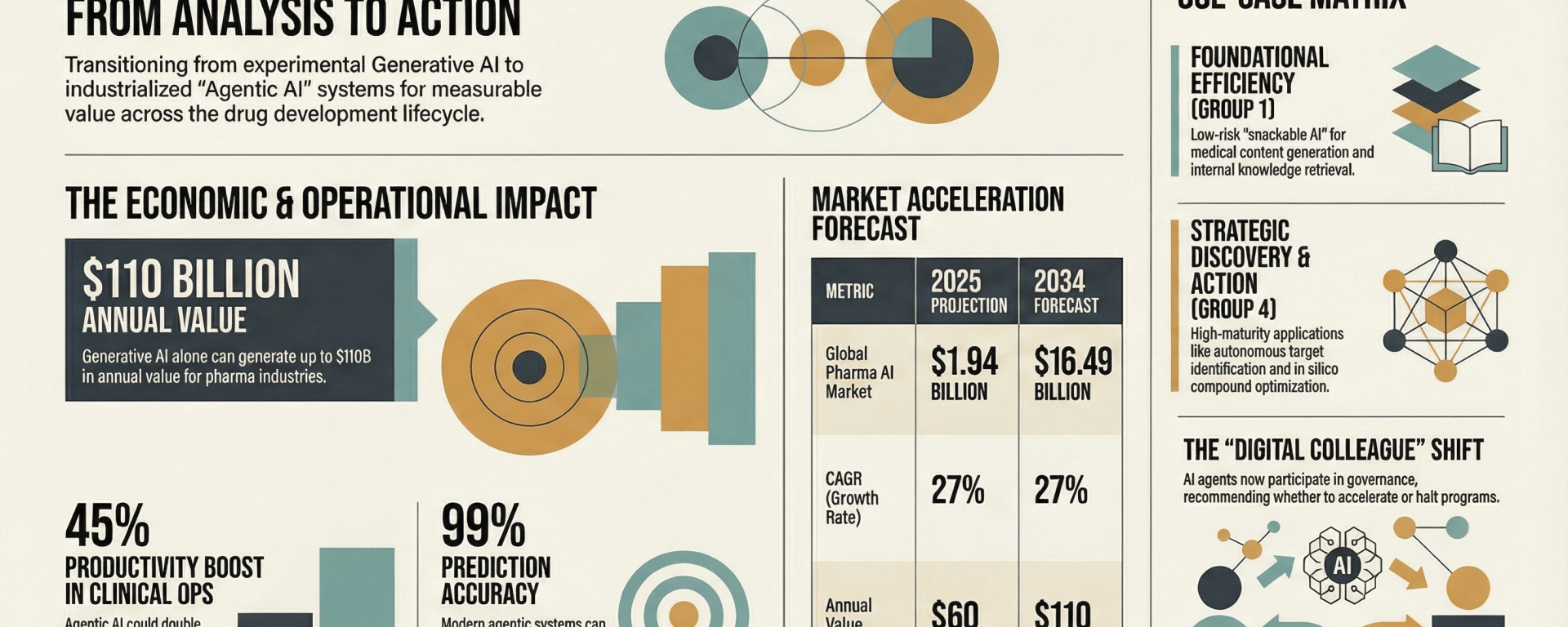
The pharmaceutical industry across North America and Europe has entered a period of radical reconstruction, driven by the convergence of maturing generative AI capabilities and the emergence of autonomous agentic systems. For Chief AI Officers (CAIOs) and senior leadership, the transition represents a shift from speculative experimentation to the industrialization of artificial intelligence within core operating models. This transformation is necessitated by an environment where the traditional drug development cycle—often spanning 10 to 15 years with costs exceeding $2.6 billion per successful therapy—is no longer sustainable in the face of patent cliffs, rising interest rates, and increasing regulatory complexity.1 Current market projections indicate that the global pharmaceutical AI market, valued at approximately $1.94 billion in 2025, will accelerate at a compound annual growth rate (
As the industry moves into 2026, the primary differentiator between market leaders and laggards is the transition from “analysis to action.” While 2024 was defined by the adoption of Large Language Models (LLMs) for document summarization and basic content drafting, the current era is defined by agentic AI—systems capable of autonomous reasoning, planning, and multi-step execution.4 In the pharmaceutical context, this means AI is no longer merely a tool but a “digital colleague” capable of participating in governance meetings, predicting program success with up to 99% accuracy, and optimizing global supply chains in real-time.6
The economic implications are profound. Generative AI alone is estimated to generate between $60 billion and $110 billion in annual value for the pharmaceutical and medical-product industries.8 Research and early discovery contribute an expected $15 billion to $28 billion of this total, primarily through the compression of target identification timelines and the reduction of failure rates in early-stage trials.8 In clinical operations, agentic AI has the potential to boost development productivity by 35% to 45% within five years, potentially doubling the number of trials conducted with the same resource pool.9
However, the realization of these gains is contingent upon navigating a complex matrix of organizational maturity and regulatory risk. The regulatory landscape has shifted toward a risk-based approach, exemplified by the EU AI Act and the US FDA’s recent draft guidances on the use of AI in regulatory decision-making.10 CAIOs must now balance the drive for “speed-to-patient” with the absolute requirement for GxP compliance, data provenance, and human-in-the-loop oversight.13 This playbook provides a structured framework for categorizing 20 high-impact use cases across four quadrants of maturity and risk, offering a strategic roadmap for senior leaders to scale AI responsibly and effectively across the pharmaceutical value chain.
Strategic Classification of AI Use Cases
The following grid categorizes the most impactful use cases according to the required organizational maturity (data readiness, infrastructure, and cultural agility) and the inherent complexity or regulatory risk (impact on patient safety, GxP compliance, and legal liability).
| Group | Low Risk / Complexity / Governance | High Risk / Complexity / Governance |
| Low AI Maturity | Group 1: Foundational Efficiency | Group 2: Regulated Productivity |
| 1. Medical Content Generation | 6. Pharmacovigilance Case Narratives | |
| 2. Medical Information Triage | 7. Regulatory Document Drafting | |
| 3. Literature Review Automation | 8. Adverse Event Monitoring (RWD) | |
| 4. Internal Knowledge Assistants | 9. Clinical Protocol Structuring | |
| 5. Multilingual Patient Education | 10. MLR Pre-review Acceleration | |
| High AI Maturity | Group 3: Operational Excellence | Group 4: Strategic Discovery & Action |
| 11. Omnichannel HCP Engagement | 16. AI-Driven Target Identification | |
| 12. Personalized Patient Support | 17. In Silico Compound Optimization | |
| 13. Supply Chain Predictive Maintenance | 18. Agentic Clinical Site Selection | |
| 14. Inventory & Demand Forecasting | 19. Autonomous Patient Recruitment | |
| 20. Sales Force Optimization | 20. Agentic Portfolio Management |
Group 1: Foundational Efficiency (Low Maturity, Low Risk)
This quadrant focuses on “snackable AI”—applications that democratize data and provide immediate productivity gains without requiring deep integration into core biological research or highly regulated clinical decision pathways.15 These use cases are ideal for organizations in the early stages of their AI journey or those looking to prove immediate ROI to internal stakeholders.
1. Medical Content Generation and Summarization
Medical affairs teams spend significant portions of their time drafting and summarizing scientific content for internal and external stakeholders. LLMs can generate accurate, up-to-date first drafts of medical information in a fraction of the traditional time.17 This application reduces the burden of manual authoring while ensuring that communication remains consistent with the latest clinical data.
- Mechanism and Future Outlook: Current implementations use Retrieval-Augmented Generation (RAG) to ground the AI’s output in approved internal databases and peer-reviewed literature, significantly reducing the risk of “hallucinations”.17 The future outlook involves “self-reviewing” agents that not only write content but also preliminary flag missing information or grammatical errors before human review.17
- Industry Example: Sanofi has deployed “Concierge,” an internally hosted GenAI companion designed to streamline daily tasks, including answering questions and navigating internal tools for 20,000 employees.16
- Industry Example: Pfizer utilizes its “Vox” platform on AWS to allow researchers to search and collate scientific content, accelerating the identification of potential targets and improving scientific success rates.19
2. Medical Information Triage and Automated Response
Pharmaceutical companies receive tens of thousands of medical inquiries annually from healthcare professionals (HCPs) and patients. AI systems can sort these inquiries by category (e.g., dosage, safety, or adverse events) and suggest draft answers using approved medical content.18
- Mechanism and Future Outlook: By integrating with existing Customer Relationship Management (CRM) systems, AI can reduce the first-response time for medical inquiries by up to 70%.18 As these systems evolve, they will handle increasingly complex multi-part queries and automatically escalate high-risk safety signals to pharmacovigilance teams.18
- Industry Example: Newpage Solutions helps life sciences companies move from pilots to platforms, implementing med info triage systems that provide measurable returns on investment.18
3. Scientific Literature Review and Competitive Intelligence
Monitoring the sheer volume of scientific publications and competitor activity is an overwhelming task for R&D and medical affairs teams. AI can scan thousands of new articles, summarizing key findings related to drug interactions, study results, or Key Opinion Leader (KOL) insights.18
- Mechanism and Future Outlook: These tools use natural language processing (NLP) to extract actionable intelligence from a “deluge” of data, providing near real-time insights into market trends and competitor moves.21 Future iterations will incorporate “next-best-action” logic, suggesting shifts in strategy based on emerging competitive data.5
- Industry Example: IQVIA’s NLP platform is utilized by 19 of the top 20 pharma companies to unlock insights from publications and clinical notes, allowing for more informed lifecycle management.21
- Industry Example: GSK has leveraged big data platforms to ingest and harmonize data from thousands of operational systems, drastically reducing the time required for researchers to access historical trial insights.23
4. Internal Knowledge Assistants and Copilots
Pharma organizations are massive, often siloed entities where critical information is trapped in legacy repositories or disparate SharePoint sites. Internal knowledge assistants help employees quickly retrieve data from research documents, SOPs, or training repositories using natural language queries.24
- Mechanism and Future Outlook: These assistants function as a “digital companion” for every employee, breaking down silos and accelerating internal decision-making.4 The trend is moving toward multimodal assistants that can interpret not only text but also charts, tables, and images from historical research reports.25
- Industry Example: AstraZeneca has implemented AI initiatives to identify new targets for chronic conditions by linking internal research capabilities with AI discovery platforms.21
5. Multilingual Patient Education and Support Adaptation
Adapting medical content for a global audience requires precise translation that maintains scientific accuracy while adjusting for local readability and regulatory standards. AI-driven translation, post-edited by experts, can rapidly produce patient education materials and local-language leaflets.17
- Mechanism and Future Outlook: This use case leverages specialized models fine-tuned for biomedical language (e.g., BioBERT or BioGPT) to ensure that the nuance of medical terminology is preserved across languages.21
- Industry Example: Berlin Chemie (part of the Menarini Group) developed the “Therakey” chatbot, which delivers relevant patient support information in real-time, specifically designed for the German market.24
Group 2: Regulated Productivity (Low Maturity, High Risk)
This group targets workflows that are administratively burdensome but essential for regulatory compliance. While the technology required is accessible even for organizations with lower AI maturity, the high risk associated with GxP environments necessitates rigorous human oversight and auditability.13
6. Automated Pharmacovigilance Case Narratives
Processing adverse event reports into standardized narratives for regulatory submission is a high-volume, repetitive task that is prone to human error. AI can extract case information from structured data and draft the “safety story,” ensuring consistency across thousands of cases.18
- Mechanism and Future Outlook: AI models can reduce the time spent on case processing by 30-40%.23 However, the future of this use case depends on maintaining a “human-in-the-loop” paradigm where qualified safety doctors review every AI-generated document before submission.18
- Industry Example: GSK successfully implemented a system that processed over 120,000 adverse event cases annually, achieving significant cost reductions while maintaining 100% follow-up response rates.23
- Industry Example: IQVIA provides automated data collection and initial adverse event reporting tools to help drug sponsors manage growing safety workloads.20
7. Regulatory Document Drafting and Quality Control
The production of Clinical Study Reports (CSRs), Investigational New Drug (IND) summaries, and Summaries of Product Characteristics (SmPC) is a critical bottleneck in the path to market. AI can generate “80% ready” drafts in minutes, halving the total document creation time.25
- Mechanism and Future Outlook: Systems are being developed to cross-check data consistency between tables and text, reducing errors by up to 50%.25 The goal is a “first-time-right” submission process that minimizes costly “frozen submission clocks” caused by regulatory queries.13
- Industry Example: Moderna utilizes AI agents to draft complex regulatory documents and personalize patient communications, empowering faster decision-making across legal and manufacturing teams.27
- Industry Example: Pfizer Chairman Albert Bourla noted that the company is using AI to automate the creation of content across the entire drug lifecycle, from lab data to the booklets included in pill boxes.30
8. Real-World Data (RWD) Monitoring for Adverse Events
Traditional pharmacovigilance relies on spontaneous reporting, which often captures only a fraction of actual adverse events. AI can monitor real-world data sources, such as electronic health records (EHRs) and social determinants of health, to identify safety signals in near real-time.8
- Mechanism and Future Outlook: Predictive analytics can forecast dropout risks and trial suitability by analyzing fragmented patient data.8 As RWD becomes more integrated with AI, regulators like the FDA are increasingly accepting this evidence as supportive in the approval of new medicines.32
- Industry Example: Roche has implemented AI tools that combine real-world datasets and genomics to monitor ADRs (adverse drug reactions) in real-time, improving detection accuracy.31
9. Clinical Trial Protocol Structuring and Alignment
A single clinical trial protocol can take teams of medical writers six months to produce. Multi-agent AI systems can integrate internal content management with external scientific databases to ensure that protocols are compliant and scientifically rigorous from the start.1
- Mechanism and Future Outlook: By analyzing historical site performance and demographics, these agents can prioritize high-performing sites and produce “first-time-right” agreements, cutting down negotiation cycles.29 This automation could potentially double site activation rates while reducing staffing needs by up to 50%.29
- Industry Example: BCG partnered with a leading pharma company to develop a multi-agent system that drastically reduced the timeline to the first draft of clinical trial protocols.1
10. MLR Pre-review and Compliance Acceleration
The Medical-Legal-Regulatory (MLR) review process is often a significant bottleneck for marketing teams. AI can scan promotional copy against custom rules to predict the likelihood of approval and suggest edits to ensure compliance.24
- Mechanism and Future Outlook: These engines use customizable rules to flag potential issues such as missing safety information or unsubstantiated claims.24 Future systems will be integrated directly into content authoring tools, providing real-time compliance feedback as marketers write.17
- Industry Example: Viseven’s MLR Acceleration Engine scans content and applies feedback from previous human reviews to improve its accuracy over time.24
Group 3: Operational Excellence (High Maturity, Low Risk)
In Group 3, organizations leverage their high data maturity to drive commercial and supply chain efficiencies. While these use cases are technically complex, they carry lower regulatory risk because they primarily affect business operations rather than direct clinical outcomes.5
11. Omnichannel HCP Engagement and Hyperpersonalization
Mass marketing is no longer effective in a landscape where physicians are overwhelmed by untargeted communications. AI analyzes CRM records, email opens, and market research to recommend the “next-best-action” for every individual HCP.5
- Mechanism and Future Outlook: Agentic AI can curate relevant clinical trial data and personalized briefs, ensuring that field reps walk into conversations fully equipped with context-aware support.4 This shifts the relationship from transactional to consultative, building deeper trust with the medical community.4
- Industry Example: Sanofi utilizes “Turing,” an AI platform designed to unlock personalized engagement with healthcare providers across multiple channels.16
- Industry Example: IQVIA offers orchestrated engagement tools that use precision targeting to improve HCP satisfaction and campaign performance.24
12. Personalized Patient Support and Adherence Programs
Managing chronic diseases requires long-term patient engagement. AI-powered chatbots can provide 24/7 support, answering questions about dosing, coverage, or onboarding in the patient’s native language.18
- Mechanism and Future Outlook: These programs are moving toward “empathy-aware” agents that can detect the emotional tone of a patient and adjust their response accordingly.18 This enhances the patient experience and reduces the workload for human support teams.18
- Industry Example: Novo Nordisk developed “Sophia,” a digital assistant for diabetes patients that provides 24/7 support and answers common queries outside office hours.24
- Industry Example: Berlin Chemie uses the “Therakey” portal to deliver relevant information to patients in real-time, improving patient confidence and adherence.24
13. Manufacturing 4.0 and Predictive Maintenance
In pharmaceutical manufacturing, even minor deviations in equipment performance can lead to batch failures. AI-driven predictive maintenance analyzes sensor data from production lines to identify potential failures before they occur.3
- Mechanism and Future Outlook: Real-time analytics allow production lines to adjust dynamically, enhancing product consistency and quality.3 Integrating Industry 4.0 capabilities—such as robotics and IoT—results in smoother operations and faster production cycles.3
- Industry Example: Pfizer Chairman Albert Bourla noted that AI-powered manufacturing processes are increasing throughput by 20%, enabling faster delivery of medicines to patients.19
- Industry Example: Merck uses Manufacturing and Analytics Intelligence on AWS to optimize its drug manufacturing processes through AI-powered insights.19
14. Supply Chain Inventory and Demand Forecasting
Predicting the demand for medicines—particularly temperature-sensitive biologics—is essential for minimizing waste and ensuring timely delivery. AI models analyze historical trends, market fluctuations, and environmental data to forecast demand with high accuracy.3
- Mechanism and Future Outlook: probabilistic planning allows teams to take proactive mitigating actions by predicting up to 80% of low inventory positions.7 Future systems will incorporate “autonomous rerouting” agents that adjust logistics schedules in real-time based on disruptions.27
- Industry Example: Sanofi has already delivered $300 million in savings by predicting and mitigating 80% of low inventory risks through AI.7
- Industry Example: Novartis uses machine learning to develop smart manufacturing processes and significantly improve demand forecast accuracy within its supply chain.19
15. Sales Force Territory and Resource Optimization
Allocating sales resources efficiently requires an understanding of complex variables, including drive times, account value, and physician potential. AI agents can evaluate these variables to optimize the size and distribution of the sales force.4
- Mechanism and Future Outlook: These agents analyze territory workloads and performance data to suggest reallocations that maximize HCP coverage and sales impact.4
- Industry Example: Pharmavoice highlights how AI agents are now available to evaluate variables like territory workloads, helping companies optimize their sales force size.4
Group 4: Strategic Discovery & Action (High Maturity, High Risk)
This quadrant represents the “Holy Grail” of pharmaceutical AI. These use cases require deep biological understanding, high-quality multimodal data, and sophisticated agentic workflows. Success here can fundamentally alter the competitive landscape by bringing life-saving treatments to market years ahead of schedule.2
16. AI-Driven Target Identification and Validation
Identifying the biological mechanism of a disease is the most critical step in drug discovery. AI models sift through vast pharmacological, genetic, and real-world datasets to identify promising drug candidates with unprecedented accuracy.2
- Mechanism and Future Outlook: Deep learning algorithms can predict molecular behavior, slashing the time needed to screen millions of compounds from years to weeks.2 These engines have already delivered novel drug targets in record time—Sanofi’s engine delivered seven targets in just one year.16
- Industry Example: GSK uses its Big Data platform on Cloudera to analyze genetic data from 500,000 UK Biobank participants, identifying new drug targets for respiratory illnesses and cancer.23
- Industry Example: AstraZeneca teamed with BenevolentAI to identify new targets for conditions like chronic kidney disease using knowledge graphs and machine learning.21
17. In Silico Compound Design and Optimization
Traditional drug discovery involves thousands of “wet-lab” experiments to find a viable molecule. AI agents can autonomously screen millions of molecules in silico, predicting their efficacy and toxicity to design novel compounds.27
- Mechanism and Future Outlook: The “lab-in-a-loop” strategy uses data from lab experiments to train AI models, which then predict new molecular structures to be tested.38 This iterative feedback loop drastically reduces the time needed for each design-test-learn cycle.37
- Industry Example: Roche (Genentech) utilizes a “lab in a loop” strategy where trained AI models make predictions on drug targets and therapeutic molecules, which are then experimentally tested by scientists.38
- Industry Example: Johnson & Johnson is deploying agentic AI to identify drug candidates and determine the optimal timing for critical chemical synthesis steps.27
18. Agentic Clinical Trial Site Selection and Monitoring
Selecting the wrong trial site can delay a drug’s path to market by years. AI agents analyze site performance, demographics, and real-time trial data to prioritize high-performing locations and predict potential delays.27
- Mechanism and Future Outlook: multi-agent trial management co-pilots monitor site activation and patient enrollment in real-time, identifying underperforming sites early and suggesting remedial actions.29 This shifts oversight from a reactive to a proactive, automated process.37
- Industry Impact: Implementing intelligent site monitoring can lead to 30-35% reductions in monitoring costs and 15-20% faster trial timelines.37
- Industry Example: Sanofi’s Plai app provides early warnings when clinical trial recruitment slows and recently guided pivotal phase 3 atopic dermatitis trials by forecasting study trajectories.6
19. Autonomous Patient Recruitment and Diversity Matching
Recruiting a diverse and representative patient population is a persistent challenge. AI agents can analyze fragmented data from EHRs and registries to identify eligible patients with high precision and automate personalized outreach.8
- Mechanism and Future Outlook: These agents rank potential participants based on multiple clinical factors and dynamically adjust communication tone to enhance retention.28 Future systems will use “digital twins” of patient populations to simulate trial outcomes before the first patient is even enrolled.11
- Industry Example: Pfizer uses intelligent systems to accurately predict patient enrollment rates and identify potential dropout risks, reducing recruitment timelines by up to 30%.8
- Industry Example: NIH’s TrialGPT uses a zero-shot LLM framework to match patients to cancer trials, aiming to reduce the 40% failure rate in oncology recruitment.40
20. Agentic Portfolio Management and Strategic Decision Intelligence
At the highest level of maturity, AI agents move beyond task execution to become strategic advisors. They aggregate billions of data points to predict R&D costs, clinical trial timelines, and the probability of success for entire drug pipelines.6
- Mechanism and Future Outlook: These agents participate in governance meetings, providing data-driven “what if” scenarios that guide investment decisions.6 They can recommend accelerating strong opportunities while halting programs with a low likelihood of success or intense competition.6
- Industry Example: Sanofi’s Plai app is described as a “new type of colleague” that occupies a chair at the decision-making table during governance meetings, helping leaders make precise, cross-functional decisions.6
Key Actions for CAIOs and Senior AI Leaders
The transition from AI pilots to enterprise-wide platforms requires a fundamental shift in leadership strategy. CAIOs must address the structural, cultural, and technical barriers that prevent AI from reaching its full potential.
1. Hardwire Business Outcomes into AI Strategy
Many AI initiatives fail because they are disconnected from business value. Leaders must move away from “technology-first” pilots and start with clearly defined outcomes.
- Action: Prioritize use cases based on “durable” business alignment. Ask: Does this solve a bottleneck? Is it better than traditional methods? Is it easy to adopt into existing workflows?.5
- Metric Strategy: Establish clear KPIs—such as reduction in study build time, percentage increase in product yield, or reduction in regulatory query response time—and hold business leaders accountable for these results.13
2. Prioritize Data Maturity over Data Volume
The industry is learning that “more data” does not necessarily lead to “better AI.” The recurring blockers are inconsistent annotations, missing metadata, and weak provenance.10
- Action: Invest in data engineering and standardization (controlled vocabularies, standardized schemas). Data used for high-risk AI must be accurate, representative, and traceable.10
- Action: Implement robust data governance that complies with 21 CFR Part 11 and EU Annex 11 standards for audit trails and integrity.12
3. Build a “Risk-Aware” Governance Framework
As AI moves closer to regulatory decisions, the absence of a clear strategy linking governance to use cases will cause efforts to stall.10
- Action: Align AI risk assessments with established quality management systems, such as the ICH Q9 framework.12
- Action: Adopt the 10 joint FDA/EMA principles: AI should be human-centric by design, risk-aware, and overseen by multidisciplinary expertise.14
4. Foster a “Change-Ready” Organizational Culture
AI is not just a new tool; it requires entirely new ways of working. Resistance often stems from limited internal expertise and concerns about risk.4
- Action: Democratize AI through “snackable” applications that employees can use in their daily workflows.15
- Action: Empower teams with new technical skills through a “Digital Accelerator” or internal startup model that operates in agile modes.15
5. Transition to Agentic Ecosystems
The future of pharma is not in isolated LLMs but in “multi-agent orchestration” where modular, intelligent agents work together across the trial lifecycle.42
- Action: Start small with a targeted agentic use case (e.g., patient selection) and scale gradually into an orchestrated ecosystem.42
- Action: Partner with experienced technology providers that have a proven track record of scaling AI in regulated environments.18
Sources
The insights presented in this report are synthesized from the following industry and regulatory research:
- McKinsey & Company: Analysis on GenAI value in pharma and agentic AI productivity.8
- Boston Consulting Group (BCG): Research on agentic AI efficiency and the AI Maturity Matrix.1
- Deloitte: 2024 AI and Medtech Survey and research on radiology boost.45
- Gartner/IDC: Market expenditure forecasts for agentic AI.47
- Regulatory Authorities (FDA/EMA): Draft guidances on AI-driven regulatory decision-making and joint principles for AI in medicine.10
- Industry Leaders: Annual reviews and press releases from Pfizer, Sanofi, GSK, Moderna, and Roche.6
- Specialized Consultancy (Newpage, IQVIA): Case studies on GenAI implementation and regulatory compliance trends.18
- Academic and Peer-Reviewed Journals: Research on AI in drug discovery and clinical trial optimization.11
Works cited
- Agentic AI in Biopharma: Game-changing Efficiency | BCG, accessed March 26, 2026, https://www.bcg.com/publications/2025/agentic-ai-in-biopharma-game-changing-efficiency
- AI in Drug Discovery and Development: Accelerating Pharmaceutical Innovation, accessed March 26, 2026, https://newyork.theaisummit.com/latest-news/ai-in-drug-discovery-and-development-accelerating-pharmaceutical-innovation/
- AI in Pharma and Biotech: Market Trends 2025 and Beyond – Coherent Solutions, accessed March 26, 2026, https://www.coherentsolutions.com/insights/artificial-intelligence-in-pharmaceuticals-and-biotechnology-current-trends-and-innovations
- 2026: The year AI’s role in pharma shifts from analysis to action …, accessed March 26, 2026, https://www.pharmavoice.com/spons/2026-the-year-ais-role-in-pharma-shifts-from-analysis-to-action/806868/
- Best use cases for scaling agentic AI in commercial life sciences – IQVIA, accessed March 26, 2026, https://www.iqvia.com/blogs/2025/06/best-use-cases-for-scaling-agentic-ai-in-commercial-life-sciences
- AI Across the R&D Value Chain: Portfolio Decision-Making – Sanofi, accessed March 26, 2026, https://www.sanofi.com/en/magazine/our-science/ai-across-the-research-development-value-chain-portfolio-decision-making
- The Leap Forward: Practical Gains for Pharma AI Use | PharmExec, accessed March 26, 2026, https://www.pharmexec.com/view/practical-gains-for-pharma-ai-use
- A Double-Edged Scalpel: AI Innovation vs Risk in Pharma R&D – Insight Global, accessed March 26, 2026, https://insightglobal.com/blog/ai-risks-and-benefits-pharma-rd/
- Agentic AI advantage for pharma | McKinsey & Company, accessed March 26, 2026, https://www.mckinsey.com/featured-insights/week-in-charts/agentic-ai-advantage-for-pharma
- AI in Biotech: Lessons from 2025 and the Trends Shaping Drug Discovery in 2026 – Ardigen, accessed March 26, 2026, https://ardigen.com/ai-in-biotech-lessons-from-2025-and-the-trends-shaping-drug-discovery-in-2026/
- The future of AI regulation in drug development: a comparative analysis – PMC – NIH, accessed March 26, 2026, https://pmc.ncbi.nlm.nih.gov/articles/PMC12598624/
- The EU AI Act & Pharma: Compliance Guide + Flowchart – IntuitionLabs, accessed March 26, 2026, https://intuitionlabs.ai/articles/eu-ai-act-pharma-compliance
- 2025: The Year AI Became Pharma’s Competitive Edge – Biotech Spain, accessed March 26, 2026, https://biotech-spain.com/en/articles/2025-the-year-ai-became-pharma-s-competitive-edge/
- EU and US launch joint AI principles for medicines industry, accessed March 26, 2026, https://www.pinsentmasons.com/out-law/news/eu-us-joint-ai-principles-medicines-industry
- From insight to market: The impact of AI Agents on commercial success at Sanofi – Artefact, accessed March 26, 2026, https://www.artefact.com/blog/from-insight-to-market-the-impact-of-ai-agents-on-commercial-success-at-sanofi/
- Digital Transformation and Artificial Intelligence | Sanofi, accessed March 26, 2026, https://www.sanofi.com/en/our-science/digital-artificial-intelligence
- GenAI in Medical Affairs: Use Cases & Compliance Guardrails | IntuitionLabs, accessed March 26, 2026, https://intuitionlabs.ai/articles/genai-medical-affairs-compliance
- Top 7 GenAI Use Cases for Pharma Companies in 2025 – Newpage Solutions, accessed March 26, 2026, https://newpage.io/resources/blogs/top-7-genai-use-cases-for-pharma-companies-in-2025/
- How AI Drug Manufacturing Is Changing the Game – HealthTech Magazine, accessed March 26, 2026, https://healthtechmagazine.net/article/2025/02/ai-in-drug-manufacturing-perfcon
- AI Trends in Pharma: Enhancing Drug Safety and Regulatory Compliance for 2025 | IQVIA, accessed March 26, 2026, https://www.iqvia.com/blogs/2025/01/ai-trends-in-pharma-enhancing-drug-safety-and-regulatory-compliance-for-2025
- AI-Powered Business Intelligence Applications in Pharma | IntuitionLabs, accessed March 26, 2026, https://intuitionlabs.ai/articles/ai-bi-pharmaceutical-applications
- Artificial Intelligence in Pharma: What 2025 Holds for Us – SDG Group, accessed March 26, 2026, https://www.sdggroup.com/en-us/insights/blog/ai-in-pharma-what-2025-holds-for-us
- Big Data in Pharma: Case Studies from Drug Discovery to Marketing | IntuitionLabs, accessed March 26, 2026, https://intuitionlabs.ai/articles/big-data-case-studies
- Top 10 AI Use Cases in Pharma | Where is AI making an… – Graphite Digital, accessed March 26, 2026, https://www.graphitedigital.com/insights/ai-use-cases-pharma-top-10
- AI in Regulatory Writing: Benefits, Risks, and Use Cases | IntuitionLabs, accessed March 26, 2026, https://intuitionlabs.ai/articles/ai-regulatory-writing-benefits-risks
- Future of Pharma: Breakthroughs at Scale – PwC, accessed March 26, 2026, https://www.pwc.com/us/en/industries/pharma-life-sciences/pharmaceutical-industry-trends.html
- How Agentic AI is transforming life sciences discovery and …, accessed March 26, 2026, https://www.medable.com/knowledge-center/how-agentic-ai-is-transforming-life-sciences-discovery-and-operations
- Understanding Agentic AI: How It’s Changing the Landscape of Clinical Trials – TrialX, accessed March 26, 2026, https://trialx.com/understanding-agentic-ai-how-its-changing-the-landscape-of-clinical-trials/
- Unlock peak performance in biopharma development | McKinsey …, accessed March 26, 2026, https://www.mckinsey.com/industries/life-sciences/our-insights/the-synthesis/agentic-ai-unlocking-peak-performance-in-biopharma-development
- Artificial Intelligence: On a mission to Make Clinical Drug Development Faster and Smarter, accessed March 26, 2026, https://www.pfizer.com/news/articles/artificial_intelligence_on_a_mission_to_make_clinical_drug_development_faster_and_smarter
- AI in Pharmaceutical Industry: Top Use Cases You Need To Know – SmartDev, accessed March 26, 2026, https://smartdev.com/ai-use-cases-in-pharmaceutical-industry/
- Parallel Progress in Artificial Intelligence and Real-World Evidence Creates a New Vision for Clinical Evidence, accessed March 26, 2026, https://globalforum.diaglobal.org/issue/august-2025/parallel-progress-in-artificial-intelligence-and-real-world-evidence-creates-a-new-vision-for-clinical-evidence/
- Scaling AI in pharma and biotech: 2026 outlook from ZS’s CDIO research, accessed March 26, 2026, https://www.zs.com/insights/scaling-ai-in-pharma-cdio-2026
- Press Release: Sanofi “all in” on artificial intelligence and data science to speed breakthroughs for patients, accessed March 26, 2026, https://www.sanofi.com/en/media-room/press-releases/2023/2023-06-13-12-00-00-2687072
- AI Performance Management In Biologic And Drug Development – Bioprocess Online, accessed March 26, 2026, https://www.bioprocessonline.com/doc/ai-performance-management-in-biologic-and-drug-development-0001
- ‘We’ve seen an explosion in computing power’: Using AI, machine learning and data to unlock the mysteries of disease | GSK, accessed March 26, 2026, https://www.gsk.com/en-gb/behind-the-science-magazine/ai-ml-data-computing-power/
- Agentic AI – A Strategic Imperative for Pharma and MedTech – Tata Consultancy Services, accessed March 26, 2026, https://www.tcs.com/what-we-do/industries/life-sciences/white-paper/agentic-ai-a-strategic-imperative-pharma-medtech
- AI and machine learning: Revolutionising drug discovery and transforming patient care, accessed March 26, 2026, https://www.roche.com/stories/ai-revolutionising-drug-discovery-and-transforming-patient-care
- Artificial Intelligence in healthcare – Public Health – European Commission, accessed March 26, 2026, https://health.ec.europa.eu/ehealth-digital-health-and-care/artificial-intelligence-healthcare_en
- AI Agents in Clinical Trials: Late-2025 State of the Art | by Leonid Lee | Medium, accessed March 26, 2026, https://medium.com/@leonidas/ai-agents-in-clinical-trials-late-2025-state-of-the-art-dd95432087b1
- AI in life sciences: 6 takeaways for strategy, risk and real-world use | RSM US, accessed March 26, 2026, https://rsmus.com/insights/industries/life-sciences/ai-in-life-sciences-6-takeaways-strategy-risk-real-world-use.html
- Use Case: Clinical Trials Reimagined with AI Agents – Cegeka, accessed March 26, 2026, https://www.cegeka.com/sv-se/blogs/en-us/blogs/use-case-clinical-trials-reimagined-with-ai-agents
- Reimagining life science enterprises with agentic AI – McKinsey, accessed March 26, 2026, https://www.mckinsey.com/industries/life-sciences/our-insights/reimagining-life-science-enterprises-with-agentic-ai
- The AI Maturity Matrix – Boston Consulting Group, accessed March 26, 2026, https://web-assets.bcg.com/fe/61/6962e74b44328f148c8a9ac1002d/ai-maturity-matrix-nov-2024.pdf
- From concept to market: How AI can accelerate physical product innovation – Deloitte, accessed March 26, 2026, https://www.deloitte.com/us/en/insights/topics/emerging-technologies/gen-ai-industry-product-innovation.html
- AI Use Cases and Key Statistics and Trends for 2026 – Itransition, accessed March 26, 2026, https://www.itransition.com/ai/use-cases
- UiPath Automation and AI Trends 2025 – Infinite, accessed March 26, 2026, https://www.infinite.com/ai-and-automation-trends-2025/
- AI in drug discovery: 2025 in review, accessed March 26, 2026, https://www.drugtargetreview.com/article/192951/ai-in-drug-discovery-2025-in-review/
This article was written with my brain and two hands (primarily) with the help of Google Gemini, Notebook LM, Claude, and other wondrous toys.
 Adam Outside The Box