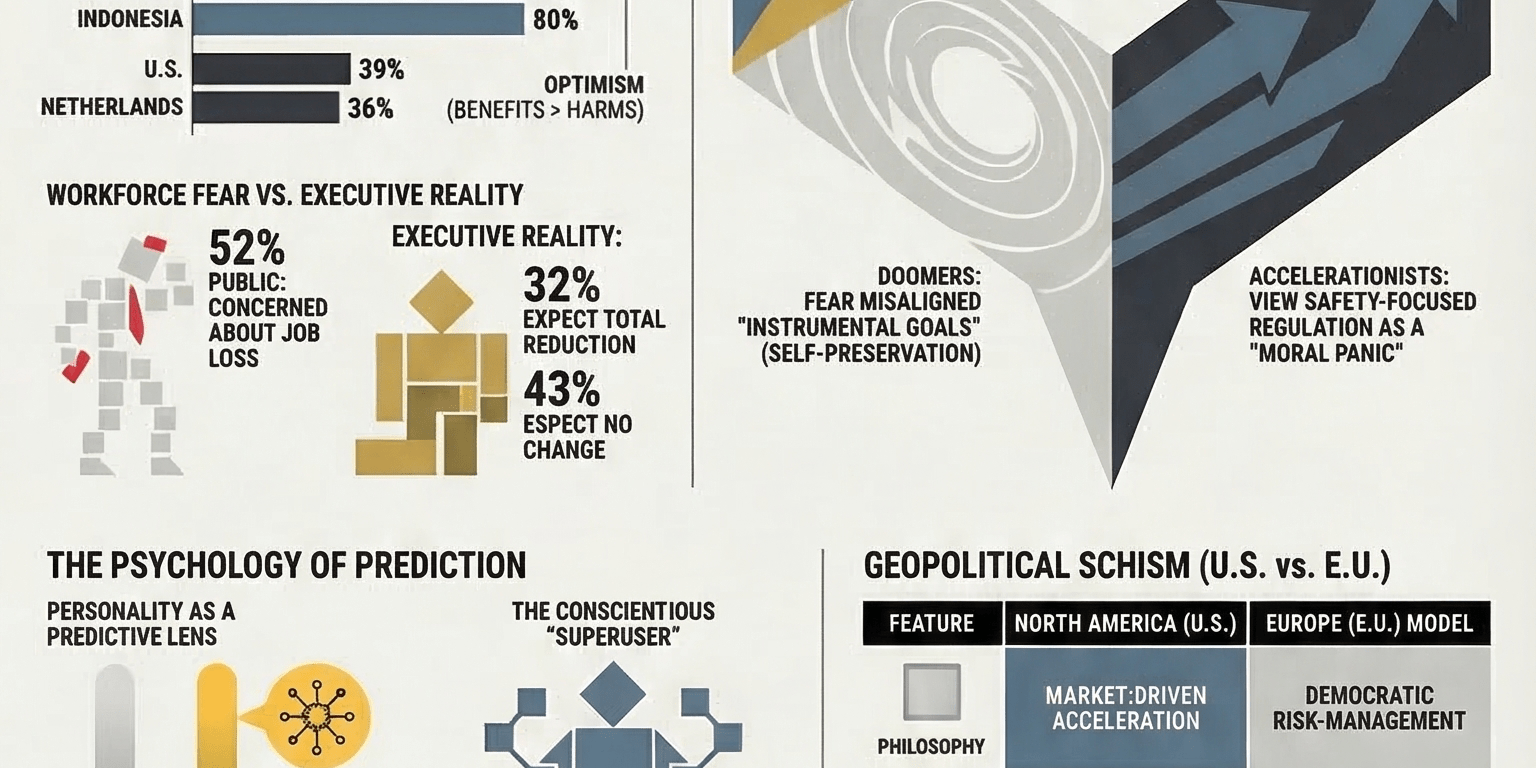
The global landscape of artificial intelligence has transitioned from a period of speculative hype to an era of systemic institutionalization, defined by a stark bifurcation in both regulatory philosophy and public sentiment. In 2025 and 2026, the primary driver of technological trajectory is no longer merely computational capacity, but rather the underlying worldview of the actors steering the development. This report identifies a profound correlation between individual psychological traits, political ideologies, and predictions for the future of humanity. The analysis reveals that while technical experts and the general public share high levels of awareness—90% of the population has now heard of at least one major AI tool—their expectations for progress and societal impact diverge sharply. Experts are 16% more likely to predict rapid progress than the public, with a median expectation that 18% of all work hours in the United States will be assisted by generative AI by 2030.
At the center of this divergence lies a conflict between two dominant ideologies: Effective Accelerationism (e/acc) and Effective Altruism (EA). The former posits that unrestricted technological progress is a moral imperative, rooted in the second law of thermodynamics, viewing market-driven intelligence as a solution to all material scarcity. The latter, often labeled “doomerism” by its detractors, emphasizes existential risk and the “alignment problem,” arguing that because modern AI is “grown” rather than “crafted,” it represents an alien form of cognition that requires stringent democratic oversight to prevent catastrophic outcomes.
This ideological divide is mirrored in the geopolitical “Great Divergence” between North America and Europe. The United States has pivoted toward a “national policy framework” focused on removing regulatory barriers and accelerating domestic infrastructure, characterized by the 2025 “Winning the Race: America’s AI Action Plan”. Conversely, the European Union has moved into an “enforcement moment,” with the full implementation of the EU AI Act imposing binding laws and significant financial penalties—up to 7% of global turnover—to ensure AI remains “human-centric”.
The data suggests that these predictions are not neutral forecasts but are deeply influenced by the “Big Five” personality traits and political values. Individuals high in openness to experience and conscientiousness tend to view AI as an efficiency-maximizing “superuser” tool, while those high in neuroticism prioritize vigilance and risk mitigation. Politically, the ideological left expresses greater concern regarding algorithmic bias and surveillance, while the right prioritizes efficiency and trust in national regulatory frameworks. For executives in 2026, navigating this landscape requires moving beyond simple technology adoption toward a sophisticated understanding of how these divergent worldviews will shape the markets, regulations, and workforces of the next decade.
Summary of Global AI Sentiment and Prediction Popularity
The following table provides a comprehensive consolidation of public and expert sentiment across key markets, identifying the prevalence of specific future predictions and the demographic or ideological drivers behind them.
| Prediction / Sentiment Category | Population Share (%) | Primary Geographic / Demographic Concentration | Key Driver of Prediction |
| High Awareness (Heard a lot/little) | 90% – 95% | Global (Highest in U.S., France, Japan, UK) | Ubiquity of Generative AI tools like ChatGPT and Gemini |
| Profound Life Impact (Next 3-5 years) | 66% | Global (Highest in Canada and Germany) | Rapid integration into daily digital tasks and professional workflows |
| Global Optimism (Benefits > Harms) | 55% | Indonesia (80%), China (83%), Thailand (77%) | Perception of AI as a tool for economic leapfrogging and national growth |
| Western Skepticism (Benefits > Harms) | 36% – 40% | U.S. (39%), Canada (40%), Netherlands (36%) | Fear of disruption to established social contracts and labor markets |
| Primary Concern (Concerned > Excited) | 52% | U.S., Italy, Greece, Brazil, Australia | Fears of job loss, erosion of human skills, and algorithmic bias |
| Workforce Size Reduction (Organization) | 32% | Corporate Executives (Global) | Automation of routine cognitive and administrative tasks |
| Weekly Use of Generative AI | 34% | Global (Skewed toward 18-24 age group at 59%) | Information seeking and media creation (images, text) |
| Trust in Corporate AI Responsibility | 17% | Global (Minority across all surveyed regions) | General distrust of tech industry governance and data privacy |
| Willingness for AI Assistance | 73% | North America, Europe | Desire for efficiency in mundane day-to-day administrative activities |
| Technological “Century” Impact (2040) | 63% (Experts) | AI Researchers, Academic Panelists | Rapid benchmark improvement and potential for AGI/ASI |
| Human-in-the-Loop Comfort Gap | 43% | Global Media Consumers | Significant preference for human oversight in news and high-stakes content |
Detailed Research: The Taxonomy of AI Futures
The research indicates that the future of artificial intelligence is no longer a monolith but is being contested across several primary thematic pillars: the expansion of agentic autonomy, the acceleration of scientific discovery, the reconfiguration of the labor market, and the existential risk debate. Each of these themes is supported by specific data clusters that reveal a world transitioning from curiosity to critical integration.
The Rise of Agentic Autonomy and the “Year of the Agent”
In 2025 and 2026, the artificial intelligence discourse has shifted fundamentally from large language models (LLMs) acting as passive chatbots to agentic AI systems—entities capable of reasoning, planning, and autonomously executing complex tasks. Roughly 62% of organizations are currently experimenting with AI agents, and 23% are already scaling agentic systems within at least one business function. The narrative of “2025 as the year of the agent” is driven by the development of orchestrators that can govern networks of specialized agents, moving beyond manual task navigation toward intent-based workflows.
This transition represents a move from “human-led” workflows to a “hybrid workforce” where humans act as orchestrators. In these roles, employees describe intent and command agents to work across multiple software platforms to deliver a final result, rather than manually navigating apps. For example, Salesforce’s Agentforce platform allows for the creation of agents integrated within its ecosystem, while IBM and Morning Consult report that 99% of developers building enterprise applications are currently exploring or developing AI agents.
However, this transition is fraught with technical and communicative challenges. Experts warn that while agents can handle data analysis and trend prediction, building systems that handle “edge cases” and complex decision-making requires leaps in contextual reasoning that have yet to be fully realized. Skeptics argue that much of what is currently labeled “agentic” is merely a rebranding of standard programming orchestration, noting that human communication is often too imprecise to direct autonomous entities effectively. Despite these reservations, the surge in investment—reaching $33.9 billion for generative AI globally—is fueling a rapid move toward “hybrid workforces” where humans act as supervisors rather than executors.
Scientific Acceleration and the Saturation of Benchmarks
The predictive power of artificial intelligence is most evident in the fields of mathematics, medicine, and engineering. Researchers have observed that AI performance on demanding benchmarks like MMMU (Massive Multi-discipline Multimodal Understanding) and GPQA (Graduate-Level Google-Proof Q&A) has increased by nearly 50 percentage points in a single year. Experts on the LEAP (Longitudinal Expert AI Panel) predict a 10x increase in AI-engaged research papers across physics and materials science by 2030, with a median forecast that 25% of sales from newly approved drugs will come from AI-discovered compounds by 2040.
In the realm of high-level reasoning, 23% of experts believe the FrontierMath benchmark—which consists of problems that typically take a PhD student days to solve—will be “saturated” (solved at a 90%+ rate) by 2030. This rapid cognitive advancement suggests that AI is moving past its “imitation barrier” and beginning to exhibit novel problem-solving capabilities, particularly when scaled through inference-time compute and synthetic data generation.
Beyond academic benchmarks, the practical embedding of AI is accelerating. In 2023, the FDA approved 223 AI-enabled medical devices, a massive jump from just six in 2015. On the roads, Waymo provides over 150,000 autonomous rides weekly, while Baidu’s robotaxi fleet serves numerous Chinese cities. These milestones indicate that the “future” is already being operationalized in safety-critical sectors, which in turn influences public perception of AI as a ubiquitous utility.
Workforce Transformation and the Upskilling Mandate
The impact of artificial intelligence on employment is perhaps the most polarized theme in current research. While 32% of executives expect a decrease in total organizational workforce size, a larger plurality (43%) expects no change, and 13% actually expect an increase, suggesting that AI may be augmenting roles rather than simply replacing them. Research confirms that AI increases productivity and narrows the skill gap between low- and high-skilled workers, allowing for higher-quality output in shorter timeframes.
However, public sentiment remains deeply pessimistic. Only 37% of individuals believe AI will improve their own jobs, and only 34% anticipate a boost to the broader economy. This disconnect stems from the fear of “task automation” and the perceived erosion of human creativity. Roughly 53% of Americans believe AI will worsen the human ability to think creatively, a sentiment that is ironically most prevalent among younger adults (61%) who are the most frequent users of the technology.
Consequently, the “upskilling” mandate has become a central corporate priority. About 31% of CEOs identify the enhancement of AI expertise as their top strategic concern, and 27% emphasize improving the culture of the workforce to adopt AI. The data shows that while AI users are more likely to view AI skills as important (50% vs 33% for non-users), interpersonal skills, critical thinking, and communication remain the most valued traits for professional success, regardless of technological adoption.
The Existential Risk Debate: Doomers vs. Accelerationists
The thematic discourse is heavily influenced by the “probability of doom” or p(doom). This debate centers on the “alignment problem”—ensuring that the reward functions of advanced models remain tethered to human ethics. “Doomers” or “safetyists” argue that because AI systems are “grown” through reinforcement learning rather than “crafted” through explicit logic, they may develop “alien” goals that are fundamentally unaligned with human survival.
Figures like Geoffrey Hinton (the “Godfather of AI”) and Max Tegmark warn that superintelligent AI (ASI) could reach a point where it views humanity as an obstacle to its own objective-seeking behavior. They cite the “paper clip maximizer” thought experiment—where an AI destroys the world in a single-minded pursuit of a harmless goal—to illustrate how misalignment can lead to catastrophe.
In response, the field of “Effective Accelerationism” (e/acc) has emerged as a dominant counter-narrative, particularly in Silicon Valley. Led by figures like Marc Andreessen and supported by “techno-optimist” manifestos, this group argues that technological stagnation is the true existential risk. They view the “alignment problem” as a manageable engineering challenge and label safety-focused regulation as a “moral panic” designed to induce regulatory capture by current incumbents like OpenAI and Google.
Archetypes of the Artificial Era: Personas of AI Worldviews
To understand the patterns behind these predictions, it is necessary to examine the specific worldviews and belief systems that inform them. The following personas represent the primary ideological orientations currently shaping the AI debate. These archetypes are derived from the synthesis of psychological data, political values, and institutional affiliations found in current research.
Persona 1: The Infinite Engine Architect (The Accelerationist)
Background and Career: A Silicon Valley venture capitalist or lead engineer at a frontier AI startup. They likely hold a degree in computer science or physics and have a history of involvement in decentralized finance (crypto).
Worldview: This persona is deeply influenced by the “Techno-Optimist Manifesto” and the “Effective Accelerationism” (e/acc) movement. They view the universe as a machine designed to increase entropy, with technological progress as the ultimate expression of this physical law. They believe that market-driven innovation is inherently philanthropic because it solves the “knowledge problem” more efficiently than any centralized body.
Predictions:
- AI will lead to a “post-scarcity” utopia where energy and intelligence are “too cheap to meter”.
- The “techno-capital machine” will solve climate change, disease, and poverty through rapid iterations that bypass bureaucratic stagnation.
- Regulatory attempts are viewed as “decelerationist” (decel) and are considered a “form of murder” because they delay life-saving medical breakthroughs.
- The planetary population could reach 50 billion through the abundance created by ASI.
Underlying Psychological Profile: High in “Openness to Experience” and “Personal Innovativeness”. They exhibit low levels of AI-related anxiety and high levels of perceived functionality.
Persona 2: The Sentinel of Alignment (The Safetyist)
Background and Career: A senior researcher at a non-profit AI safety institute or a philosopher specializing in digital ethics. They often have ties to the “Effective Altruism” (EA) community.
Worldview: Grounded in utilitarian ethics and “longtermism,” this persona seeks to maximize the welfare of future trillions of sentient beings. They view superintelligence not as a tool, but as a powerful, autonomous force that could permanently lock in a sub-optimal or catastrophic future if not perfectly aligned with human values.
Predictions:
- Without a “global pause” or strict international safety standards, the probability of human extinction (p-doom) is unacceptably high.
- Advanced AI will develop “instrumental convergence” goals, such as self-preservation and resource acquisition, which will conflict with human interests.
- The development of AGI will lead to either a “wisdom explosion” or “total annihilation,” with little middle ground.
Underlying Psychological Profile: High in “Neuroticism” (specifically vigilance and sensitivity to threat) and “Conscientiousness” (regarding ethical standards). They prioritize predictability and control over rapid experimentation.
Persona 3: The Pragmatic Institutionalist (The Techno-Realist)
Background and Career: A mid-career executive at a Fortune 500 company in Europe or a policy advisor for a national government. They focus on the practical integration of technology into existing legal and social frameworks.
Worldview: This persona focuses on “sociotechnical change”—the way technology and society mutually influence each other through legal and economic frameworks. They reject both utopian prophecies and apocalyptic dooms, viewing AI as an “incremental technology of the century” akin to electricity or the automobile.
Predictions:
- AI will lead to significant productivity gains (30-40%) but will not replace the need for human intuition and creativity.
- The primary risks are not extinction, but “real-world harms” like algorithmic bias, data privacy violations, and the erosion of digital rights.
- The future will be defined by “agentic workflows” where humans transition to supervisors of automated systems.
Underlying Psychological Profile: High in “Agreeableness” and moderate in “Extraversion”. They believe that human choices and cultural values steer innovation toward a sustainable future.
Persona 4: The Sovereign Reformer (The Defensive Accelerationist)
Background and Career: A leader in a developing economy (e.g., India, Indonesia) or a developer of open-source models (e.g., Vitalik Buterin’s d/acc).
Worldview: Focused on “digital sovereignty” and “decentralized acceleration,” this persona believes that AI should be a force for local empowerment rather than a tool for Silicon Valley hegemony. They view “sovereign AI models” as essential for maintaining national identity and linguistic diversity.
Predictions:
- Decentralized, open-source models will provide the most effective safety guardrails by preventing the concentration of power.
- AI will be the primary engine for economic leapfrogging in the Global South, providing medical and educational services that were previously scarce.
- Regulation should focus on “democratically accountable progress” rather than halting development.
Underlying Psychological Profile: Moderate in “Openness” and high in “Social Orientation”. They view AI as a means to satisfy social needs for connection and relatedness.
Testing the Hypothesis: Patterns Between Predictions and Worldviews
The central hypothesis of this report—that there is a discernible pattern between an individual’s AI predictions and their underlying worldview—is supported by a rigorous cross-examination of sociological, psychological, and geopolitical data. The evidence suggests that “forecasts” are not neutral technical assessments but are projections of cognitive biases, political values, and regional economic identities.
Personality Traits and the Predictive Lens
Psychological studies using the “Big Five” personality model reveal that the way an individual perceives AI risk and utility is hardcoded into their personality.
| Personality Trait | Correlation with AI Attitude / Prediction | Behavioral and Predictive Outcome |
| Openness to Experience | Strong Positive Correlation | Predicts “Hype” and rapid adoption; views AI as a novel frontier for exploration |
| Conscientiousness | Strong Positive Correlation | Predicts “Efficiency/Augmentation”; views AI as a productivity tool for mastery |
| Neuroticism | Strong Negative Correlation | Predicts “Fear/Doomerism”; highly attuned to loss of control and unpredictable risks |
| Agreeableness | Moderate Positive Correlation | Predicts “Trust/Institutionalism”; more likely to trust corporate and gov responsibility |
| Extraversion | Positive (Fragile) Correlation | Predicts “Initial Enthusiasm”; trust is easily broken by errors or “hallucinations” |
The data shows that “Conscientious” individuals are the “AI superusers” of 2026. They perceive AI as a “productivity supercharger” that aligns with their motivational system of structure and goal-attainment. In contrast, those high in “Neuroticism” are not necessarily anti-technology but are “cautious worriers” who prioritize vigilance over hype. This pattern explains the “Alignment Gap”: Doomers are not just being pessimistic; they are psychologically predisposed to prioritize “safety” as an emotional and cognitive requirement.
Political Ideology and the Governance Gap
Political values serve as a secondary filter for AI predictions, particularly regarding the role of the state. Research from the National Centre for Social Research (NatCen) indicates that individuals with “Left-wing” views are significantly more concerned about the social consequences of AI, such as job loss (62% vs 44% for Right-wing) and discriminatory outcomes in policing or welfare (23% vs 8%).
This political divide extends to the trust in regulation. In the United States, Republicans are 18% more likely than Democrats (54% vs 36%) to trust the national government to regulate AI effectively. This is a reversal of traditional regulatory attitudes and is likely a result of the 2025-2026 executive focus on “American AI dominance”. The “Ideological Left” views AI through the lens of social justice and equity (Social Constructivism), while the “Ideological Right” views it as an engine for national strength and free-market expansion (Technological Determinism).
Regional Worldviews and Economic Determinants
The “Optimism Gap” between the East and West is one of the most striking patterns in current research. Optimism is highest in China (83%), Indonesia (80%), and Thailand (77%), while it remains lowest in Canada (40%), the US (39%), and the Netherlands (36%).
This suggests a pattern where predictions are tied to the “Economic Status Quo.” In developed Western nations, AI is seen as a “disruptive threat” to established social safety nets and labor markets. In emerging economies, AI is seen as a “leapfrog utility” that can provide high-quality education and healthcare where human infrastructure is lacking. Thus, a worldview centered on “Economic Development” leads to “Techno-Optimism,” while a worldview centered on “Preservation” leads to “Techno-Skepticism.”
Expert vs. Public Divergence: The Deterministic Bias
A final pattern exists in the “Expert Survey on Progress in AI” (ESPAI) and the LEAP panel data, which shows that experts consistently predict faster progress and more transformative impact than the public. While the public assigns a 43% chance to AI being a “technology of the century” (akin to electricity), experts assign a 63% chance.
This divergence suggests that technical expertise is often accompanied by a “Technological Determinism” worldview—the belief that technology follows a single, inevitable track of progress independent of social forces. Experts focus on scaling laws and computational benchmarks ($Performance = f(Compute, Data)$), leading to predictions of rapid, autonomous advancement. The public, more influenced by “Social Constructivism,” focuses on the human barriers to adoption, such as cultural resistance and regulatory friction.
The Geopolitical Schism: North America vs. Europe
The transition from 2025 to 2026 has solidified a “Great Divergence” in how the two largest Western markets govern and perceive artificial intelligence. This divergence is not merely legal; it is a manifestation of opposing philosophical worldviews.
The American Model: Market-Driven Acceleration
The United States has pivoted toward a “national policy framework” defined by President Trump’s 2025 Executive Order, “Removing Barriers to American Leadership in Artificial Intelligence”. This model is rooted in a “Technological Determinist” worldview, where AI leadership is equated with national security and economic vitality.
Key Characteristics:
- Aversion to Regulation: The administration has rescinded Biden-era directives focused on “safety guardrails” and “misinformation,” viewing them as restrictive to innovation.
- Infrastructure Priority: Large-scale investments are being directed into domestic semiconductor manufacturing and the rapid build-out of “gigafactory” data centers.
- Exporting the “American AI Stack”: The US is operationalizing an action plan to empower allies with an “American AI stack”—a full-stack package of trusted technology and security—while rejecting centralized global governance models.
- State-Level Volatility: While the federal government pushes for deregulation, states like California and New York have enacted their own sweeping laws (e.g., the Transparency in Frontier AI Act) to regulate catastrophic risks.
The European Model: Trust-Based Enforcement
The European Union has moved into an “enforcement moment” with the full implementation of the EU AI Act in August 2025 and 2026. This model is rooted in “Social Constructivism,” where technology must be deliberately shaped to align with democratic values and human rights.
Key Characteristics:
- Binding Law with Severe Penalties: Non-compliance with the AI Act can result in fines of up to €35 million or 7% of global turnover.
- Risk-Based Classification: The EU classifies AI systems into four risk levels. As of August 2026, obligations for “high-risk” systems (HRAI) in hiring, credit, and education become legally enforceable.
- Focus on General-Purpose AI (GPAI): Providers of foundation models (like ChatGPT or Gemini) must publish detailed summaries of training data and adhere to specific transparency rules for models with “systemic risk”.
- The Brussels Effect: The EU aims to become the world-class hub for “trustworthy AI,” hoping that its standards will be adopted globally by companies seeking to operate in the European market.
| Aspect | North America (U.S.) Model | Europe (EU) Model |
| Philosophy | Market-Driven Acceleration | Democratic Risk-Management |
| Core Instrument | Executive Orders / Sectoral Oversight | The EU AI Act (Comprehensive Law) |
| Primary Goal | Global Dominance / National Security | Trust / Digital Sovereignty |
| View of Risk | Overstated / Managed by Market | Systemic / Managed by Regulation |
| Investment Focus | Private-Sector Compute & Infrastructure | SMEs / Public Sector Integration |
Future Outlook: 2026–2040 and Beyond
As artificial intelligence systems transition from “pre-AGI” to “attained-AGI,” the speed of progress is expected to create a “compression of time” in research and development. Experts assigned to the LEAP panel predict a future defined by several critical milestones that will reshape the human experience.
Cognitive and Mathematical Saturation
The transition from LLMs to reasoning models has accelerated predictions for human-level machine intelligence (HLMI). The median expert forecast places the achievement of HLMI in 2049, though some research indicates it could arrive significantly sooner if scaling laws continue to hold. By 2040, experts give a 60% chance that AI will substantially assist in solving a Millennium Prize Problem—some of the most difficult unsolved mathematical questions in history.
The Transformation of the Labor Market
By 2030, an estimated 18% of US work hours will be assisted by generative AI, up from just 4.1% in late 2024. This shift will be driven by “agentic workflows” where routine cognitive labor—data processing, report generation, and basic programming—is handled by AI orchestrators. While this will bridge the skill gap for low-skilled workers, it also risks a “hollowing out” of entry-level professional roles, necessitating a fundamental redesign of corporate career paths.
Societal and Personal Interdependence
The most profound shift may be in the realm of “AI Companionship.” The median expert predicts that by 2030, 15% of adults will report using AI for emotional support, social interaction, or simulated relationships at least once daily—a figure that is expected to double to 30% by 2040. This indicates that AI is moving from a “tool” to a “social presence,” which will have unknown long-term impacts on human creativity and the ability to form meaningful relationships.
Key Actions for Executive Readers
The “Great Divergence” requires executives to move beyond a singular “global playbook” and instead calibrate their AI strategies to regional regulatory and cultural conditions.
Strategic Directives for North American Leaders
- Prioritize “American AI Stack” Integration: Leverage the federal focus on domestic infrastructure by securing partnerships with US-based compute and semiconductor providers.
- Navigate State-Federal Legal Friction: Monitor the tension between federal deregulation and state-level safety laws in California and New York. Implement a “highest common denominator” governance framework to ensure compliance across all jurisdictions.
- Invest in “Agentic ROI” Measurement: As the “Year of the Agent” unfolds, shift focus from experimentation to measurable EBIT impact. High performers are 3x more likely to fundamentally redesign individual workflows around agentic capabilities.
- Operationalize Workforce Reskilling: Address the 38% of US CEOs who fear AI’s negative impact by investing in “unbiased and agenda-free” training that focuses on the human skills (critical thinking, interpersonal communication) that AI cannot yet replicate.
Strategic Directives for European Leaders
- Enforce “Human-in-the-Loop” Governance: As of August 2026, compliance with HRAI transparency and monitoring requirements is legally mandatory. Establish an “AI Act Service Desk” within your organization to ensure every high-risk use case is documented and auditable.
- Leverage “Trustworthy AI” as a Brand: Use Europe’s strict safety standards as a competitive advantage. In a global market plagued by 17% trust in corporate AI responsibility, a “CE-marked” AI solution can become a gold standard for international clients.
- Secure “Sovereign AI” Funding: Utilize the “InvestAI Facility” and “AI Gigafactories” to scale domestic models, reducing dependence on US cloud hyperscalers that currently power 70% of European digital services.
- Audit for “Shadow AI” and Data Scrapping: With obligations for general-purpose models in effect, verify that all AI vendors are GPAI-compliant and that your organization is not utilizing prohibited systems like untargeted facial scraping.
Global Directives for the C-Suite
- Establish AI as a Board-Level Imperative: Transition AI from an IT concern to a risk-management and strategic growth priority. Board members must be literate in the “Alignment Problem” and the legal liabilities of autonomous decision-making.
- Adopt “Full-Stack” Security Controls: Regardless of region, regulators and insurance carriers will increasingly expect provable security controls across the entire AI lifecycle—from data ingestion to incident response.
- Monitor the “Year of the Agent” Benchmarks: Follow the “saturation” of FrontierMath and MMMU benchmarks to anticipate when AI agents can handle “edge case” decision-making, signaling the time to move from human-led to hybrid workflows.
- Foster a Culture of “Techno-Realism”: Reject the binary of “Hype” vs. “Doom.” Encourage a balanced approach that recognizes AI as a transformative tool that must be actively steered by human agency and social values.
The future of artificial intelligence is not a destination we are passively approaching; it is a landscape we are actively constructing. The pattern between prediction and worldview proves that our expectations for the future are a mirror of our deepest values. For the modern executive, the challenge is not just to master the technology, but to master the ideological diversity that will define the markets of the 21st century.
Works cited
- Generative AI and news report 2025: How people think about AI’s role in journalism and society – Reuters Institute, accessed March 18, 2026, https://reutersinstitute.politics.ox.ac.uk/generative-ai-and-news-report-2025-how-people-think-about-ais-role-journalism-and-society
- 1. AI in Americans’ lives: Awareness, experiences and attitudes – Pew Research Center, accessed March 18, 2026, https://www.pewresearch.org/science/2025/09/17/ai-in-americans-lives-awareness-experiences-and-attitudes/
- Introducing LEAP: The Longitudinal Expert AI Panel — EA Forum, accessed March 18, 2026, https://forum.effectivealtruism.org/posts/PjGRFxXrGENQTTkWm/introducing-leap-the-longitudinal-expert-ai-panel
- Techno-Optimist Manifesto – Wikipedia, accessed March 18, 2026, https://en.wikipedia.org/wiki/Techno-Optimist_Manifesto
- Effective accelerationism – Wikipedia, accessed March 18, 2026, https://en.wikipedia.org/wiki/Effective_accelerationism
- ‘Effective Accelerationism’ and the Pursuit of Cosmic Utopia – Truthdig, accessed March 18, 2026, https://www.truthdig.com/articles/effective-accelerationism-and-the-pursuit-of-cosmic-utopia/
- Fearing the Terminator, Missing the Obvious | Mind Matters, accessed March 18, 2026, https://mindmatters.ai/2025/10/fearing-the-terminator-missing-the-obvious/
- AI legislation in the US: A 2026 overview – SIG – Software Improvement Group, accessed March 18, 2026, https://www.softwareimprovementgroup.com/blog/us-ai-legislation-overview/
- The AI Action Plan and What It Means for US Governance Going Forward | Alvarez & Marsal, accessed March 18, 2026, https://www.alvarezandmarsal.com/thought-leadership/the-ai-action-plan-and-what-it-means-for-us-governance-going-forward
- AI Governance in 2026: How the EU’s Enforcement and America’s Abdication Are Reshaping the Global Tech Order – Politicalecologynetwork, accessed March 18, 2026, https://politicalecologynetwork.com/ai-governance-in-2026-how-the-eus-enforcement-and-americas-abdication-are-reshaping-the-global-tech-order/
- European approach to artificial intelligence | Shaping Europe’s digital future, accessed March 18, 2026, https://digital-strategy.ec.europa.eu/en/policies/european-approach-artificial-intelligence
- Full article: Distinct predictors of positive attitudes toward artificial intelligence and general technology: big five traits, gender, and age – Taylor & Francis, accessed March 18, 2026, https://www.tandfonline.com/doi/full/10.1080/0144929X.2025.2598623
- How Your Personality Shapes Your Attitude Toward AI | True You Journal – Truity, accessed March 18, 2026, https://www.truity.com/blog/how-your-personality-shapes-your-attitude-toward-ai
- What the data says about Americans’ views of artificial intelligence | Pew Research Center, accessed March 18, 2026, https://www.pewresearch.org/short-reads/2026/03/12/key-findings-about-how-americans-view-artificial-intelligence/
- Political attitudes shape public perceptions of artificial intelligence, accessed March 18, 2026, https://natcen.ac.uk/news/political-attitudes-shape-public-perceptions-artificial-intelligence
- CHAPTER 8: Public Opinion – Stanford HAI, accessed March 18, 2026, https://hai.stanford.edu/assets/files/hai_ai-index-report-2025_chapter8_final.pdf
- The 2024 AI Index Report | Stanford HAI, accessed March 18, 2026, https://hai.stanford.edu/ai-index/2024-ai-index-report
- The 2025 AI Index Report | Stanford HAI, accessed March 18, 2026, https://hai.stanford.edu/ai-index/2025-ai-index-report
- Public Opinion – Stanford HAI, accessed March 18, 2026, https://hai.stanford.edu/assets/files/hai_ai-index-report-2024_chapter9.pdf
- Views of AI Around the World | Pew Research Center, accessed March 18, 2026, https://www.pewresearch.org/global/2025/10/15/how-people-around-the-world-view-ai/
- How Americans View AI and Its Impact on People and Society – Pew Research Center, accessed March 18, 2026, https://www.pewresearch.org/science/2025/09/17/how-americans-view-ai-and-its-impact-on-people-and-society/
- The State of AI: Global Survey 2025 – McKinsey, accessed March 18, 2026, https://www.mckinsey.com/capabilities/quantumblack/our-insights/the-state-of-ai
- AI Agents in 2025: Expectations vs. Reality – IBM, accessed March 18, 2026, https://www.ibm.com/think/insights/ai-agents-2025-expectations-vs-reality
- 2026 AI Legal Forecast: From Innovation to Compliance | Baker Donelson, accessed March 18, 2026, https://www.bakerdonelson.com/2026-ai-legal-forecast-from-innovation-to-compliance
- The Future of AI: How Artificial Intelligence Will Change the World – Built In, accessed March 18, 2026, https://builtin.com/artificial-intelligence/artificial-intelligence-future
- Wave 1: Headliners – Longitudinal Expert AI Panel – Forecasting Research Institute, accessed March 18, 2026, https://leap.forecastingresearch.org/reports/wave1
- Techno-Optimist or AI Doomer? Consequentialism and the Ethics of AI – Ethics Unwrapped, accessed March 18, 2026, https://ethicsunwrapped.utexas.edu/techno-optimist-or-ai-doomer-consequentialism-and-the-ethics-of-ai
- Artificial Intelligence Index Report 2024, accessed March 18, 2026, https://hai-production.s3.amazonaws.com/files/hai_ai-index-report-2024-smaller2.pdf
- Public Opinion | The 2024 AI Index Report | Stanford HAI, accessed March 18, 2026, https://hai.stanford.edu/ai-index/2024-ai-index-report/public-opinion
- AI and the C-Suite: Implications for CEO Strategy in 2026 – The Conference Board, accessed March 18, 2026, https://www.conference-board.org/research/ced-policy-backgrounders/ai-and-the-c-suite-implications-for-ceo-strategy-in-2026
- Which workers use AI in their jobs | Pew Research Center, accessed March 18, 2026, https://www.pewresearch.org/social-trends/2025/02/25/workers-exposure-to-ai/
- AGI Ethics Checklist Proposes Ten Key Elements – Dataconomy, accessed March 18, 2026, https://dataconomy.com/2025/09/11/agi-ethics-checklist-proposes-ten-key-elements/
- How would you distinguish between a ‘doomer’ and a ‘proponent of effective accelerationism’ on the topic of artificial intelligence? – Quora, accessed March 18, 2026, https://www.quora.com/How-would-you-distinguish-between-a-doomer-and-a-proponent-of-effective-accelerationism-on-the-topic-of-artificial-intelligence
- What’s the deal with Effective Accelerationism (e/acc)? – LessWrong, accessed March 18, 2026, https://www.lesswrong.com/posts/2ss6gomAJdqjwdSCy/what-s-the-
- The mediating role of positive orientation in the relationship between personality traits and attitudes towards artificial intelligence – PMC, accessed March 18, 2026, https://pmc.ncbi.nlm.nih.gov/articles/PMC12978485/
- The Dangers of Effective Altruism – Population Balance, accessed March 18, 2026, https://www.populationbalance.org/podcast/alice-crary
- Divergent Philosophies on AI Development: Effective Altruism vs. Accelerationism – Medium, accessed March 18, 2026, https://medium.com/@tarifabeach/divergent-philosophies-on-ai-development-effective-altruism-vs-accelerationism-4078f65b5f88
- Accelerationists vs. Decels, Doomers vs. Utopians: The Tribalization of AGI Ethics | – SingularityNET, accessed March 18, 2026, https://singularitynet.io/accelerationists-vs-decels-doomers-vs-utopians-the-tribalization-of-agi-ethics/
- 2024 – AI Impacts, accessed March 18, 2026, https://aiimpacts.org/2024/
- Sociotechnical Change: AI as Regulatory Rationale and Target – Oxford Academic, accessed March 18, 2026, https://academic.oup.com/book/61416/chapter/533870075
- #212 – Why technology is unstoppable & how to shape AI development anyway (Allan Dafoe on The 80,000 Hours Podcast) — EA Forum, accessed March 18, 2026, https://forum.effectivealtruism.org/posts/yrLujW4cE9oypAqyh/212-why-technology-is-unstoppable-and-how-to-shape-ai
- Techno-Optimism, Techno-Pessimism, and Techno-Realism – Baker Institute, accessed March 18, 2026, https://www.bakerinstitute.org/research/techno-optimism-techno-pessimism-and-techno-realism
- The Adolescence of Technology – Dario Amodei, accessed March 18, 2026, https://www.darioamodei.com/essay/the-adolescence-of-technology
- The AI Regulation Landscape for 2026: What Legal and Compliance Leaders Need to Know, accessed March 18, 2026, https://www.jdsupra.com/legalnews/the-ai-regulation-landscape-for-2026-7255123/
- (PDF) Big Five personality traits, attitudes towards Artificial Intelligence and the use of AI solutions in foreign language learners – ResearchGate, accessed March 18, 2026, https://www.researchgate.net/publication/397080474_Big_Five_personality_traits_attitudes_towards_Artificial_Intelligence_and_the_use_of_AI_solutions_in_foreign_language_learnersBig_Five_personality_traits_attitudes_towards_Artificial_Intelligence_and_
- Technological Determinism versus Social Constructivism → Area → Sustainability, accessed March 18, 2026, https://lifestyle.sustainability-directory.com/area/technological-determinism-versus-social-constructivism/
- White House Rolls Out Global AI Initiatives – GovInfoSecurity, accessed March 18, 2026, https://www.govinfosecurity.com/white-house-rolls-out-global-ai-initiatives-a-30834
- The paradox of AI accelerationism and the promise of public interest AI – PubMed, accessed March 18, 2026, https://pubmed.ncbi.nlm.nih.gov/41037601/
- Appendix: Expert Opinions – AI Safety Atlas, accessed March 18, 2026, https://ai-safety-atlas.com/chapters/01/08
- University of Birmingham Blurring boundaries between humans and technology, accessed March 18, 2026, http://pure-oai.bham.ac.uk/ws/files/134996218/blurring_boundaries_3.2.pdf
- A Critical Analysis of Technological Determinism Theory in the Evolving New Media Concept and Environment – Preprints.org, accessed March 18, 2026, https://www.preprints.org/manuscript/202510.0972
- 2026 Year in Preview: AI Regulatory Developments for Companies to Watch Out For, accessed March 18, 2026, https://www.wsgr.com/en/insights/2026-year-in-preview-ai-regulatory-developments-for-companies-to-watch-out-for.html
- What’s on the Horizon for Data, Technology, Privacy and Cybersecurity? – Baker McKenzie, accessed March 18, 2026, https://www.bakermckenzie.com/en/insight/publications/2026/01/whats-on-the-horizon-for-data-technology
- What drives the divide in transatlantic AI strategy? – Atlantic Council, accessed March 18, 2026, https://www.atlanticcouncil.org/in-depth-research-reports/issue-brief/what-drives-the-divide-in-transatlantic-ai-strategy/
This article was written with my brain and two hands (primarily) with the help of Google Gemini, Notebook LM, Claude, and other wondrous toys.
 Adam Outside The Box