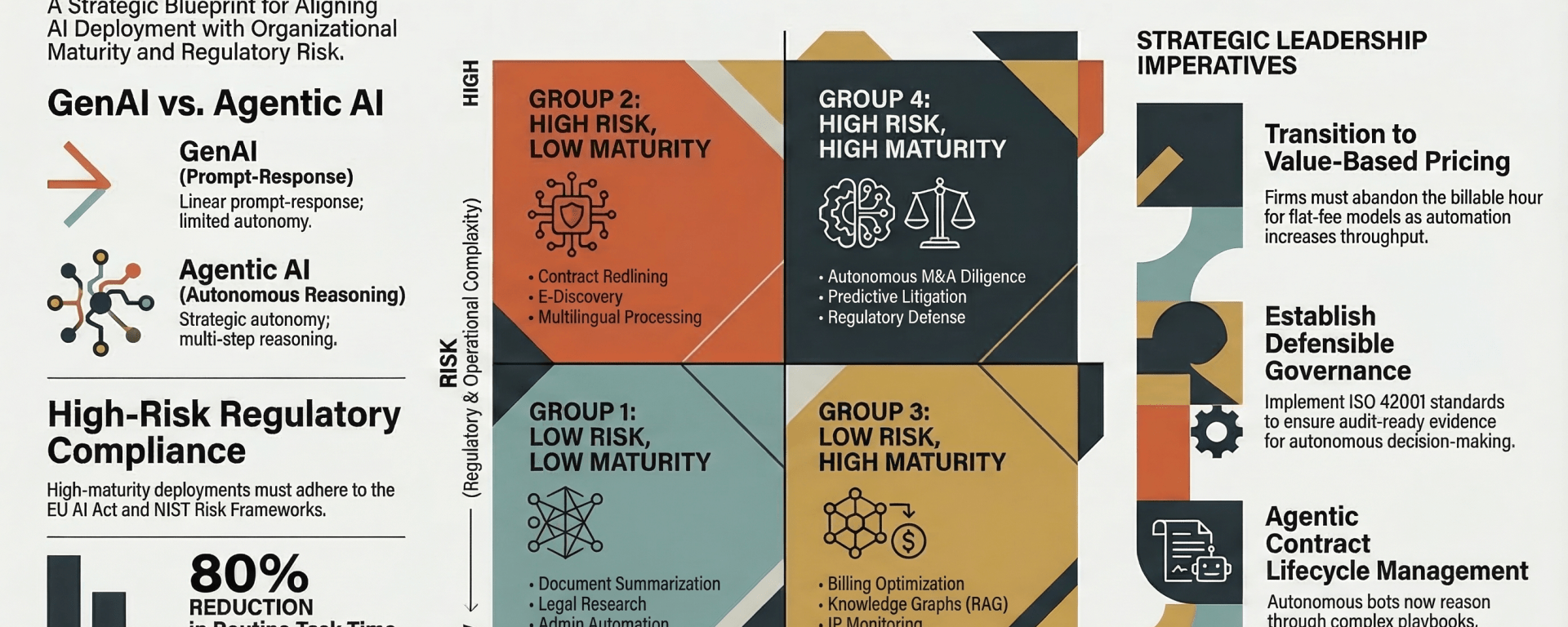
The global legal industry is currently navigating a profound and irreversible technological paradigm shift. Driven by the rapid maturation of artificial intelligence (AI), generative AI (GenAI), and the emerging frontier of agentic AI, the fundamental mechanisms of legal service delivery are being reconstructed. For medium to large law firms and government legal agencies operating across North America and Europe, the deployment of these advanced computational technologies has transcended operational novelty to become an existential strategic imperative. Corporate legal departments, facing immense macroeconomic pressure to optimize legal spend, are now explicitly utilizing a law firm’s AI maturity as a primary selection criterion for outside counsel. This evaluation often occurs even before the client organizations have fully developed their own internal AI governance strategies.
The transition from traditional machine learning and rule-based automation to GenAI introduced the legal sector to the ability to synthesize, summarize, and generate highly complex natural language at scale. By 2025, approximately 79% of legal professionals reported incorporating some form of AI into their daily workflows, with 26% of legal organizations actively deploying enterprise-grade GenAI. However, the industry is already crossing a new, more disruptive threshold into the era of agentic AI. Unlike GenAI, which functions primarily as an advanced drafting or research assistant requiring continuous, linear human prompting, agentic AI operates with contextual awareness, multi-step reasoning, and strategic autonomy. These agentic systems possess the capability to break down complex legal objectives into subtasks, interact dynamically with diverse digital ecosystems, execute complete workflows, and adapt their strategies based on real-time data inputs. This evolution promises to resolve the “GenAI paradox,” a phenomenon where high initial adoption rates of AI copilots have frequently failed to deliver proportional bottom-line impacts due to isolated, horizontally bolted-on deployments rather than deep, vertical process integration.
As these autonomous technologies scale, they inherently challenge the traditional economic foundations of the law firm business model, most notably the billable hour. Because AI possesses the capacity to reduce the time required for routine legal tasks by up to 80%, a structural pivot toward value-based pricing, alternative fee arrangements (AFAs), and automated subscription models is required to maintain firm profitability. The efficiencies are staggering; industry analyses suggest AI could save individual lawyers up to 240 hours per year, fundamentally altering capacity and throughput.
Furthermore, the deployment of these systems introduces unprecedented governance, privacy, and regulatory risks. Operating within comprehensive legislative frameworks such as the European Union’s AI Act and a highly fragmented landscape of United States federal and state regulations, legal entities must balance rapid innovation with stringent compliance. High-risk deployments—particularly those interacting directly with courts, consumer rights, or judicial decision-making—require continuous monitoring, algorithmic auditing, and defensible governance architectures.
This research report provides an exhaustive, granular analysis of the top 20 most impactful business use cases for AI, GenAI, and Agentic AI in the legal sector. These applications are strategically categorized into a matrix based on the deploying organization’s AI maturity and the inherent risk, complexity, and governance requirements of the use case. By mapping these technological capabilities alongside actionable, high-level imperatives, this document serves as a comprehensive strategic blueprint for navigating the complex technological and regulatory realities of the 2026 legal landscape.
Legal AI Capability and Risk Matrix
The following matrix categorizes the 20 most impactful AI business use cases into four distinct quadrants. This classification is designed to assist organizational leadership in aligning technology deployment with their current operational maturity while appropriately scaling risk management and compliance frameworks.
| Quadrant | Organizational AI Maturity | Risk, Complexity & Governance | Recommended AI Technologies | Impactful Business Use Cases |
| Group 1 | Low | Low | AI, GenAI | 1. Automated Document Summarization & Triage 2. Routine Legal Research & Citation Generation 3. Administrative Task & Workflow Automation 4. Automated Client Intake & Conversational Triage 5. Routine Correspondence & Email Drafting |
| Group 2 | Low | High | GenAI, AI | 6. First-Pass Contract Review & Redlining 7. E-Discovery & Large-Scale Document Analysis 8. Drafting Routine Motions and Briefs 9. Legal Translation & Multilingual Processing 10. Basic Regulatory Compliance Monitoring |
| Group 3 | High | Low | GenAI, RAG, AI | 11. AI-Driven Billing & Pricing Optimization 12. Internal Legal Knowledge Graphs (RAG) 13. Talent Management & Resource Allocation 14. Automated IP & Trademark Portfolio Monitoring 15. Pitch Generation & Client Intelligence |
| Group 4 | High | High | Agentic AI, AI | 16. Autonomous Contract Lifecycle Management 17. Multi-Agent Due Diligence in M&A 18. Predictive Litigation Analytics & Forecasting 19. Autonomous Regulatory Defense Agents 20. Judicial Decision Support & Risk Assessment |
To contextualize this matrix, organizational AI maturity is defined by the depth of data infrastructure, executive sponsorship, and the presence of formalized AI governance structures (such as adherence to the NIST AI Risk Management Framework or ISO 42001). Risk and complexity are defined by the potential for sociotechnical harm, the proximity of the AI to core legal advice, the exposure to data privacy breaches, and the classification of the system under prevailing laws such as the EU AI Act.
Detailed Analysis of Strategic AI Use Cases
Group 1: Low AI Organizational Maturity and Low Risk / Complexity / Governance
For legal organizations in the nascent stages of AI adoption, Group 1 represents the foundational layer of technological integration. These “quick-win” deployments target operational bottlenecks, administrative friction, and high-volume, low-margin tasks. Because these use cases rely on non-binding, internal-facing processes or highly structured external engagements, the regulatory and ethical risks—such as malpractice claims, algorithmic bias, or attorney-client privilege waivers—are minimized. They require only baseline IT governance, standard data security protocols, and human-in-the-loop oversight to deliver immediate, measurable return on investment (ROI).
1. Automated Legal Document Summarization and Triage
The legal profession demands the continuous ingestion and comprehension of massive volumes of unstructured text, ranging from case files and deposition transcripts to regulatory filings. Traditionally, junior associates or paralegals spent countless billable hours reading and summarizing these documents. GenAI models, utilizing advanced natural language processing (NLP), excel at extracting key entities, thematic overlaps, and chronologies from lengthy legal texts in seconds. By automating the triage phase, legal professionals can reach the high-value analytical phase of their work exponentially faster. Strategic impacts include time savings of up to 20% to 30% per week for legal staff, allowing firms to increase their overall case capacity without expanding headcount.
- Industry Example (Europe): Freshfields has partnered with Google Cloud to integrate Gemini and Google Workspace across its operations to drive enterprise-wide document analysis and summarization, streamlining knowledge extraction.
- Industry Example (Europe): LegalFly provides a generative AI platform utilized by mid-sized European law firms to summarize complex legislation and generate impact assessments for clients, shortening research cycles from days to mere hours.
2. Routine Legal Research and Citation Generation
Traditional Boolean search methodologies across massive legal databases are increasingly being replaced by conversational, natural language search interfaces powered by GenAI. These systems allow practitioners to ask complex legal questions and receive synthesized answers. To mitigate the risk of AI hallucination, premium legal AI tools restrict the model’s generation process to closed, verified databases of primary case law, statutes, and regulations. This democratizes high-level research capabilities across the firm, empowering paralegals to conduct preliminary research that previously required senior expertise. The strategic impact is profound, saving up to 74% of the time traditionally spent on legal research.
- Industry Example (North America):(https://legal.lexisnexis.com/AI-Case-Studies), a mid-sized North American firm, integrated Lexis+ AI into their practice. By accelerating precedent discovery and citation verification, the firm increased its attorney caseload capacity by 10%.
- Industry Example (Global):(https://legal.thomsonreuters.com/blog/generative-ai-for-legal-professionals-top-use-cases-tri/) is deployed by numerous global firms. Grounded in the authoritative content of Westlaw, it provides verifiable, citation-backed research within a highly secure, end-to-end encrypted environment.
3. Administrative Task and Workflow Automation
Behind every successful legal outcome is a mountain of administrative execution. AI models are increasingly deployed to manage non-billable, operational tasks that drain profitability. This includes the automated extraction of filing dates from court orders, intelligent calendar synchronization, automated time-tracking, and standardized document naming conventions. This use case directly addresses the issue of unbillable administrative drag, which often consumes up to 40% of a lawyer’s day. By automating these workflows, firms improve cash flow, reduce missed deadlines (a primary driver of malpractice claims), and increase overall operational resilience.
- Industry Example (North America):(https://www.clio.com/blog/law-firm-predictive-analytics/), embedded within Clio Manage, utilizes AI to extract critical dates from uploaded court orders, calculate related statutory deadlines, and automatically update the firm’s central calendar.
- Industry Example (Europe/North America): Activepieces enables custom, secure workflow orchestration for law firms, allowing them to visually map logic to automate intake routing, deadline tracking, and billing reminders without writing code.
4. Automated Client Intake and Conversational Triage
The initial phase of client engagement is highly repetitive but critical for conversion and risk management. AI-driven chatbots and virtual assistants handle these early interactions using NLP to conduct structured, practice-specific intake interviews. For instance, an AI agent assessing a personal injury claim can autonomously gather accident facts, insurance details, and medical timelines before routing the qualified lead to the appropriate attorney. This enhances the client experience through immediate, 24/7 responsiveness while systematically filtering out non-viable cases or immediate conflicts of interest. Furthermore, in the public sector, this technology drastically improves access to justice by providing free, immediate legal triage to underserved populations.
- Industry Example (North America): Legal Aid of North Carolina deploys a GenAI chatbot acting as a Legal Information Assistant, providing immediate legal triage and answers to common legal questions in both English and Spanish.
- Industry Example (North America):(https://www.americanbar.org/groups/journal/articles/2025/access-to-justice-how-ai-powered-software-can-bridge-the-gap/), launched by the Law Center for Better Housing in Illinois, uses an AI virtual assistant to help tenants access information on housing rights and prepare for potential litigation.
5. Routine Correspondence and Email Drafting
Legal professionals dedicate an exorbitant amount of time to drafting routine communications, client status updates, and procedural emails to opposing counsel. GenAI tools integrate directly into email clients and word processors to draft these communications based on brief bullet points or prompt instructions provided by the lawyer. Because legally trained AI models have ingested large volumes of professional precedents, they can maintain tonal consistency, ensure flawless grammar, and utilize judicially tested language. This accelerates the communication cycle, reduces friction in client management, and boosts overall responsiveness metrics—a key driver of client retention.
- Industry Example (Europe): Clifford Chance utilizes “Clifford Chance Assist,” a secure AI tool built on Microsoft’s Azure OpenAI platform. It is used by over 60% of the firm daily for tasks including email drafting and routine communication synthesis.
- Industry Example (North America): EverlawAI Assistant is heavily utilized by government attorneys in the United States to rapidly draft policy memos, compliance reports, and routine legal correspondence, ensuring alignment with agency-specific guidelines.
Group 2: Low AI Organizational Maturity and High Risk / Complexity / Governance
Use cases mapped to Group 2 remain technologically accessible for firms with relatively low AI maturity, often utilizing off-the-shelf or slightly customized GenAI vendor solutions. However, these applications carry significantly higher regulatory, ethical, and reputational risks. Because these deployments touch upon core substantive legal advice, client confidentiality, and formal representations made to the court, they require strict data ring-fencing, rigorous human verification protocols, and careful attention to evolving jurisprudence regarding AI errors. Failures in this quadrant can lead to severe judicial sanctions, malpractice lawsuits, and brand destruction.
6. First-Pass Contract Review and Redlining
Contract review is a foundational, yet highly labor-intensive, component of transactional law. AI models are now routinely deployed to ingest third-party contracts, compare incoming clauses against the firm’s or client’s standard playbooks, flag high-risk deviations (such as hidden indemnification or sub-optimal limitation of liability clauses), and suggest alternative redlined language. This application reduces document review time by an estimated 60% to 80%. However, the risk is inherently high; an undetected anomaly or an AI misinterpreting a highly nuanced jurisdiction-specific clause can expose the client to massive, unmitigated financial risk. Consequently, stringent “human-in-the-loop” review remains mandatory.
- Industry Example (North America):(https://www.spellbook.legal/learn/ai-use-in-law-firms), powered by models like GPT-4, operates directly inside Microsoft Word. It allows North American lawyers to conduct comprehensive risk assessments on incoming contracts, saving up to 45 minutes per agreement.
- Industry Example (Europe): Luminance is extensively utilized by European law firms in contract-heavy areas like M&A to scan thousands of agreements simultaneously, generating red-flag reports for deviations from internal standards.
7. E-Discovery and Large-Scale Document Analysis
In modern litigation, regulatory investigations, and M&A due diligence, legal teams are often buried under terabytes of unstructured data, emails, and financial records. AI is deployed to perform continuous active learning (predictive coding) and natural language conceptual clustering to identify relevant evidence and privileged communications. This transforms a process that historically took weeks of paralegal time into an exercise lasting a few hours. The high risk stems from the potential of the AI algorithm to inadvertently skip a “smoking gun” document or misclassify privileged information, necessitating rigorous statistical validation, sampling techniques, and deep technical competence to defend the methodology in court.
- Industry Example (North America): Altumatim, a legal tech startup, utilizes Google Vertex AI to process and analyze millions of unstructured documents specifically for e-discovery workflows.
- Industry Example (North America): The(https://counciloncj.org/doj-report-on-ai-in-criminal-justice-key-takeaways/) actively utilizes AI for digital forensics, assisting in analyzing photos, videos, and communications across massive datasets while detecting potential AI-generated deepfake content.
8. Drafting Routine Motions and Substantive Legal Briefs
Moving beyond basic correspondence, GenAI is increasingly utilized to construct complete first drafts of substantive legal briefs, incorporating complex fact patterns and suggesting applicable legal arguments. While this massively increases drafting efficiency, it introduces severe risks regarding “hallucinations”—the generation of highly plausible but entirely fabricated case law, citations, or statutory interpretations. If a hallucinated brief is submitted to a court without meticulous verification, it triggers immediate judicial sanctions, breaches of professional ethics codes, and severe reputational damage.
- Industry Example (North America):(https://www.harvey.ai/blog/4-mid-sized-legal-teams-turning-ai-into-real-results) utilizes Harvey AI to structure massive datasets and draft motions in high-stakes litigation. To mitigate hallucination risks, the firm relies on the tool to link every generated conclusion directly back to verified source evidence.
- Industry Example (North America):(https://pro.bloomberglaw.com/insights/technology/ai-in-legal-practice-explained/) uses machine learning to review drafted briefs in seconds, check citations against current databases, and suggest linguistic improvements to strengthen the argument.
9. Legal Translation and Multilingual Document Processing
In globalized legal practice, particularly cross-border M&A and international arbitration, the rapid translation of complex legal documentation is critical. GenAI and advanced neural machine translation models are deployed to translate contracts, regulatory filings, and evidence while attempting to preserve jurisdictional nuances and highly specific legal terminology. While this accelerates international workflows, the risk lies in the extreme subtlety of legal language; a minor translation error regarding an arbitration clause, a standard of care, or a liability cap can fundamentally alter the contract’s enforceability and expose the firm to malpractice.
- Industry Example (Europe):(https://www.lefebvre-group.com/a-human-centered-ai-designing-legal-technology-around-professionals-and-clients/) operates across France, Spain, Germany, and the Netherlands. Its platform provides highly accurate, verifiable multi-lingual legal translation and analysis, grounded in local statutory frameworks.
- Industry Example (Europe):(https://www.ncbar.org/2025/07/14/the-emergence-of-agentic-ai/) partnered with Sweden-based legal AI platform Legora to provide multilingual due diligence analysis and drafting support across its European offices.
10. Basic Regulatory Compliance Monitoring
The global regulatory environment is highly fragmented and constantly shifting. AI models are utilized to continuously ingest data from international regulatory bodies, legislative updates, and court rulings, matching these inputs against a corporate client’s operational footprint. The system flags upcoming compliance requirements or potential policy violations. This shifts compliance from a reactive, periodic audit to a proactive, continuous stance. The high risk involves the AI failing to detect a critical regulatory update or misinterpreting the scope of a new privacy law, exposing the enterprise to severe statutory fines (e.g., under the GDPR, CCPA, or the EU AI Act).
- Industry Example (Global):(https://www.dlapiper.com/capabilities/industry/technology/artificial-intelligence-data-analytics) utilizes AI tools to help massive corporate clients monitor real-time compliance requirements across jurisdictions, coupling the AI’s output with rigorous human-in-the-loop validation to manage regulatory risk.
- Industry Example (North America):(https://www.ncbar.org/2025/07/14/the-emergence-of-agentic-ai/) uses Google Cloud AI to conduct continuous compliance checks and monitor regulatory shifts for corporate clients, scaling their advisory capabilities.
Group 3: High AI Organizational Maturity and Low Risk / Complexity / Governance
Firms operating in Group 3 have moved beyond ad-hoc experimentation. They possess mature data infrastructures, formalized governance frameworks, and dedicated AI leadership (such as a Chief AI Officer). They leverage their proprietary, historical data to gain strategic operational advantages. Because these tools focus heavily on internal optimization, business intelligence, and resource management, the external regulatory risk remains relatively low. However, they require exceptionally high technical competence, data engineering, and change management to build, integrate, and maintain effectively.
11. AI-Driven Law Firm Billing and Pricing Optimization
As AI drastically reduces the hours required to complete traditional tasks, the foundational billable hour model is rendered increasingly obsolete. Mature firms use predictive AI and machine learning to analyze years of historical billing data, resource utilization rates, and case outcomes. This intelligence is used to structure highly accurate, profitable flat-fee models or Alternative Fee Arrangements (AFAs). This strategic pivot protects law firm profitability against AI-driven time reductions, allowing firms to price complex matters competitively, increase cost transparency for clients, and maintain profit margins.
- Industry Example (North America): Clio Manage provides deep predictive analytics on firm financial health and billing workflows, assisting law firm leadership in setting competitive, data-driven pricing strategies.
- Industry Example (North America):(https://www.wsgr.com/en/insights/wilson-sonsini-adds-ai-enabled-fixed-fee-commercial-contract-offering-to-neuron-platform.html) utilizes its proprietary Neuron platform to accurately forecast effort and offer an AI-enabled, fixed-fee commercial contracting service for cloud companies.
12. Internal Legal Knowledge Graphs and Enterprise Search (RAG)
Over decades of practice, law firms generate vast amounts of valuable intellectual property, including research memos, successful motions, and negotiated contracts. Highly mature firms build Retrieval-Augmented Generation (RAG) architectures atop their secure Document Management Systems (DMS). This effectively creates a proprietary legal knowledge graph, allowing lawyers to use conversational AI to query the firm’s entire historical precedent securely. This prevents knowledge silos, stops lawyers from “reinventing the wheel,” and systematically raises the baseline quality of work across the entire firm, all while maintaining strict data privacy perimeters.
- Industry Example (Europe/Global):(https://www.aoshearman.com/en/news/ao-shearman-and-harvey-to-roll-out-agentic-ai-agents-targeting-complex-legal-workflows) developed “ContractMatrix” in collaboration with Harvey and Microsoft, an enterprise tool that leverages the firm’s deep internal corporate precedent to aid in contract analysis.
- Industry Example (North America):(https://www.netdocuments.com/blog/ai-driven-legal-tech-trends-for-2025/) provides an AI-powered document management ecosystem that allows conversational querying and conceptual search across a firm’s secure internal data.
13. Talent Management and Resource Allocation
Large legal organizations struggle with optimal resource distribution. AI platforms are now used to track associate workloads, map complex expertise profiles, and analyze historical performance metrics to optimally assign attorneys to incoming matters. This systemic intelligence prevents associate burnout, ensures optimal utilization rates across the firm, and fundamentally supports diversity, equity, and inclusion (DEI) initiatives by removing human bias and favoritism from the task allocation process.
- Industry Example (Europe): The UK Ministry of Justice (MOJ) incorporates AI for the smarter scheduling of people and resources, aiming to reduce administrative backlogs and optimize workforce management across the justice system.
- Industry Example (Global):(https://legal.thomsonreuters.com/blog/agentic-ai-use-cases-in-the-legal-industry/) agentic integrations are utilized by large firms to generate automated plans for distributing complex research tasks to associate teams based on real-time capacity and specific legal expertise matrices.
14. Automated Trademark and IP Portfolio Monitoring
Protecting intellectual property requires constant vigilance. Computer vision and NLP models are deployed to continuously scan global patent databases, trademark registries, ecommerce platforms, and the broader internet to detect potential intellectual property infringement, counterfeit goods, or conflicting filings. This application allows law firms to productize their expertise, offering IP monitoring as an ongoing, highly profitable subscription service to corporate clients without requiring massive, unscalable human capital to manually review registries.
- Industry Example (Europe): Pinsent Masons partnered with the data startup Solomonic to develop a bespoke IP disputes analytics module, supporting data-driven risk assessment and proactive brand protection for clients.
- Industry Example (North America): Kirkland & Ellis leverages advanced technological platforms to continuously monitor, manage, and defend vast intellectual property portfolios for leading corporate clients.
15. Pitch Generation and Client Intelligence
Business development is a critical function for law firm partners. GenAI is used to rapidly synthesize public market data, a prospective client’s SEC filings, their historical litigation footprint, and the law firm’s own historical successes to generate highly tailored pitch decks, RFPs, and marketing communications. By analyzing an opponent’s or judge’s historical behavior, firms can demonstrate unique, data-backed strategic value to a prospective client during the pitching phase, significantly increasing win rates for new business.
- Industry Example (North America): Lex Machina reports that 67% of large law firms actively use data analytics platforms specifically to pitch and demonstrate empirical expertise to clients by accurately forecasting case durations and costs.
- Industry Example (Europe): Gide Loyrette Nouel, a prominent French firm, utilizes Jimini AI to synthesize complex market data and enhance their business intelligence and client advisory output.
Group 4: High AI Organizational Maturity and High Risk / Complexity / Governance
Group 4 represents the absolute frontier of legal AI: Agentic AI and high-stakes predictive systems. These deployments involve autonomous systems capable of executing multi-step legal reasoning, interacting with external systems via APIs, and making binding decisions with minimal human intervention. They carry extreme regulatory, financial, and ethical risks. Deploying these systems requires highly sophisticated governance aligned with stringent frameworks like the EU AI Act—which explicitly categorizes many of these applications as “High-Risk”—and the NIST AI RMF.
16. Autonomous Contract Lifecycle Management (Agentic AI)
Moving far beyond simple GenAI redlining, agentic AI operates autonomously to manage the entirety of the contract lifecycle. An AI agent receives an initial strategic prompt, reviews a third-party contract against intricate corporate playbooks, autonomously drafts necessary revisions, routes the document for specific human approvals based on dynamic liability thresholds, and can even negotiate directly with opposing AI agents. This fundamentally transforms transactional law. However, the risk is acute; under principal-agent law, if an autonomous bot accepts a sub-optimal governing law clause or waives a critical liability cap without human oversight, the firm or corporation faces immense, legally binding financial exposure.
- Industry Example (North America):(https://www.dioptra.ai/post/the-first-ai-agent-that-reviews-contracts-with-lawyer-level-accuracy), utilizing the Dioptra agentic framework, achieves 92-95% accuracy in complex playbook application. The agent autonomously reasons through advanced logical connections in contract negotiations before final lawyer sign-off.
- Industry Example (Europe):(https://www.aoshearman.com/en/news/ao-shearman-and-harvey-to-roll-out-agentic-ai-agents-targeting-complex-legal-workflows) is rolling out Harvey-backed multi-step reasoning agents that autonomously conduct complex loan reviews and generate intermediate legal work products.
17. Multi-Agent Due Diligence in M&A
In massive corporate transactions, the due diligence process is sprawling. Highly mature firms deploy distinct, specialized AI agents (e.g., an employment law agent, a tax compliance agent, an IP agent) into a single environment. These agents autonomously comb through massive virtual data rooms, cross-reference their findings, and collaborate to compile comprehensive due diligence reports that identify hidden, cross-disciplinary liabilities. This compresses M&A timelines from months to days. The extreme risk stems from the “black box” nature of interacting agents; if the agents hallucinate a synergy or fail to communicate a critical risk across domains, the acquiring company may assume toxic, unforeseen liabilities.
- Industry Example (Europe/Global):(https://www.aoshearman.com/en/news/ao-shearman-and-harvey-to-roll-out-agentic-ai-agents-targeting-complex-legal-workflows) utilizes multi-agent systems specifically targeted at highly complex workflows like antitrust filing analysis and fund formation, breaking down issues into actionable, interconnected plans.
- Industry Example (North America):(https://www.lw.com/en/practices/data-centers-ai-cloud-infrastructure) deploys high-end AI analytics to aggressively structure, negotiate, and perform diligence on complex data center technology and M&A commercial agreements.
18. Predictive Litigation Analytics and Outcome Forecasting
Litigation is inherently uncertain, but mature firms are utilizing machine learning models to analyze decades of judicial decisions, opposing counsel behaviors, and court docket data to generate statistical probabilities of a case’s outcome, optimal settlement values, and specific judge biases. This quantitative intelligence guides “bet-the-company” litigation strategies and informs multi-million dollar litigation funding decisions. The primary risk involves algorithmic bias and the danger of over-reliance; historical statistical probability cannot perfectly predict the outcome of unprecedented or highly nuanced legal circumstances, potentially leading to disastrous strategic miscalculations.
- Industry Example (Europe):(https://www.solomonic.co.uk/news-insights/solomonic-launches-the-uks-first-data-driven-recognition-of-commercial-litigation-excellence) is extensively used in the UK High Court by top firms. It evaluates claim volumes, success rates, and judge behaviors to formulate highly accurate, data-driven litigation and settlement strategies.
- Industry Example (North America): Lex Machina and similar platforms are utilized by 68% of major US law firms to conduct early case assessments, craft winning data-driven strategies, and forecast precise litigation outcomes.
19. Autonomous Regulatory Defense and Compliance Agents
To navigate the highly fragmented and punitive global regulatory environment, corporations and their outside counsel deploy continuous, autonomous agents that monitor data flows and operations 24/7. If a regulatory breach is detected (e.g., a potential GDPR violation or a financial anomaly), the agent autonomously initiates a legal hold on relevant documents, flags the compromised data, and drafts the initial regulatory defense or incident response report for urgent human review. The risk is profound; an autonomous agent taking incorrect action during a cyber-incident or failing to execute a legal hold properly can lead to spoliation of evidence, compounding legal liability and regulatory fines.
- Industry Example (Global):(https://www.dlapiper.com/capabilities/industry/technology/artificial-intelligence-data-analytics) employs dedicated AI teams to establish enterprise governance systems and test AI defense systems under legal privilege to proactively front-run risks for massive corporate clients.
- Industry Example (North America):(https://www.ncbar.org/2025/07/14/the-emergence-of-agentic-ai/) is developing autonomous agents for complex compliance checks and regulatory monitoring, scaling their advisory capabilities across regulatory environments.
20. AI-Assisted Judicial Decision Support and Risk Assessment
Government justice agencies increasingly utilize AI to assess recidivism risks, manage parole eligibility, and optimize sentencing guidelines by analyzing vast troves of historical offender data. While intended to standardize justice and reduce systemic court backlogs, this is arguably the highest-risk use case globally. The EU AI Act explicitly classifies AI used in the administration of justice, law enforcement, and individual risk assessment as “High-Risk”. The potential for algorithmic bias—where models replicate historical racial or socioeconomic discrimination present in the training data—creates a severe risk of violating fundamental human and civil rights.
- Industry Example (Europe): The UK Ministry of Justice (MOJ) is developing the Assess Risks, Needs and Strengths (ARNS) digital tool, piloting predictive risk assessment models to support probation and sentencing decisions.
- Industry Example (North America): The(https://counciloncj.org/doj-report-on-ai-in-criminal-justice-key-takeaways/) actively utilizes databases like the Threat Intake Processing System (TIPS) and employs AI for predictive analytics, risk assessment, and resource allocation in law enforcement.
Strategic Imperatives for CAIOs, CEOs, and Senior Legal Leaders
The transition from isolated GenAI pilots to enterprise-wide, agentic AI integration requires a fundamental shift in executive strategy. For Chief AI Officers (CAIOs), Managing Partners, and CEOs, long-term success is dictated not merely by the procurement of advanced algorithms, but by aligning technology with rigorous governance, reimagined talent structures, and evolved business models.
1. Establish Defensible AI Governance and Compliance Frameworks
As AI capabilities expand into high-risk domains—such as autonomous contracting and judicial risk assessment—legal exposure grows exponentially. CAIOs must ensure the organization transitions from “ad hoc” experimentation to continuous, defensible oversight.
- Actionable Frameworks: Leadership must mandate the implementation of the NIST AI Risk Management Framework (AI RMF) to systematically Map, Measure, and Manage sociotechnical harms, particularly algorithmic bias, data privacy, and unexplainable outputs.
- Audit Readiness: Align internal operations with ISO/IEC 42001:2023 standards to establish automated drift detection, ensuring the generation of audit-ready evidence as a byproduct of daily operations.
- Regulatory Alignment: For firms operating in or advising clients in Europe, strict adherence to the EU AI Act’s mandates on high-risk systems is non-negotiable. This requires continuous lifecycle monitoring and clear demarcation of AI-human interactions to avoid punitive fines and reputational damage. Furthermore, organizations must proactively address the shifting landscape of US state-level AI regulations and disclosure requirements.
2. Redesign the Economic Engine and Business Model
The greatest threat AI poses to the traditional law firm is the erosion of the billable hour. If more than 50% of a firm’s routine work is susceptible to automation, optimizing the current model is insufficient; a fundamental redesign is required. Clients will increasingly refuse to pay traditional associate rates for diligence or drafting that an AI agent can execute in minutes.
- Strategic Scenario Planning: CEOs must actively transition the firm toward new economic models. This involves auditing historical billing data to develop highly profitable flat-fee, subscription-based, and value-based pricing structures for standardized diligence, contract lifecycle management, and routine litigation.
- Avoid the “Dangerous Middle”: Firms must clearly declare their strategic direction—whether becoming a high-volume “Tech-Led Disruptor” utilizing AI for scale, or an “Elite Boutique” using AI strictly to augment high-stakes, bespoke human judgment. Firms that fail to differentiate and remain in the “dangerous middle” face an existential threat of being squeezed out of the market by more agile competitors.
3. Build an “Agentic-Ready” Secure Data Infrastructure
The value and accuracy of GenAI and agentic AI rely entirely on the quality, security, and integration of the underlying data it accesses. Garbage in equates to high-liability garbage out.
- Data Silo Elimination: CAIOs must lead the integration of disparate data silos between the firm’s Document Management System (DMS), billing software, and CRM, establishing a unified, clean data architecture.
- Privacy and Privilege: Implementing robust Data Privacy and Security protocols—such as end-to-end encryption, localized deployment, and private cloud instances—is vital. This prevents the inadvertent waiver of attorney-client privilege or the violation of data sovereignty laws when utilizing external Large Language Models (LLMs). Establishing a proprietary Retrieval-Augmented Generation (RAG) architecture ensures that AI outputs are securely grounded in the firm’s verified intellectual property, mitigating hallucination risks.
4. Cultivate AI Fluency and Manage Organizational Culture
A critical barrier to scaling AI in the highly conservative legal sector is cultural resistance, often driven by a fear of job displacement or a fundamental lack of technological understanding among attorneys.
- Intelligence Augmentation: Leadership must pivot the internal narrative from viewing AI as a labor-replacement tool to an “intelligence-augmentation” strategy. The era of the “Luddite Lawyer” is over; technological competence is now an ethical duty.
- Cross-Functional Innovation: CAIOs should establish comprehensive “AI Literacy” programs and create cross-functional innovation boards to co-design AI workflows alongside the practicing attorneys who will ultimately use them. By utilizing AI to eliminate the “day-to-day drudgery” of administrative and routine tasks, firms can effectively redirect their human capital toward high-margin strategic counsel, complex negotiations, and empathetic client relationship management—areas where human judgment remains irreplaceable.
List of Sources
https://www.mycase.com/blog/ai/legal-ai-companies/ https://legal.thomsonreuters.com/blog/generative-ai-for-legal-professionals-top-use-cases-tri/ https://www.activepieces.com/blog/ai-agents-for-law-firms https://trustarc.com/resource/ai-governance-maturity-model/ https://pro.bloomberglaw.com/insights/technology/ai-in-legal-practice-explained/ https://www.spellbook.legal/learn/ai-use-in-law-firms https://legal.thomsonreuters.com/blog/generative-ai-for-legal-professionals-top-use-cases-tri/ https://mitsloan.mit.edu/ideas-made-to-matter/a-framework-assessing-ai-risk https://legal.thomsonreuters.com/blog/how-ai-is-transforming-the-legal-profession/ https://www.ncbar.org/2025/07/14/the-emergence-of-agentic-ai/ https://legal.thomsonreuters.com/blog/agentic-ai-and-legal-how-its-redefining-the-profession/ https://legal.thomsonreuters.com/blog/agentic-ai-use-cases-in-the-legal-industry/ https://swiftwaterco.com/blog/legal-operations/b/agentic-ai-use-cases/ https://www.aline.co/post/agentic-ai-use-cases-for-legal https://targetjobs.co.uk/careers-advice/law/ai-in-law https://www.cliffordchance.com/insights/resources/blogs/responsible-business-insights/2024/09/a-responsible-approach-to-secure-generative-AI-tool-adoption.html https://www.thelawyerportal.com/blog/law-firms-that-are-leading-the-way-with-ai-technology/ https://counciloncj.org/doj-report-on-ai-in-criminal-justice-key-takeaways/ https://www.techandjustice.bsg.ox.ac.uk/research/united-kingdom https://www.statewatch.org/news/2025/april/uk-over-1-300-people-profiled-daily-by-ministry-of-justice-ai-system-to-predict-re-offending-risk/ https://www.dioptra.ai/post/the-first-ai-agent-that-reviews-contracts-with-lawyer-level-accuracy https://www.wsgr.com/en/insights/wilson-sonsini-adds-ai-enabled-fixed-fee-commercial-contract-offering-to-neuron-platform.html https://www.osbplf.org/assets/in_briefs_issues/ChatGPT_part%20II.pdf https://www.purduegloballawschool.edu/blog/news/risks-and-benefits-chat-gpt-legal-practice https://www.americanbar.org/content/dam/aba/publications/Jurimetrics/spring-2024/exploring-the-intersections-of-privacy-and-generative-ai-a-dive-into-attorney-client-privilege-and-chatgpt.pdf https://paragonlegal.com/insights/ethical-concerns-with-using-chatgpt-to-provide-legal-services/ https://www.refontelearning.com/blog/predictive-analytics-in-law-leveraging-jurimetrics-for-strategic-advantage https://pages.lexmachina.com/rs/098-SHZ-498/images/2024%20Legal%20Analytics%20Survey.pdf?version=0 https://www.clio.com/blog/law-firm-predictive-analytics/ https://www.lefebvre-group.com/a-human-centered-ai-designing-legal-technology-around-professionals-and-clients/ https://www.thomsonreuters.com/en-us/posts/legal/iltacon-2025-billable-hour/ https://legal.thomsonreuters.com/blog/the-2000-hour-problem-when-ai-efficiency-collides-with-billable-time-tri/ https://vsb.org/common/Uploaded%20files/docs/pub-future-law-report-2025.pdf https://www.wolterskluwer.com/en/expert-insights/ai-impact-on-legal-business-models https://www.netdocuments.com/blog/ai-driven-legal-tech-trends-for-2025/ https://www.alvarezandmarsal.com/thought-leadership/demystifying-ai-agents-in-2025-separating-hype-from-reality-and-navigating-market-outlook https://www.thomsonreuters.com/en/insights/articles/the-4-scenarios-which-law-firm-business-model-are-you-building https://maturity.imanage.com/resources/essays/the-ai-path-forward-for-law-firms/ https://legal.thomsonreuters.com/blog/agentic-ai-use-cases-in-the-legal-industry/ https://www.foley.com/insights/publications/2024/12/intersection-agentic-ai-emerging-legal-frameworks/ https://www.clio.com/blog/ai-use-cases-in-law/ https://legal.thomsonreuters.com/blog/generative-ai-for-legal-professionals-top-use-cases-tri/ https://www.cbh.com/insights/articles/5-effective-ways-law-firms-are-using-ai-today/ https://www.harvey.ai/blog/4-mid-sized-legal-teams-turning-ai-into-real-results https://www.aoshearman.com/en/news/ao-shearman-and-harvey-to-roll-out-agentic-ai-agents-targeting-complex-legal-workflows https://www.lw.com/en/practices/data-centers-ai-cloud-infrastructure https://www.kirkland.com/services/practices/intellectual-property/artificial-intelligence-and-related-fields https://www.globallegalpost.com/news/its-a-win-win-how-top-european-law-firms-are-using-gen-ai-to-streamline-legal-drafting-308421107 https://www.gov.uk/government/publications/ai-action-plan-for-justice/ai-action-plan-for-justice https://counciloncj.org/doj-report-on-ai-in-criminal-justice-key-takeaways/ https://data.aclum.org/storage/2025/01/DOJ_www_justice_gov_open_archives_page_file_1517316_dl.pdf https://www.dlapiper.com/capabilities/industry/technology/artificial-intelligence-data-analytics https://www.gide.com/en/news-insights/gide-poursuit-lintegration-de-lia-avec-le-deploiement-de-jimini-ai/ https://www.gide.com/sites/default/files/2023-07-24_gli-ct23_chapter_4_-_france.pdf https://www.dlapiper.com/en/news/2025/11/media-mention-danny-tobey-forbes https://www.americanbar.org/groups/journal/articles/2025/access-to-justice-how-ai-powered-software-can-bridge-the-gap/ https://www.dlapiper.com/en/insights/publications/innovation-law-insights/2025/innovation-law-insights-3-october-2025 https://digital-strategy.ec.europa.eu/en/policies/regulatory-framework-ai https://artificialintelligenceact.eu/high-level-summary/ https://www.solomonic.co.uk/news-insights/solomonic-launches-the-uks-first-data-driven-recognition-of-commercial-litigation-excellence https://www.solomonic.co.uk/year-in-review-2025 https://www.pinsentmasons.com/about-us/announcements/pinsent-masons-partners-with-solomonic-to-develop-ip-disputes-analytics-module https://www.dioptra.ai/post/the-first-ai-agent-that-reviews-contracts-with-lawyer-level-accuracy https://www.wsgr.com/en/insights/wilson-sonsini-adds-ai-enabled-fixed-fee-commercial-contract-offering-to-neuron-platform.html https://www.lefebvre-group.com/lefebvre-presents-in-spain-the-new-ai-features-incorporated-into-genia-l-that-transform-legal-work/ https://www.wolterskluwer.com/en-gb/expert-insights/legal-ai-adoption-growth-small-law-firms-europe https://agility-at-scale.com/ai/governance/ai-governance-maturity-model/ https://arxiv.org/html/2401.15229v1 https://www.ncbar.org/2025/07/14/the-emergence-of-agentic-ai/ https://www.2civility.org/2025-clio-legal-trends-report/ https://www.whitecase.com/insight-our-thinking/ai-watch-global-regulatory-tracker-united-states https://www.fedbar.org/blog/the-times-they-are-a-changin-the-rise-of-generative-ai-in-the-legal-profession/ https://www.deloitte.com/us/en/services/consulting/articles/iso-42001-standard-ai-governance-risk-management.html https://www.dlapiper.com/insights/publications/ai-outlook/2025/the-rise-of-agentic-ai–potential-new-legal-and-organizational-risks https://cloud.google.com/transform/101-real-world-generative-ai-use-cases-from-industry-leaders https://www.legalfly.com/post/generative-ai-legal-teams https://www.vantedgesearch.com/resources/blogs-articles/the-caio-emergence-why-the-chief-ai-officer-is-todays-critical-c-suite-role/ https://www.activepieces.com/blog/ai-agents-for-law-firms https://agility-at-scale.com/ai/governance/ai-governance-maturity-model/ https://www.uslegalsupport.com/blog/ai-governance-framework/ https://emerj.com/ai-in-law-legal-practice-current-applications/ https://www.deloitte.com/us/en/services/consulting/articles/iso-42001-standard-ai-governance-risk-management.html https://www.acc.com/resource-library/ai-maturity-roadmap https://www.everlaw.com/blog/federal-government/generative-ai-transforming-legal-workflows-in-the-public-sector/ https://www.ncbar.org/2025/07/14/the-emergence-of-agentic-ai/ https://www.hyperstart.com/blog/legal-ai-tools/ https://www.mckinsey.com/capabilities/quantumblack/our-insights/seizing-the-agentic-ai-advantage https://legal.thomsonreuters.com/blog/how-ai-is-transforming-the-legal-profession/ https://www.americanbar.org/groups/law_practice/resources/law-technology-today/2025/ai-legal-issues-and-concerns-for-legal-practitioners/ https://www.wilmerhale.com/en/insights/blogs/keeping-current-disclosure-and-governance-developments/20260217-managing-legal-risk-in-the-age-of-artificial-intelligence-what-key-stakeholders-need-to-know-today https://legal.thomsonreuters.com/blog/how-ai-is-transforming-the-legal-profession/ https://ir.fticonsulting.com/news-releases/news-release-details/ai-adoption-corporate-legal-departments-doubles-according https://www.whitecase.com/insight-our-thinking/ai-watch-global-regulatory-tracker-united-states https://bipartisanpolicy.org/explainer/high-risk-high-reward-ai/ https://www.netdocuments.com/blog/ai-driven-legal-tech-trends-for-2025/ https://legal.lexisnexis.com/AI-Case-Studies https://iapp.org/news/a/global-ai-law-and-policy-tracker-highlights-and-takeaways https://www.americanbar.org/groups/law_practice/resources/law-technology-today/2025/the-legal-industry-report-2025/ https://www.honigman.com/publication-3258 https://www.legalfly.com/post/generative-ai-legal-teams https://epthinktank.eu/2025/03/12/eu-and-uk-approaches-to-ai-latest-developments/ https://www.spellbook.legal/learn/ai-use-cases-in-law https://www.aline.co/post/agentic-ai-use-cases-for-legal https://www.ncbar.org/2025/07/14/the-emergence-of-agentic-ai/ https://smartdev.com/de/ai-use-cases-in-law-firms/ https://pro.bloomberglaw.com/insights/technology/ai-in-legal-practice-explained/ https://www.dlapiper.com/insights/publications/ai-outlook/2025/the-rise-of-agentic-ai–potential-new-legal-and-organizational-risks https://www.dlapiper.com/insights/publications/ai-outlook/2025/the-rise-of-agentic-ai–potential-new-legal-and-organizational-risks https://epic.org/issues/ai/government-use-of-ai/ https://legal.thomsonreuters.com/blog/generative-ai-for-legal-professionals-top-use-cases-tri/ https://www.activepieces.com/blog/ai-agents-for-law-firms https://www.clio.com/blog/ai-use-cases-in-law/ https://www.lefebvre-group.com/a-human-centered-ai-designing-legal-technology-around-professionals-and-clients/ https://www.gov.uk/government/publications/ai-action-plan-for-justice/ai-action-plan-for-justice https://www.thomsonreuters.com/en/insights/articles/the-4-scenarios-which-law-firm-business-model-are-you-building
This article was written with my brain and two hands (primarily) with the help of Google Gemini, Notebook LM, Claude, and other wondrous toys.
 Adam Outside The Box