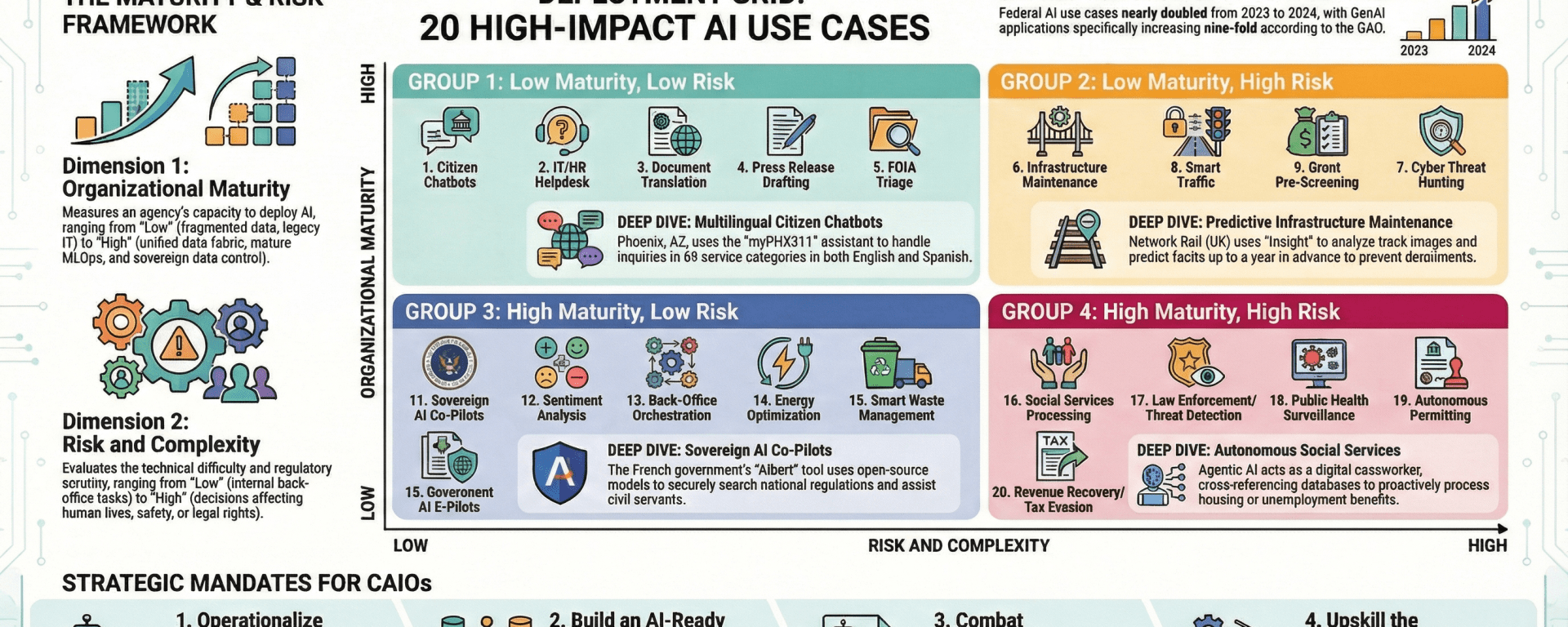
The integration of artificial intelligence into public sector operations has reached a critical inflection point. As federal and municipal governments across North America and Europe face mounting macroeconomic pressures, stringent budget constraints, and citizen expectations molded by seamless private-sector digital experiences, artificial intelligence has definitively transitioned from an experimental novelty to an operational necessity. The technological paradigm has rapidly evolved over the past thirty-six months. Initial deployments focused heavily on predictive machine learning and basic robotic process automation. Subsequently, the widespread availability of Generative AI (GenAI) enabled the rapid synthesis of information, document summarization, and content generation. Most recently, the landscape has shifted toward Agentic AI. While GenAI systems excel at generating text and images based on static user prompts, Agentic AI represents a profound functional leap forward: these autonomous systems possess the capacity to perceive environments, maintain persistent memory and context, break down complex overarching goals into sequential sub-tasks, interact with multiple enterprise systems via application programming interfaces (APIs), and execute multi-step workflows with minimal human intervention.
The scale of adoption is accelerating at an unprecedented rate. Recent assessments from the United States Government Accountability Office indicate that the number of reported artificial intelligence use cases across selected federal agencies nearly doubled from 571 in 2023 to over 1,110 in 2024, with GenAI use cases specifically increasing nine-fold. Globally, the Organisation for Economic Co-operation and Development (OECD) has catalogued thousands of AI applications across core government functions, observing that 57% of these initiatives aim to automate, streamline, or tailor public services. Furthermore, industry projections suggest that by 2028, over 33% of enterprise software applications will feature embedded Agentic AI capabilities, automating significant portions of administrative decision-making.
Despite the profound potential of these technologies to eradicate “process debt”—the accumulated workflow inefficiency of fragmented legacy systems—the public sector faces a unique set of constraints not shared by commercial enterprises. Government agencies are bound by strict, non-negotiable mandates regarding transparency, equity, civil liberties, and data privacy. A misguided deployment of an algorithmic system in the public sphere can result in wrongful benefit denials, the erosion of public trust, or the catastrophic compromise of highly sensitive national security data. Consequently, Chief AI Officers (CAIOs) and senior digital leaders must navigate an increasingly complex regulatory environment characterized by the European Union’s AI Act, which categorizes systems by risk severity, and the United States Office of Management and Budget (OMB) memoranda M-25-21, which establishes minimum risk management practices for high-impact AI.
To effectively scale these technologies, agencies must move beyond ad-hoc, siloed pilot projects and embed intelligent systems directly into core administrative and citizen-facing workflows. This requires a strategic deployment roadmap that accounts for both the internal readiness of the organization and the external impact of the technology. This research report provides a comprehensive taxonomy of the 20 most impactful artificial intelligence business use cases for municipal and federal governments. By categorizing these deployments across a matrix of organizational maturity and risk complexity, the analysis provides a strategic blueprint for CAIOs to sequence their investments responsibly. The report concludes with actionable, forward-looking mandates for establishing robust data foundations, mitigating algorithmic bias, and operationalizing trustworthy governance at scale.
The Organizational Maturity and Risk-Complexity Matrix Framework
To accurately assess and prioritize technology use cases, government organizations must evaluate initiatives through a two-dimensional framework. This analytical approach prevents agencies from pursuing highly complex, autonomous systems before establishing the requisite data architecture, cybersecurity protocols, and governance guardrails.
Dimension 1: Artificial Intelligence Organizational Maturity
Organizational Maturity refers to a government entity’s internal capacity to develop, deploy, secure, and monitor algorithmic systems. Drawing upon established maturity models from entities such as Gartner, Deloitte, and the OECD, organizational readiness can be classified across a spectrum of development.
Agencies exhibiting Low Organizational Maturity typically operate with fragmented, siloed datasets trapped in legacy IT infrastructure. Their technological initiatives are largely driven by individual curiosity rather than institutional strategy, resulting in localized experimentation using off-the-shelf commercial tools. These organizations lack centralized governance boards, mature machine learning operations (MLOps) pipelines, and dedicated in-house data science talent. They are fundamentally reactive, focusing on basic automation rather than systemic transformation.
Conversely, agencies exhibiting High Organizational Maturity possess a unified data fabric, secure cloud-based or hybrid compute environments, and mature API management systems that allow Agentic systems to interact seamlessly with core enterprise resource planning architectures. They operate under established ethics guidelines, employ continuous impact assessments, and view algorithmic integration as a cross-functional catalyst for workforce transformation. High-maturity organizations focus on orchestration, multi-agent collaboration, and sovereign data control.
Dimension 2: Risk, Complexity, and Governance
The second dimension evaluates the systemic risk, technical complexity, and regulatory scrutiny associated with a specific application. This axis aligns closely with the risk-based approaches codified in the NIST AI Risk Management Framework and the European Union’s AI Act.
The following table outlines the comparative regulatory frameworks that define risk complexity across North American and European jurisdictions:
| Regulatory Framework | Jurisdiction | Risk Categorization Approach | Key Mandates for Public Sector Deployments |
| EU AI Act | European Union | Four-tier system: Unacceptable (banned), High-Risk, Limited Risk, Minimal Risk. | Mandatory fundamental rights impact assessments; strict data governance; human oversight requirements for all public service and law enforcement applications. |
| OMB M-25-21 | United States Federal | Binary categorization: High-Impact (affects safety/rights) vs. Non-High-Impact. | Mandatory Chief AI Officer oversight; public AI use case inventories; pre-deployment bias testing; continuous monitoring; public appeal mechanisms. |
| NIST AI RMF | United States (Voluntary/Adopted) | Contextual risk mapping across four functions: Govern, Map, Measure, Manage. | Continuous evaluation of validity, reliability, safety, security, privacy, and fairness across the entire software lifecycle. |
Low Risk and Complexity use cases generally involve internal, back-office processes that do not directly impact citizen rights, legal standing, or physical safety. These applications, such as internal document summarization or routine IT ticket routing, require humans in the loop and do not process highly sensitive personally identifiable information.
High Risk and Complexity use cases involve autonomous or semi-autonomous systems that make or inform critical decisions affecting human lives. These include applications in law enforcement biometric scanning, critical infrastructure control, public health surveillance, and the disbursement of financial benefits. Under global frameworks, these applications require stringent algorithmic auditing, pre-deployment bias testing, continuous performance monitoring, and clear mechanisms for public appeal and redress.
Deployment Grid: The Top 20 High-Impact Public Sector Use Cases
The following matrix maps the 20 most impactful applications across the four quadrants defined by the intersection of organizational maturity and deployment risk.
| Quadrant | Maturity Level | Risk & Complexity | Primary Use Cases | Core Technologies Utilized |
| Group 1 | Low | Low | 1. Multilingual Citizen Chatbots & Navigators 2. Routine IT & HR Helpdesk Automation 3. Automated Document Translation & Accessibility 4. Public Communications & Press Release Drafting 5. Freedom of Information Act (FOIA) Triage | Large Language Models, Natural Language Processing |
| Group 2 | Low | High | 6. Predictive Maintenance for Critical Infrastructure 7. Cybersecurity Threat Hunting & Response 8. Smart Traffic Management & Signal Optimization 9. Grant & Subsidy Application Pre-Screening 10. Public Procurement Collusion Detection | Machine Learning, Computer Vision, Anomaly Detection |
| Group 3 | High | Low | 11. Sovereign AI Co-Pilots for Civil Servants 12. Public Sentiment & Regulatory Feedback Analysis 13. Agentic Workflow Orchestration for Back-Office 14. Municipal Building Energy Optimization 15. Smart Waste Management & Optical Sorting | Agentic AI, Retrieval-Augmented Generation, Digital Twins |
| Group 4 | High | High | 16. Autonomous Social Services & Benefits Processing 17. AI-Driven Law Enforcement & Threat Detection 18. Public Health Surveillance & Outbreak Prediction 19. Autonomous Permit Workflow Orchestration 20. Targeted Revenue Recovery & Tax Evasion Modeling | Multi-Agent Swarms, Advanced Predictive Analytics |
Detailed Analysis of High-Impact Use Cases
The following sections provide a granular examination of each application, analyzing the underlying technological mechanism, the expected return on investment for citizens and employees, the associated governance challenges, and real-world deployments from municipal and federal agencies in North America and Europe.
Group 1: Low Organizational Maturity and Low Risk
This foundational tier represents the optimal entry point for governments initiating their digital transformation journeys. These applications rely heavily on commercially available Generative AI and Natural Language Processing technologies. They offer immediate productivity gains and alleviate administrative bottlenecks without exposing the agency to severe regulatory liabilities or requiring highly specialized in-house engineering talent.
1. Multilingual Citizen Chatbots and Digital Navigators
Traditional rules-based chatbots deployed on government portals frequently trapped users in frustrating, dead-end logic loops. Generative AI has fundamentally altered this interaction paradigm. Modern virtual assistants can comprehend complex semantic nuance, remember conversational context, and seamlessly translate queries across diverse languages, providing 24/7 access to civic information. By offloading basic, repetitive inquiries regarding facility hours, waste collection schedules, and municipal fees, governments can dramatically reduce call center volumes. This allows human representatives to dedicate their time to complex constituent needs that require empathy and nuanced judgment. The broader implication of this technology is the democratization of civic engagement; non-native speaking populations and marginalized groups who previously found government portals inaccessible can now interact with the state in their native languages. Industry Examples: The city of Phoenix, Arizona, successfully deployed the “myPHX311” virtual assistant, which handles inquiries across 69 distinct service categories in both English and Spanish. In Europe, the municipality of Kortrijk, Belgium, implemented a highly effective multilingual virtual assistant built on standard content management platforms to ensure equitable access to services across varied linguistic demographics.
2. Routine IT and HR Helpdesk Automation
Public sector employees frequently suffer from severe process friction, spending excessive time navigating internal bureaucracy to reset passwords, request software provisioning, or query complex human resources policies. Generative and basic Agentic systems can act as internal digital co-workers, triaging IT tickets, synthesizing HR documentation, and providing instant, accurate responses based exclusively on internal employee handbooks. This application yields an immediate reduction in administrative overhead and operational downtime. Furthermore, this technology facilitates the institutionalization of tribal knowledge; new public servants can onboard faster because these systems provide immediate access to procedural workflows that previously lived exclusively in the minds of veteran staff members. Industry Examples: The German Federal Employment Agency partnered with technology consultancies to deploy an intelligent system that automatically extracts key details from emails, structures Jira tickets for IT service requests, and checks for duplicates, accelerating issue resolution and freeing staff for higher-value tasks. Similarly, the government of Flanders in Belgium introduced commercial copilot tools for 10,000 civil servants to assist with routine administrative burdens.
3. Automated Document Translation and Accessibility
Federal and multinational governmental bodies produce an immense volume of regulatory, legal, and public-facing information daily. Manually translating these documents is cost-prohibitive and introduces significant delays in public communication. Large Language Models specialized in linguistic conversion can instantly process massive archives of public policy into dozens of languages, ensuring strict compliance with accessibility mandates. Beyond mere operational efficiency, this capability fosters greater diplomatic and cross-border collaboration by eliminating linguistic bottlenecks in international treaties, trade agreements, and joint security protocols. Industry Examples: The European Commission has heavily invested in its eTranslation tool, which leverages deep neural machine learning trained on the massive Euramis repository. This system provides highly nuanced, context-aware translations across all 24 official EU languages and is crucial for preserving under-resourced languages like Maltese and Slovenian from digital extinction. In North America, the city of Dearborn, Michigan, actively utilizes translation tools to seamlessly convert municipal web content to assist its large Arab and Hispanic populations.
4. Public Communications and Press Release Drafting
Local government communications teams are historically under-resourced, struggling to rapidly disseminate critical information during public safety crises or outline complex administrative updates. Generative AI serves as a powerful, rapid drafting engine, synthesizing rough meeting notes, raw statistical data, and complex policy changes into highly readable press releases, social media posts, and constituent newsletters. Human communication officers transition from content creators to content editors, verifying tone, accuracy, and strategic alignment. A notable secondary effect is the standardization of government communications; the models ensure that the tone remains objective, clear, and aligned with established municipal branding guidelines. Industry Examples: The town of Reading, Massachusetts, successfully utilizes a GenAI system to draft the vast majority of its public-facing communications and press releases, ensuring timely and consistent updates for residents. Similarly, Wentzville, Missouri, acts as an early municipal adopter of generative tools to streamline communication workflows, ensuring citizens remain informed about critical infrastructure projects.
5. Freedom of Information Act (FOIA) and Records Request Triage
Processing public records requests requires government clerks to sift through vast, unstructured “digital heaps” of emails, historical documents, and internal memos. This manual process is notoriously backlogged across democratic governments. Intelligent data discovery and natural language processing tools can automate the intake of FOIA requests, locate highly relevant documents across disparate agency databases, and automatically suggest redactions for classified or personally identifiable information. The acceleration of FOIA processing directly bolsters government transparency and democratic accountability. Furthermore, the technology protects governments from the severe legal liability of accidentally releasing sensitive information through automated, highly accurate redaction sweeps. Industry Examples: The United States Food and Drug Administration integrated automated screening into its records intake process, cutting processing time by 93% and saving an estimated 5,200 hours of manual labor. In the United Kingdom, the Cabinet Office utilizes advanced computational appraisal tools to sift through massive volumes of born-digital records, accurately identifying historically significant documents for long-term preservation at the National Archives while scheduling ephemeral data for deletion.
Group 2: Low Organizational Maturity and High Risk
Governments operating in this quadrant recognize the critical necessity for advanced technological capabilities in infrastructure, defense, and public safety but generally lack the internal engineering maturity to build these systems from scratch. Consequently, they rely heavily on specialized, commercial-off-the-shelf solutions or external vendor partnerships. While the internal maturity is low, the operational risk of failure is exceedingly high, requiring rigorous procurement standards, continuous auditing, and strict vendor oversight.
6. Predictive Maintenance for Critical Infrastructure
Traditional maintenance of public infrastructure—encompassing railways, bridges, highways, and water treatment facilities—relies on reactive repairs following a breakdown or arbitrary, calendar-based scheduled inspections. Machine learning alters this paradigm entirely by analyzing continuous streams of Internet of Things (IoT) sensor data, acoustic monitoring, and visual inputs to predict mechanical failures weeks or months before they occur. This transition from reactive to prescriptive maintenance prevents catastrophic infrastructure failures, protects public safety, and dramatically optimizes municipal maintenance budgets by allowing engineers to schedule downtime during off-peak hours. However, the risk is substantial: a false negative in an algorithmic model monitoring a high-speed rail switch or a municipal dam could result in massive loss of life. Industry Examples: Network Rail in the United Kingdom utilizes a web-based platform named “Insight,” which ingests massive datasets from measurement trains and track images to predict track faults up to a year in advance, actively preventing derailments. In Washington, D.C., municipal utility workers deploy a computer vision system to analyze video feeds of 1,800 miles of subterranean sewer pipes, cutting manual inspection reporting times from 75 minutes to just 10 minutes per segment.
7. Cybersecurity Threat Hunting and Response
Public administrations, from local city councils to federal defense departments, are increasingly targeted by advanced persistent threats, state-sponsored hacktivists, and ransomware syndicates seeking to disrupt critical civic services. Static, rules-based firewalls are entirely insufficient against modern, polymorphic cyber warfare. Machine learning and Agentic systems are deployed to continuously monitor immense volumes of network traffic, identify anomalous behavioral patterns, and autonomously isolate compromised endpoints before lateral movement occurs. The complexity here lies in the arms race nature of the technology; adversaries also utilize intelligent automation, meaning government defense systems must evolve autonomously. The risk is extreme, as algorithmic failures could allow threat actors to cripple municipal power grids or exfiltrate classified national security intelligence. Industry Examples: The United States Cybersecurity and Infrastructure Security Agency (CISA) employs deep learning algorithms to reverse engineer complex malware samples, automating triage and indicator extraction to generate shareable cyber threat intelligence rapidly for other federal branches. The US Treasury Department relies on advanced machine learning to detect real-time cyber fraud, recovering over $4 billion in illicit transactions during a single fiscal year.
8. Smart Traffic Management and Signal Optimization
Urban congestion stifles economic productivity, degrades public health through air pollution, and exacerbates greenhouse gas emissions. Intelligent traffic management systems ingest real-time, unstructured data from intersection cameras, radar sensors, and connected public transit vehicles to dynamically adjust traffic light timings across an entire metropolitan grid. These systems optimize the flow of transit, seamlessly prioritize emergency response vehicles, and reduce engine idle times. The risk involves both algorithmic bias—such as models inadvertently prioritizing throughput in wealthy suburban neighborhoods over marginalized urban corridors—and the severe cybersecurity threat of bad actors manipulating traffic signals to cause deliberate gridlock or accidents. Industry Examples: Pittsburgh, Pennsylvania, deployed a dynamic traffic management platform to analyze intersection data in real-time, adjusting signals to optimize vehicle flow, which directly supports the city’s mandate to reduce transportation-related emissions by 50% by 2030. Similarly, Cambridge, Massachusetts, utilizes predictive analytics to preemptively mitigate peak-hour traffic gridlock before it cascades through the city.
9. Grant and Subsidy Application Pre-Screening
Federal and municipal governments disburse billions of dollars in grants, research funding, and agricultural subsidies annually. The manual review of highly complex, lengthy applications creates massive bureaucratic bottlenecks, delaying critical funding for infrastructure, academic research, and social programs. Machine learning systems can automatically pre-screen applications by comparing submitted documentation against rigid eligibility criteria, flagging missing information, and categorizing submissions for human review. While this vastly accelerates capital deployment, the risk is severe: opaque algorithms could exhibit bias, disproportionately rejecting applications from minority-owned businesses or marginalized communities without providing clear explainability. Industry Examples: United States National Science Foundation researchers developed “GrantCheck,” a secure, locally hosted tool integrating rule-based natural language processing and LLMs to ensure grant proposals comply with evolving federal policy requirements, achieving highly accurate screening without exposing proprietary research data to the public internet. In Europe, the UK government’s AI Incubator built “Extract,” a generative tool that converts complex, unstructured municipal planning applications and architectural blueprints into digitized data in just 40 seconds.
10. Public Procurement Collusion and Fraud Detection
Public procurement accounts for a massive percentage of government spending and is historically highly vulnerable to fraud, bid-rigging, and vendor collusion. Analytical systems can ingest decades of historical contracting data, cross-reference complex vendor ownership structures, analyze pricing anomalies across thousands of line items, and detect subtle behavioral patterns indicative of corruption. By rooting out inefficiencies and fraud, governments save taxpayer funds and ensure fair market competition. The complexity arises from the absolute necessity to integrate disparate financial databases and navigate strict data privacy regulations when investigating corporate entities and their subsidiaries. Industry Examples: The Generalitat Valenciana in Spain deployed an advanced screening system specifically designed for the early detection of irregularities and fraud in public contracting, reinforcing a procurement model centered on transparency and integrity. In Eastern Europe, Ukraine revolutionized procurement transparency using the Dozorro platform, which continuously monitors public tenders for risk indicators and anti-competitive behavior.
Group 3: High Organizational Maturity and Low Risk
Organizations operating in this tier have successfully developed robust internal data architectures, established clear governance structures, and possess the MLOps talent necessary to build, tune, and deploy customized models. They leverage these capabilities to execute highly sophisticated orchestration of back-office and internal operations, achieving massive scale and cost savings without directly jeopardizing public safety or individual citizen rights.
11. Internal Sovereign AI Co-Pilots for Civil Servants
Rather than relying on public, commercial LLMs that pose severe data leakage and intellectual property risks, highly mature governments are training “sovereign” models on their own proprietary, internal data. Utilizing Retrieval-Augmented Generation (RAG), these internal Co-Pilots allow civil servants to securely query decades of legal precedents, internal memos, and procedural guidelines. This radically shifts the daily workflow of government employees, elevating them from mundane information gatherers to strategic decision-makers. Because these models operate exclusively within secure, air-gapped government firewalls and assist internal staff rather than making autonomous external decisions, the immediate public risk remains low. Industry Examples: The French government successfully deployed “Albert,” an internal generative tool built on open-source Llama and Mistral models. Managed by the digital directorate (DINUM), Albert securely searches national regulations and drafts summaries specifically to assist civil servants in accurately answering complex citizen requests. Similarly, the European Commission developed “GPT@EC,” an internal environment offering staff secure access to various generative models depending on the strict sensitivity levels of the documents being processed.
12. Public Sentiment and Regulatory Feedback Analysis
When municipal and federal governments propose new regulations, zoning changes, or major infrastructure projects, they frequently receive tens of thousands of public comments. Manually reading and categorizing this feedback leads to “analysis paralysis,” causing valuable constituent insights to be effectively ignored. Mature governments utilize advanced natural language processing to automatically tag, categorize, and synthesize sentiment from massive volumes of public feedback, social media data, and town hall transcripts. This allows policymakers to rapidly understand macro-trends and address specific public concerns. While the risk of direct harm is low, ensuring the system does not filter out dissenting opinions through poor training data is a key governance requirement. Industry Examples: European regulatory bodies utilized natural language processing to analyze free-text data from social media and public forums to gauge real-time public sentiment and reactions during the highly contentious drafting of the EU AI Act. In the United States, progressive municipalities like Lebanon, New Hampshire, have established algorithmic registries to transparently document their use of sentiment analysis tools, ensuring public visibility into how civic data is processed.
13. Agentic Workflow Orchestration for Back-Office Processing
Moving significantly beyond simple robotic process automation, mature governments use Agentic AI to autonomously orchestrate end-to-end back-office functions such as budget reconciliation, invoice coding, and complex supply chain ordering. Agentic systems do not merely follow a rigid script; they possess the logic to detect an anomaly in an invoice, independently query a separate vendor database for verification, draft an email to the supplier requesting clarification, and update the financial ledger upon resolution. This eliminates the accumulated inefficiency of fragmented legacy systems, allowing municipal administrative bodies to operate with private-sector agility. Industry Examples: Mt. Lebanon, Pennsylvania, implemented an automated platform to autonomously code, verify, and process municipal invoices, slashing the standard turnaround time from a full week to just 48 hours, radically improving vendor relations. In the United Kingdom, Capita’s Catalyst Lab is deploying agentic orchestrators to manage back-office workflows for civil service contracts, independently handling document status changes and automating compliance audit logs.
14. Municipal Building Energy Optimization via Digital Twins
Public buildings account for a massive percentage of a municipality’s carbon footprint and operational expenditure. High-maturity cities are integrating IoT sensor networks with Agentic controllers to create precise “digital twins” of public facilities. These agents continuously analyze live occupancy data, historical weather patterns, and real-time utility grid pricing to autonomously adjust HVAC, lighting, and boiler systems. By autonomously pre-cooling buildings during off-peak energy pricing windows and reducing airflow to unoccupied zones, governments drastically cut utility costs and advance Net-Zero climate mandates. The continuous adjustment happens seamlessly in the background, presenting minimal risk to operational continuity. Industry Examples: In New York City, commercial and municipal buildings are utilizing advanced systems like BrainBox AI to take live readings of humidity, sun angle, and occupancy to continuously write autonomous commands to legacy HVAC systems, aiding compliance with the city’s strict Local Law 97 emissions mandates. In Germany, the PAUL system utilizes specialized hardware to analyze real-time data and autonomously adjust the flow of heating water to individual radiators in large municipal building complexes, achieving significant energy reductions.
15. Smart Waste Management and Optical Sorting
Traditional municipal waste management relies on fixed, inefficient collection schedules and manual sorting at recycling facilities, resulting in excessive fleet fuel consumption and massive cross-contamination of recyclables. Mature municipal infrastructure models combine computer vision with automated analytics to optimize the entire waste lifecycle. Smart cameras placed in public dumpsters detect fill levels, allowing routing algorithms to dispatch sanitation trucks only when necessary. At recycling plants, infrared sensors and vision systems identify and sort distinct types of plastics at speeds impossible for human workers. This heavily impacts both environmental sustainability and municipal balance sheets. Industry Examples: Miami, Florida, successfully installed smart cameras inside municipal dumpsters to categorize waste types and continuously optimize collection routing, significantly cutting fleet fuel costs and reducing urban traffic. Montgomery County, Maryland, integrated visual algorithms with infrared technology at recycling centers to rapidly and accurately identify various plastic polymers, drastically reducing downstream contamination.
Group 4: High Organizational Maturity and High Risk
This apex tier represents the absolute frontier of public sector technology. These Agentic and advanced machine learning systems operate autonomously in domains with profound implications for citizen health, physical safety, civil liberty, and financial security. Deploying these systems requires not only world-class, unified data infrastructure but also uncompromising adherence to legal frameworks, continuous ethical auditing, and mandated human oversight protocols.
16. Autonomous Social Services and Benefits Processing
Social welfare systems are frequently paralyzed by incredibly complex eligibility requirements, leaving marginalized citizens waiting months for critical support. Agentic AI acts as a highly capable digital caseworker, utilizing full contextual understanding of a citizen’s history to autonomously cross-reference disparate federal and state databases, verify eligibility, and proactively process applications for unemployment or housing benefits. By removing administrative friction, these systems ensure rapid and equitable resource distribution. However, the risk of “algorithmic cruelty”—where a machine incorrectly denies life-saving health or housing benefits without obvious recourse—demands rigorous fail-safes, explainability mandates, and rapid human-in-the-loop overrides. Industry Examples: Aspiranet, a non-profit operating across 30 California counties, uses an advanced natural language processing solution to allow human caseworkers to instantly query unstructured case files across jurisdictions to proactively assist youth transitioning from foster care. The UK government uses advanced systems to ingest and summarize deeply complex benefits claims involving lengthy medical histories, accelerating highly accurate decision-making by human assessors.
17. AI-Driven Law Enforcement and Threat Detection
The application of algorithmic systems in policing and border security is perhaps the most heavily scrutinized use case globally. Advanced computer vision and machine learning networks analyze massive datasets from surveillance cameras, biometric scanners, and cross-border traffic histories to uncover hidden links between criminal syndicates, detect illicit cargo, and locate missing persons. While the public safety benefits are immense, the risks of algorithmic bias (particularly in facial recognition), false imprisonment, and the erosion of privacy rights are paramount. Consequently, frameworks like the EU AI Act classify these tools as “high risk,” imposing strict limitations on real-time biometric identification in public spaces. Industry Examples: The United States Customs and Border Protection leverages machine learning algorithms to identify suspicious historical border crossing patterns; one such anomaly detection led directly to the interdiction of 75 kilograms of narcotics hidden in a vehicle. In Europe, Amsterdam-Schiphol Airport utilizes advanced scanning technology to rapidly flag legitimate threats in baggage, accelerating security throughput without compromising safety standards.
18. Public Health Surveillance and Epidemic Outbreak Detection
Traditional epidemiological surveillance relies heavily on delayed clinical reporting, severely hampering proactive crisis response. Advanced technologies overcome this by ingesting real-time, unstructured data from global news reports, social media sentiment, municipal wastewater sampling, and anonymized clinical records to detect statistical anomalies that precede a full-scale viral outbreak. By accurately predicting the geographic spread of pathogens, governments can preemptively allocate medical countermeasures. The immense complexity of these systems lies in achieving international data interoperability while strictly adhering to patient privacy laws like HIPAA in the US and GDPR in Europe. Industry Examples: The United States Department of Health and Human Services initiated a highly successful effort to extract and synthesize global publication data to identify emerging poliovirus outbreaks in geographic zones previously considered entirely eradicated. In Europe, health agencies rely on the Epidemic Intelligence from Open Sources (EIOS) system, which fuses multi-disciplinary data streams to provide early threat detection and situational awareness across member states.
19. Intelligent Civic Workflow and Autonomous Permitting
Navigating civic bureaucracy for business licenses, commercial building permits, or complex federal grant allocations is notoriously difficult for the public, leading to economic stagnation. Mature municipalities are deploying Agentic AI to serve as proactive, autonomous guides. When a citizen initiates a permit process, the agent interacts with the user, prepopulates forms based on existing state data, cross-checks complex local zoning regulations, validates submitted architectural blueprints, and autonomously routes the verified package to the correct department for final sign-off. This frictionless service restores public trust in government competence. The severe risk lies in the autonomous approval of structurally unsound projects or the failure of the agent to navigate obscure legal edge cases appropriately. Industry Examples: While advanced deployments are global, United States federal agencies are utilizing agentic capabilities to orchestrate complex farm loan applications, guiding users through dense compliance rules and automatically flagging missing data before submission. The city of San Jose has heavily invested in sophisticated policy templates and frameworks to responsibly deploy automated decision-making tools for these exact types of civic workflows.
20. Targeted Revenue Recovery and Tax Evasion Modeling
Federal and local tax authorities lose hundreds of billions of dollars annually to the “tax gap” caused by sophisticated evasion, fraud, and non-compliance. Advanced machine learning models ingest billions of unstructured financial records, international transaction histories, and corporate ownership webs to identify highly complex, multi-layered evasion schemes that human auditors simply could not detect. Furthermore, predictive algorithms are used locally to identify which citizens are likely to default on municipal bills and intervene with targeted assistance. The critical governance challenge is ensuring these powerful financial models do not disproportionately target lower-income demographics or minority groups due to historically biased training data. Industry Examples: The United States Internal Revenue Service deploys advanced algorithms within its Risk-Based Collection Model to identify unusual patterns in massive tax filings, drastically improving its ability to target high-net-worth evasion while reducing audit burdens on compliant citizens. At the municipal level, Wilmington, Delaware, utilized predictive targeting to analyze geographic and delinquent customer data, launching highly specific digital interventions that successfully recovered $1.1 million in previously unpaid civic water bills.
Strategic Mandates for Chief AI Officers and Senior Leaders
As government agencies definitively pivot from the experimental phase of Generative AI toward the operational reality of autonomous Agentic systems in 2026, the role of the Chief AI Officer has evolved from a technology evangelist to a critical risk, data, and governance orchestrator. To safely capture the immense public value of the aforementioned use cases, CAIOs must urgently execute on the following strategic imperatives:
1. Operationalize Robust Governance and Risk Frameworks
Relying on ad-hoc oversight and abstract ethical pledges is no longer tenable in the public sector. CAIOs must build operational “Control Towers” that translate policy into auditable engineering realities. Agencies must adopt rigorous risk-benefit matrices derived from the NIST AI Risk Management Framework and strictly adhere to the binding guidelines established by OMB M-25-21 and the EU AI Act. This requires mandating formal AI Impact Assessments prior to the deployment of any system classified as “High-Impact” (e.g., benefits processing, biometric scanning, or law enforcement tools). CAIOs must enforce continuous monitoring protocols to detect model drift and ensure that algorithmic decisions remain explainable, auditable, and subject to transparent human appeal mechanisms.
2. Establish a Unified, “AI-Ready” Data Foundation
Agentic AI cannot function securely or accurately within a fragmented, legacy IT infrastructure. An autonomous agent is only as intelligent, reliable, and unbiased as the underlying data it accesses. CAIOs must forcefully mandate the dissolution of departmental data silos, architecting unified data fabrics that provide agents with real-time, context-rich information via secure, governed APIs. Furthermore, as foreign state actors and cyber syndicates increasingly target public sector technological capabilities, CAIOs must advocate for sovereign compute strategies. This ensures that highly sensitive governmental and citizen data is processed on domestic, highly secure infrastructure rather than outsourced to opaque, third-party commercial clouds.
3. Redesign Procurement to Combat “Agent Washing”
As the commercial software market floods with vendors claiming autonomous capabilities, governments face the severe risk of purchasing “agentic workslop”—poorly designed, legacy automation tools rebranded as AI that actually degrade operational efficiency and add administrative burden. CAIOs must thoroughly overhaul public procurement guidelines, moving away from traditional software purchasing models toward outcomes-based contracts. Agencies must legally require vendors to provide a comprehensive AI Bill of Materials (AI-BOM) to ensure absolute transparency regarding the datasets used to train the models. This mitigates the risk of copyright infringement, hidden algorithmic bias, and supply chain vulnerabilities.
4. Transition the Workforce from ‘Doers’ to ‘Orchestrators’
The widespread deployment of Agentic AI fundamentally alters the nature of public sector work. Rather than executing repetitive administrative tasks and data entry, government employees will increasingly serve as strategic managers and ethical reviewers of autonomous digital co-workers. CAIOs must spearhead comprehensive, agency-wide upskilling initiatives designed to build an AI-fluent workforce. Public servants must be trained not just on how to prompt these tools, but on how to critically evaluate outputs, recognize algorithmic hallucinations, and understand precisely when to initiate a human-in-the-loop override to prevent automated harm to citizens.
By methodically aligning use-case deployment with internal organizational maturity and rigorously policing the associated risks, CAIOs can bridge the critical gap between technological ambition and mission execution, ultimately forging a more responsive, efficient, and deeply trusted public sector.
Sources
https://www.gao.gov/products/gao-25-107653 https://statetechmagazine.com/article/2026/02/agentic-ai-turns-government-workflows-autonomous-governed-systems-perfcon https://www.capgemini.com/in-en/insights/expert-perspectives/six-steps-for-making-agentic-ai-real-in-the-public-sector/ https://www.osborneclarke.com/insights/ai-and-public-procurement-spain-anti-collusion-screening-secure-automation https://www.butterflydata.co.uk/blog/ai-a-game-changer-in-combating-corruption-in-public-procurement https://cms.law/en/media/international/files/potential-use-of-ai-in-public-procurement-processes-in-cee?v=7 https://www.europarl.europa.eu/RegData/etudes/STUD/2021/691722/IPOL_STU(2021)691722_EN.pdf https://www.eib.org/en/essays/energy-efficiency-housing-artificial-intelligence-climate https://capacity.com/blog/government-workflow-automation/ https://www.onetrust.com/news/onetrust-introduces-government-records-request-automation/ https://pmc.ncbi.nlm.nih.gov/articles/PMC12442487/ https://www.capita.com/news-and-insights/insights/2025/agentic-ai-future-government-operations-and-citizen-services https://www.enisa.europa.eu/news/public-administration-increasingly-targeted-by-ddos-attacks https://www.dhs.gov/ai https://www.dhs.gov/ai/use-case-inventory/cisa https://www.mckinsey.com/industries/public-sector/our-insights/unlocking-the-potential-of-generative-ai-three-key-questions-for-government-agencies https://translation.ec.europa.eu/language-data-and-ai-using-ai-break-down-language-barriers/ai-based-multilingual-services-using-eu-language-data-innovate_en https://chetty.ai/post/chatbot-for-municipal-websites https://www.cornerstone.com/insights/articles/eu-ai-act-analysing-public-response-with-ai/ https://www.nlc.org/wp-content/uploads/2025/01/AI-in-Cities-Report.pdf https://www.the-future-of-commerce.com/2025/02/20/examples-of-ai-use-cases-in-government/ https://pmc.ncbi.nlm.nih.gov/articles/PMC12699247/ https://www.nsf.gov/news/notice-to-the-research-community-on-ai https://iee.psu.edu/news/blog/how-smart-buildings-use-ai-cut-energy-use-and-improve-health https://oxmaint.com/industries/government/ai-energy-optimization-public-buildings https://time.com/7201501/ai-buildings-energy-efficiency/ https://pmc.ncbi.nlm.nih.gov/articles/PMC12343694/ https://www.mdpi.com/2227-7390/13/12/1911 https://pmc.ncbi.nlm.nih.gov/articles/PMC10052500/ https://www.frontiersin.org/journals/artificial-intelligence/articles/10.3389/frai.2025.1645467/full https://www.valtech.com/en-us/thread-magazine/14-real-world-agentic-ai-use-cases/ https://www.smartsimple.com/blog/introducing-ai-assisted-application-screening https://publicpolicy.google/article/driving-public-good-eu/ https://ciltuk.org.uk/insights/resources-best-practice/ai-in-british-rail/ https://www.networkrail.co.uk/industry-and-commercial/insight-using-ai-to-run-a-reliable-railway/ https://www.mdpi.com/1424-8220/26/3/906 https://rail-research.europa.eu/latest-news/research-and-innovation-keeps-ai-on-the-right-track/ https://statetechmagazine.com/article/2026/02/agentic-ai-turns-government-workflows-autonomous-governed-systems-perfcon https://www.ibm.com/thought-leadership/institute-business-value/en-us/report/chief-ai-officer https://www.oecd.org/en/publications/2025/06/governing-with-artificial-intelligence_398fa287/full-report/ai-in-public-service-design-and-delivery_09704c1a.html https://www.govocal.com/blog/how-can-ai-help-prioritize-issues-based-on-public-feedback https://csgsouth.org/wp-content/uploads/Joe-Barnes_CSG-Leveraging-Generative-AI-in-State-Government.pdf https://digital-strategy.ec.europa.eu/en/policies/regulatory-framework-ai https://www.torys.com/our-latest-thinking/publications/2025/ir-a-new-era-of-innovation-in-canada/artificial-intelligence https://canadacouncil.ca/funding/resources/guidance-on-ai-in-grant-applications https://statetechmagazine.com/article/2026/02/agentic-ai-turns-government-workflows-autonomous-governed-systems-perfcon https://www.carahsoft.com/blog/onspring-the-practical-applications-of-ai-in-government-blog-2025 https://unesdoc.unesco.org/ark:/48223/pf0000397145 https://www.imd.org/ibyimd/artificial-intelligence/strategic-leapfrogging-moving-past-ai-maturity-models-with-diagnostic-precision/ https://www.servicenow.com/content/dam/servicenow-assets/public/en-us/doc-type/resource-center/white-paper/wp-enterprise-ai-maturity-index-2025.pdf https://www.forbes.com/councils/forbestechcouncil/2026/02/12/the-agentic-government-5-ways-ai-agents-will-reshape-public-services-in-2026/ https://www.digit.fyi/uk-public-sector-ai/ https://www.deloitte.com/us/en/insights/topics/technology-management/tech-trends/2026/agentic-ai-strategy.html https://statetechmagazine.com/article/2026/02/agentic-ai-turns-government-workflows-autonomous-governed-systems-perfcon https://governmenttechnologyinsider.com/five-effective-ai-tips-for-federal-agencies-to-drive-real-mission-impact-in-2026/ https://www.agiloft.com/blog/ai-in-the-eu-and-how-it-impacts-clm-and-legal-tech/ https://boomi.com/blog/10-agentic-ai-use-cases/ https://www.weforum.org/stories/2026/01/the-new-era-of-public-sector-service-is-about-building-trust-through-agentic-ai/ https://www.gartner.com/en/newsroom/press-releases/2025-09-09-gartner-reveals-top-technologies-shaping-government-ai-adoption https://smartdev.com/ai-use-cases-in-federal-government/ https://statetechmagazine.com/article/2026/02/agentic-ai-turns-government-workflows-autonomous-governed-systems-perfcon https://www.akingump.com/en/insights/ai-law-and-regulation-tracker/gao-issues-report-on-generative-ai-use-and-management-at-federal-agencies https://www.gartner.com/en/chief-information-officer/research/ai-maturity-model-toolkit https://www.deloitte.com/us/en/what-we-do/capabilities/applied-artificial-intelligence/articles/ai-dossier-government-public-services.html https://www.infor.com/platform/enterprise-ai/agentic-ai-use-cases https://www.abtglobal.com/insights/perspectives/agentic-ai-for-citizen-centered-services https://digitalgovernmenthub.org/library/ai-and-government-workers-use-cases-in-public-administration/ https://www.oecd.org/en/publications/2025/06/governing-with-artificial-intelligence_398fa287.html https://www.boozallen.com/insights/data-optimization/harnessing-agentic-ai-for-civilian-government.html https://boomi.com/blog/10-agentic-ai-use-cases/ https://statetechmagazine.com/article/2026/02/agentic-ai-turns-government-workflows-autonomous-governed-systems-perfcon https://www.pwc.com/gx/en/services/alliances/microsoft/agentic-ai-for-public-sector.html https://www.salesforce.com/news/stories/digital-version-agentic-ai-for-government/ https://www.idc.com/resource-center/blog/how-agentic-and-genai-will-advance-smarter-more-resilient-cities/ https://www.paloaltonetworks.es/cyberpedia/ai-risk-management-framework https://www.diligent.com/resources/blog/nist-ai-risk-management-framework https://www.torys.com/en/our-latest-thinking/resources/forging-your-ai-path/artificial-intelligence-regulation-in-canada-and-abroad https://www.snowflake.com/en/fundamentals/ai-us-government/ https://www.ispartnersllc.com/blog/nist-ai-rmf-2025-updates-what-you-need-to-know-about-the-latest-framework-changes/ https://www.whitehouse.gov/wp-content/uploads/2025/02/M-25-21-Accelerating-Federal-Use-of-AI-through-Innovation-Governance-and-Public-Trust.pdf https://digital-strategy.ec.europa.eu/en/policies/european-approach-artificial-intelligence https://trilateralresearch.com/responsible-ai/ai-in-local-government-european-success-stories-and-challenges https://www.oecd.org/en/publications/2025/06/governing-with-artificial-intelligence_398fa287/full-report/ai-in-public-service-design-and-delivery_09704c1a.html https://www.oecd.org/en/publications/2025/06/governing-with-artificial-intelligence_398fa287.html https://www.pwc.com/us/en/services/consulting/cybersecurity-risk-regulatory/library/tech-regulatory-policy-developments/responsible-ai.html https://www.abtglobal.com/insights/perspectives/agentic-ai-for-citizen-centered-services https://www.nlc.org/article/2025/07/31/use-ai-to-transform-city-operations/ https://dataforpolicy.org/canadas-new-ai-strategy-and-emerging-trends-in-asias-ai-landscape/ https://www.cyber.gc.ca/en/guidance/national-cyber-threat-assessment-2025-2026 https://www.boozallen.com/insights/data-optimization/harnessing-agentic-ai-for-civilian-government.html https://www.oracle.com/sa/artificial-intelligence/ai-local-government/ https://www.capita.com/news-and-insights/insights/2025/agentic-ai-future-government-operations-and-citizen-services https://www.euractiv.com/news/how-europes-governments-are-using-genai/
This article was written with my brain and two hands (primarily) with the help of Google Gemini, Notebook LM, Claude, and other wondrous toys.
 Adam Outside The Box