The nonprofit and charitable sectors across North America and Europe are undergoing a profound technological paradigm shift. Driven by intersecting macroeconomic pressures—including surging demand for social services, stagnant or declining philanthropic giving, and persistent workforce burnout—organizations are rapidly transitioning from initial digital modernization to comprehensive Artificial Intelligence (AI) integration. While the historical adoption of AI in the third sector was largely limited to predictive analytics for major gift prospecting, the proliferation of Generative AI (GenAI) and the nascent emergence of Agentic AI are redefining operational boundaries and mission delivery capabilities.
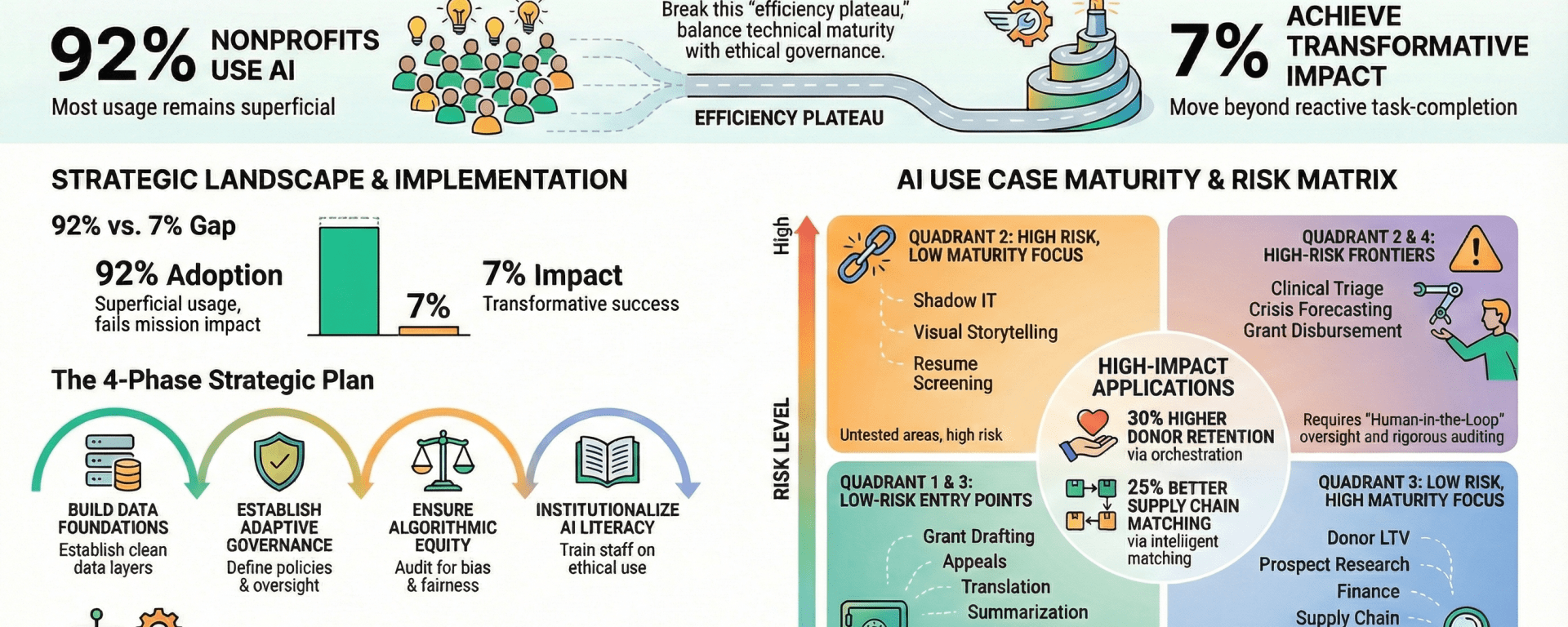
Recent sectoral analyses indicate that AI adoption has reached near-universal levels, with approximately 92 percent of surveyed nonprofits utilizing AI tools in some capacity 1. However, a stark “efficiency plateau” exists within this landscape. Despite widespread experimentation, only 7 percent of organizations report that AI has fundamentally transformed their strategic capabilities or delivered measurable mission impact 1. For the vast majority of nonprofits, AI adoption currently manifests as reactive, individualized usage—such as single employees utilizing consumer-grade large language models (LLMs) to draft appeals—rather than integrated, enterprise-wide workflows. This superficial adoption layer fails to address systemic inefficiencies and, paradoxically, risks exacerbating employee burnout by accelerating the pace of routine tasks without alleviating foundational operational friction 2.
For Chief AI Officers (CAIOs) and senior digital leaders, overcoming this plateau requires architecting enterprise-wide deployments that align explicitly with organizational maturity and risk tolerance. This strategic alignment is further complicated by regional regulatory divergences. European nonprofits are currently navigating the stringent compliance requirements of the EU AI Act, which imposes rigorous safeguards, transparency mandates, and conformity assessments on “high-risk” systems—such as those used for recruitment, biometric identification, and access to essential services 3. Conversely, North American organizations operate in a more fragmented regulatory landscape, relying heavily on voluntary frameworks such as the updated NIST AI Risk Management Framework (AI RMF) to guide ethical deployment and mitigate supply chain vulnerabilities 4.
The technological frontier for the nonprofit sector is the transition toward Agentic AI. Unlike conventional GenAI, which functions as a reactive co-pilot requiring constant human prompting, Agentic AI consists of autonomous systems capable of perceiving digital environments, formulating multi-step plans, and executing complex actions across interconnected software ecosystems with minimal human oversight 5. For nonprofits, this distinction is revolutionary. Agentic systems enable the autonomous orchestration of entire donor stewardship lifecycles, real-time supply chain logistics for disaster relief, and dynamic grant disbursement tracking 6.
Furthermore, the integration of AI must be carefully balanced against donor perceptions and ethical obligations. Recent research highlights a “personalization paradox” among donors: while optimized, AI-driven communications increase engagement, nearly 40 percent of donors express discomfort with how their data might be utilized to generate these personalized experiences 7. Trust remains the currency of the philanthropic sector, and an overwhelming 93 percent of donors demand transparency regarding how charities deploy AI technologies 7.
This comprehensive research report provides an exhaustive analysis of the top 20 most impactful AI business use cases for the nonprofit sector. By categorizing these applications across a matrix of organizational AI maturity and inherent risk complexity, CAIOs can systematically balance low-risk operational efficiencies with high-risk, high-reward mission innovations. This strategic blueprint is designed to optimize the value delivered to benefactors, enhance donor relationships, and safeguard the internal workforce against the mounting pressures of the modern philanthropic landscape.
2. AI Use Case Maturity and Risk Matrix
The following matrix categorizes twenty high-impact AI use cases tailored specifically to the nonprofit and charitable sector. The classifications are predicated on two primary axes of evaluation. The first axis measures AI Organizational Maturity, which encompasses the prerequisite data infrastructure, technical literacy, and cross-functional integration required to successfully deploy the solution. The second axis measures Risk, Complexity, and Governance, which evaluates the potential for algorithmic bias, data privacy breaches, regulatory non-compliance under frameworks like the EU AI Act or GDPR, and the absolute necessity for “Human-in-the-Loop” (HITL) oversight.
| Quadrant | Use Case Definition | Primary Technology | Primary Beneficiary Focus |
| 1. Low Maturity & Low Risk | 1. AI-Assisted Grant Proposal Drafting | Generative AI (LLMs) | Employees / Benefactors |
| 2. Dynamic Content Generation for Appeals | Generative AI | Donors / Employees | |
| 3. Multilingual Translation for Accessibility | NLP / GenAI | Benefactors | |
| 4. Knowledge Extraction & Meeting Summarization | Generative AI | Employees | |
| 5. Rule-Based Chatbots for Navigation | GenAI / NLP | Donors / Benefactors | |
| 2. Low Maturity & High Risk | 6. Unvetted Beneficiary Data Analysis (Shadow IT) | Generative AI | Employees / Benefactors |
| 7. AI-Generated Visual Storytelling | Generative AI (Image) | Donors | |
| 8. Basic Predictive Donor Segmentation | Predictive ML | Donors / Employees | |
| 9. Automated Volunteer Resume Screening | Machine Learning | Employees | |
| 10. Social Listening & Sentiment Analysis | NLP | Donors | |
| 3. High Maturity & Low Risk | 11. Advanced Donor Lifetime Value (LTV) Forecasting | Predictive ML | Employees |
| 12. Agentic Prospect Research & Wealth Screening | Agentic AI | Employees | |
| 13. Automated Financial Reconciliation | ML / Agentic AI | Employees | |
| 14. Supply Chain & In-Kind Donation Matching | Predictive ML | Benefactors | |
| 15. Omnichannel Donor Journey Orchestration | Agentic AI | Donors | |
| 4. High Maturity & High Risk | 16. Autonomous Clinical Triage & Hotline Routing | Agentic AI / NLP | Benefactors |
| 17. Algorithmic Beneficiary-to-Service Matching | Predictive ML | Benefactors | |
| 18. Virtual Gift Officers for Donor Portfolios | Agentic AI | Donors | |
| 19. Crisis Forecasting & Anticipatory Action | Predictive ML | Benefactors | |
| 20. Agentic Grant Management & Disbursement | Agentic AI | Benefactors / Employees |
3. Detailed Analysis of Top 20 Business Use Cases
3.1 Low AI Organizational Maturity and Low Risk / Complexity / Governance
Use cases situated within this quadrant represent the optimal entry points for organizations initiating their artificial intelligence journey. These applications rely primarily on commercially available, off-the-shelf Generative AI tools and require minimal backend systems integration. Because they process low-sensitivity, publicly available, or non-personally identifiable data, they carry minimal regulatory risk while offering immediate, highly visible relief to employee burnout and administrative bottlenecks.
1. AI-Assisted Grant Proposal Drafting
The grant acquisition process is notoriously time-consuming, often requiring understaffed development teams to manually parse complex funder rubrics and synthesize organizational data into highly specific narrative formats. AI-assisted grant drafting utilizes Large Language Models (LLMs) fine-tuned on historical, successful grant applications to generate first-draft proposals, compile literature reviews, and format budget narratives in a fraction of the traditional time 8. The technical mechanism involves inputting programmatic parameters into specialized software, which then retrieves relevant institutional knowledge to construct tailored narratives. This drastically reduces the administrative burden on employees, allowing them to shift their focus from blank-page drafting to strategic editing and relationship building with foundation officers. Benefactors indirectly gain immense value, as the organization can rapidly scale its grant application volume, securing more diversified and stable funding for community programs. In North America, organizations are utilizing purpose-built platforms such as FreeWill’s Grant Assistant, which is trained on thousands of winning proposals. Small teams, such as the US-based nonprofit Pets for Patriots, have successfully leveraged this technology to secure major foundation grants within their first month of adoption by optimizing their proposal language to match specific institutional criteria 8.
2. Dynamic Content Generation for Annual Appeals
Nonprofit communication teams frequently struggle to maintain consistent, high-quality engagement across multiple digital channels due to resource constraints. Dynamic content generation deploys multimodal Generative AI tools to ideate campaign slogans, draft personalized email cadences, and adapt core organizational messaging for diverse social media platforms 9. The mechanism relies on prompting GenAI interfaces with core campaign goals, which the system then translates into platform-specific copy, adjusting tone and length automatically. Donors receive communications that feel consistently fresh and aligned with modern digital marketing standards, thereby increasing open and conversion rates. Employees benefit from a massive force-multiplier effect, enabling lean marketing departments to produce agency-level output without proportional budget increases. In the United States, animal welfare organizations such as Austin Pets Alive! utilize generative AI to manage high-volume email campaigns during critical fundraising periods, ensuring continuous donor contact 10. Similarly, European charities leverage these tools to rapidly draft personalized acknowledgment letters at scale, ensuring that every donor feels individually recognized for their contribution without overwhelming development staff 11.
3. Multilingual Translation for Beneficiary Accessibility
Language barriers represent a significant friction point in equitable service delivery, particularly for nonprofits operating in immigrant communities or international development contexts. Multilingual translation utilizes Natural Language Processing (NLP) and GenAI to instantly translate plain-language service documents, intake forms, and digital platforms into dozens of localized languages 12. The mechanism involves feeding source documents through advanced linguistic models that capture regional dialects and contextual nuances far more effectively than legacy translation software. Benefactors from diverse linguistic backgrounds gain immediate, equitable access to critical services, legal rights information, and health resources. Employees bypass the prohibitive costs and severe time delays historically associated with hiring manual translation services, allowing for rapid crisis response. The U.S. Digital Response, for instance, utilizes AI to power its unemployment insurance tool, providing real-time, plain-language Spanish translations for workers with limited English proficiency 12. On a global scale, the nonprofit Worldreader deployed generative AI to rapidly translate its extensive digital library into multiple languages, thereby scaling its early childhood literacy programs to families across varying geographic regions 13.
4. Knowledge Extraction and Meeting Summarization
Institutional knowledge within nonprofits is frequently trapped within siloed documents, lengthy board meeting transcripts, and fragmented email chains. Knowledge extraction tools employ AI transcription and summarization algorithms to transcribe virtual meetings, extract key action items, and synthesize sprawling internal policy documents into concise, searchable briefs 14. The mechanism integrates directly into standard enterprise communication suites, actively listening to or scanning corporate data to formulate coherent summaries. Employees are liberated from rote administrative note-taking, enabling deeper cognitive engagement and active participation during strategic planning sessions. Furthermore, institutional memory becomes highly accessible, accelerating the onboarding of new staff and volunteers. In Europe, the British Heart Foundation (BHF)—the region’s largest independent funder of cardiovascular research—deployed Microsoft 365 Copilot to streamline operations. By automating the summarization of extensive medical research literature and administrative meetings, the organization significantly increased staff bandwidth, empowering their teams to focus entirely on scientific innovation and funding strategy 14.
5. Rule-Based Chatbots for Web Navigation
Navigating complex nonprofit websites for specific program requirements, eligibility criteria, or donation portals can frustrate stakeholders. Rule-based chatbots, augmented with basic NLP, are integrated into organizational websites to handle routine frequently asked questions, triage visitor intent, and direct traffic to appropriate internal resources 15. The technical mechanism involves training a closed-domain bot strictly on the organization’s existing public documentation, ensuring it cannot hallucinate information outside its programmed parameters. Donors and benefactors experience frictionless, round-the-clock service when seeking to make a contribution or understand service availability. Employees see a drastic reduction in high-volume, low-complexity email and phone inquiries, allowing administrative staff to focus on more nuanced stakeholder interactions. In the United Kingdom, the West of England Centre for Inclusive Living (WECIL) developed an AI chatbot named “Cecil from WECIL.” Designed specifically for accessibility, the bot functions similarly to an Easy Read document, offering visual options and simplified language to help neurodivergent and learning-disabled beneficiaries seamlessly navigate their digital infrastructure 15.
3.2 Low AI Org Maturity and High Risk / Complexity / Governance
Use cases within this quadrant represent scenarios where the technological barrier to entry is deceptively low—often involving free, consumer-grade applications—but the specific deployment poses severe ethical, legal, or reputational risks. CAIOs must intervene heavily in these areas, prioritizing rigid policy enforcement, continuous auditing, and the establishment of strict operational guardrails.
6. Unvetted Beneficiary Data Analysis (Shadow IT)
A pervasive risk in low-maturity organizations is the emergence of AI “shadow IT,” where well-intentioned employees utilize unauthorized, public LLMs to accelerate their daily tasks. The mechanism involves staff manually inputting sensitive, personally identifiable information (PII)—such as beneficiary case notes, domestic abuse reports, or donor financial records—into public AI tools for summarization or analysis 16. The impact is a catastrophic risk to benefactors, as their confidential data may be ingested into the proprietary training models of external tech conglomerates, potentially surfacing in public outputs later. This creates severe legal liabilities for the organization under regulatory frameworks such as the European GDPR or the American HIPAA regulations. The Charity Excellence Framework in the UK explicitly warns against this practice, noting that over half of charities remain entirely unprepared to manage the cybersecurity risks associated with generative AI. Effective governance requires CAIOs to strictly ban the input of raw, unanonymized data into public tools, mandating the procurement and utilization of secure, closed-tenant AI enterprise instances where data retention policies protect the organization’s intellectual property 16.
7. AI-Generated Visual Storytelling
Visual storytelling is the cornerstone of nonprofit marketing, utilized to evoke empathy and drive charitable giving. The advent of AI image generation allows organizations to create highly realistic visual collateral depicting synthetic beneficiaries, environmental crises, or program impacts. The mechanism utilizes text-to-image diffusion models to generate assets in seconds, bypassing the cost of professional photography. However, the impact on donor trust can be devastating. Donors may feel fundamentally deceived if they discover that emotionally resonant imagery of human suffering or environmental degradation is entirely fabricated. In Europe, the European Holocaust Research Infrastructure (EHRI) issued urgent public warnings regarding the surge of AI-generated, fabricated images of Nazi crimes circulating on social media, emphasizing that such synthetic content distorts historical truth and disrespects victims 17. Conversely, the World Wildlife Fund (WWF) successfully managed this specific risk by transparently labeling their “Future of Nature” exhibition; they explicitly disclosed the use of AI to imagine a bleak future landscape if conservation efforts fail, thereby maintaining institutional integrity through clear and proactive disclosure 18.
8. Basic Predictive Donor Segmentation
Determining which prospective donors to target for major gifts is a foundational development task. Basic predictive segmentation utilizes entry-level machine learning algorithms to score constituents based on their “likelihood to give,” relying exclusively on historical transactional data and basic demographic markers 19. The mechanism mathematically clusters donors, allowing employees to optimize mailing lists. The high risk stems from algorithmic bias. Models trained on historically biased philanthropic datasets may systematically assign lower “wealth” or “engagement” scores to marginalized communities, women, or minority demographics. The impact is exclusionary fundraising; the AI effectively redlines diverse donors, creating a feedback loop where only traditional demographics are solicited. Research from the AI Equity Project reveals that while 64 percent of nonprofits are familiar with the concept of AI bias, a concerningly low 36 percent actively implement equity practices to audit their models 19. CAIOs in both North America and Europe must mandate that all segmentation models undergo rigorous algorithmic fairness audits before deployment to ensure inclusive donor engagement.
9. Automated Volunteer and Employee Resume Screening
Nonprofits frequently face overwhelming volumes of applications for limited volunteer or staff positions. Automated screening deploys machine learning software to parse resumes, rank candidate qualifications against job descriptions, and autonomously advance individuals to the interview stage 3. While the mechanism provides massive efficiency gains for human resources employees, it presents acute, structural risks of replicating historical hiring biases against female, minority, or non-traditional applicants whose resumes may lack specific keywords recognized by the AI. Under the regulatory framework of the European Union, the EU AI Act strictly categorizes AI systems utilized for recruitment, task allocation, and worker management as “high-risk” applications 3. European NGOs, as well as North American charities with international operations, must conform to rigorous documentation, traceability, and mandatory human-oversight directives before deploying these systems. Failure to comply not only risks severe financial penalties but fundamentally contradicts the core equity missions of social sector organizations.
10. Social Listening and Sentiment Analysis
Understanding public perception is critical for advocacy-driven organizations. Social listening utilizes NLP algorithms to continuously scrape social media platforms, public forums, and digital news channels to monitor public sentiment regarding the charity’s brand or specific legislative issues 20. The mechanism categorizes vast streams of unstructured text into positive, negative, or neutral sentiment scores. This allows organizations to rapidly pivot their messaging strategies in real time. However, the practice poses significant privacy and ethical concerns regarding the mass collection and analysis of user data without explicit consent, especially when dealing with vulnerable populations discussing sensitive health or social issues. During the COVID-19 pandemic, Parkinson’s UK deployed AI tools using comparative linguistics to monitor real-time conversations on patient forums and helplines. This allowed the charity to understand the rapidly shifting anxieties of their community and adjust support services accordingly; however, executing this safely required exceptional governance to ensure complete anonymization of patient data and strict adherence to European privacy standards 20.
3.3 High AI Org Maturity and Low Risk / Complexity / Governance
Use cases within this tier require robust, enterprise-grade data architecture—characterized by unified Customer Relationship Management (CRM) systems, clean data lakes, and seamless API integrations. Because these systems operate primarily in the background to optimize internal processes rather than making autonomous decisions affecting human rights or physical safety, the regulatory and governance hurdles remain relatively low.
11. Advanced Donor Lifetime Value (LTV) Forecasting
Moving beyond basic segmentation, advanced LTV forecasting deploys highly sophisticated machine learning models across aggregated, clean datasets to accurately predict a donor’s total financial trajectory over decades 21. The mechanism ingests data from the CRM, wealth screening APIs, event attendance records, and broader macroeconomic indicators to predict attrition risk, upgrade potential, and optimal solicitation timing. The impact on employees is transformative; major gift officers can mathematically maximize their return on investment by focusing high-touch stewardship exclusively on high-LTV prospects. Donors benefit by receiving an engagement cadence appropriately calibrated to their genuine philanthropic capacity, rather than generic mass appeals. Prostate Cancer UK provides a premier example of this maturity. The organization utilized advanced machine learning to analyze a massive dataset comprising 1.5 million supporters, 5.5 million historical transactions, and 15 million campaign activities. By identifying highly granular, optimal segments for their major holiday appeals, the charity drove unprecedented conversion rates and minimized campaign wastage 21.
12. Agentic Prospect Research and Wealth Screening
Traditional prospect research requires development staff to manually scour disparate databases to build donor profiles. The transition to high-maturity AI involves Agentic AI systems that autonomously crawl public records, SEC filings, real estate databases, and corporate announcements to identify major gift prospects in real time 8. The technical mechanism utilizes intelligent agents that are programmed with specific qualification criteria; they continuously monitor the digital landscape and actively notify human fundraisers when a mid-tier donor experiences a liquidity event—such as selling a business or receiving a major promotion. The impact is a massive reclamation of employee time, saving hundreds of hours of manual research and enabling immediate, timely outreach. In North America, sophisticated platforms like DonorSearch AI leverage machine learning across the world’s largest philanthropic databases to identify subtle “warmth and wealth” behavioral patterns. This high-maturity integration helps organizations autonomously uncover prospects who possess up to 20 times higher lifetime values than those identified through traditional screening methods 8.
13. Automated Financial Reconciliation and Budget Forecasting
Nonprofit finance departments are frequently burdened by archaic, manual accounting processes that delay the reporting of critical financial metrics to the board of directors. Automated financial reconciliation implements AI directly within Enterprise Resource Planning (ERP) systems to automatically reconcile ledger accounts, flag anomalous spending patterns indicative of fraud, and generate predictive budget forecasts 22. The mechanism uses machine learning to recognize historical transaction patterns and seasonality, predicting future cash flow requirements based on complex variables like impending grant cliffs or macroeconomic shifts. Finance employees eliminate tedious manual data entry, elevating their roles to strategic fiscal planning. Donors and grantmakers directly benefit from enhanced financial transparency, faster reporting cycles, and demonstrably lower administrative overhead ratios. Globally, modern cloud financial management systems, such as Sage Intacct, are utilized by highly mature nonprofits to merge AI-powered automation with strict, built-in governance, thereby accelerating audit readiness and providing executive leadership with real-time dashboards of fund utilization 22.
14. Supply Chain and In-Kind Donation Matching
For charities focused on disaster relief, poverty alleviation, or medical supplies, managing the sudden influx of corporate in-kind donations presents a massive logistical hurdle. AI-driven supply chain matching utilizes predictive algorithms and complex operations research models to dynamically pair incoming physical inventory with the specific, real-time demands of community distribution partners 10. The mechanism continuously analyzes inventory telemetry, geographic data, and partner requests to route goods efficiently, preventing warehouse bottlenecks. The impact on benefactors is profound; vulnerable populations receive precisely the supplies they require, exactly when they need them, while the organization drastically reduces logistical waste and storage costs. Good360, a prominent US-based nonprofit specializing in product philanthropy, successfully employs advanced machine learning algorithms to optimally match massive influxes of corporate product donations with verified community needs across the country. This algorithmic matching architecture resulted in a reported 25 percent increase in overall operational efficiency and significantly reduced critical warehouse holding times 10.
15. Omnichannel Donor Journey Orchestration
Sustaining donor loyalty requires consistent, meaningful touchpoints across various mediums. Omnichannel orchestration relies on Agentic AI systems connected directly to the organization’s CRM and marketing automation platforms 23. The mechanism involves the AI agent autonomously deciding the precise timing, optimal channel (e.g., email, SMS, direct mail), and specific content of outreach based on a donor’s real-time behavioral cues—such as abandoning a donation form or attending a webinar. The impact is a seamless, hyper-personalized relationship between the donor and the charity. The AI ensures that constituents are neither spammed with irrelevant mass communications nor ignored during critical engagement windows. Charity: Water, an organization renowned for its digital maturity, revolutionized its donor engagement by utilizing AI-driven orchestration to autonomously send hyper-personalized project updates, GPS coordinates of funded wells, and impact reports triggered by specific donor interactions. This sophisticated, automated journey mapping resulted in a remarkable 30 percent increase in their donor retention rates 23.
3.4 High AI Org Maturity and High Risk / Complexity / Governance
This quadrant represents the apex of current artificial intelligence capabilities within the social sector. These complex use cases rely heavily on Agentic AI and predictive modeling to autonomously execute actions, disburse financial funds, or directly influence the health, safety, and livelihoods of vulnerable populations. Consequently, they demand the highest levels of executive oversight, continuous algorithmic auditing, and rigorous compliance architectures.
16. Autonomous Clinical Triage and Hotline Support
Organizations providing crisis intervention or mental health support face overwhelming call volumes that outpace human capacity. Autonomous triage deploys Agentic AI and advanced voice-recognition bots to answer crisis hotlines, parse natural language to assess the psychological severity of the caller’s situation, and autonomously route high-risk individuals to human specialists 24. Simultaneously, the AI resolves low-tier informational requests without human intervention. The mechanism relies on highly trained, sector-specific NLP models capable of detecting nuanced distress signals. Benefactors in acute crisis experience drastically reduced wait times for life-saving interventions. Human employees are protected from severe burnout by focusing their finite emotional labor exclusively on critical casework. Polaris, the nonprofit operating the U.S. National Human Trafficking Hotline, implemented a sophisticated machine-learning-powered voice bot to triage non-urgent, general information requests. By autonomously handling over 1,700 routine calls in its first six months of deployment, the AI ensured human caseworkers were entirely unencumbered and immediately available to engage directly with trafficking survivors in urgent, real-time need 24.
17. Algorithmic Beneficiary and Service Matching
Connecting vulnerable individuals with the appropriate social services—such as housing, medical care, or mentorship—is traditionally a slow, subjective process. Algorithmic matching utilizes sophisticated AI to ingest massive datasets comprising beneficiary psychological profiles, geographic needs, or housing availability, and autonomously computes the statistically optimal match 25. The impact is highly optimized, personalized interventions delivered at unprecedented speed. However, the risk lies in algorithmic determinism and bias; if the AI makes an erroneous or biased match based on flawed training data, the human cost is substantial and immediate. Big Brothers Big Sisters of Puget Sound collaborated directly with KPMG to architect a Microsoft Fabric-driven AI recommendation engine. The system analyzes vast behavioral datasets to suggest optimal mentor-mentee pairings, reducing a highly manual matching process that previously took months down to mere minutes. Crucially, recognizing the high stakes of child welfare, the organization enforces a strict Human-in-the-Loop policy, explicitly requiring trained human specialists to review and approve all final matches suggested by the algorithm 25.
18. Virtual Gift Officers for Donor Portfolios
Managing mid-tier donors who give consistently but fall below the threshold for dedicated major gift officers is a persistent challenge. Deploying Agentic AI as a “Virtual Gift Officer” allows the system to autonomously manage portfolios of thousands of donors 8. The mechanism involves an autonomous agent that reads incoming emails, drafts highly personalized replies reflecting the organization’s specific tone, analyzes donor sentiment, schedules virtual meetings, and updates the CRM—all entirely on its own. This democratizes the “major gift experience” by providing white-glove, conversational stewardship to the broad middle of the donor pyramid. The risk is that an unmonitored AI could hallucinate organizational commitments, share inaccurate financial data, or deeply offend high-value donors, jeopardizing critical relationships. Platforms like Momentum AI allow organizations to safely launch personalized AI agents that mimic a human fundraiser’s specific writing style. Institutions such as Metropolitan State University of Denver use this technology to orchestrate scaled engagement flows, drastically increasing outreach volume while instituting a mandatory human-approval gateway before any communication is officially transmitted 8.
19. AI-Powered Crisis Forecasting and Anticipatory Action
Traditional humanitarian aid is inherently reactive, deploying resources only after a disaster has struck. Crisis forecasting utilizes deep learning models to ingest real-time satellite imagery, macroeconomic indicators, weather patterns, and human mobility datasets to predict humanitarian crises—such as famines, floods, or mass forced displacements—months before they occur 26. The technical mechanism identifies microscopic geopolitical and environmental anomalies invisible to human analysts. The profound impact allows international NGOs to transition toward proactive, anticipatory action, pre-positioning vital supplies and saving lives at a fraction of the cost of reactive emergency response. The Danish Refugee Council (DRC) and the European EUMigraTool initiative utilize advanced AI to forecast short- and mid-term forced displacement and migration flows. This predictive data autonomously informs strategic funding decisions at the executive level and triggers the localized pre-deployment of specific resources—such as safe spaces and reproductive healthcare units—directly to anticipated crisis zones across European borders 26.
20. Agentic Grant Management and Automated Disbursement
The traditional grant distribution process is burdened by heavy bureaucratic review, delaying the delivery of vital capital to frontline initiatives. Agentic grant management systems review incoming applications, autonomously cross-reference applicant data with global compliance and anti-fraud databases, monitor institutional governance risks, and execute multi-step workflows to approve and disburse funds directly to recipients 25. The impact radically accelerates the speed of philanthropy. The risk, however, is monumental: unchecked algorithmic bias could systematically defund specific demographics or geographic regions, while AI hallucinations could lead to major financial compliance breaches or the funding of illicit entities. In advanced pilot programs demonstrated via Microsoft Foundry (such as the simulated Contoso Trust scenario), Agentic AI successfully manages end-to-end grant approvals. The system tracks complex governance risks autonomously and prepares comprehensive, finalized compliance packets for human board review, demonstrating how AI can safely accelerate capital deployment when bound by strict, final-stage human authorization 25.
4. Strategic Action Plan for CAIOs and Senior AI Leaders
To move beyond the sector’s current 7 percent efficiency plateau and achieve transformative, long-term mission impact, Chief AI Officers must deliberately transition their organizations from ad hoc, individual experimentation to structured, enterprise-wide AI orchestration. The following comprehensive action plan outlines the critical operational imperatives for the 2025–2026 strategic horizon.
Phase 1: Architecting Robust Data Foundations
Agentic AI and advanced generative models cannot function in a vacuum; they require a unified, high-fidelity data ecosystem to navigate context and execute tasks accurately. Currently, over 80 percent of nonprofits report that their institutional data remains too siloed, unstructured, or inaccurate to be leveraged effectively for artificial intelligence 25. CAIOs must prioritize the aggressive elimination of legacy data silos, transitioning toward integrated architectures such as Salesforce Data Cloud or Microsoft Fabric.
| Strategic Action | Implementation Mechanism | Expected Outcome |
| Data Auditing | Conduct a comprehensive audit to build an “AI Bill of Materials” (AI-BOM) cataloging all data sources. | Complete visibility into data lineage and system dependencies. |
| Master Record Creation | Establish authoritative master records for donors and beneficiaries across all platforms. | Ensures AI agents access a single, accurate source of truth for decision-making. |
| API Integration | Connect fragmented legacy systems (CRM, ERP, HRIS) via secure APIs. | Enables Agentic AI to execute multi-step workflows across different software environments. |
Phase 2: Implementing Adaptive Governance and Risk Frameworks
The era of relying on static, generalized IT acceptable-use policies is fundamentally over. CAIOs must implement dynamic governance models that are meticulously tailored to the specific risk profiles of their localized AI deployments.
In North America, leaders must map their internal controls directly to the updated NIST AI Risk Management Framework, ensuring continuous alignment with the core functions: Govern, Map, Measure, and Manage 4. In Europe, strict adherence to the EU AI Act is legally mandatory. CAIOs overseeing operations in European jurisdictions must execute rigorous conformity assessments, particularly for systems classified as “high-risk,” such as those impacting employment or beneficiary access to essential social services 3.
- Establish an AI Ethics Committee: Form a cross-functional governance body comprising leaders from IT, Legal, Programs, and Human Resources to vet all new AI software procurements.
- Mandate Human-in-the-Loop (HITL): Institute an unyielding institutional mandate requiring human authorization for any AI-generated output that directly affects human lives, financial disbursements, or external public communications.
Phase 3: Combating “Moral Outsourcing” and Ensuring Algorithmic Equity
As philanthropic organizations lean increasingly heavily on AI for predictive decision-making, there arises a critical systemic danger of “moral outsourcing”—the dangerous abdication of human ethical judgment to machine logic. AI models trained on historical societal data inherently reflect historical inequities. Without deliberate intervention, predictive models will inevitably deprioritize marginalized donors or misallocate vital social services.
| Equity Initiative | Operational Execution | Risk Mitigated |
| Algorithmic Auditing | Mandate third-party fairness audits for all predictive models prior to deployment. | Prevents systemic bias in beneficiary selection and donor segmentation. |
| Diverse Training Data | Actively source and weight data representing marginalized communities during model fine-tuning. | Prevents the erasure of non-traditional demographics from AI insights. |
| Transparent Disclosures | Clearly label all AI-generated content and provide mechanisms for stakeholders to contest automated decisions. | Mitigates the erosion of donor trust and ensures regulatory compliance. |
Phase 4: Transforming the Workforce Through AI Literacy
The integration of an AI-augmented workforce requires profound and empathetic change management. Employees across the social sector frequently view AI with a volatile mixture of enthusiasm for efficiency and existential dread regarding job displacement. CAIOs must actively reframe Agentic AI not as a mechanism for reducing human headcount, but as a crucial expansion of organizational capacity—a digital tool that automates the mundane to elevate the meaningful human connection required in philanthropy.
To operationalize this, CAIOs must institutionalize continuous AI skilling. Leaders should leverage highly vetted, sector-specific resources, such as NetHope’s “Unlocking AI for Nonprofits” curricula or the comprehensive training modules provided by the Charity Excellence Framework 2716. The ultimate objective is to empower staff to transition their core competencies from acting as “authors” of raw content to serving as sophisticated “editors” and directors of AI agents, cultivating the critical thinking skills necessary to audit, refine, and ethically deploy AI outputs.
5. List of Sources
- Huron Consulting Group: Agentic AI Advancement Fundraising. https://www.huronconsultinggroup.com/insights/agentic-ai-advancement-fundraising
- European Holocaust Research Infrastructure (EHRI): Open letter against AI-generated Holocaust distortions. https://www.ehri-project.eu/open-letter-consistent-action-against-ai-generated-holocaust-distortions-on-social-media-platforms/
- Cube84: How Agentic AI will transform nonprofit fundraising. https://cube84.com/blog/how-agentic-ai-will-transform-nonprofit-fundraising-and-donor-engagement
- Forvis Mazars: AI Governance for Nonprofit Boards. https://www.forvismazars.us/forsights/2026/02/ai-governance-for-nonprofit-boards
- Ignite Microsoft: Session BRK380. https://ignite.microsoft.com/en-US/sessions/BRK380
- BWF: AI Fundraising Use Cases. https://www.bwf.com/ai-fundraising-use-cases/
- Mason Hayes & Curran: Rise of the Helpful Machines (EU AI Act). https://www.mhc.ie/latest/insights/rise-of-the-helpful-machines
- NIST: AI Risk Management Framework (AI RMF). https://nvlpubs.nist.gov/nistpubs/ai/NIST.AI.600-1.pdf
- SAP: How nonprofits use AI to find and keep good donors. https://www.sap.com/blogs/how-nonprofits-use-ai-to-find-and-keep-good-donors
- NonProfit PRO: Nonprofit AI Adoption Hits 92% But Only 7% See Major Impact. https://www.nonprofitpro.com/article/nonprofit-ai-adoption-hits-92-but-only-7-see-major-impact/
- ReliefWeb: Unlocking AI for Nonprofits. https://reliefweb.int/training/4165543/unlocking-ai-nonprofits
- FedInsider: Agentic AI – The Application Agencies Need. https://www.fedinsider.com/agentic-ai-the-application-agencies-need/
- Ignite Microsoft: Session BRK380 (Case Studies). https://ignite.microsoft.com/en-US/sessions/BRK380
- Fidelity Charitable: Donor Perceptions of AI. https://www.fidelitycharitable.org/articles/donor-perceptions-of-ai.html
- Directory of Social Change: How charities are using AI in service delivery in 2025. https://www.dsc.org.uk/content/how-charities-are-using-ai-in-service-delivery-in-2025/
- William Joseph: How people in charities are using AI right now. https://www.williamjoseph.co.uk/blog/how-people-in-charities-are-using-ai-right-now
- Giving USA: How AI is Transforming Nonprofits in 2025. https://givingusa.org/how-ai-is-transforming-nonprofits-in-2025/
- Chronicle of Philanthropy: How Savvy Nonprofits Are Using Generative AI. https://connect.chronicle.com/rs/931-EKA-218/images/How%20Savvy%20Nonprofits%20Are%20Using%20Generative%20AI%20Trends%20Snapshot.pdf
- Social Targeter: Case Studies on the Use of AI in Nonprofit Organizations. https://www.socialtargeter.com/blogs/case-studies-on-the-use-of-ai-in-nonprofit-organizations-for-fundraising-efforts
- Sigma Forces: Nonprofits AI Social Impact 2025. https://www.sigmaforces.com/post/nonprofits-ai-social-impact-2025
- Candid: What AI equity for nonprofits means and looks like in practice. https://candid.org/blogs/what-ai-equity-for-nonprofits-means-looks-like-in-practice/
- Third Sector Lab: 7 Charities using AI to deliver impact. https://thirdsectorlab.co.uk/7-charities-using-ai-to-deliever-impact/
- AWS Public Sector Blog: Highlights from AWS Nonprofit Generative AI Week 2025. https://aws.amazon.com/blogs/publicsector/highlights-from-aws-nonprofit-generative-ai-week-2025/
- IS Partners: NIST AI RMF 2025 Updates. https://www.ispartnersllc.com/blog/nist-ai-rmf-2025-updates-what-you-need-to-know-about-the-latest-framework-changes/
- Virtuous: What the 2026 Nonprofit AI Adoption Report Reveals. https://virtuous.org/blog/what-the-2026-nonprofit-ai-adoption-report-reveals/
- arXiv: European MigraTool Initiative. https://arxiv.org/html/2510.15509v1
- JAA Media: Unleashing the power potential of AI in the charity sector. https://jaa-media.co.uk/unleashing-the-power-potential-of-ai-in-the-charity-sector/
- Charity Excellence Framework: AI Policy for Charities and Nonprofits. https://www.charityexcellence.co.uk/ai-policy-charities-and-nonprofits/
- FreeWill: Best AI Tools for Nonprofits. https://www.nonprofits.freewill.com/resources/blog/ai-tools-for-nonprofits
- Stanford Social Innovation Review (SSIR): AI-Powered Nonprofits Landscape. https://ssir.org/articles/entry/ai-powered-nonprofits-landscape
This article was written with my brain and two hands (primarily) with the help of Google Gemini, Notebook LM, Claude, and other wondrous toys.
 Adam Outside The Box