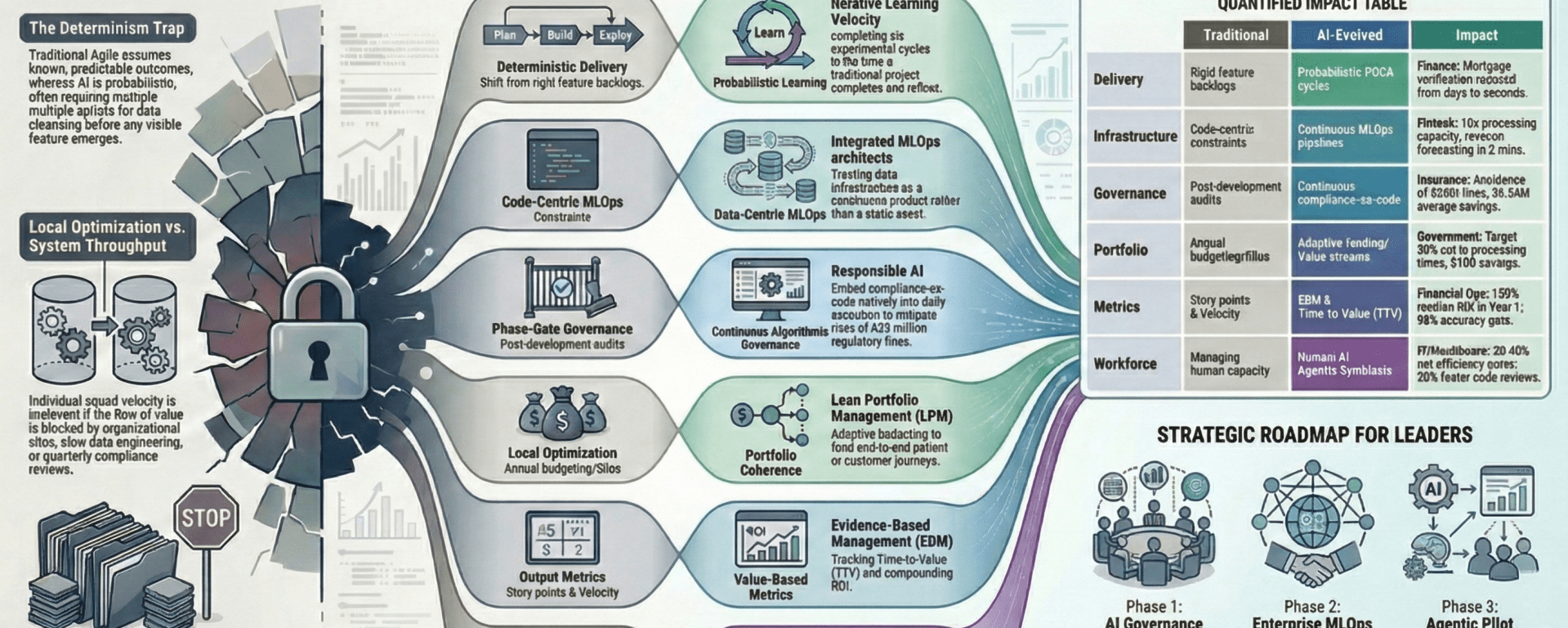
The integration of Artificial Intelligence (AI) into the enterprise operating model represents a fundamental technological, cultural, and organizational paradigm shift. According to recent market analyses, worldwide AI spending is forecast to reach $1.5 trillion by 2025, with 98% of organizations actively using or planning AI initiatives, and 82% of IT leaders reporting early value realization. However, a glaring paradox has emerged within this wave of technological adoption across regulated industries in North America and Europe: despite heavy investments in digital maturity and traditional Agile transformation programs, an estimated 70% to 90% of enterprise AI pilots stall in “pilot purgatory,” failing to reach production or deliver scalable, sustainable business impact.
For senior organizational leaders—spanning the financial services, insurance, fintech, healthcare, education, charity, and government sectors—this high failure rate is not merely a symptom of immature technology. It is indicative of a structural failure within the traditional enterprise operating model. Traditional Business Agility approaches, formalized through frameworks such as Scrum, Large-Scale Scrum (LeSS), and the Scaled Agile Framework (SAFe), were engineered for the deterministic, highly predictable world of traditional software development. They optimize for localized team velocity, linear feature delivery, and structured, phase-gate governance. AI, by contrast, is inherently probabilistic, heavily reliant on continuous data flows, and requires systemic, cross-functional integration.
This comprehensive research report challenges the assumption that existing Agile frameworks require only minor procedural adjustments to accommodate AI. The evidence suggests that traditional Business Agility at both the portfolio and team levels is fundamentally insufficient for the unique demands of AI transformation. To realize the compounding return on investment (ROI) that AI promises, Agile methodologies must evolve across six critical dimensions:
- From Deterministic Delivery to Probabilistic Learning (Iterative Velocity).
- From Code-Centric Sprints to Data-Centric MLOps Integration.
- From Phase-Gate Compliance to Continuous, Algorithmic Governance.
- From Localized Team Optimization to Systems-Centric Portfolio Coherence.
- From Output-Based Metrics (Velocity) to Value-Based Metrics (Evidence-Based Management).
- From Human Resource Allocation to Human-AI Symbiosis and Agentic Workflows.
This report exhaustively details these six evolutionary dimensions, providing empirical evidence, quantified impact metrics, and real-world case studies from highly regulated industries across North America and Europe. Furthermore, it outlines specific, actionable short-term (3–6 months) and mid-term (1–2 years) strategic recommendations for C-suite executives. These recommendations are designed to bridge the transformation gap, ensuring that AI investments yield sustainable returns while navigating complex, fragmented regulatory landscapes such as the European Union Artificial Intelligence Act (EU AI Act) and emerging North American data privacy frameworks.
B. The Insufficiency of Traditional Business Agility and the Evolution of AI Initiatives
Despite years of investing in Agile transformation programs and operating model redesigns, many enterprises find themselves trapped in a paradox: more Agile frameworks have been implemented, yet systemic delivery speed has slowed, and system responsiveness is declining under the pressure of AI disruption. Traditional Agile methodologies are breaking under the weight of AI for several foundational reasons.
Traditional Agile is built upon the premise of deterministic software engineering. In standard software development, business rules are explicitly programmed by human developers to produce known, predictable outcomes. Sprints are designed to deliver “working software” in two-to-four-week increments. AI and machine learning (ML), however, operate on probabilistic learning. The algorithmic model derives its rules from the underlying data. An AI initiative may spend multiple sprints purely in data cleansing, harmonization, vector embedding, and exploratory data analysis without producing a tangible, user-facing feature. In a traditional Agile environment, this lack of visible software output is frequently mischaracterized as a failure to deliver incremental value, leading to portfolio-level frustration, defunded projects, and the aforementioned pilot purgatory.
Furthermore, Agile frameworks often unintentionally foster “Local Optimization at the Expense of System Throughput”. Agile teams may increase their localized sprint velocity, but the actual flow of value to the customer remains heavily constrained by organizational silos, complex data dependencies, and cross-team bottlenecks. In the context of AI, value is inextricably linked to the entire enterprise data lifecycle. A highly “agile” data science squad cannot deliver a functional AI model if the central data engineering team operates on a separate, slower priority queue, or if compliance review boards only meet quarterly.
Finally, the traditional Agile approach to risk management—often relegated to a static “Definition of Done” or handled via external steering committees at the end of a release cycle—results in “Governance Overload and Portfolio Paralysis”. Regulated industries face stringent, non-negotiable obligations regarding data privacy, algorithmic bias, emotional recognition restrictions, and model explainability. When Agile teams attempt to push probabilistic AI models through traditional, manual risk-compliance stage gates, the process creates invisible bottlenecks, severe decision latency, and endless review loops that entirely stall innovation.
To break out of this limiting paradigm, organizations must transcend traditional Business Agility and embrace a systems-centric blueprint. The following six dimensions identify the exact evolutionary pathways required to adapt Agile practices for the era of enterprise AI.
Dimension 1: From Deterministic Delivery to Probabilistic, Continuous Learning
Traditional Agile relies heavily on predictable planning metrics, utilizing story points and historical velocity to accurately forecast project completion dates. However, AI model development is an empirical research and development process. Models must be trained, evaluated, tuned, and retrained iteratively based on data performance rather than a predefined feature backlog. Agile must evolve from measuring the output of code to measuring “Iterative Learning Velocity”—defined as the number of Plan-Do-Check-Adapt (PDCA) cycles completed per AI initiative. Because AI capabilities evolve empirically and rapidly, organizations must achieve faster learning cycles; a modernized Agile AI adoption should complete six experimental cycles in the time a traditional project completes one rigid rollout.
Industry Examples in Regulated Sectors
- Finance (Europe): Lloyds Banking Group. As the United Kingdom’s largest digital bank, Lloyds transitioned away from rigid, quarterly deployment cycles toward rapid, probabilistic machine learning experimentation utilizing Google Cloud’s Vertex AI. By empowering over 300 data scientists and AI developers to experiment continuously within a secure environment, they evolved their agile practices to support rapid hypothesis testing rather than linear feature development.
- Finance/Fintech (North America): ATB Financial. As the largest Alberta-based financial institution, ATB Financial integrated generative AI (Gemini) directly into routine workflows. Rather than treating AI adoption as a massive, multi-year, deterministic software release, they utilized agile, continuous deployment of AI capabilities directly into end-user tools like Google Sheets to support probabilistic financial modeling and immediate user feedback.
- Healthcare (North America): Seattle Children’s Hospital. Operating under strict patient safety and HIPAA constraints, the hospital implemented Agile continuous learning cycles to deploy an AI-powered clinical assistant. By rapidly iterating on the model’s outputs based on immediate, daily physician feedback, they bypassed the traditional, lengthy waterfall rollout typical of healthcare IT procurement, ensuring the tool adapted to actual clinical workflows.
Quantifying the Impact of Iterative Velocity
Evolving to rapid PDCA learning cycles directly impacts speed-to-market and operational efficiency, fundamentally altering the economics of technology deployment. At Lloyds Banking Group, the shift to continuous ML experimentation allowed the bank to reduce the income verification process in complex mortgage applications from several days to mere seconds, while successfully pushing 18 distinct GenAI systems into production—a stark contrast to the industry-standard 70-90% failure rate. For ATB Financial, the iterative, continuous deployment of AI tools saved financial analysts approximately two hours of routine work per week, achieving a sustainable 40% daily adoption rate among the team. By increasing Iterative Learning Velocity, these organizations transformed unpredictable R&D into continuous value generation.
Dimension 2: Integrating MLOps and Enterprise-Grade Data Fabrics
Agile at the team level traditionally operates on the assumption that the primary constraint to delivery is developer capacity or human resource availability. In AI initiatives, however, the primary constraint is almost invariably data readiness, quality, and infrastructure. Research indicates that 57% of organizations estimate their enterprise data is fundamentally not AI-ready, a deficiency that guarantees the failure of business objectives and introduces severe regulatory compliance risks. Traditional Agile methodologies must evolve to inextricably link software development sprints with Machine Learning Operations (MLOps) and the establishment of an enterprise-grade data foundation. This evolution requires Agile teams to expand their cross-functional composition beyond developers and product owners to actively include data engineers, data stewards, and MLOps architects. These teams must ensure that automated data ingestion pipelines, continuous integration/continuous deployment (CI/CD) of models, and automated drift monitoring are built inherently into the sprint cycles, preventing data from becoming a downstream bottleneck.
Industry Examples in Regulated Sectors
- Healthcare (Europe): United Kingdom National Health Service (NHS). The NHS possessed decades of highly valuable but deeply siloed healthcare data spread across local trusts. To enable agile AI development without violating patient privacy, the NHS deployed a federated data platform (FDP) provided by C3 AI. This enterprise data fabric allowed agile AI teams to access a unified, virtual data image securely. The data remained physically in place with local controllers, maintaining strict compliance with the UK Data Protection Act of 2018, while allowing data scientists to build predictive capacity models.
- Finance/Fintech (Europe): Bud Financial. Serving the highly regulated financial intelligence sector, UK-based Bud Financial adopted a systemic approach to its AI infrastructure by linking its data strategy directly to operational execution via DataStax Astra DB on Google Cloud. Instead of manual data extracts, they integrated automated data preprocessing and training pipelines directly into their agile delivery workflows, treating data infrastructure as a continuous product rather than a static IT asset.
- Education (Global): Pearson. Facing a massive market demand for AI upskilling, the educational publisher Pearson utilized agile MLOps pipelines to rapidly analyze, update, and deploy new learning content and large language model (LLM) training courses. By automating the data ingestion and content generation pipelines, they evolved past traditional, slow editorial cycles to match the rapid evolution of the technology market.
Quantifying the Impact of MLOps Integration
The integration of automated MLOps into the Agile framework fundamentally alters core business metrics and resource expenditure. For the NHS, the MLOps-enabled federated data fabric optimized clinical resource planning across the system, directly reducing queues for surgical procedures and eliminating unnecessary diagnostic test duplication by providing general practitioners with a complete, real-time patient picture. At Bud Financial, the integration of automated data pipelines and Gemini models shortened the time required for clients to access critical data analytics from several weeks to mere minutes. This infrastructure agility allowed their financial clients to reduce fraudulent transactions by over 90%. Broad industry analyses reveal that automated MLOps reduces the time-to-market for production models from months to weeks, freeing up significant analyst time and generating massive indirect returns, such as reducing operational rework by 85% and lowering audit costs by 35% due to improved data lineage tracking.
Dimension 3: Embedding Dynamic Governance and Responsible AI
In highly regulated industries, traditional Agile governance—which frequently relies on static review boards, annual risk assessments, and end-of-phase compliance checks—creates severe “portfolio paralysis”. With the introduction of stringent regulatory frameworks like the European Artificial Intelligence Act (EU AI Act), organizations face severe, enterprise-threatening penalties (up to €35 million or 7% of global annual turnover) for deploying non-compliant AI systems. The EU AI Act explicitly categorizes systems by risk; for instance, AI used in evaluating creditworthiness, pricing life and health insurance, or performing emotional recognition in the workplace is classified as high-risk or unacceptable risk, requiring intense documentation, human oversight, and continuous bias auditing. Agile methodologies must evolve to integrate “Responsible AI” natively into the backlog and daily execution. This requires the inclusion of a Responsible AI Officer or AI Ethics Lead directly within the Agile squad. Teams must utilize frameworks like ISO/IEC 42001:2023 to embed compliance-as-code and automated ethical auditing continuously throughout the sprint, rather than waiting for post-development legal reviews that delay deployment.
Industry Examples in Regulated Sectors
- Insurance (Europe): Munich Re and the European Insurance Market. In direct response to the enforcement of the EU AI Act, European insurers are aggressively pivoting their agile frameworks to prioritize “interpretable AI.” Agile teams must now prove a continuous audit trail for individual, case-level decisions made by algorithms to regulators. This has forced the integration of dynamic compliance checks directly into the continuous delivery pipeline to manage delegated authority risks and thoroughly vet third-party AI vendor outputs before they impact policyholders.
- Charity / Non-Governmental Organizations (Global): UNICEF. Operating in highly sensitive environments with vulnerable populations, UNICEF evolved its technology delivery approach to implement agile, child-centered AI policy guidance. Working iteratively with government and business pilot partners, UNICEF utilized continuous feedback loops to develop AI systems that comply with strict global privacy and non-discrimination requirements for children, effectively operationalizing ethical AI principles in real-time crisis scenarios.
- Government (North America): The Government of Canada. In deploying public-facing AI tools such as the Canada Revenue Agency (CRA) Chatbot and Agriculture and Agri-Food Canada’s Document Detective, the federal government embedded continuous algorithmic auditing. Built on Microsoft Azure Cloud and utilizing Natural Language Processing (NLP) engines like QnA Maker, the agile delivery teams ensured bilingual accuracy, accessibility, and strict adherence to the Canadian Privacy Act, navigating the immense complexities of protecting citizen data while modernizing services.
Quantifying the Impact of Dynamic Governance
Embedding dynamic governance directly correlates with massive financial risk mitigation and operational continuity. For European insurers, embedding interpretable AI into the agile lifecycle is the primary mechanism for mitigating the risk of €35 million regulatory fines. Furthermore, this agile compliance enables the safe, sustained deployment of AI tools that yield average operational savings of 11% (roughly $6.24 million per early-adopter firm), a return that would be wiped out by a single compliance failure. For the Government of Canada, robust, embedded governance is the foundational bedrock of a national “AI-first” strategy. By safely governing these tools, the government is targeting a 50% reduction in processing times across critical services like immigration and tax processing, with a projected $10 billion in annual savings achieved by safely reducing reliance on external consultants.
Dimension 4: Systems-Centric Portfolio Coherence Over Local Team Optimization
A critical failure point of traditional Business Agility is the frequent disconnect between enterprise portfolio strategy and local team execution. Often, Agile teams hit their local sprint goals and celebrate high velocity, while the overall strategic initiative misses crucial market windows or fails to integrate with the broader enterprise architecture. Traditional annual budgeting cycles restrict the ability to pivot funding dynamically toward successful AI experiments or away from failing ones, creating a rigid structure that cannot respond to AI’s rapid evolution. Agile must evolve into an adaptable, portfolio-based budgeting approach utilizing Constraint-Based Optimization. Senior leaders must transition to Lean Portfolio Management (LPM), empowering portfolios to autonomously distribute budgets across cross-functional value streams based on fast feedback loops and real-time AI performance. This creates “Strategic-Operational Coherence”—a measurable state ensuring that insights derived from local AI experimentation immediately flow upward to influence strategic pivots and funding reallocations.
Industry Examples in Regulated Sectors
- Education (Europe): Agile EDU Project. The EU-funded Agile EDU project investigated data use in education across multiple European nations. By taking an ecosystem perspective—linking local school data usage directly to central municipal and regional decision-making—they created a coherent portfolio strategy. In Norway, for example, this systemic approach allowed municipalities to rapidly and cohesively manage the deployment of generative AI and chatbots across the entire educational system, rather than allowing fragmented, highly risky local adoptions by individual schools.
- Healthcare (North America & Europe): Payer Operations Transformation. Top healthcare payer organizations are actively abandoning siloed agile IT teams in favor of cross-functional, system-wide portfolio teams. These new structures encompass advanced data analytics, machine learning operations, and clinical precision medicine experts working in unison. This systemic realignment allows portfolio leaders to fund end-to-end patient journey transformations—such as predictive claims automation—rather than isolated, disconnected IT features.
- Government/Infrastructure (North America): Oak Ridge National Laboratory (US Department of Energy). To manage complex disaster response planning, the laboratory utilized BigQuery and Google Kubernetes Engine to analyze massive human mobility datasets. By aligning the data scientists, infrastructure engineers, and public policy experts into a single, coherent portfolio stream, they ensured that highly technical computational outputs immediately served macro-level government disaster response strategies, achieving perfect strategic-operational coherence.
Quantifying the Impact of Portfolio Coherence
Achieving Strategic-Operational Coherence drastically improves the velocity of enterprise value realization and structural efficiency. In the healthcare payer space, shifting from fragmented operations-heavy structures to centralized, systemic AI models transforms workforce composition and drives documented 30% to 40% gains in net operational efficiency across the entire value chain. In the government sector, the cohesive portfolio approach at Oak Ridge National Laboratory enabled their DICER workflow to complete complex computations on mobility datasets of up to 259.2 billion rows efficiently, a scale of processing impossible without perfect alignment between infrastructure provisioning and strategic public sector goals.
Dimension 5: Shifting Metrics from Output to AI-Powered Business Value
Traditional Agile heavily relies on localized output metrics—such as story points, team velocity, and sprint burndown charts—to gauge the success and health of a project. However, an AI model that requires 100 story points to develop is functionally worthless if it experiences severe data drift in production, hallucinates, or fails to fundamentally improve business outcomes. Agile for AI requires abandoning traditional velocity in favor of adopting Evidence-Based Management (EBM) and AI-powered Key Performance Indicators (KPIs). Measurement must comprehensively shift to four key value areas: Current Value, Unrealized Value, Time to Market, and Ability to Innovate. Specific operational metrics must include “Cross-Functional Flow Efficiency” (the percentage of AI initiative time spent in active value creation versus waiting for governance approvals or data access) and “Time to Value” (TTV). Furthermore, organizations must track algorithmic-specific metrics like Model Drift, Data Quality, and the “compounding ROI effect” generated by removing cognitive load from human workers.
Industry Examples in Regulated Sectors
- Financial Services (Global): Intelligent Automation Rollouts. Across 247 organizations transitioning their financial operations (Accounts Payable/Receivable) via AI and Robotic Process Automation (RPA), leaders successfully abandoned traditional software output metrics. Instead, they evaluated the success of their agile AI squads purely on direct financial impact, measuring accuracy gains, cycle time reduction, and labor reallocation metrics rather than code production.
- Insurance (North America & Australia): Gallagher’s AI Adoption Strategy. Gallagher purposefully shifted its measurement of AI initiatives toward meticulous, long-term ROI tracking. Acknowledging the inherent complexity of embedding AI into legacy workflows, the organization stopped measuring success by immediate sprint outputs. They began tracking the multi-year trajectory of employee productivity, revenue enhancement, and long-term cost recovery, aligning executive expectations with the reality of AI adoption.
- Charity/NGO Sector (Global): AI Applicant Tracking Systems (ATS). Non-profit organizations utilizing platforms like TFY (an AI-powered ATS) shifted their operational Agile metrics from “number of platform features deployed” to measuring tangible mission outcomes. Success was defined by the reduction in hiring cycles, the speed of global compliance verification for field officers, and the acceleration of critical humanitarian program launches in crisis environments.
Quantifying the Impact of Value-Based Metrics
Transitioning to value-based EBM metrics reveals the true, highly lucrative financial architecture of AI transformation. In the financial automation sector, measuring explicitly by ROI proved that intelligent automation generates between 30% and 300% ROI, with a median of 150% realized within the very first year. Accuracy gains exceeding 95% in financial processing generated annual cost savings ranging from $300,000 to $8 million per organization, alongside a staggering $2.3 million average annual cost reduction through labor reallocation. The Gallagher insurance data underscores the critical importance of managing executive expectations through proper, long-term metrics: organizations actively measuring the ROI of AI project an average of 28 months to fully recover upfront costs and realize meaningful, compounded returns. Tracking this accurate Time-to-Value metric is what prevents reactionary executives from prematurely defunding highly promising AI portfolios.
Dimension 6: Fostering Human-AI Symbiosis and Agentic Workflows
Traditional Agile is fundamentally a framework optimized for managing human collaboration, communication, and cognitive capacity. The rapid advent of “Agentic AI”—where autonomous or semi-autonomous AI agents actively participate in enterprise workflows—forces a radical redefinition of the Agile team itself. AI is no longer merely a passive tool to be utilized; it is a cognitive collaborator. Agile teams must evolve to integrate AI agents that can autonomously simulate user story risk, generate code scaffolds, evolve QA test suites, and continuously monitor deployments. Furthermore, as AI automates routine inquiries and removes massive cognitive load, the roles of human workers must strategically shift toward complex problem-solving, empathy, and relationship management. If this transition is not managed with extreme care, organizations risk workforce burnout, digital fatigue, and a severe breakdown of the psychological safety required for high-performing Agile teams. Consequently, a strong, integrated partnership between the Chief Human Resources Officer (CHRO) and the CIO is now a mandatory prerequisite for successful Agile AI transformation.
Industry Examples in Regulated Sectors
- Manufacturing/NGO (North America & Europe): Mercer International. With 4,000 employees distributed across the US, Canada, and Germany, Mercer integrated Gemini AI into its workforce to translate critical safety training materials dynamically. By removing the heavy cognitive load of navigating complex language barriers across seven different languages on the factory floor daily, the AI acted as a partner. This fostered a more agile, collaborative, and measurably safer workforce, demonstrating true human-AI symbiosis.
- Software & IT Services (Global): Ideas2IT & GitLab. These organizations pioneered the embedding of AI agents directly into Agile Software Development Life Cycle (SDLC) loops. Using AI to rapidly synthesize scattered stakeholder feedback before critical releases, the AI acts to propose actionable solutions, while the human team retains ultimate decision-making authority. This “AI proposes, Team decides, Purpose guides” model vigorously protects human interaction and agency while massively accelerating development timelines.
- Higher Education (North America): McGraw Hill & Georgia State University. Universities and educational publishers are integrating AI to empower educators and advisors rather than replace them. Georgia State utilized AI predictive models to monitor student performance and provide early, personalized interventions. This fundamentally changed the academic advisory workflow, utilizing AI to enhance human-to-human student support, thereby drastically improving graduation rates and reducing dropouts through empowered human interaction.
Quantifying the Impact of Human-AI Symbiosis
When AI is integrated as a symbiotic, agentic partner rather than an opaque, top-down automation tool, the productivity compounding effect is immense. By utilizing AI agents for complex data analysis and real-time translation, organizations report up to an 88% reduction in time-to-insight for non-technical users, democratizing data access across the enterprise. In software and IT operations, integrating AI productivity tools effectively balances development speed, software quality, and security, directly reducing code review times by upwards of 30% without sacrificing human oversight. In the higher education and NGO sectors, this symbiosis ensures that highly constrained HR and advisory staff can handle exponentially larger pools of applicants and students without sacrificing the human empathy and nuanced judgment that are central to their organizational missions.
Table 1: Summary of Quantified Impacts – Traditional vs. AI-Evolved Agility
| Agile Evolutionary Dimension | Traditional Agile Approach | AI-Evolved Agile Approach | Quantified Industry Impact (Regulated Case Studies) |
| 1. Delivery Mechanism | Deterministic sprints, rigid feature backlogs. | Probabilistic experimentation, high PDCA cycle velocity. | Finance: Mortgage verification reduced from days to seconds; 18 GenAI systems deployed seamlessly. |
| 2. Infrastructure Focus | Code-centric, software engineering constraints. | Data-centric, continuous MLOps, unified data fabrics. | Fintech: 10x processing capacity increase, handling 100k TPS; revenue forecasting in 2 mins. |
| 3. Governance & Risk | Static phase-gate reviews, post-development audits. | Continuous compliance-as-code, embedded Responsible AI. | Insurance: Avoidance of EU AI Act fines (up to €35M); unlocking $6.24M average savings via compliant AI. |
| 4. Portfolio Alignment | Annual budgeting, local team optimization (siloed). | Adaptive funding, constraint-based portfolio optimization. | Government: Target 50% cut in processing times; projected $10B annual savings via cross-functional alignment. |
| 5. Performance Metrics | Story points, velocity, sprint burndown charts. | EBM, Time-to-Value (TTV), ROI, Flow Efficiency. | Financial Ops: 150% median ROI in Year 1; 95% accuracy gain; $2.3M labor reduction. |
| 6. Workforce Dynamics | Managing human capacity, AI viewed as external tool. | Agentic workflows, human-AI symbiosis, CHRO-CIO alliance. | Healthcare/IT: 30-40% net efficiency gains; 88% reduction in time-to-insight; 30% faster code reviews. |
C. Strategic Recommendations for Senior Organizational Leaders
To successfully navigate this paradigmatic shift, C-suite executives—specifically the CEO, CIO, CFO, and CHRO—must fundamentally orchestrate an enterprise-wide transformation. Leaders must treat AI not merely as an isolated IT initiative or a novel toolset, but as a foundational evolution of the organizational operating model itself. The following strategic recommendations outline highly actionable steps to address the identified gaps in Agile methodologies, categorized into short-term and mid-term horizons.
Short-Term Imperatives (3 to 6 Months)
1. Establish an Executive AI Governance Council and Baseline “AI-Ready” Data Before attempting to scale AI through Agile teams, executive leadership must immediately address the foundational data constraint. Recognizing that 57% of organizations currently lack AI-ready data, the CIO and Chief Data Officer must execute a comprehensive, enterprise-wide data fabric audit. Simultaneously, the CEO must mandate the creation of a cross-functional AI Governance Council. This council’s immediate directive is to define baseline Responsible AI standards explicitly mapped to leading frameworks such as ISO/IEC 42001:2023 or the NIST AI Risk Management Framework. This governance structure ensures that as agile teams begin to experiment, they do so strictly within pre-approved, safe regulatory guardrails. This is particularly vital for organizations navigating the immediate compliance requirements of the EU AI Act and fragmented North American data privacy laws.
2. Audit and Reset Agile Metrics Utilizing Evidence-Based Management (EBM) Leadership must immediately instruct Agile Centers of Excellence to cease evaluating AI and data science teams based on traditional software output metrics like story points and sprint velocity. The CFO and CIO must collaboratively implement Evidence-Based Management (EBM) frameworks. Begin by tracking baseline “Cross-Functional Flow Efficiency” to quantitatively identify exactly how much time AI initiatives spend waiting in governance bottlenecks or queuing for data-provisioning. Furthermore, establish clear “Time to Value” (TTV) and “Capability-to-Value Latency” metrics. This crucial pivot will align executive expectations with the stark reality of probabilistic AI development, ensuring leadership measures the actual market value generated rather than the volume of code produced.
3. Launch “Agentic AI” Pilots within Existing High-Performing Agile Squads Instead of utilizing AI to aggressively replace human workers—which degrades organizational trust—introduce specialized AI agents into existing, high-performing Agile teams to handle specific, high-friction operational tasks. These tasks can include automated code scaffolding, routine data cleansing, or the synthesis of sprint retrospectives. Utilize these tightly controlled pilots to actively build a resilient culture of human-AI collaboration. Reinforce the operational ethos that “AI proposes, the Team decides, and Purpose guides”. This approach establishes the psychological safety required for broader workforce transformation.
Mid-Term Imperatives (1 to 2 Years)
1. Transition to Adaptive, Portfolio-Based Lean Budgeting To permanently overcome the “portfolio paralysis” that stifles AI innovation, the CFO must progressively transition the organization away from rigid, annual budget cycles for technology investments. Implement an adaptable, portfolio-based budgeting approach that allocates broad funding pools to cross-functional value streams based on overarching strategic objectives. Empower portfolio leaders (such as those managing the “Customer Experience” or “Claims Automation” portfolios) to dynamically shift financial resources between various AI initiatives based on the real-time feedback loops and ROI metrics established during the short-term phase. This application of constraint-based optimization ensures that enterprise capital flows seamlessly and continuously to the AI models that demonstrate true, verifiable market value.
2. Institutionalize End-to-End MLOps as a Core Enterprise Capability Organizations must move definitively beyond ad-hoc data science projects by institutionalizing an automated MLOps infrastructure across the enterprise. This requires a structural reorganization of IT and engineering departments so that data engineers, ML architects, cybersecurity personnel, and software developers operate in unified, cross-functional Agile Release Trains. By heavily investing in the automation of data preprocessing, model testing, and CI/CD pipelines, organizations can sustainably reduce model deployment times from several months to mere days. This structural shift will drastically lower operational maintenance costs and systematically mitigate the severe compliance risks associated with model drift and data degradation in live production environments.
3. Redefine Workforce Architecture through a Formal CHRO-CIO Partnership As AI inevitably automates routine cognitive tasks across the enterprise, the fundamental nature of human work will profoundly shift. A siloed IT rollout that ignores the human element will inevitably result in widespread digital fatigue, workforce resistance, and organizational failure. The CHRO and CIO must form a formalized strategic alliance to map the future skills architecture of the enterprise. This long-term initiative involves designing targeted, continuous reskilling programs, redefining career pathways to prioritize algorithmic literacy and emotional intelligence over routine processing, and ensuring that the workforce is psychologically prepared to operate alongside autonomous AI agents. Organizations that proactively and humanely manage this human-AI symbiosis will achieve a compounding competitive advantage that mere technological adoption can never replicate.
D. List of Sources
- https://www.forbes.com/councils/forbestechcouncil/2026/02/26/going-from-ai-exploration-to-enterprise-wide-value-realization/
- https://www.6sigma.us/lean-six-sigma-articles/enterprise-agility/
- https://agility-at-scale.com/resource-center/
- https://medium.com/@armankamran/beyond-agile-a-systems-centric-blueprint-for-enterprise-resilience-and-growth-in-the-gen-ai-era-8908028a4765
- https://www.deloitte.com/ch/en/services/consulting/perspectives/how-finance-can-enable-business-agility.html
- https://sapns2.com/the-real-demands-of-ai-for-u-s-regulated-industries-and-how-to-meet-them/
- https://www.mckinsey.com/industries/healthcare/our-insights/transforming-healthcare-with-ai
- https://www.augmentcode.com/guides/6-ai-transformation-approaches-that-work-and-why-most-fail
- https://www.mckinsey.com/capabilities/tech-and-ai/our-insights/superagency-in-the-workplace-empowering-people-to-unlock-ais-full-potential-at-work
- https://www.gartner.com/en/articles/hype-cycle-for-artificial-intelligence
- https://www.mdpi.com/2071-1050/17/14/6591
- https://cloud.google.com/transform/101-real-world-generative-ai-use-cases-from-industry-leaders
- https://www.scrum.org/resources/blog/beyond-velocity-metrics-how-measure-ai-agile-synchronization
- https://www.usaii.org/ai-insights/ai-metrics-evolution-pioneering-change-in-organizational-development
- https://about.gitlab.com/the-source/ai/4-steps-for-measuring-the-impact-of-ai/
- https://c3.ai/wp-content/uploads/2023/04/UK_Transforming_National_Data_Platform.pdf
- https://plc.pearson.com/en-GB/news-and-insights/news/pearson-accelerates-and-increases-development-ai-learning-content-meet
- https://www.cxotalk.com/episode/ai-in-education-a-conversation-with-mcgraw-hill-ceo
- https://wiki.gccollab.ca/images/6/66/AI_Project_Support_Toolkit.pdf
- https://www.buildcanada.com/memos/ai-first-government-services
- https://www.canada.ca/en/government/system/digital-government/digital-government-innovations/responsible-use-ai/gc-ai-strategy-overview.html
- https://www.munichre.com/automation-solutions/en/resources/insights/ai/new-eu-act-regulates-ai-in-insurance.html
- https://www.hoganlovells.com/en/publications/governance-and-underwriting-in-the-age-of-ai-a-dual-challenge-for-insurers
- https://www.eiopa.europa.eu/publications/ai-act-and-its-impacts-european-financial-sector_en
- https://davies-group.com/knowledge/ai-in-the-insurance-industry-and-the-emerging-regulatory-landscape/
- https://www.debevoise.com/insights/publications/2025/05/europes-regulatory-approach-to-ai-in-the-insurance
- https://riskandinsurance.com/most-companies-see-ai-benefits-but-roi-timeline-stretches-into-2028/
- https://upliift.com/2025/11/05/ai-driven-transformation-in-european-insurance/
- https://www.researchgate.net/publication/394436747_The_return_on_investment_ROI_of_intelligent_automation_Assessing_value_creation_via_AI-enhanced_financial_process_transformation
- https://www.bcg.com/publications/2025/insurance-leads-ai-adoption-now-time-to-scale
- https://cloud.google.com/transform/101-real-world-generative-ai-use-cases-from-industry-leaders
- https://eu.entrepreneur.com/growing-a-business/ai-is-transforming-how-charities-and-ngos-hire/500089
- https://www.ideas2it.com/blogs/agentic-ai-agile-software-delivery
- https://www.conference-board.org/research/ced-policy-backgrounders/ai-and-the-c-suite-implications-for-ceo-strategy-in-2026
- https://eightfold.ai/blog/2025-ai-transformation-playbook/
- http://www.diva-portal.org/smash/get/diva2:1955532/FULLTEXT01.pdf
- https://www.unicef.org/innocenti/reports/policy-guidance-ai-children
- https://production-new-commonwealth-files.s3.eu-west-2.amazonaws.com/s3fs-public/2023-05/UNICEF-Global-Insight-policy-guidance-AI-children-draft-1.0-2020.pdf
- https://www.unicef.org/innocenti/media/11991/file/UNICEF-Innocenti-Guidance-on-AI-and-Children-3-2025.pdf
- http://agile-edu.eun.org/case-studies
- https://www.youtube.com/watch?v=1hGDntoqSqM
- https://pmc.ncbi.nlm.nih.gov/articles/PMC12438950/
- https://www.researchgate.net/publication/379326042_Digital_Transformations_Artificial_Intelligence_in_Higher_Education
- https://emerline.com/blog/how-mlops-transforms-businesses
- https://ssahuupgrad-93226.medium.com/forecasting-success-in-mlops-and-llmops-key-metrics-and-performance-bd8818882be4
- https://mactores.com/blog/the-impact-of-automated-mlops-on-business-efficiency-and-innovation
- https://www.workday.com/en-us/perspectives/ai/2025/08/5-industries-where-ai-is-having-an-impact-today.html
- https://www.mckinsey.com/industries/healthcare/our-insights/reimagining-healthcare-industry-service-operations-in-the-age-of-ai
- https://www.projectmanagement.com/discussion-topic/227067/how-do-you-keep-ai-a-partner–not-a-replacement–in-agile-
- https://learn.microsoft.com/en-us/azure/cloud-adoption-framework/ai-agents/responsible-ai-across-organization
- https://www.scrum.org/forum/scrum-forum/90418/integrating-ai-people-management-enhancing-team-dynamics-scrum-projects
- https://www.scrum.org/resources/blog/beyond-velocity-metrics-how-measure-ai-agile-synchronization
- https://cloud.google.com/transform/101-real-world-generative-ai-use-cases-from-industry-leaders
This article was written using my brain and two hands (primarily) with the help of Google Gemini, Notebook LM, Claude, and other wondrous toys.
 Adam Outside The Box
Honestly, this feels like it’s trying to reinvent the wheel. Agile isn’t fundamentally incompatible with AI, most organizations just never practiced real agility to begin with. Calling it a “structural failure” of the operating model sounds dramatic, but in many cases it’s just poor execution, bloated governance, and leadership indecision. If 70–90% of AI pilots fail, that’s more about unclear strategy and weak product ownership than Scrum somehow being too “deterministic.”
Plenty of software initiatives stalled long before AI showed up, so this isn’t some brand-new paradox. Throwing around terms like “probabilistic learning velocity” and “agentic workflows” doesn’t magically solve prioritization chaos or siloed data teams. You don’t need a six-dimension evolution framework you need empowered teams, clear accountability, and leaders who actually make decisions quickly.
Also, AI projects failing isn’t proof Agile is outdated; experimentation failing fast is kind of the point. Not every model deserves to scale, and that’s okay. Rebranding governance as “compliance-as-code” won’t matter if executives still demand certainty in inherently uncertain work. At the end of the day, this sounds less like Agile is the issue and more like enterprises struggling with basic change management. AI doesn’t require a grand philosophical overhaul, it requires focus, simplicity, and leaders willing to stop overengineering their own processes.