The healthcare and life sciences sectors in 2025 stand at a technological inflection point that represents the most significant paradigm shift since the meaningful use era of electronic health record adoption. For the Chief AI Officer (CAIO) and senior technology leaders in North America and Europe, the strategic imperative has moved beyond the curious exploration of large language models to the disciplined deployment of agentic artificial intelligence systems capable of autonomous reasoning, multi-step orchestration, and direct operational impact.1 Current market analysis indicates that the global agentic AI in healthcare market, valued at approximately $538.51 million in 2024, is projected to surge to $4.96 billion by 2030, representing a compounded annual growth rate of over 45%.3 This growth is not merely a reflection of increased spending but a fundamental restructuring of how care is delivered, administered, and researched in a landscape defined by chronic staffing shortages and tightening fiscal margins.
The transition from generative AI to agentic AI marks a shift from tools that provide information to systems that perform work. While generative AI focuses on content creation—such as summarizing a clinical note or drafting a patient response—agentic AI introduces a “virtual workforce” capable of setting goals, adapting to environmental changes, and executing complex workflows without constant human oversight.2 In the North American context, where the focus remains on revenue cycle optimization and clinical documentation efficiency, and in the European context, where the EU AI Act and “AI Sovereignty” dictate high-risk classifications and federated data models, the CAIO must navigate a complex matrix of organizational maturity and regulatory risk.5
To capture enterprise-level value, high-performing organizations are moving away from “pilot purgatory” and toward the fundamental redesign of clinical and administrative workflows. Research from 2025 suggests that while 88% of organizations use AI in at least one business function, only about 6% qualify as “AI high performers” who derive more than 5% of their EBIT from these technologies.1 These leaders follow the “10-20-70 principle,” dedicating 70% of their effort to people, processes, and cultural transformation, 20% to data and technology infrastructure, and only 10% to the algorithms themselves.8 This report provides a comprehensive strategic framework for identifying, categorizing, and scaling the top 20 business use cases for AI across four quadrants of organizational maturity and regulatory risk.
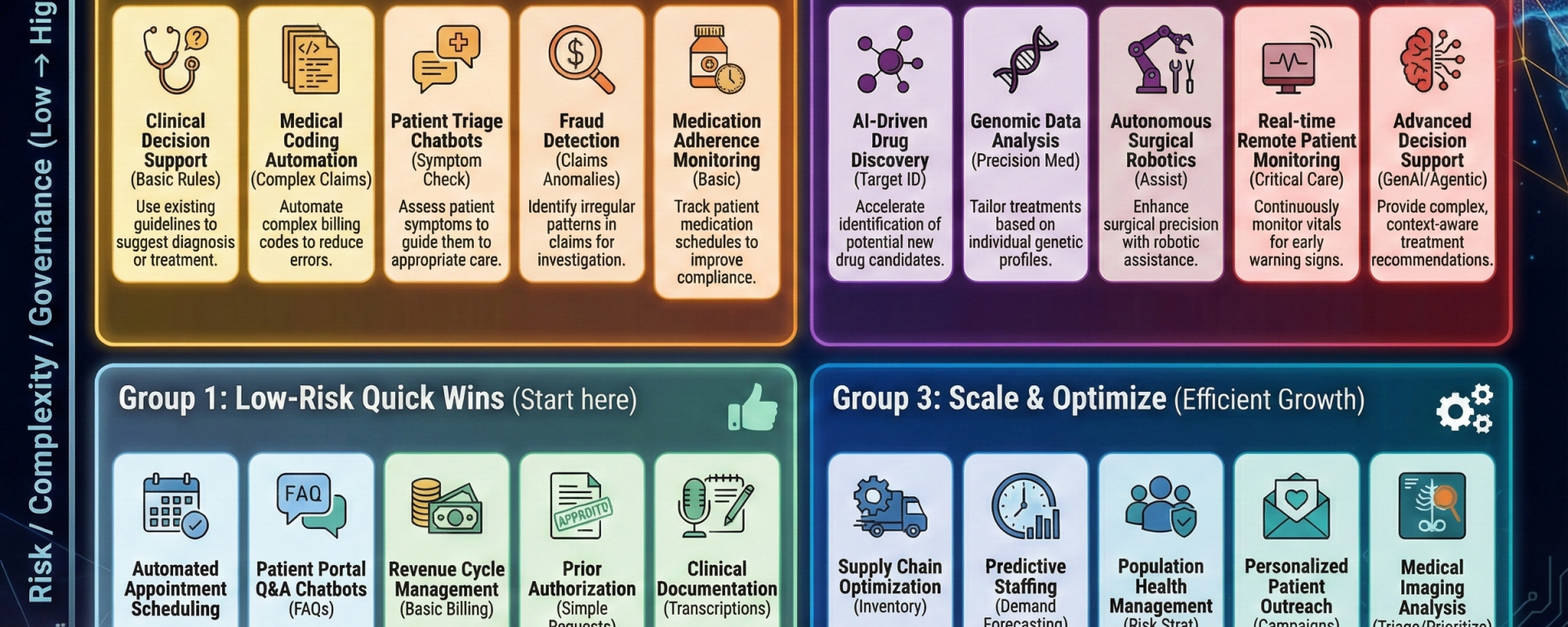
Use Case Prioritization Matrix for Strategic Implementation
The following grid categorizes 20 high-impact use cases across two dimensions: the organization’s current AI maturity (ranging from siloed data and ad-hoc experiments to board-approved strategies and centralized data lakes) and the level of complexity, regulatory risk, and governance required for safe deployment.
| Quadrant | Low Risk / Low Complexity / Low Governance | High Risk / High Complexity / High Governance |
| Low AI Maturity | Group 1: Foundational Automation 1. Ambient Clinical Scribing 2. Automated Appointment Scheduling 3. Patient FAQ & Navigation Chatbots 4. Automated Medical Coding 5. Front-End Eligibility Verification | Group 2: Targeted Clinical Innovation 6. Clinical Trial Matching & Recruitment 7. Medical Imaging Triage 8. Remote Patient Monitoring (RPM) 9. Virtual Symptom Assessment 10. Automated Drug Target Identification |
| High AI Maturity | Group 3: Enterprise Orchestration 11. “Touchless” Revenue Cycle Management 12. Hospital Bed & Resource Optimization 13. Enterprise Search & Knowledge Management 14. Supply Chain & Inventory Prediction 15. Workforce & Shift Scheduling Optimization | Group 4: Advanced Clinical Intelligence 16. AI-Powered Surgical Robotics 17. Personalized Oncology & Treatment Planning 18. Real-Time ICU Monitoring & Sepsis Prediction 19. Federated Machine Learning for Drug Discovery 20. Patient Digital Twins for Trial Simulation |
Group 1: Low AI Organizational Maturity and Low Risk / Complexity / Governance
This quadrant represents the entry point for most healthcare organizations. These use cases are characterized by high volume, repetitive tasks where the impact of an error is operational rather than clinical. They provide immediate ROI, which can be used to fund more complex initiatives while building organizational trust in AI.
1. Ambient Clinical Scribing and Documentation
The primary driver of physician burnout in North America is the administrative burden of clinical documentation. Ambient AI tools listen to the patient-doctor conversation and autonomously generate structured clinical notes, discharge summaries, and referral letters.3 This technology significantly reduces “pajama time”—the hours clinicians spend charting after work—allowing them to focus on face-to-face care. In 2025, the shift is toward agentic scribes that not only record notes but also flag dosing issues or detect protocol deviations during the conversation.11
- Industry Example (North America): Microsoft’s Nuance Dragon Copilot is widely used in US health systems to streamline clinical workflows and create EHR-ready documentation in real-time.3
- Industry Example (Europe): In Canada, the federally funded “Canada Health Infoway” program distributed 10,000 AI scribe licenses to primary care clinicians in 2025 to reduce administrative fatigue.13
2. Automated Patient Appointment Scheduling
Traditional scheduling is a labor-intensive process that results in high no-show rates and underutilized clinical assets. AI agents can autonomously handle the entire booking lifecycle: responding to inquiries, verifying availability across multiple provider calendars, and managing rescheduling or cancellations via natural language interfaces.3 These systems are “goal-oriented,” aiming to minimize patient wait times while maximizing resource utilization.16
- Industry Example (North America): Hippocratic AI launched a “Healthcare AI Agent App Store” in early 2025, allowing clinicians to deploy agents specifically for appointment scheduling and patient reminders.3
- Industry Example (Europe): Cabot specializes in deploying bespoke voice agents for German hospitals that integrate with leading Hospital Information Systems (HIS) to automate booking in a GDPR-compliant manner.17
3. Patient FAQ and Navigation Chatbots
Patient portals often present a high friction point for users. Multi-channel AI agents provide 24/7 support, answering non-clinical questions regarding facility directions, billing procedures, and general health education.18 These tools create a “digital front door” for the organization, handling routine queries that would otherwise overwhelm contact centers.
- Industry Example (North America): Aveanna Healthcare utilizes Amelia AI agents to handle repetitive employee and patient inquiries via mobile apps, including HR tasks and patient onboarding.15
- Industry Example (Europe): Virgin Pulse, operating across Europe and the US, maintains a 40% containment rate for patient inquiries by using Cognigy AI agents to resolve questions without human intervention.15
4. Automated Medical Coding
Medical coding requires translating clinical encounters into complex ICD-10 or CPT codes for reimbursement. AI agents use natural language processing (NLP) to analyze clinical notes and assign codes with higher precision than manual entry, reducing claim denials and accelerating the revenue cycle.14
- Industry Example (North America): Sully.ai provides AI medical coder agents that review records and ensure coding compliance, reportedly saving clinicians 3 hours per day on administrative charting.15
- Industry Example (Europe): XpertCoding is an AI-powered software used by European and North American practices to automatically code medical claims within 24 hours, facilitating faster revenue realization.21
5. Front-End Eligibility Verification and Prior Authorization
Denials at the “back end” of the revenue cycle are often rooted in “front end” failures, specifically incorrect insurance data or missing authorizations. AI agents can autonomously enter payer portals, read unstructured medical records to identify clinical evidence, and submit authorization forms with minimal human intervention.20
- Industry Example (North America): Thoughtful AI utilizes agents like “EVA” specifically for verifying eligibility and “CAM” for claims management, streamlining labor-intensive RCM tasks for US providers.23
- Industry Example (Europe): In the UK, the NHS AI Lab has piloted real-time data warehousing tools like CogStack to improve operational efficiencies and financial coding for NHS trusts.25
Group 2: Low AI Organizational Maturity and High Risk / Complexity / Governance
This quadrant includes use cases that touch clinical decision-making or sensitive research data. While the organization may still be developing its AI infrastructure, these initiatives require stringent governance, human-in-the-loop oversight, and adherence to specific clinical regulations like the EU AI Act (Annex III) or the HIPAA Security Rule.6
6. Clinical Trial Matching and Recruitment
Eighty-six percent of clinical trials fail to meet their enrollment targets. Agentic AI addresses this by autonomously reading clinical protocols, extracting complex eligibility rules, and scanning electronic health record (EHR) data to flag and rank potential participants without human prompting.11 This speeds up recruitment timelines from months to weeks and ensures a more diverse patient pool.
- Industry Example (North America): Pfizer and AstraZeneca utilize agentic AI in approximately 38% of their ongoing clinical trials to automate patient follow-up and recruitment matching.11
- Industry Example (Europe): IQVIA has partnered with NVIDIA to build specialized AI agents that navigate vast datasets to accelerate site activation and patient recruitment across European life sciences firms.4
7. Medical Imaging Triage and Anomaly Detection
Radiology teams face increasing pressure due to rising imaging volumes. AI algorithms can analyze scans (X-rays, CTs, MRIs) in seconds to flag life-threatening abnormalities such as fractures, strokes, or tumors. This allows for an “intelligent triage” system where the most urgent cases are pushed to the top of the radiologist’s queue.18
- Industry Example (North America): Radiologists in the US utilize AI tools to scan chest X-rays for pneumonia or lung cancer, allowing for immediate treatment instead of waiting for a manual review of thousands of images.29
- Industry Example (Europe): University Hospital Freiburg in Germany uses AI to automate the selection of exam protocols and triage clinical images, helping the team focus on complex cases while maintaining quality.28
8. Remote Patient Monitoring (RPM) and Risk Prediction
For patients with chronic conditions like heart failure or diabetes, AI-driven RPM uses wearable biosensors and mobile apps to monitor vital signs in real-time. Agentic systems analyze these data streams to detect patterns indicative of an impending crisis—such as atrial fibrillation or stroke—alerting clinicians before the patient requires emergency hospitalization.13
- Industry Example (North America): Canadian healthcare providers are increasingly deploying remote health monitoring that pairs biosensors with predictive analytics to identify health risks earlier in outpatient settings.13
- Industry Example (Europe): Cardiology centers in Europe use AI-powered ECG analysis to detect early signs of heart failure days before clinical symptoms appear, enabling proactive intervention.18
9. Virtual Symptom Assessment and Triage
Virtual triage assistants assess patient symptoms through structured natural language dialogues and recommend the next steps—whether it be home care, a telehealth visit, or an emergency room trip. This ensures that patients access the right level of care at the right time, reducing the burden on urgent care centers.3
- Industry Example (North America): Microsoft Cloud for Healthcare launched a healthcare agent service that assists with patient triage and appointment routing, helping US hospitals manage rising patient demand.3
- Industry Example (Europe): A study in the north of England found that AI could correctly predict 80% of cases where a patient needed transfer to a hospital based on mobility, pulse, and blood oxygen levels.10
10. AI-Accelerated Drug Target Identification
AI can process massive multi-omics and genomic datasets to identify new therapeutic targets that would be missed by human researchers. By predicting how proteins will fold (using models like AlphaFold) or identifying new antimicrobial peptides, AI compresses the early stages of drug discovery from years to months.16
- Industry Example (North America): Insilico Medicine uses AI to reason through hypotheses and design molecules autonomously, compressing early development timelines to just 12–18 months.11
- Industry Example (Europe): Iktos, a French startup, specializes in AI for discovering new chemical molecules for drug research, securing €15.5 million in funding to accelerate drug design pipelines.32
Group 3: High AI Organizational Maturity and Low Risk / Complexity / Governance
High-maturity organizations have centralized data, board-level AI oversight, and the technical backbone (such as FHIR-based APIs and scalable cloud environments) to orchestrate complex operations.12 These use cases focus on enterprise-wide efficiency and systemic optimization.
11. “Touchless” Revenue Cycle Management (RCM)
In a high-maturity environment, AI agents manage the entire back end of the revenue cycle autonomously. They can detect denials, enter the EHR to find clinical evidence for appeals, draft specific appeal letters, and log into payer portals to submit them.20 This approach can reduce the “cost-to-collect” by 30-60%, potentially saving a large health system $60 million to $120 million annually.20
- Industry Example (North America): Ensemble Health Partners combines AI with certified operators to achieve a “touchless” RCM engine for some of the largest health systems in the US.36
- Industry Example (Europe): Siemens Healthineers provides advanced workflow automation platforms in Germany that integrate clinical documentation with billing to ensure reimbursement accuracy.28
12. Hospital Bed and Resource Optimization
Predictive models analyze real-time admission and discharge data to forecast bed availability and staffing needs. High-maturity organizations use these insights to optimize hospital throughput, ensuring that resources like ICU beds and operating rooms are available exactly when needed, thereby reducing waste and wait times.27
- Industry Example (North America): Xsolis’s Dragonfly Platform uses predictive analytics to determine the appropriate level of care, helping Valley Medical Center improve review completion from 60% to 100%.27
- Industry Example (Europe): The Gloucestershire Hospital Business Intelligence team in the UK developed a machine learning model to identify patients at risk of long hospital stays, allowing for proactive discharge planning.25
13. Enterprise Knowledge Management and Semantic Search
Healthcare organizations generate petabytes of unstructured data in the form of clinical notes, research papers, and policy documents. Agentic AI acts as an intelligent layer that captures, processes, and delivers this information through conversational interfaces, allowing clinicians to find evidence-based answers in seconds.1
- Industry Example (North America): High-performing US health systems are 3x more likely to redesign workflows around AI, using agentic systems for deep research and service-desk management.1
- Industry Example (Europe): The NHS AI Lab’s “Data Lens” project provides a fast-access data search in multiple languages, bringing together information from multiple fragmented databases.25
14. AI-Driven Supply Chain and Inventory Prediction
Supply chain disruptions can halt surgical procedures and impact patient care. AI agents analyze usage patterns to predict when medications or surgical supplies will run low and automatically place reorders. This prevents shortages while simultaneously reducing the cost of overstocking and expired inventory.4
- Industry Example (North America): Large healthcare networks in the US use AI agents to manage medication inventory in real-time, predicting drug shortages and coordinating refills autonomously.15
- Industry Example (Europe): DHL’s Dortmund hub in Germany utilizes AI for route planning and warehouse management, achieving efficiency gains of up to 40% for medical supply chains.39
15. Workforce and Shift Scheduling Optimization
Staffing is the single largest expense and operational risk for healthcare providers. AI models forecast patient volumes to generate optimal nursing and physician placement schedules that adhere to complex labor laws and clinical requirements while minimizing staff burnout.18
- Industry Example (North America): US health systems use predictive analytics to model shift schedules based on anticipated patient volume, helping to reduce turnover and manage staffing shortages.18
- Industry Example (Europe): The NHS AI Lab has piloted tools to automatically generate nurse placement schedules that diversify student experience while meeting hospital staffing constraints.25
Group 4: High AI Organizational Maturity and High Risk / Complexity / Governance
This quadrant represents the “North Star” of healthcare AI—applications that are high-stakes, life-critical, and require the most advanced levels of organizational maturity, technical rigor, and regulatory alignment.
16. AI-Powered Surgical Robotics and Real-Time Guidance
The latest surgical robots use AI to provide real-time, intra-operative insights to surgeons. These systems can identify anatomical structures, stabilize tool movement to reduce tissue trauma, and even perform specific steps of a procedure—such as suturing—autonomously.18
- Industry Example (North America): Johns Hopkins University researchers demonstrated a robot that autonomously performed a portion of a gallbladder removal on a lifelike patient using models trained directly from surgical video.41
- Industry Example (Europe): CMR Surgical, a UK-based “unicorn,” uses NVIDIA’s IGX Thor platform to evaluate AI integration into its Versius surgical system, providing real-time recommendations to surgeons during procedures.42
17. Personalized Oncology and Precision Medicine Planning
AI agents synthesize genomic data, pathology slides, and clinical history to recommend individualized treatment plans. In oncology, these systems can predict how a specific patient’s tumor will respond to different chemotherapy regimens or immunotherapies, enabling “precision pharmacology”.18
- Industry Example (North America): Cleveland Clinic uses AI-powered pathology diagnostics to detect biomarkers for cancer and predict patient outcomes, reducing diagnostic error and accelerating time-to-treatment.27
- Industry Example (Europe): The “Digital Health Priority Research Program” in France focuses on imaging and AI to position France as a leader in precision oncology and personalized prevention.32
18. Real-Time ICU Monitoring and Sepsis Prediction
Sepsis is a life-threatening emergency where every hour of delayed treatment increases mortality. AI systems in the ICU continuously analyze hundreds of data points to predict the onset of sepsis or acute kidney injury hours before physical symptoms appear, giving clinicians a critical window for intervention.18
- Industry Example (North America): Large US medical centers use ICU monitoring agents that detect subtle signs of physiological deterioration, preventing “failure to rescue” events.18
- Industry Example (Europe): AI systems deployed in European ICUs have been shown to predict sepsis hours in advance, allowing for the timely administration of life-saving antibiotics.37
19. Federated Machine Learning for Multi-Partner Drug Discovery
Drug discovery usually involves proprietary data that companies are reluctant to share. Federated learning allows AI models to be trained on datasets housed behind multiple corporate firewalls without the data ever being moved or exposed. This “co-opetitive” model allows pharmaceutical giants to pool their insights to find promising molecules faster while maintaining data sovereignty.31
- Industry Example (North America): Major US biotech firms are adopting federated learning platforms to collaborate on rare disease research while complying with strict HIPAA privacy requirements.33
- Industry Example (Europe): The MELLODDY project, a consortium of 10 pharmaceutical companies including Roche, Janssen, and Sanofi, used federated learning and blockchain to pool a billion drug-development data points for predictive modeling.31
20. Patient Digital Twins for Trial Simulation and Surgery Planning
A digital twin is a personalized computational model of a patient’s physiology. High-maturity organizations use digital twins to simulate how a patient will respond to a specific surgical intervention or medication, effectively allowing for “virtual trials” before any physical treatment is administered.16
- Industry Example (North America): Siemens Healthineers has modeled the human liver to create digital patient twins, allowing surgeons in Canada and the US to simulate complex liver surgeries risk-free.28
- Industry Example (Europe): The EDITH project, supported by the European Commission, is developing a simulation platform for Virtual Human Twins to improve diagnosis and treatment across the EU.30
Deep Insight: The Convergence of Agentic AI and Structural Workflow Redesign
A critical second-order insight for CAIOs is that the value of agentic AI is not additive but transformative. Organizations that merely “bolt on” AI to existing manual processes often fail to see a significant ROI.1 High-performing organizations are nearly three times as likely to fundamentally redesign their workflows to integrate AI.1 For instance, in the revenue cycle, the shift is from a “human-led, AI-supported” model to an “agentic-led, human-oversight” model.20
The implications of this shift extend to the workforce. While 32% of survey respondents expect AI to decrease workforce size, 43% expect no change, suggesting that AI will primarily serve to “release” human capital for higher-value tasks.1 In a surgical context, the goal is not to replace the surgeon but to “empower” them with intelligent support, thereby “democratizing” minimally invasive surgery.42 This necessitates a new “Human-in-the-Loop” paradigm where AI generates the output and human experts review it for clinical judgment and empathy—a concept championed in France as “Human Guarantee”.11
Regional Analysis: North American Commercial Speed vs. European Regulatory Rigor
The CAIO must adapt their strategy based on the distinct regulatory and cultural landscapes of North America and Europe.
North American Landscape: Scaling for ROI and Efficiency
In the US and Canada, the focus is on “value generation” and rapid ROI. Healthcare organizations are shifting from “experimentation” to “operational deployment at scale”.2 North American CAIOs are prioritizing:
- HIPAA Compliance: Ensuring that AI training data and prompts do not leak protected health information (PHI).5
- Revenue Infrastructure: Reframing provider credentialing and coding as revenue-enabling functions that can be accelerated through automation.40
- SaMD Regulation: Navigating the FDA’s classification of AI as a medical device when it enters the realm of diagnosis or treatment.5
European Landscape: Sovereignty, Trust, and the AI Act
In Europe, the strategy is shaped by a “third way”—balancing innovation with high ethical standards and digital sovereignty.7 European CAIOs must prioritize:
- EU AI Act Compliance: High-risk systems (including most clinical diagnostics) face stringent requirements for transparency, human oversight, and technical documentation.6 Non-compliance can lead to penalties of up to €35 million or 7% of global turnover.50
- Data Sovereignty: Strategies in France and Germany emphasize that health data is a strategic asset that must remain under European jurisdiction, fostering a unique ecosystem for federated learning and “sovereign AI” models.7
- GDPR Interpretation: Managing the fragmented enforcement of GDPR across different EU member states (e.g., Germany’s 16 federal states) while ensuring that data used for AI training is lawfully processed.51
Key Strategic Actions for CAIOs and Senior AI Leaders
To move beyond the pilot phase and capture the projected 30-60% efficiency gains, CAIOs must execute a disciplined strategic playbook.
1. Formalize Governance and Oversight Committees
AI deployment requires a cross-functional steering committee that includes clinical leads, IT specialists, compliance officers, and ethicists.53 This committee should establish:
- Risk Classification: Categorizing every use case according to the EU AI Act or HIPAA risk frameworks.50
- Bias Mitigation: Implementing regular audits to ensure that AI models do not perpetuate health disparities across demographic groups.53
- Escalation Paths: Defining exactly when an AI system must “hand over” a decision to a human clinician.5
2. Prioritize “Vertical AI” Partnerships
General-purpose AI models are prone to “hallucinations” and lack the deep domain knowledge required for clinical accuracy.10 CAIOs should prioritize “Vertical AI” companies that specialize in healthcare and life sciences, grounding their models in medical terminology and specific regulatory requirements.26 Partnerships with platform leaders like NVIDIA and Microsoft can provide the “AI-ready” infrastructure needed to scale these specialized agents.4
3. Redesign Workflows for Agentic Collaboration
True value is captured when AI is not just a tool but a participant in the workflow. Leaders must:
- Map “White Space”: Identify the unproductive time between trial phases or clinical tasks where agentic AI can eliminate bottlenecks.26
- Define Success Metrics Upfront: Link every AI initiative to a specific operational KPI, such as “reduction in cost-to-collect” or “improvement in time-to-diagnosis”.40
- Invest in Change Management: Dedicate 70% of the effort to training staff and fostering a culture of “AI fluency”.8
4. Build Adaptive and Interoperable Data Systems
Maturity Level 4 requires that data integration is achieved in real-time or near-real-time for critical applications.34 CAIOs must:
- Implement Standardized APIs: Use FHIR (Fast Healthcare Interoperability Resources) to ensure that AI agents can communicate seamlessly with EHRs and HIS.12
- Monitor Model Drift: Establish continuous performance monitoring to detect when an AI model’s accuracy degrades as real-world data evolves.5
- Harden Infrastructure: Embed cybersecurity and Zero Trust architectures into the AI lifecycle to protect sensitive patient data.12
5. Transition to Production-Scale Deployments
The era of experimentation is ending. By 2026, the focus for healthcare CIOs and CAIOs will be on “disciplined execution” and “platformized architectures”.12 Leaders should launch data-driven pilot projects with clear KPIs and then move rapidly to full-scale implementation, avoiding the “pilot purgatory” that has stalled previous digital initiatives.40
The future of healthcare is one of “intelligent surgical support,” “touchless revenue cycles,” and “personalized oncology,” all orchestrated by goal-oriented AI agents.20 For the CAIO, the challenge is to lead this transition with a strategy that balances the aggressive acceleration of technology with the foundational requirements of clinical safety, regulatory compliance, and human empathy.
Works cited
- The State of AI: Global Survey 2025 | McKinsey, accessed January 28, 2026, https://www.mckinsey.com/capabilities/quantumblack/our-insights/the-state-of-ai
- Generative AI success patterns: what to expect in 2025 – Onix Networking, accessed January 28, 2026, https://www.onixnet.com/blog/generative-ai-success-patterns-what-to-expect-in-2025/
- Agentic AI In Healthcare Market Size | Industry Report, 2030 – Grand View Research, accessed January 28, 2026, https://www.grandviewresearch.com/industry-analysis/agentic-ai-healthcare-market-report
- Agentic AI | Life Sciences | IQVIA, accessed January 28, 2026, https://www.iqvia.com/solutions/innovative-models/artificial-intelligence-and-machine-learning/agentic-ai
- Healthcare AI Governance: Safety, Compliance & Trust in Medical AI – Swept AI, accessed January 28, 2026, https://www.swept.ai/healthcare-ai-governance
- High-level summary of the AI Act | EU Artificial Intelligence Act, accessed January 28, 2026, https://artificialintelligenceact.eu/high-level-summary/
- France’s National Strategy on Data and Artificial Intelligence in Healthcare (2025–2028), accessed January 28, 2026, https://www.frenchexpertinireland.com/blog/frances-national-strategy-on-data-and-artificial-intelligence-in-healthcare-2025-2028/
- The State of AI in 2024-2025: What McKinsey’s Latest Report Reveals About Enterprise Adoption – PUNKU.AI Blog, accessed January 28, 2026, https://www.punku.ai/blog/state-of-ai-2024-enterprise-adoption
- From pilot to scale: Bringing structure to AI chaos – Vizient Inc., accessed January 28, 2026, https://www.vizientinc.com/insights/blogs/2025/from-pilot-to-scale-bringing-structure-to-ai-chaos
- 7 ways AI is transforming healthcare – The World Economic Forum, accessed January 28, 2026, https://www.weforum.org/stories/2025/08/ai-transforming-global-health/
- Understanding Agentic AI: How It’s Changing the Landscape of …, accessed January 28, 2026, https://trialx.com/understanding-agentic-ai-how-its-changing-the-landscape-of-clinical-trials/
- 10 Key Priorities Every Healthcare CIO Needs for 2026 – RapidScale, accessed January 28, 2026, https://rapidscale.net/resources/blog/industries/10-key-priorities-every-healthcare-cio-needs-for-2026
- Healthcare AI 2025 – Canada | Global Practice Guides | Chambers and Partners, accessed January 28, 2026, https://practiceguides.chambers.com/practice-guides/healthcare-ai-2025/canada/trends-and-developments
- Agentic AI in Healthcare System and its Uses | Complete Guide – XenonStack, accessed January 28, 2026, https://www.xenonstack.com/blog/agentic-ai-healthcare-system
- Top 10+ AI Agents in Healthcare: Use Cases & Examples – AIMultiple research, accessed January 28, 2026, https://research.aimultiple.com/ai-agents-in-healthcare/
- AI Agents in Healthcare: Benefits, Use Cases, Future Trends | SaM Solutions, accessed January 28, 2026, https://sam-solutions.com/blog/ai-agents-in-healthcare/
- AI-Powered Voice Agents for Healthcare in Germany – Cabot Solutions, accessed January 28, 2026, https://www.cabotsolutions.com/loc/ai-powered-voice-agents-healthcare-germany
- AI for Healthcare: Better Care, Access, and Efficiency | Vonage, accessed January 28, 2026, https://www.vonage.com/resources/articles/ai-for-healthcare/
- AI in Healthcare: 70+ Use Cases, Trends & Outlook – GoGloby, accessed January 28, 2026, https://gogloby.com/case-studies/ai-use-cases-in-healthcare/
- Revenue Cycle Management: Why Agentic AI is the answer to $140 Billion in waste, accessed January 28, 2026, https://moveo.ai/blog/revenue-cycle-management
- HGS Healthcare vs. Thoughtful AI Comparison – SourceForge, accessed January 28, 2026, https://sourceforge.net/software/compare/HGS-Healthcare-vs-Thoughtful.ai/
- How Agentic AI is Changing Healthcare RCM | FinThrive, accessed January 28, 2026, https://finthrive.com/blog/how-agentic-ai-is-changing-healthcare-rcm-finthrive
- Bookend Healthcare AI Agent vs. Thoughtful AI Comparison – SourceForge, accessed January 28, 2026, https://sourceforge.net/software/compare/Bookend-Healthcare-AI-Agent-vs-Thoughtful.ai/
- Compare Smarter Technologies vs. Thoughtful AI in 2026, accessed January 28, 2026, https://slashdot.org/software/comparison/Smarter-Technologies-vs-Thoughtful.ai/
- Case studies – NHS England Digital, accessed January 28, 2026, https://digital.nhs.uk/services/ai-knowledge-repository/case-studies
- Building blocks: Agentic AI is Transforming trial design, management, and outcomes, accessed January 28, 2026, https://www.medable.com/knowledge-center/guides-building-blocks-agentic-ai-is-transforming-trial-design-management-and-outcomes
- AI Use Cases in Healthcare – Xsolis, accessed January 28, 2026, https://www.xsolis.com/blog/ai-use-cases-in-healthcare/
- From innovation to impact: How AI elevates patient care – Siemens Healthineers, accessed January 28, 2026, https://www.siemens-healthineers.com/perspectives/from-innovation-to-impact-AI-in-healthcare
- How AI-Powered Applications Are Redefining Healthcare in 2025, accessed January 28, 2026, https://www.brevitytechnology.ca/how-ai-powered-applications-are-redefining-healthcare-in-2025/
- Review of AI/ML applications in medicines lifecycle (2024) – Horizon …, accessed January 28, 2026, https://www.ema.europa.eu/en/documents/report/review-artificial-intelligence-machine-learning-applications-medicines-lifecycle-2024-horizon-scanning-short-report_en.pdf
- MELLODDY: A ‘co-opetitive’ machine learning platform powered by Owkin, accessed January 28, 2026, https://www.owkin.com/blogs-case-studies/melloddy-a-co-opetitive-platform-for-machine-learning-across-companies-powered-by-owkin-technology
- Digital health – French Healthcare, accessed January 28, 2026, https://frenchhealthcare.com/expertises/digital-health/
- Top 8 French AI Startups Shaping the future of Tech Industries in 2025 – AI News Hub, accessed January 28, 2026, https://www.ainewshub.org/post/top-8-french-ai-startups-shaping-the-future-of-tech-industries-in-2025
- Health AI Maturity Model – Digital Medicine Society (DiMe), accessed January 28, 2026, https://dimesociety.org/ai-implementation-in-healthcare-playbook/ai-evaluation-readiness/health-ai-maturity-model/
- Agentic AI: The race to a touchless revenue cycle | McKinsey, accessed January 28, 2026, https://www.mckinsey.com/industries/healthcare/our-insights/agentic-ai-and-the-race-to-a-touchless-revenue-cycle
- Agentic AI Use Cases in Revenue Cycle Management – Ensemble Health Partners, accessed January 28, 2026, https://www.ensemblehp.com/blog/top-use-cases-for-agentic-ai-in-revenue-cycle-management/
- Artificial Intelligence in healthcare – Public Health – European Commission, accessed January 28, 2026, https://health.ec.europa.eu/ehealth-digital-health-and-care/artificial-intelligence-healthcare_en
- Top 11 agentic AI uses in healthcare – Becker’s Hospital Review, accessed January 28, 2026, https://www.beckershospitalreview.com/healthcare-information-technology/ai/top-11-agentic-ai-uses-in-healthcare/
- How German Companies Take Off with AI Tools – Success Stories from Cities and Federal States – Linvelo, accessed January 28, 2026, https://linvelo.com/how-german-companies-take-off-with-ai-tools-success-stories-from-cities-and-federal-states/
- Healthcare Strategy 2026: Key Lessons from 2025 Trends – Neolytix, accessed January 28, 2026, https://neolytix.com/articles/planning-healthcare-strategy-2026-lessons-from-2025/
- AI-Driven Surgical Robotics: The New Standard – Claret Capital, accessed January 28, 2026, https://www.claret-capital.com/articles/ai-driven-surgical-robotics-the-new-standard/
- CMR Surgical adopts NVIDIA IGX THOR for AI-powered, next generation surgical robotics, accessed January 28, 2026, https://www.cic.vc/cmr-surgical-adopts-nvidia-igx-thor-for-ai-powered-next-generation-surgical-robotics/
- Newest Surgical Robot: The Amazing Technology for Today – Liv Hospital, accessed January 28, 2026, https://int.livhospital.com/newest-surgical-robot-the-amazing-technology-for-today/
- CMR Surgical – BVCA, accessed January 28, 2026, https://www.bvca.co.uk/casestudy/cmr-surgical.html
- CMR Surgical Turns to NVIDIA AI for Smarter Surgical Robotics, accessed January 28, 2026, https://www.mpo-mag.com/breaking-news/cmr-surgical-turns-to-nvidia-ai-for-smarter-surgical-robotics/
- Agentic AI in Healthcare: Use Cases, Benefits & Strategies – Ideas2IT, accessed January 28, 2026, https://www.ideas2it.com/blogs/agentic-ai-in-healthcare
- MELLODDY | IHI Innovative Health Initiative – European Union, accessed January 28, 2026, https://www.ihi.europa.eu/projects-results/project-factsheets/melloddy
- New Research Consortium Seeks to Accelerate Drug Discovery Using Machine Learning to Unlock Maximum Potential of Pharma Industry Data, accessed January 28, 2026, https://innovativemedicine.jnj.com/emea/stories/new-research-consortium-seeks-accelerate-drug-discovery-using-machine-learning-unlock-maximum
- Federated learning model allows competitors to pool data & identify promising molecules, accessed January 28, 2026, https://www.ihi.europa.eu/news-events/newsroom/federated-learning-model-allows-competitors-pool-data-identify-promising
- How to Achieve EU AI Act Compliance and Build Trustworthy AI – Secureframe, accessed January 28, 2026, https://secureframe.com/blog/eu-ai-act-compliance
- The SME Compliance Paradox: Why German Small Businesses Excel at GDPR but Struggle with AI Rules – AI & Automation – Issues – dotmagazine, accessed January 28, 2026, https://www.dotmagazine.online/issues/ai-automation/german-smes-ai-compliance
- Artificial Intelligence 2025 – Germany | Global Practice Guides | Chambers and Partners, accessed January 28, 2026, https://practiceguides.chambers.com/practice-guides/artificial-intelligence-2025/germany
- AI Governance in Healthcare: Frameworks & Best Practices – Superblocks, accessed January 28, 2026, https://www.superblocks.com/blog/ai-governance-healthcare
- AI Risk Management Framework – Palo Alto Networks, accessed January 28, 2026, https://www.paloaltonetworks.com/cyberpedia/ai-risk-management-framework
- View of 2025 Watch List: Artificial Intelligence in Health Care, accessed January 28, 2026, https://canjhealthtechnol.ca/index.php/cjht/article/view/ER0015/ER0015
- Healthcare IT Workforce Trends for 2026 | CIO Guide – HealthStream, accessed January 28, 2026, https://www.healthstream.com/cio-trends-to-watch-2026
- 2025 Watch List: Artificial Intelligence in Health Care – Canada’s Drug Agency, accessed January 28, 2026, https://www.cda-amc.ca/sites/default/files/Tech%20Trends/2025/ER0015%3D2025_Watch_List.pdf
This article was written with my brain and two hands (primarily) with the help of Google Gemini, Notebook LM, Claude, and other wondrous toys.
 Adam Outside The Box