The financial services sector in North America and Europe has entered a transformative period characterized by the transition from passive analytical tools to proactive, autonomous systems known as agentic AI. For the Chief AI Officer (CAIO) and senior leadership, the strategic mandate has shifted from simple experimentation and “pilot purgatory” to the large-scale orchestration of digital workforces that can reason, plan, and execute complex business processes with minimal human intervention.1 Research indicates that the potential value at stake is monumental, with estimates suggesting that AI could deliver between $2.6 trillion and $4.4 trillion in annual value across more than 60 use cases globally.2 In the banking sector alone, Citi estimates that AI could lift industry profits by 9%, or approximately $170 billion, by 2028.3
The current landscape is defined by a dichotomy between organizational maturity and risk tolerance. While 65% of organizations reported using generative AI in at least one business function by 2025, only 23% are successfully scaling agentic AI systems.4 This report provides a comprehensive taxonomy of 20 high-impact use cases, categorized by organizational maturity and risk complexity, to help CAIOs prioritize investments. These use cases range from internal productivity tools—which provide immediate 50% efficiency gains—to autonomous anti-money laundering (AML) squads capable of driving 2,000% productivity improvements by fundamentally reimagining the human-to-machine relationship.6
As financial institutions navigate the regulatory pressures of the EU AI Act and North American sectoral requirements, the adoption of “Sovereign AI” and specialized foundation models is becoming a strategic necessity.8 The report concludes with actionable recommendations for CAIOs, focusing on the development of agentic governance frameworks, the modernization of data foundations, and the radical redesign of roles where humans transition from practitioners to supervisors of an AI-driven workforce.6
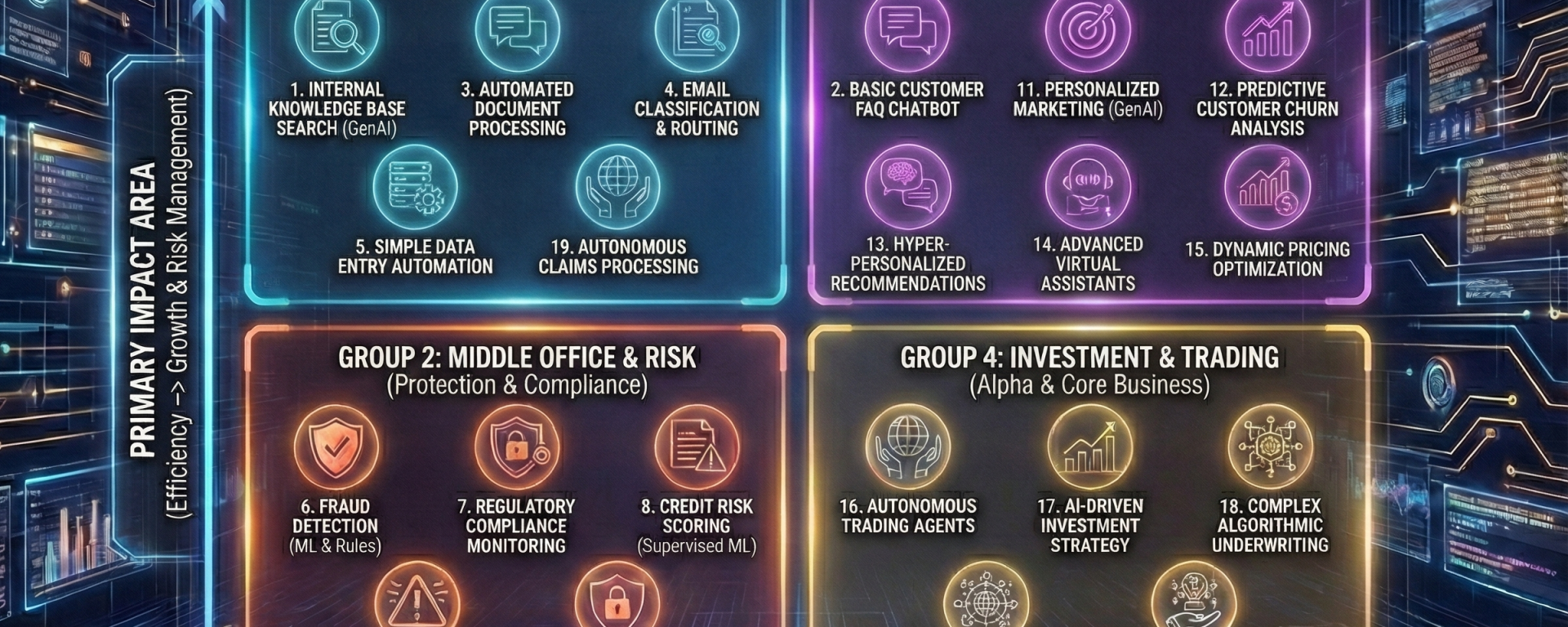
The Strategic AI Use Case Grid
The following grid categorizes the top 20 business use cases across four distinct quadrants based on organizational maturity and the complexity of the risk/governance environment.
| Quadrant | Use Case Classification | Business Use Cases | Strategic Driver |
| 1 | Low Maturity / Low Risk & Governance | 1. Employee Productivity Assistants 2. Retail Banking FAQ Bots 3. Automated Document Extraction 4. IT Service Desk Automation 5. Marketing Copy Generation | Operational Efficiency |
| 2 | Low Maturity / High Risk & Governance | 6. AI-Assisted KYC Onboarding 7. Regulatory Change Monitoring 8. Real-time Transaction Monitoring 9. ESG Compliance Aggregation 10. Legacy Code Refactoring | Regulatory Resilience |
| 3 | High Maturity / Low Risk & Governance | 11. Hyper-Personalized Wealth Nudges 12. Predictive Customer Churn Prevention 13. AI-Native DevOps Triage 14. Multi-Agent Sales Acceleration 15. Autonomous Campaign Orchestration | Revenue Growth |
| 4 | High Maturity / High Risk & Governance | 16. Agentic Fraud Kill-Switches 17. Real-Time Liquidity Optimization 18. Autonomous Credit Underwriting 19. Multi-Agent AML Squads 20. Autonomous Claims Adjudication | Business Transformation |
Detailed Examination of High-Impact AI Use Cases
Quadrant 1: Low Maturity and Low Risk, Complexity, and Governance
The primary objective for organizations in this quadrant is to achieve rapid “quick wins” that demonstrate value to stakeholders while building foundational AI capabilities. These use cases focus on internal efficiencies and low-stakes customer interactions.
1. Internal Employee Productivity Assistants
The deployment of Large Language Model (LLM) powered assistants for internal use represents the most widespread application of generative AI. These tools assist employees in summarizing research, drafting internal communications, and transcribing calls. In Singapore and Europe, OCBC Bank reported a 50% efficiency gain after a trial where chatbots were used to summarize reports and handle document translation.7
- Organizational Impact: High (Reduces manual synthesis time).
- Customer Impact: Moderate (Indirectly improves response times).
- Employee Impact: High (Eliminates drudgery).
- Industry Example: OCBC Bank (Europe/Asia) utilized internal knowledge bases to optimize back-office operations.7
2. Retail Banking FAQ Chatbots
Standard conversational agents provide 24/7 support for routine inquiries such as balance checks or account troubleshooting. These systems serve as the first line of defense in customer service. Wells Fargo’s virtual assistant, “Fargo,” handled over 245 million interactions in 2024, demonstrating that even basic AI can operate at massive volume in a regulated environment.3
- Organizational Impact: High (Massive deflection of call center traffic).
- Customer Impact: High (Instant 24/7 service).
- Employee Impact: Moderate (Reduces volume of repetitive tickets).
- Industry Example: Wells Fargo (North America) uses Fargo to provide insights into spending and routine task assistance.3
3. Automated Document Extraction for Mortgages
Mortgage processing in the US and Europe is traditionally document-intensive. AI-driven information extraction tools use OCR and NLP to digitize application data, reducing manual entry errors and cycle times. McKinsey research suggests these tools can cut document production lead times by up to 60%.4
- Organizational Impact: Moderate (Speeds up the lending pipeline).
- Customer Impact: Moderate (Faster loan approvals).
- Employee Impact: High (Reduces data entry burden).
- Industry Example: Universal banks in North America have deployed data extraction for KYC and mortgage validation pilots.6
4. IT Service Desk Automation
Automating password resets and software provisioning via AI agents allows IT teams to focus on cybersecurity and infrastructure rather than routine support. Leading firms use “IT Helpdesk Agents” to resolve software access requests instantly, which is critical for maintaining productivity in large financial institutions.11
- Organizational Impact: Moderate (Improves internal uptime).
- Customer Impact: Low (Internal focused).
- Employee Impact: High (Immediate resolution of technical blockers).
- Industry Example: General fintechs in the US and Europe use IT agents to handle account setup and troubleshooting.7
5. Marketing Content Personalization
Generative AI enables marketing departments to create thousands of variations of ad copy and email content tailored to specific customer segments. In the retail banking sector, this allows for hyper-local campaigns that increase conversion rates.4
- Organizational Impact: Moderate (Lower content production costs).
- Customer Impact: Moderate (More relevant product offers).
- Employee Impact: Moderate (Augments creative teams).
- Industry Example: European retail banks use AI-driven content generation for personalized marketing campaigns.4
Quadrant 2: Low Maturity and High Risk, Complexity, and Governance
Organizations in this quadrant must navigate stringent regulatory requirements and high-stakes operational risks. The focus here is on compliance, safety, and modernizing core infrastructure.
6. AI-Assisted KYC Onboarding
Know Your Customer (KYC) processes are a critical bottleneck in banking. AI agents can autonomously gather data from public registers and verify beneficial owners, flagging only complex cases for human review. Citigroup and HSBC have been leaders in deploying these tools to reduce onboarding costs by 30-40%.12
- Organizational Impact: High (Significant reduction in compliance costs).
- Customer Impact: High (Faster account opening).
- Employee Impact: Moderate (Focus shifts to investigative work).
- Industry Example: Citi (North America/Europe) uses AI tools to manage decision cycles and operational cost reduction.12
7. Regulatory Scanning and Horizon Scanning
Financial firms must track thousands of shifting regulations across North America and Europe. Agentic AI can continuously monitor regulatory bodies, map changes to specific business processes, and alert compliance officers to potential gaps.2
- Organizational Impact: High (Protects against non-compliance penalties).
- Customer Impact: Low (Internal compliance).
- Employee Impact: High (Automates tedious monitoring tasks).
- Industry Example: Kyriba and Bloomberg (Global) provide platforms that automate regulatory scanning and compliance checks.15
8. Real-Time Transaction Monitoring for Fraud
Traditional fraud systems generate high false-positive rates. AI-driven monitoring uses behavioral analysis to detect anomalies in real-time, reducing customer friction while enhancing security. Mastercard reported that AI helped cut false positives by up to 200% and doubled detection speed.3
- Organizational Impact: High (Reduces fraud losses).
- Customer Impact: High (Fewer legitimate transactions blocked).
- Employee Impact: Moderate (Investigators handle higher-quality alerts).
- Industry Example: Mastercard (North America) uses generative AI to detect compromised cards and at-risk merchants.3
9. ESG Data Aggregation and Reporting
The European Union’s CSDDD and other ESG mandates require firms to report on the sustainability of their entire supply chain. AI aggregates data from audits, satellite imagery, and news to provide a consolidated view for reporting.14
- Organizational Impact: Moderate (Ensures regulatory compliance).
- Customer Impact: Moderate (Transparency on ethical banking).
- Employee Impact: Moderate (Simplifies complex data gathering).
- Industry Example: Prewave (Europe) monitors ESG risks for businesses to ensure compliance with European regulations.16
10. Legacy Code Migration and Refactoring
Many North American banks still rely on COBOL-based systems. Agentic AI can analyze legacy code, generate modern counterparts in Java or Python, and autonomously write tests to ensure functional parity.1
- Organizational Impact: High (Reduces technical debt and operational risk).
- Customer Impact: Moderate (Indirectly improves service agility).
- Employee Impact: High (Empowers developers to modernize systems).
- Industry Example: BNY (North America) utilizes AI agents to work autonomously on coding and operational validation.10
Quadrant 3: High Maturity and Low Risk, Complexity, and Governance
Organizations in this quadrant leverage their technological edge to drive revenue, optimize internal workflows, and deliver a superior customer experience through sophisticated, proactive systems.
11. Hyper-Personalized Wealth Management Nudges
High-maturity wealth management platforms use AI to provide tailored “financial health” nudges. These systems analyze spending patterns and market shifts to recommend specific portfolio adjustments or savings goals. Citi’s wealth platform uses conversational assistants to help advisors answer complex scenario-based questions.12
- Organizational Impact: High (Increases AUM and customer loyalty).
- Customer Impact: High (Personalized financial guidance).
- Employee Impact: High (Advisors focus on strategy, not data entry).
- Industry Example: Citi (North America) has rolled out AI tools in its wealth arm to improve decision support.12
12. Predictive Customer Churn Prevention
Advanced fintechs use predictive analytics to identify early signs of churn—such as declining app engagement or lower transaction frequency—and trigger automated, personalized retention offers.17
- Organizational Impact: High (Reduces customer acquisition costs).
- Customer Impact: Moderate (Receives relevant retention benefits).
- Employee Impact: Moderate (Marketing teams work with higher-quality data).
- Industry Example: Fintech apps in the North American streaming and lending space use these models to maintain engagement.17
13. AI-Native DevOps Triage and Release Readiness
For organizations with thousands of deployments per month, AI agents can autonomously triage failed builds, identify root causes in logs, and propose fixes. This reduces MTTR and ensures high-speed delivery cycles.18
- Organizational Impact: High (Faster release velocity).
- Customer Impact: Moderate (Fewer app outages/bugs).
- Employee Impact: High (Reduces on-call developer burnout).
- Industry Example: Digital-first banks in Europe and North America utilize AI to optimize their software delivery pipelines.18
14. Multi-Agent Sales Acceleration
Agentic systems can coordinate across disparate sales databases to enrich leads, prioritize high-value prospects, and draft personalized outreach. This has been shown to increase net new AUM by up to 40% in wealth management contexts.13
- Organizational Impact: High (Direct revenue uplift).
- Customer Impact: Moderate (More relevant sales interactions).
- Employee Impact: High (Sales teams focus on closing, not research).
- Industry Example: Wealth management firms in North America use multi-agent systems for prospecting acceleration.13
15. Autonomous Marketing Campaign Orchestration
Sophisticated marketing platforms use “Agentic Studios” to plan, execute, and optimize multi-channel campaigns autonomously. These systems can adjust spending in real-time based on conversion data, eliminating manual intervention in campaign management.1
- Organizational Impact: Moderate (Optimized marketing spend).
- Customer Impact: Moderate (Consistent, personalized messaging).
- Employee Impact: Moderate (Marketing managers focus on high-level strategy).
- Industry Example: New marketing platforms launched in 2025 feature agentic collaboration for end-to-end production.1
Quadrant 4: High Maturity and High Risk, Complexity, and Governance
This quadrant represents the “North Star” of AI implementation, where autonomous agents take over mission-critical workflows, driving massive productivity gains while requiring the most advanced governance and auditability frameworks.
16. Agentic Fraud Kill-Switches
Going beyond detection, agentic fraud systems can take autonomous action—such as instantly freezing a card or a commercial account—when high-risk patterns are detected in real-time. These systems operate with “kill-switch” protocols that trigger without waiting for human intervention.12
- Organizational Impact: High (Dramatically lower fraud losses).
- Customer Impact: High (Immediate protection of funds).
- Employee Impact: Moderate (Fraud teams oversee system logic).
- Industry Example: Tier-one banks in North America use these agents for real-time portfolio adjustments and fraud alerts.12
17. Real-Time Liquidity and Treasury Optimization
In treasury management, agentic systems act as dynamic liquidity optimizers, making real-time decisions on pricing, hedging, and cash sweeps across multiple currencies and jurisdictions. HSBC research indicates that deploying AI in treasury can boost efficiency by up to 70%.19
- Organizational Impact: High (Optimized working capital).
- Customer Impact: Moderate (Better rates for corporate clients).
- Employee Impact: High (Teams focus on strategic capital allocation).
- Industry Example: HSBC (Europe) has integrated AI to help corporate treasurers run stress-testing and cash flow forecasting in minutes.21
18. Autonomous Credit Underwriting and Scoring
AI models can now analyze non-traditional data—such as transactional behavior and utility payments—to provide instant credit decisions. This is particularly impactful for “thin-file” borrowers. In the UK, an AI model for a high-street bank identified 83% of bad debt missed by traditional scores.23
- Organizational Impact: High (Lower default rates, higher loan volume).
- Customer Impact: High (Instant loan approvals and financial inclusion).
- Employee Impact: Moderate (Underwriters handle only complex exceptions).
- Industry Example: Neontri and high-street banks in the UK use AI models to improve default prediction by 15-25%.23
19. Multi-Agent AML Investigations
By deploying “squads” of agents—including Researchers, Critics, and QA agents—banks can automate the end-to-end AML investigation process. McKinsey reports that this can lead to productivity gains of 200% to 2,000%, as humans transition from practitioners to supervisors of the AI workforce.6
- Organizational Impact: High (Significant reduction in investigative costs).
- Customer Impact: Low (Internal compliance).
- Employee Impact: High (Radical shift in daily workflow).
- Industry Example: Global universal banks have implemented “AI factories” for end-to-end KYC and AML workflows.6
20. Autonomous Claims Adjudication
In the insurance and payments space, agentic AI can handle simple claims—such as food spoilage or routine medical bills—with no human intervention. Allianz’s “Project Nemo” uses seven specialized agents to adjudicate claims in minutes, reducing processing time by 80%.24
- Organizational Impact: High (Dramatic reduction in LAE ratios).
- Customer Impact: High (Claims paid in seconds/minutes).
- Employee Impact: Moderate (Claims adjusters handle complex, empathetic cases).
- Industry Example: Allianz (Australia/Europe) and Lemonade (North America/Europe) handle over 55% of claims autonomously.24
Comparative Impact Analysis
The following table summarizes the quantitative impact of these use cases on organizational performance, as reported by major research firms and financial institutions.
| Performance Metric | Traditional Baseline | GenAI Impact (Copilot) | Agentic AI Impact (Colleague) |
| AML/KYC Investigation Time | 4-8 Hours 13 | 3-4 Hours | 5-15 Minutes 6 |
| Credit Scoring Accuracy | 70-75% | 80-85% | 90%+ 23 |
| Claims Cycle Time | 10-14 Days 24 | 3-5 Days | <1 Hour 24 |
| Fraud False Positive Ratio | High (Varies) | -50% | -200% 3 |
| Treasury Op Efficiency | Manual/Reactive | Semi-Automated | +70% Efficiency 20 |
| Code Migration Velocity | Very Slow | 2x Speed | 5-10x Speed 1 |
Key Strategic Actions for CAIOs and Senior AI Leaders
The transition to an agentic financial institution requires a multi-faceted strategy that addresses governance, data, talent, and infrastructure.
1. Modernize Model Risk Management (MRM) for Autonomy
Traditional MRM is insufficient for agents that can plan and act. CAIOs must implement “Agentic Governance” which includes real-time monitoring of agent conversations and rationales.
- Audit Trails: Every decision made by an agent must be accompanied by an auditable rationale and a record of the data used.6
- Self-Healing QA: Incorporate “Critic” agents in every squad to review outputs before they are finalized.6
- Regulatory Alignment: Ensure systems comply with the EU AI Act’s transparency and fairness requirements, especially for high-risk credit and insurance models.9
2. Radical Redesign of the Operating Model
Avoid the trap of automating subpar processes. Instead, reimagine the value chain for an “AI-first” world where humans supervise rather than perform tasks.
- Squad Architectures: Move away from individual AI tools toward “squads” of agents with specialized roles (Planner, Researcher, Auditor).6
- Exception Management: Design systems to autonomously handle the bottom 80% of volume, allowing human experts to focus on the 20% of high-complexity, high-empathy cases.6
3. Build a Robust Data and Infrastructure Foundation
Agentic AI is only as good as the data it can access.
- API Abstraction Layers: Build secure, high-concurrency API layers to connect modern AI agents with legacy core systems (COBOL/Mainframe) without latency.12
- Data Lineage and Governance: Establish robust data lineage to enhance the explainability of agentic decisions and meet regulatory standards like GDPR and DORA.10
- Sovereign AI Stacks: Invest in specialized foundation models and local infrastructure to reduce reliance on third-party providers and ensure data sovereignty.5
4. Solve the AI Talent and Skills Gap
Education is the single biggest barrier to AI integration.
- Supervisor Training: Retrain staff to oversee and “coach” AI colleagues rather than just using them as tools.8
- Cross-Functional Teams: Establish “AI Factories” that pair risk specialists and data scientists with product owners to ensure safe and impactful deployment.6
List of Sources
- 4
itransition.com/ai/use-cases – Global trends in AI use cases for 2025-2026. - 13
neurons-lab.com/article/agentic-ai-in-financial-services-2026/ – Deep dive into agentic AI impact on banking. - 8
deloitte.com/us/en/capabilities/applied-artificial-intelligence/state-of-ai-in-the-enterprise.html – The state of AI in 2025 and 2026. - 5
correctcontext.com/the-enterprise-ai-revolution-20-saas-and-ai-trends-redefining-corporate-america-in-2026/ – Enterprise AI market trends. - 18
c-sharpcorner.com/article/top-2026-agentic-ai-use-cases – Agentic AI in DevOps and Security. - 31
finreglab.org/wp-content/uploads/2025/09/The-Next-Wave-Arrives-Main.pdf – Detailed research on Agentic AI in banking. - 6
mckinsey.com/capabilities/risk-and-resilience/how-agentic-ai-can-change-the-way-banks-fight-financial-crime – AI impact on AML/KYC. - 10
deloitte.com/us/en/insights/industry/financial-services/agentic-ai-banking.html – High-impact use cases in the banking value chain. - 12
appinventiv.com/blog/agentic-ai-in-banking/ – Real-world examples of agentic AI at HSBC, Citi, and UBS. - 28
osfi-bsif.gc.ca/en/guideline-e-23-model-risk-management-2027 – Regulatory guidance on AI model risk. - 16
cloud.google.com/transform/101-real-world-generative-ai-use-cases – Real-world deployment examples. - 7
ideas2it.com/blogs/generative-ai-in-banking – Real-world banking applications. - 3
masterofcode.com/blog/generative-ai-in-banking – ROI and scaling of GenAI in banking. - 1
xcubelabs.com/blog/10-real-world-examples-of-ai-agents-in-2025/ – specialized vertical platform examples. - 9
eba.europa.eu/sites/default/files/2025-11/AI%20Act%20implications%20for%20the%20EU%20banking%20sector.pdf – EU AI Act mapping. - 32
linklaters.com/financialregulation/post/102lw5y/eu-authorities-weigh-up-impact-of-ai-regulation-on-financial-services – ECB and EBA on AI regulation. - 33
smart.stream/industries/banking/ – Real-time liquidity and reconciliation metrics. - 15
credenceresearch.com/report/treasury-management-market/ – Treasury management systems and AI. - 26
dashdevs.com/blog/ai-credit-scoring-for-mordern-banking/ – AI credit scoring metrics and workflow. - 23
neontri.com/blog/ai-credit-scoring/ – UK high street bank case study and ROI analysis. - 24
allianz.com/en/mediacenter/news/articles/251103-when-the-storm-clears-so-should-the-claim-queue.html – Allianz Project Nemo. - 19
business.hsbc.com.bh/en-gb/insights/innovation/the-future-of-ai-in-treasury – HSBC research on AI in treasury. - 20
finainews.com/banking/hsbc-ai-use-in-treasury-functions-can-boost-efficiency-by-up-to-70/ – HSBC efficiency metrics. - 25
mlq.ai/research/lemonade-lmnd-ai-powered-insurtech/ – Lemonade AI metrics 2025. - 34
trixlyai.com/blog/blog/our-blog-1/agentic-ai-insurance-lemonade-case-study-28 – Lemonade autonomous claims deep dive. - 2
ncino.com/blog/agentic-ai-banking-revolution-autonomous-intelligence – Agentic AI revolution and trillions in value. - 6
mckinsey.com/capabilities/risk-and-resilience/our-insights/how-agentic-ai-can-change-the-way-banks-fight-financial-crime – Detailed breakdown of AI AML squads.
Works cited
- 10 Real-World Examples of AI Agents in 2025 – [x]cube LABS, accessed January 28, 2026, https://www.xcubelabs.com/blog/10-real-world-examples-of-ai-agents-in-2025/
- Agentic AI in Banking: How Autonomous AI Is Transforming FIs – nCino, accessed January 28, 2026, https://www.ncino.com/blog/agentic-ai-banking-revolution-autonomous-intelligence
- Generative AI in Banking: Real Use Cases & 13 Banks Using AI – Master of Code, accessed January 28, 2026, https://masterofcode.com/blog/generative-ai-in-banking
- AI Use Cases and Key Statistics and Trends for 2026 – Itransition, accessed January 28, 2026, https://www.itransition.com/ai/use-cases
- The Enterprise AI Revolution: 20 SaaS and AI Trends Redefining Corporate America in 2026 – Correct Context, accessed January 28, 2026, https://correctcontext.com/the-enterprise-ai-revolution-20-saas-and-ai-trends-redefining-corporate-america-in-2026/
- How agentic AI in banking drives KYC/AML transformation | McKinsey, accessed January 28, 2026, https://www.mckinsey.com/capabilities/risk-and-resilience/our-insights/how-agentic-ai-can-change-the-way-banks-fight-financial-crime
- Generative AI in Banking: 7 Real-World Use Cases (2026) – Ideas2IT, accessed January 28, 2026, https://www.ideas2it.com/blogs/generative-ai-in-banking
- The State of AI in the Enterprise – 2026 AI report | Deloitte US, accessed January 28, 2026, https://www.deloitte.com/us/en/what-we-do/capabilities/applied-artificial-intelligence/content/state-of-ai-in-the-enterprise.html
- AI Act: implications for the EU banking and payments sector, accessed January 28, 2026, https://www.eba.europa.eu/sites/default/files/2025-11/d8b999ce-a1d9-4964-9606-971bbc2aaf89/AI%20Act%20implications%20for%20the%20EU%20banking%20sector.pdf
- Agentic AI in banking | Deloitte Insights, accessed January 28, 2026, https://www.deloitte.com/us/en/insights/industry/financial-services/agentic-ai-banking.html
- How Agentic AI Will Save Financial Services from the Perfect Storm – Salesforce, accessed January 28, 2026, https://www.salesforce.com/blog/how-agentic-ai-will-save-financial-services/
- Agentic AI in Banking: Autonomous AI Agents for Fraud, Compliance …, accessed January 28, 2026, https://appinventiv.com/blog/agentic-ai-in-banking/
- Agentic AI in Financial Services: A Research Roundup for 2026 …, accessed January 28, 2026, https://neurons-lab.com/article/agentic-ai-in-financial-services-2026/
- How TCS Intelligent Urban Exchange™ Redefines ESG and CSRD Compliance, accessed January 28, 2026, https://www.tcs.com/what-we-do/products-platforms/tcs-intelligent-urban-exchange/white-paper/intelligent-urban-exchange-redefines-esg-csrd-compliance
- Treasury Management Market Size, Growth and Forecast 2032 – Credence Research, accessed January 28, 2026, https://www.credenceresearch.com/report/treasury-management-market/
- Real-world gen AI use cases from the world’s leading organizations | Google Cloud Blog, accessed January 28, 2026, https://cloud.google.com/transform/101-real-world-generative-ai-use-cases-from-industry-leaders
- National Journal of Research in Marketing, Finance & HRM, accessed January 28, 2026, https://www.rimrd.org/pdf/National%20Journal%20(4).pdf
- Top 2026 Agentic AI Use Cases: What They Are and How to Drive Leads from DevOps to HR – C# Corner, accessed January 28, 2026, https://www.c-sharpcorner.com/article/top-2026-agentic-ai-use-cases-what-they-are-and-how-to-drive-leads-from-devops/
- Navigating the AI Wave:The Future of AI in Treasury – HSBC Bahrain, accessed January 28, 2026, https://www.business.hsbc.com.bh/en-gb/insights/innovation/the-future-of-ai-in-treasury
- HSBC: AI use in treasury functions can boost efficiency by up to 70% – FinAi News, accessed January 28, 2026, https://finainews.com/banking/hsbc-ai-use-in-treasury-functions-can-boost-efficiency-by-up-to-70/
- HSBC AI Markets: From Data to Decisions, accessed January 28, 2026, https://www.europe.business.hsbc.com/en-gb/insights/innovation/hsbc-ai-markets-from-data-to-decisions
- Sibos day 2: A tech-driven treasury future | Insights | HSBC, accessed January 28, 2026, https://www.business.hsbc.com/en-gb/insights/innovation/sibos-day-two
- AI Credit Scoring Explained: Benefits, Challenges, and Use Cases – Neontri, accessed January 28, 2026, https://neontri.com/blog/ai-credit-scoring/
- Allianz launched its first agentic AI to automate claims, accessed January 28, 2026, https://www.allianz.com/en/mediacenter/news/articles/251103-when-the-storm-clears-so-should-the-claim-queue.html
- Lemonade (LMND): An Overview of AI-Powered Insurtech, accessed January 28, 2026, https://mlq.ai/research/lemonade-lmnd-ai-powered-insurtech/
- AI Credit Scoring Implementation: From Legacy Systems to Intelligent Lending – DashDevs, accessed January 28, 2026, https://dashdevs.com/blog/ai-credit-scoring-for-mordern-banking/
- Claims Team Efficiency Metrics: 40+ Key Statistics Every Insurance Professional Should Know in 2025 – Talli Insights, accessed January 28, 2026, https://blog.talli.ai/claims-team-efficiency-metrics/
- Guideline E-23 – Model Risk Management (2027) – Office of the Superintendent of Financial Institutions, accessed January 28, 2026, https://www.osfi-bsif.gc.ca/en/guidance/guidance-library/guideline-e-23-model-risk-management-2027
- AI Act: key measures and implications for financial services | Eurofi, accessed January 28, 2026, https://www.eurofi.net/wp-content/uploads/2024/12/ii.2-ai-act-key-measures-and-implications-for-financial-services.pdf
- EU AI Act: A New Regulatory Era for Banking AI Systems – Latinia, accessed January 28, 2026, https://latinia.com/en/resources/the-eu-ai-act-is-now-in-force
- The Next Wave Arrives: Agentic AI in Financial Services – FinRegLab, accessed January 28, 2026, https://finreglab.org/wp-content/uploads/2025/09/FinRegLab_09-04-2025_The-Next-Wave-Arrives-Main.pdf
- EU authorities weigh up impact of AI regulation on financial services, accessed January 28, 2026, https://financialregulation.linklaters.com/post/102lw5y/eu-authorities-weigh-up-impact-of-ai-regulation-on-financial-services
- Banking | Industries we serve through our data-driven solutions – Smartstream, accessed January 28, 2026, https://smart.stream/industries/banking/
- A Case Study of Agentic AI in Insurance Operations: Lemonade – Blogs – Trixly AI Solutions, accessed January 28, 2026, https://www.trixlyai.com/blog/blog/our-blog-1/agentic-ai-insurance-lemonade-case-study-28
This article was written with my brain and two hands (primarily) with the help of Google Gemini, Notebook LM, Claude, and other wondrous toys.
 Adam Outside The Box