As we navigate through 2025 and approach 2026, the artificial intelligence landscape across North America and Europe is undergoing a seismic transformation. We are witnessing the end of the “pilot era” of static Generative AI (GenAI) and the dawn of Agentic AI—systems capable not just of generating content, but of reasoning, planning, and executing complex, multi-step workflows with varying degrees of autonomy. For Chief AI Officers (CAIOs) and senior leaders in higher education and corporate learning and development (L&D), this transition represents the most significant strategic inflection point since the advent of the internet.
This report provides an exhaustive, expert-level analysis of the top 20 high-impact business use cases for AI in these sectors. Drawing from over 300 unique data points, including recent developments from Harvard University, Siemens, Unilever, the University of Amsterdam, and the European Commission, our research indicates a market in flux. While 92% of organizations plan to increase AI investment over the next three years, true organizational maturity remains rare, with fewer than 1% of leaders describing their AI deployment as fully “mature”.1
The central thesis of this report is that the value of AI is moving up the “agency” curve. In 2023, the focus was on Creation (generating text or images). In 2024, it shifted to Reasoning (RAG and analysis). In 2025 and beyond, the focus is on Action—agents that act as digital teammates, capable of identifying a skill gap, scheduling the necessary training, and assessing the employee’s progress without human intervention.2 However, this shift exacerbates the tension between operational efficiency and institutional integrity.
The Great Divergence: North America vs. Europe
Our analysis reveals a distinct geopolitical divergence in AI strategy.
- Europe: Driven by the EU AI Act, European institutions are prioritizing “Sovereign AI” and “Trustworthy AI.” The focus is on building internal, secure infrastructures (e.g., the University of Amsterdam’s “UvA AI Chat” or the “Edinburgh Language Model”) to mitigate GDPR risks and avoid reliance on US-based “black boxes”.4 The regulatory framework treats high-stakes educational use cases (like admissions and grading) as “High Risk,” enforcing strict governance that slows deployment but builds long-term resilience.7
- North America: The approach is more fragmented and market-driven, characterized by rapid experimentation and a reliance on voluntary frameworks like the NIST AI Risk Management Framework.8 While innovation speed is higher—evidenced by the rapid adoption of tools like Khanmigo and commercial agentic pilots—the lack of unified regulation has led to high-profile stumbles, such as the retraction of algorithmic admissions tools at the University of Texas due to bias concerns.9
The Strategic Grid Framework
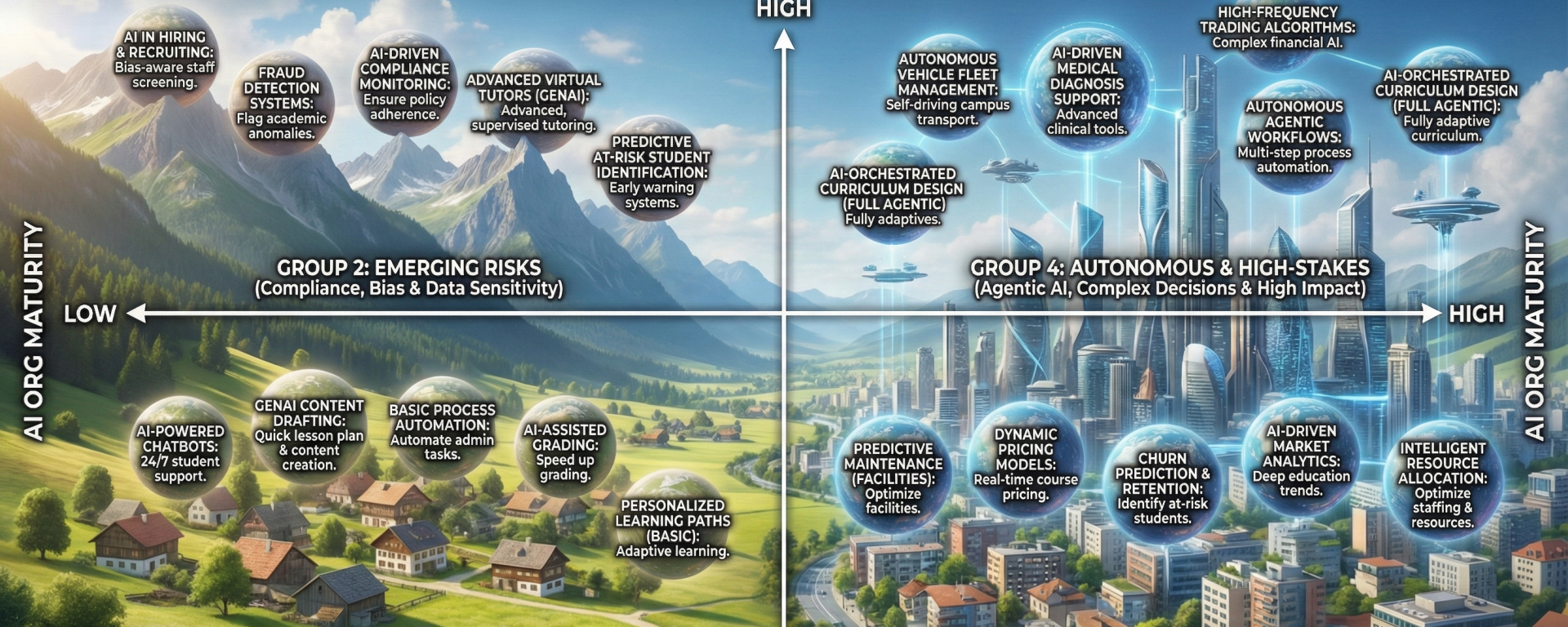
To help CAIOs navigate this complexity, we have mapped the top 20 use cases onto a proprietary Maturity/Risk Matrix.
- Low Maturity / Low Risk: The “Quick Wins” where most organizations start (e.g., meeting summarization).
- Low Maturity / High Risk: The “Danger Zone” where governance gaps lead to reputational damage (e.g., automated grading).
- High Maturity / Low Risk: The “Scaling Engines” that require deep data integration but offer safe returns (e.g., predictive retention).
- High Maturity / High Risk: The “Frontier” of agentic AI, offering massive rewards but requiring sophisticated oversight (e.g., autonomous research agents).
This report serves not just as a catalog of technology, but as a strategic playbook. It argues that for CAIOs, the primary challenge of 2026 is not technical implementation, but governance engineering—building the “rails” that allow powerful AI agents to operate safely within the fragile ecosystems of human learning and development.
2. Strategic Grid: The Top 20 AI Use Cases
The following matrix categorizes the identified use cases based on two critical dimensions:
- Organizational Maturity (x-axis): The level of data infrastructure (Data Lakes, API integration), talent density, and technical capability required to deploy the solution effectively.
- Risk / Complexity / Governance (y-axis): The level of regulatory scrutiny (GDPR, FERPA), ethical implication (bias, fairness), and potential impact on human life trajectories (grading, hiring, firing).
| Risk / Complexity | Low AI Organizational Maturity(SaaS-based, Siloed Data, Ad-hoc) | High AI Organizational Maturity(Integrated Data, Custom Models, Agentic) |
| High (High Compliance, Ethical Risk, Reputational Stakes) | Quadrant 2: “The Danger Zone” (High Risk / Low Maturity) 6. AI-Based Plagiarism & Writing Detection 7. Automated Essay Grading & Feedback 8. Unsupervised Mental Health Chatbots 9. Algorithmic Admissions & Filtering 10. Biometric Proctoring & Surveillance | Quadrant 4: “The Frontier” (High Risk / High Maturity) 16. Autonomous Research Agents (Lit Review & Lab) 17. Agentic Career Counseling & Placement 18. AI Roleplay Agents for Soft Skills/Sales Training 19. Autonomous Recruitment & Interview Agents 20. Cognitive AI Coaches for Leadership Development |
| Low (Operational Efficiency, Internal Productivity) | Quadrant 1: “Quick Wins” (Low Risk / Low Maturity) 1. AI-Assisted Meeting Summarization & Retrieval 2. Automated Content Drafting (Marketing/Comms) 3. Basic FAQ Chatbots (Student Services/IT) 4. Multilingual Translation & Accessibility Services 5. Automated Scheduling & Timetabling Assistance | Quadrant 3: “Scaling Engines” (Low Risk / High Maturity) 11. Predictive Analytics for Student Retention 12. Dynamic, Personalized Textbooks & OER 13. Intelligent Tutoring Systems (STEM/Coding) 14. Corporate Upskilling & Skills Inferencing 15. Automated Administrative Agents (Finance/HR) |
3. Detailed Use Case Analysis
Quadrant 1: Low AI Org Maturity & Low Risk / Complexity
The “Quick Wins” Sector
This quadrant represents the entry point for most institutions. The technology is typically consumed as “Software as a Service” (SaaS) with minimal need for internal model training or complex data engineering. The focus here is on operational efficiency—automating the drudgery of administration to free up human capital for higher-value tasks.
1. AI-Assisted Meeting Summarization & Knowledge Retrieval
The Business Problem:
Higher education and corporate training are notoriously meeting-heavy cultures. Faculty governance, research collaboration, and administrative planning generate thousands of hours of dialogue that is rarely captured or synthesized effectively. This leads to information silos and “organizational amnesia.”
The AI Solution:
Deployment of LLM-based tools (like Microsoft Copilot, Zoom AI Companion, or Otter.ai) to transcribe, diarize (identify speakers), and summarize meetings. Advanced implementations use RAG (Retrieval Augmented Generation) to allow staff to “chat” with the repository of past meetings to find decisions or action items.
Maturity & Risk Profile:
- Maturity: Low. These features are often “toggle-on” within existing suites (Microsoft 365, Zoom).
- Risk: Low to Moderate. The primary risk is data leakage (sending transcripts to public models). Governance requires strict “enterprise data protection” contracts.
Industry Examples:
- North America (University of British Columbia & Yale University): Both institutions have recognized the ubiquity of these tools and moved from prohibition to management. UBC and Yale have issued specific guidance authorizing the use of Microsoft Copilot and Zoom AI Companion for internal meetings, provided that “enterprise data protection” (green checkmark features) is enabled. This ensures that sensitive discussions about grant funding or student issues are not used to train public models.10
- Europe (KU Leuven, Belgium): Taking a more centralized approach typical of the European sector, KU Leuven has deployed Microsoft Copilot Chat for Education campus-wide. They explicitly designate it as the sanctioned tool for staff and students, creating a safe harbor against the use of “Shadow AI” tools that might violate GDPR. Their policy emphasizes that this tool “protects the data you enter by not storing or using it further,” addressing the specific anxieties of the EU regulatory environment.12
Future Outlook:
By 2026, we expect this to evolve from “summarization” to “autonomous follow-up,” where the meeting agent automatically schedules the next sync, creates calendar invites, and drafts emails to absentees based on the transcript action items.
2. Automated Content Drafting for Marketing & Communications
The Business Problem:
Universities and corporate L&D departments face an insatiable demand for content: alumni newsletters, course descriptions, social media updates, and internal announcements. Producing this content manually is resource-intensive and often results in generic, unengaging copy.
The AI Solution:
Generative AI tools (ChatGPT Enterprise, Jasper, Copy.ai) are used to draft high-velocity content. The AI acts as a “force multiplier,” allowing a single communications officer to produce personalized variations of a message for different stakeholders (e.g., prospective students vs. alumni vs. donors).
Maturity & Risk Profile:
- Maturity: Low. Requires prompt engineering skills but no infrastructure changes.
- Risk: Low. The risks are brand misalignment or “hallucination,” which are easily mitigated by human review.
Industry Examples:
- Europe (University of Manchester): The university established the Directorate of Communications, Marketing and Student Recruitment (DCMSR) AI working group to formalize this process. Rather than banning GenAI, they created a nuanced framework: use AI for storyboarding, ideation, and drafting, but never for final visual output representing the campus or students. This “human-in-the-loop” policy safeguards the university’s reputation while leveraging AI for efficiency.13
- North America (Vanguard & American Marketing Association): While not a university, Vanguard’s use case is the benchmark for higher ed advancement offices. They utilized AI to hyper-personalize newsletters, resulting in a 15% increase in conversion rates. US universities are now adopting similar strategies in their “Advancement” and “Alumni Relations” offices to tailor fundraising appeals based on a donor’s past engagement history.15
Future Outlook:
The next phase is Hyper-Personalization at Scale. Instead of one newsletter sent to 50,000 alumni, AI will generate 50,000 unique newsletters, each highlighting the specific campus news relevant to that alumnus’s major, dorm, and graduating class.
3. Basic FAQ Chatbots for Student Services & IT
The Business Problem:
“Summer melt” (students accepting offers but not showing up) and administrative friction are major issues. Students and employees are often overwhelmed by bureaucratic queries: “How do I reset my password?” “Where is the financial aid form?” “What is the deadline for enrollment?”
The AI Solution:
RAG-based chatbots that ingest university handbooks, IT knowledge bases, and policy documents to answer routine queries 24/7. Unlike old “decision tree” bots, these LLM-based agents can understand natural language and context.
Maturity & Risk Profile:
- Maturity: Low/Medium. Requires a clean document repository but many “no-code” bot builders exist.
- Risk: Low. If the bot is grounded in a static knowledge base, hallucination risk is minimal.
Industry Examples:
- North America (University of Tennessee, Knoxville): The university launched “UT Verse,” a conversational AI platform. It serves as a comprehensive campus concierge, helping students access Wi-Fi, navigate dining options, and find academic support. By handling these Tier-1 queries, it frees up human staff to handle complex student crises.17
- Europe (University of Amsterdam – UvA): In a move to counter the privacy risks of public tools like ChatGPT, UvA developed “UvA AI Chat” in collaboration with SURF (the Dutch education/research IT cooperative). This is a private, sovereign instance of GPT-4 hosted on secure servers. It allows students and staff to access GenAI capabilities for general inquiries and learning support without their data leaving the university’s governance perimeter.5
Future Outlook:
These bots will evolve into “Service Agents” that don’t just answer questions but perform tasks—e.g., “Reset my password” triggers the actual reset workflow, or “Register me for Math 101” completes the enrollment transaction.
4. Multilingual Translation & Accessibility Services
The Business Problem:
Universities are global hubs. Language barriers can impede learning for international students, while accessibility for hearing-impaired students remains a legal and ethical imperative. Traditional human translation/captioning is prohibitively expensive at scale.
The AI Solution:
Real-time AI speech-to-text (ASR) and neural machine translation (NMT) tools (like OpenAI’s Whisper) provide live captioning and translation of lectures and materials.
Maturity & Risk Profile:
- Maturity: Low. Cloud APIs for translation are mature and easy to integrate.
- Risk: Low. Errors in translation are generally tolerated as “better than nothing” in real-time contexts, though critical materials still require human review.
Industry Examples:
- Europe (Charles University, Czech Republic): The university utilizes the ELITR platform, integrated with Whisper models, to provide real-time transcription and translation of lectures. This allows a lecture delivered in Czech to be instantly accessible to English, German, or French-speaking students, significantly enhancing the attractiveness of their programs to international applicants.19
- North America (University of San Diego): The university reports widespread adoption of AI speech recognition tools to transcribe spoken words into text for students with disabilities. This has moved beyond “accommodation” to “universal design,” where all students benefit from searchable lecture transcripts.20
Future Outlook:
AI Dubbing: We will see the rise of video translation where the professor’s voice and lip movements are synthesized to speak the target language, preserving the pedagogical nuance of tone and emphasis.
5. Automated Scheduling & Timetabling Assistance
The Business Problem:
Course scheduling is a combinatorial nightmare involving room capacities, professor availability, student degree requirements, and conflict avoidance. Doing this manually or with legacy software leads to inefficient room utilization and student frustration.
The AI Solution:
Constraint-satisfaction algorithms and machine learning models that optimize schedules. These tools can simulate thousands of scenarios to find the optimal arrangement that maximizes student “time to degree.”
Maturity & Risk Profile:
- Maturity: Low to Medium. Can be bought as SaaS (e.g., Coursedog) but requires integration with the Student Information System (SIS).
- Risk: Low. Bad schedules are annoying but not legally perilous.
Industry Examples:
- North America (Northern Arizona University – NAU): NAU implemented Coursedog’s integrated academic scheduling platform. The AI-driven conflict detection reduced scheduling conflicts by 60% and overfilled sections by 14%. This operational efficiency directly impacted student success by ensuring required courses were available and not overlapping.21
- Europe (University of Nottingham): Nottingham employs sophisticated automated timetabling systems to manage the complexity of thousands of modules. In the UK context, where “course” often refers to a rigid degree program, the optimization of these timetables is critical for efficient estate management and student satisfaction.23
Future Outlook:
Student-Centric Optimization: Algorithms will move from optimizing for room usage to optimizing for student success, prioritizing schedules that group classes to minimize gaps for commuting students or align with student circadian rhythms.
Quadrant 2: Low AI Org Maturity & High Risk / Complexity
The “Danger Zone”
This quadrant contains the most treacherous use cases. These solutions often promise quick fixes to major problems (cheating, grading, mental health) using “black box” vendor tools. However, because the organization lacks high AI maturity (deep understanding of the models, data governance, validation pipelines), they are prone to ethical failures, bias, and legal backlash.
6. AI-Based Plagiarism & AI Writing Detection
The Business Problem:
The release of ChatGPT created a panic regarding academic integrity. Institutions felt an urgent need to “detect” AI writing to maintain the validity of their degrees.
The AI Solution:
Tools like Turnitin, GPTZero, and others that claim to classify text as “Human” or “AI-generated.”
Maturity & Risk Profile:
- Maturity: Low. Institutions simply “turn on” the feature in their LMS.
- Risk: Extremely High. These tools suffer from high false-positive rates, particularly against non-native English speakers. Accusing a student of academic dishonesty based on a flawed algorithm invites lawsuits and destroys student trust.
Industry Examples:
- North America (Vanderbilt, Michigan State, Cleveland State): A significant backlash has occurred. Vanderbilt University and Michigan State University made the strategic decision to disable Turnitin’s AI detection tool. They cited internal testing that showed unreliable results, reasoning that the risk of falsely accusing a student outweighed the benefit of catching cheaters. Cleveland State University faced a federal lawsuit regarding unconstitutional room scans, a related surveillance technology, setting a legal precedent that algorithmic monitoring is not a law-free zone.25
- Europe (UK Universities): The sector is pivoting away from detection. Reports indicate that UK universities are being warned to “stress-test” assessments rather than rely on detectors. With 92% of students using AI, the consensus is shifting toward “AI-proof” assessment design (e.g., oral exams, in-person writing) rather than an algorithmic arms race.27
Future Outlook:
Detection will likely be abandoned as a primary strategy. The focus will shift to “Process Analytics”—tracking the creation of the document (keystrokes, editing time) via tools like Google Docs Version History or specialized writing environments, rather than analyzing the final text.
7. Automated Essay Grading & Feedback
The Business Problem:
Grading is the bottleneck of education. It is time-consuming, inconsistent, and delayed. Faculty burnout is driven significantly by grading loads.
The AI Solution:
Using LLMs to grade open-ended essays, provide feedback, and assign scores.
Maturity & Risk Profile:
- Maturity: Low (if using generic models).
- Risk: High. AI grading can exhibit bias (favoring longer, complex sentences over clear ideas) and “hallucinate” feedback.
Industry Examples:
- Europe (Staffordshire University, UK): The university faced a PR crisis and student complaints after a course was reportedly taught and graded largely by AI. Students felt “a bit of my life was stolen,” arguing that paying tuition for algorithmic grading devalued their education. This highlights the “Value Perception Risk”—if students perceive AI is doing the work, they question the tuition fees.27
- North America (Ohio State University): OSU distinguishes between “Auto-grading” (static code checks) and “AI grading” (LLMs). While they use tools like Carmen Speed Grader for efficiency, they are cautious about fully automated AI grading for essays, emphasizing that it must be “AI-assisted” with a human final review to mitigate the risk of bias.28
Future Outlook:
“Feedback-First” Grading: The AI will likely be used to provide formative feedback (draft review) which is low stakes, while the summative grading (final score) remains human-led or strictly human-verified.
8. Basic Mental Health Support Chatbots
The Business Problem:
There is a massive shortage of mental health professionals on campuses and in corporations. Wait times for counseling can be weeks long, leaving students vulnerable.
The AI Solution:
Chatbots that offer Cognitive Behavioral Therapy (CBT) techniques or active listening.
Maturity & Risk Profile:
- Maturity: Low (if using off-the-shelf bots).
- Risk: Critical. An unsupervised bot giving poor advice to a suicidal user is a catastrophic failure mode.
Industry Examples:
- North America (Dartmouth College): Dartmouth is moving this from “unsupervised chatbot” to “clinical tool.” They conducted a clinical trial of “Therabot,” a generative AI tool, which showed a significant reduction in depression and anxiety symptoms. This rigorous, evidence-based approach is crucial to de-risking this use case.29
- Europe (University of Manchester): The university is piloting “MaST” (Management and Supervision Tool), an AI-enabled decision support system in community mental health teams. Rather than replacing the therapist, MaST analyzes data to help clinicians prioritize which patients need urgent care, effectively using AI as a triage nurse rather than a doctor.30
Future Outlook:
Prescription Digital Therapeutics: These tools will likely become regulated medical devices, prescribed by university health services rather than downloaded freely from an app store.
9. Automated Admissions Application Filtering
The Business Problem:
Top universities and companies receive exponentially more applications than they can review manually.
The AI Solution:
Machine learning models that score applicants based on historical data (e.g., “graduates from School X usually succeed”).
Maturity & Risk Profile:
- Maturity: Low (often relies on dirty historical data).
- Risk: High. Historical data contains historical racism, sexism, and classism. Automating this codifies inequality.
Industry Examples:
- North America (University of Texas at Austin): UT Austin serves as the primary cautionary tale. The Computer Science department discontinued its “GRADE” machine learning system after realizing that by training it on past admissions decisions, they were potentially reinforcing past biases against underrepresented groups. The “black box” nature of the tool made it impossible to guarantee fairness, leading to its retraction.9
- Europe (Imperial College London): UK universities are facing a new threat: “Deepfake Applicants.” As they automate the interview process with asynchronous video platforms, they are finding AI agents applying for jobs/degrees. This has forced a pivot from “filtering applicants” to “verifying humanity,” adding a layer of biometric complexity.27
Future Outlook:
“Glass Box” AI: Regulations like the EU AI Act will make “black box” filtering illegal. Future systems must provide “explainable AI” (XAI) outputs: “This applicant was scored lower because of X factor,” allowing for human audit.
10. Biometric Proctoring & Attendance Tracking
The Business Problem:
Ensuring the right student is taking the test or attending the class, especially in remote environments.
The AI Solution:
Facial recognition and gaze-tracking software.
Maturity & Risk Profile:
- Maturity: Low (plug-and-play surveillance).
- Risk: High. Privacy violations, racial bias in facial recognition (higher error rates for darker skin tones), and GDPR non-compliance.
Industry Examples:
- Europe (EU AI Act): The EU has taken a definitive stance. The AI Act categorizes biometric identification and emotion recognition in education as “High Risk” or prohibited. This effectively kills the market for invasive proctoring tools in Europe, forcing institutions to find alternative assessment methods.7
- North America (Cleveland State University): The legal ruling against room scans at Cleveland State (deemed a violation of the 4th Amendment) suggests that US courts are also becoming hostile to invasive digital surveillance in education.26
Future Outlook:
Browser Locking vs. Eye Tracking: The market will retreat from invasive biometrics (face/eye tracking) to less invasive environment controls (browser lockdown, keystroke dynamics) to balance integrity with privacy.
Quadrant 3: High AI Org Maturity & Low Risk / Complexity
The “Scaling Engines”
This quadrant represents the “sweet spot” for mature organizations. These institutions have invested in Data Lakes and Integration layers. They can connect their SIS, LMS, and CRM data to create powerful predictive models. Because these tools are internal and focus on optimization/support, the risk is manageable, but the ROI is massive.
11. Predictive Analytics for Student Retention & Success
The Business Problem:
Student attrition costs universities millions in lost tuition and fails the social mission of education. Identifying at-risk students manually is reactive and often too late.
The AI Solution:
Machine learning models that analyze thousands of data points (LMS login frequency, library usage, midterm grades, financial aid status) to predict dropout risk and trigger interventions.
Maturity & Risk Profile:
- Maturity: High. Requires integrated data warehouses.
- Risk: Low/Medium. Interventions are generally supportive (“How can we help?”) rather than punitive.
Industry Examples:
- North America (Georgia State University – GSU): GSU is the global gold standard. Their predictive system tracks over 800 risk factors for 40,000 students daily. If a student creates a risk signal (e.g., fails a midterm, doesn’t register for a required course), the system triggers an alert to an advisor. This generates 90,000 interventions annually, and GSU has eliminated achievement gaps based on race and income.32
- Europe (Open University, UK): The Open University uses “Taylor,” an AI digital assistant, combined with predictive analytics. It specifically targets disability support, identifying students who might struggle with accessibility and proactively offering alternate formats. This targeted use of prediction for support rather than just surveillance is a key best practice.34
Future Outlook:
Prescriptive Analytics: Moving from “This student is at risk” to “The best intervention for this specific student is a peer tutor, not a financial grant.”
12. Dynamic, Personalized Textbooks & OER
The Business Problem:
Textbooks are static, expensive, and often misaligned with the diverse prior knowledge of students.
The AI Solution:
GenAI engines that ingest Open Educational Resources (OER) and generate “dynamic textbooks.” These books can rewrite themselves: “Explain this physics concept using a soccer analogy” or “Simplify the reading level of this chapter.”
Maturity & Risk Profile:
- Maturity: High. Requires content partnerships and fine-tuned models to ensure accuracy.
- Risk: Low. If the source material is peer-reviewed OER, hallucination risk is controlled.
Industry Examples:
- North America (Rice University / OpenStax): Rice’s OpenStax, the largest publisher of OER, partnered with Microsoft to launch a “Learning Zone.” This platform allows AI to ingest trusted, peer-reviewed OpenStax textbooks and generate interactive lessons, quizzes, and personalized explanations. Because the AI is grounded in the textbook, it solves the “accuracy” problem of ChatGPT.35 UCLA also launched a pilot where an entire Comparative Literature course textbook was generated by AI (platform Kudu), tailored specifically to the professor’s syllabus.37
- Europe (Pearson): Pearson has embedded “AI study tools” into their proprietary eTextbooks. Students can chat with the book, ask for summaries, and get quizzed. Pilot data showed 75% student satisfaction, with students preferring it over ChatGPT because the “information was coming directly from the book” (Grounding).38
Future Outlook:
The “Living” Textbook: Textbooks that update themselves weekly based on current events (e.g., a Political Science book that incorporates yesterday’s election results into its examples).
13. Intelligent Tutoring Systems (STEM/Coding)
The Business Problem:
The “2 Sigma Problem”: 1-on-1 tutoring is the most effective teaching method but is too expensive to scale.
The AI Solution:
AI tutors that use Socratic methods. They don’t give the answer; they ask guiding questions to help the student solve it.
Maturity & Risk Profile:
- Maturity: High. Requires sophisticated “system prompts” and guardrails to prevent the AI from just doing the homework.
- Risk: Low/Medium.
Industry Examples:
- North America (Harvard CS50 & Khan Academy): Harvard’s CS50 introduced the “CS50 Duck” (ddb), a pedagogical AI agent. It is explicitly programmed not to give answers but to guide students through debugging their code. It effectively gives every student a 24/7 Teaching Fellow.40 Newark Public Schools piloted Khanmigo (Khan Academy’s AI), which acts as a Socratic tutor for math, helping students break down problems step-by-step.42
- Europe (University of Edinburgh): The School of Informatics employs AI-based tutoring schemes to support coding instruction. They use these systems to scale their “Informatics Tutoring Scheme,” allowing human tutors to focus on conceptual misunderstandings while the AI handles syntax errors and basic debugging.43
Future Outlook:
Multimodal Tutors: Tutors that can “see” the student’s handwriting on a tablet or “hear” their pronunciation in a language class.
14. Corporate Upskilling & Skills Inferencing
The Business Problem:
Skills become obsolete every few years. Companies don’t know what skills their employees actually have, only what their job titles are.
The AI Solution:
“Skills Inference” engines. These AI agents scan an employee’s digital footprint (GitHub commits, Jira tickets, Salesforce history, LinkedIn profile) to build a dynamic “Skills Passport.” They then recommend personalized learning paths.
Maturity & Risk Profile:
- Maturity: High. Requires deep integration into enterprise systems.
- Risk: Low. Internal use for employee development.
Industry Examples:
- Europe (Siemens Energy): Facing a massive transition to green energy, Siemens needed to upskill 100,000 employees. They used AI platforms (like Workera) to assess and certify GenAI skills across the workforce. The AI created adaptive learning paths, certifying employees in less than 90 days.44
- North America (Unilever): Unilever deployed “FLEX Experiences,” an AI-driven talent marketplace. It infers employee skills and matches them to 20% time projects (gigs) across the company. This “inner mobility” strategy unlocked 41,000 hours of capacity and improved productivity by 41%, proving that AI can uncover hidden talent assets.45
Future Outlook:
The “Self-Driving” Career: AI agents that automatically book you into a conference, sign you up for a course, and introduce you to a mentor based on your career goals.
15. Automated Administrative Agents (Finance/HR)
The Business Problem:
Back-office friction: expense reports, invoice processing, and compliance checks consume thousands of hours.
The AI Solution:
Agentic AI that can read a PDF invoice, match it to a PO, verify it against policy, and approve payment—only flagging humans for exceptions.
Maturity & Risk Profile:
- Maturity: High. Requires “Agentic” workflows (doing, not just chatting).
- Risk: Low. Operational efficiency.
Industry Examples:
- North America (Accenture): Accenture deployed “AI Refinery” agents within their own marketing and finance functions. These agents handle complex tasks like partner onboarding and campaign analytics, reducing manual steps by 25-35%.46
- Europe (Deloitte & UiPath): Deloitte partnered with UiPath to deploy autonomous agents for SAP change monitoring. These agents continuously monitor business processes and autonomously trigger tests or flag risks, effectively acting as “digital auditors” that work 24/7.48
Future Outlook:
Autonomous Procurement: Agents that not only process invoices but negotiate pricing with vendor bots for commodities like office supplies or cloud credits.
Quadrant 4: High AI Org Maturity & High Risk / Complexity
The “Frontier”
This is where the future is being built. These use cases utilize Agentic AI—autonomous systems that can plan and execute goals. They offer transformative potential (e.g., curing diseases, solving unemployment matching) but carry the highest risks regarding ethics, safety, and control.
16. Autonomous Research Agents (Literature Review & Lab)
The Business Problem:
Scientific research is slow. Literature reviews take months; experiments take years.
The AI Solution:
“Research Agents” that can autonomously search databases (PubMed, ArXiv), synthesize findings, hypothesize, and even control robotic wet-labs to run experiments.
Maturity & Risk Profile:
- Maturity: Very High. Requires specialized, fine-tuned scientific LLMs.
- Risk: High. “Scientific Hallucination” (inventing studies) creates misinformation.
Industry Examples:
- North America (Johns Hopkins University): JHU deployed an “Agent Laboratory” framework. These LLM-based agents autonomously conducted literature reviews, planned research, and documented findings. The pilot showed an 84% reduction in research costs, demonstrating that AI can act as a “force multiplier” for PhD students.49
- Europe (Imperial College London): The IDEA Lab is experimenting with “AI Avatars” (Davatar) and agentic tools to support research and education. They are exploring “Digital Twins” of faculty that can interact with students and research data, pushing the boundaries of presence and automation in academia.50
Future Outlook:
The “AI Scientist”: AI agents that are listed as co-authors on papers, having done the heavy lifting of data analysis and synthesis.
17. Agentic Career Counseling & Placement
The Business Problem:
The “Education-to-Employment” gap. Students graduate without knowing what jobs fit them or how to get them. Career centers are understaffed (1:1000 ratios).
The AI Solution:
Agentic Career Coaches that interview the student, scrape the web for live job openings that match their skills, update their resume, and even apply for them.
Maturity & Risk Profile:
- Maturity: High. Requires real-time integration with labor market data (LinkedIn, Indeed).
- Risk: High. Influences life trajectories. Bias in job matching is a major concern.
Industry Examples:
- North America (InsideTrack & University of Florida): The non-profit InsideTrack received a Salesforce grant to pilot agentic AI for student coaching, moving beyond simple “nudges” to complex, multi-turn career guidance conversations.51 At the University of Florida (Warrington College of Business), MBA students in a pilot course built their own agentic AI MVPs for real clients, effectively training the next generation of consultants to build the agents that might one day replace entry-level consulting work.52
- Europe (CareerBot): In the EU, the CareerBot project focuses on training practitioners to use chatbots. These bots create user personas and guide job seekers through labor market data. The focus is on “Augmented Intelligence”—helping the human counselor serve more students, rather than replacing them.53
Future Outlook:
Reverse Recruiting: Agents that negotiate salary and benefits on behalf of the candidate before they ever speak to a human recruiter.
18. AI Roleplay Agents for Soft Skills/Sales Training
The Business Problem:
Soft skills (empathy, negotiation, leadership) are hard to teach via video or text. They require practice. Human roleplay is expensive and awkward.
The AI Solution:
Voice-enabled AI avatars that act as “simulated humans.” They can play an angry customer, a stressed employee, or a tough negotiator.
Maturity & Risk Profile:
- Maturity: High. Requires low-latency voice AI and emotion detection.
- Risk: High. “Psychological Safety”—if the AI is too aggressive, it can traumatize the learner.
Industry Examples:
- North America (Salesforce & Highspot): These companies have integrated AI Roleplay Agents into their sales enablement platforms. Sales reps practice pitches against an AI buyer who raises objections (“That’s too expensive”). The AI then gives instant feedback on tone, pace, and keyword usage.54
- Europe (Virtway): Virtway offers immersive AI simulations for leadership training. In 3D virtual worlds, managers encounter AI characters simulating a workplace conflict (e.g., a miscommunication). The manager must resolve it, and the AI evaluates their empathy and conflict resolution skills.56
Future Outlook:
VR + AI: combining Apple Vision Pro or Meta Quest with Agentic AI for hyper-realistic “Holodeck” style training simulations.
19. Autonomous Recruitment & Interview Agents
The Business Problem:
Hiring bias and volume. Recruiters spend seconds on resumes and miss good candidates.
The AI Solution:
Agents that conduct the first-round interview autonomously via chat or voice, asking dynamic questions based on the candidate’s answers.
Maturity & Risk Profile:
- Maturity: High.
- Risk: Very High. Automated decision-making in employment is strictly regulated by the EU AI Act and NYC Bias Law.
Industry Examples:
- Europe (Unilever): A pioneer in this space, Unilever uses AI for digital recruitment, utilizing algorithms to analyze candidate responses in video interviews and “games.” However, to mitigate the high risk, they maintain a strict “human-in-the-loop” for the final selection, ensuring compliance with European ethical standards.57
- North America (Accenture): Accenture uses the Distiller Agentic AI Framework to deploy agents that screen CVs and rank candidates. These agents act as “Recruiting Coordinators,” handling the logistics and initial filtering to allow human recruiters to focus on the “sell”.58
Future Outlook:
Blind Auditions: AI agents that interview candidates via text-only chat to strip away all accent, gender, and racial markers, focusing purely on the content of the answers.
20. Cognitive AI Coaches for Leadership Development
The Business Problem:
Executive coaching is effective but costs $500/hour. Only the C-suite gets it.
The AI Solution:
“Cognitive Coaches”—AI agents that have a long-term memory of the user’s goals, challenges, and personality. They act as a 24/7 mentor.
Maturity & Risk Profile:
- Maturity: Very High. Requires “Memory” vector stores and high-context windows.
- Risk: High. The AI is giving psychological/career advice.
Industry Examples:
- North America (Skillsoft): Skillsoft launched “CAISY” (Conversation AI Simulator), a tool that democratizes executive coaching. It simulates difficult leadership scenarios (e.g., giving negative feedback) and acts as a coach, providing safe, non-judgmental feedback to help leaders improve.59
- Europe (McKinsey): McKinsey’s research into “Superagency” envisions a workplace where every leader has an AI “Chief of Staff” that not only executes tasks but offers strategic counsel. They are piloting these internal tools to “dogfood” the technology before rolling it out to clients.1
Future Outlook:
The “Board of Directors”: An AI tool that simulates a board meeting where different AI personas (The Skeptic, The Optimist, The Strategist) debate the user’s idea to help them refine it.
4. Key Actions for CAIOs and Senior AI Leaders
The transition to an AI-mature organization is not a technology project; it is a change management challenge. Based on the analysis of successful adopters (e.g., GSU, Unilever) and cautionary tales (e.g., UT Austin), we recommend the following strategic actions:
1. Establish “Sanctioned Sandboxes” (The Shadow AI Fix)
- The Problem: Students and staff are using free, public ChatGPT accounts, leaking IP and PII.
- The Fix: Do not ban AI; provide a better, safer alternative. Deploy a “Walled Garden” instance of GPT-4 (like UvA AI Chat or University of Michigan’s U-M GPT).
- Action: Negotiate enterprise agreements that guarantee zero data retention by the vendor. Make this tool free and easier to use than the public version.
2. Governance Engineering: “The Human-in-the-Loop” Protocol
- The Problem: High-risk use cases (grading, admissions) are prone to bias and backlash.
- The Fix: Codify the “Human-in-the-Loop” (HITL) workflow.
- Action:
- Tier 1 (Low Risk): AI can act autonomously (e.g., FAQ bots).
- Tier 2 (High Risk): AI can draft or recommend, but a human must finalize (e.g., grading, hiring).
- Tier 3 (Prohibited): Define “No-Go” zones (e.g., biometric surveillance in EU).
3. Data Readiness: The “Agentic” Prerequisite
- The Problem: You cannot use Agentic AI (Quadrant 4) if your data is trapped in silos (SIS, LMS, HRIS).
- The Fix: Build a “Semantic Layer.”
- Action: Invest in a Data Lakehouse architecture that unifies student/employee data. Agents need a single source of truth to reason effectively. If an agent can’t see the student’s financial aid status and their grades, it can’t give holistic advice.
4. Literacy as Defense: The “AI Drivers License”
- The Problem: Staff are afraid or incompetent with AI.
- The Fix: Mandatory, tiered upskilling.
- Action: Replicate the University of Helsinki’s “Elements of AI” approach. Create a baseline certification for all staff (“AI Drivers License”) covering prompt engineering, data privacy, and ethics. Make this a prerequisite for accessing the “Sanctioned Sandbox.”
5. Pivot from “Detection” to “Assessment Reform”
- The Problem: AI plagiarism detectors are unreliable.
- The Fix: Change the assignment, not the police.
- Action: Follow the UK university sector’s lead. Redesign assessments to be “AI-resilient”—focus on in-person oral defenses, process-based grading, and assignments that require the use of AI followed by critical reflection.
5. Sources
1 McKinsey & Company. “Superagency in the workplace: Empowering people to unlock AI’s full potential at work.” 8 NIST. “AI Risk Management Framework.” 2 eLearning Industry. “From Trainer To Training Agent: How Agentic AI Acts As A Digital L&D Specialist.” 3 McKinsey & Company. “Agentic AI: What it is and how it will transform business.” 20 University of San Diego. “Artificial Intelligence in Education.” 29 Dartmouth College. “First therapy chatbot trial yields mental health benefits.” 32 XenonStack. “Predictive Analytics in Student Retention.” 33 Mapademics. “Predictive Analytics for Student Retention.” 48 Flobotics. “Hottest Agentic AI Examples and Use Cases.” 49 Workday. “AI Agents in Education: Top Use Cases and Examples.” 17 EdTech Magazine. “AI Agents in Higher Education: Transforming Student Services.” 4 European Round Table for Industry (ERT). “Harnessing GenAI for Europe’s Industrial Future.” 54 Highspot. “AI Role Play for Sales Manager Training.” 55 Salesforce. “AI Sales Coaching.” 56 Virtway. “Immersive AI Training for Soft Skills.” 59 Skillsoft. “Discussing the impact and opportunity of GenAI in workforce development.” 34 Jisc. “How digital assistants are promoting enhanced accessibility at The Open University.” 1 McKinsey & Company. “Superagency in the workplace.” 15 Marketing AI Institute. “AI Case Studies: Content Marketing.” 10 Yale University. “Yale’s AI Tools and Resources.” 11 University of British Columbia. “Turn Your Meeting Transcripts into Actionable Summaries with AI.” 19 ELITR. “AI Interpreting Service.” 28 Ohio State University. “AI and Auto-grading in Higher Education.” 52 Warrington College of Business. “Agentic AI Consulting Course.” 51 InsideTrack. “Pioneering Student Coaching Nonprofit Awarded Salesforce Accelerator Grant.” 7 University of Washington. “Global Approaches to Artificial Intelligence Regulation.” 16 Harvard Professional Development. “AI Will Shape the Future of Marketing.” 5 University of Amsterdam. “UvA AI Chat: Why was it created?” 18 University of Amsterdam. “UvA launches its own AI chat.” 50 Imperial College London. “How AI avatars are revolutionising the student experience.” 12 KU Leuven. “Copilot for Education.” 43 University of Edinburgh. “Informatics Tutoring Scheme.” 44 Workera. “Siemens Energy Improves Gen AI Learning.” 58 Accenture. “Data & Generative AI Client Stories.” 46 Accenture. “AI Refinery: Smarter, Faster Marketing.” 47 Reddit/Lyzr. “A look at how we used AI Agents to Automate Partner Onboarding.” 45 Gloat. “Unilever Customer Success Story.” 57 CIO. “Unilever’s AI push: From shop floor to culture core.” 27 The Guardian. “University of Staffordshire course taught in large part by AI.” 9 Texas Standard. “UT quietly ends use of algorithm to evaluate computer science PhD applicants.” 31 Element451. “Unbiasing AI in Admissions.” 25 Reddit/Student. “Turnitin’s AI detection tool falsely flagged my paper.” 26 University of Michigan-Dearborn. “The Only Winning Move is Not to Play.” 40 CS50. “Harvard CS50 AI Duck Debugger Case Study.” 41 arXiv. “The Role of AI in Education (CS50 Study).” 42 Khan Academy. “Newark Public Schools Case Study.” 30 University of Manchester. “The value of an AI decision support tool for community mental health.” 60 Reddit/Researcher. “AI Chatbots for Mental Health Support Study.” 53 CareerBot. “Working with CareerBot.” 37 University of California. “Comparative lit class will be first to use UCLA-developed AI system.” 13 University of Manchester. “New guidelines available for communications and marketing.” 14 University of Manchester. “AI Guidelines.” 21 Coursedog. “Northern Arizona University Case Study.” 22 Coursedog. “Case Studies.” 35 LearnWork Ecosystem. “OpenStax OERs.” 36 InnovationMap. “OpenStax, Microsoft AI Learning Zone.” 38 Pearson. “AI Study Tool.” 39 Pearson. “Balancing AI in the Classroom.” 23 University of Nottingham. “Timetabling.” 24 ResearchGate. “An Artificial Intelligence Approach to Course Timetabling.”
Works cited
- AI in the workplace: A report for 2025 – McKinsey, accessed January 28, 2026, https://www.mckinsey.com/capabilities/tech-and-ai/our-insights/superagency-in-the-workplace-empowering-people-to-unlock-ais-full-potential-at-work
- From Trainer To Training Agent: How Agentic AI Acts As A Digital L&D Specialist, accessed January 28, 2026, https://elearningindustry.com/from-trainer-to-training-agent-how-agentic-ai-acts-as-a-digital-ld-specialist
- Agentic AI Explained | McKinsey & Company, accessed January 28, 2026, https://www.youtube.com/watch?v=DsRNp3cmJm0
- Harnessing Generative AI for Europe’s Industrial Future – ERT, accessed January 28, 2026, https://ert.eu/wp-content/uploads/2025/03/ERT-Harnessing-GenAI-for-Europe-Industrial-Future_March-2025.pdf
- UvA AI Chat: Why was it created, and what is it exactly? – Universiteit van Amsterdam, accessed January 28, 2026, https://www.uva.nl/shared-content/uva/en/news/news/2025/12/uva-ai-chat-why-was-it-created-and-what-is-it-exactly.html
- ELM | Computing – Information Services – The University of Edinburgh, accessed January 28, 2026, https://information-services.ed.ac.uk/computing/comms-and-collab/elm
- Global Approaches to Artificial Intelligence Regulation, accessed January 28, 2026, https://jsis.washington.edu/news/global-approaches-to-artificial-intelligence-regulation/
- AI Risk Management Framework | NIST – National Institute of Standards and Technology, accessed January 28, 2026, https://www.nist.gov/itl/ai-risk-management-framework
- UT Ends Use Of Algorithm To Evaluate Computer Science PhD Applicants | Texas Standard, accessed January 28, 2026, https://www.texasstandard.org/stories/ut-quietly-ends-use-of-algorithm-to-evaluate-computer-science-phd-applicants/
- Yale’s AI Tools and Resources, accessed January 28, 2026, https://ai.yale.edu/yales-ai-tools-and-resources
- Turn Your Meeting Transcripts into Actionable Summaries with AI – UBC IT Okanagan – The University of British Columbia, accessed January 28, 2026, https://it.ok.ubc.ca/2025/05/30/turn-your-meeting-transcripts-into-actionable-summaries-with-ai/
- Microsoft Copilot: three versions — KU Leuven Learning Lab, accessed January 28, 2026, https://www.kuleuven.be/english/education/leuvenlearninglab/support/tools-multimedia/toledopedia/Copilot
- AI guidelines for communications and marketing colleagues – StaffNet, accessed January 28, 2026, https://www.staffnet.manchester.ac.uk/ai-hub/news/display/?id=31458
- AI (Artificial Intelligence) Guidelines | Directorate of Communications, Marketing and Student Recruitment | StaffNet | The University of Manchester, accessed January 28, 2026, https://www.staffnet.manchester.ac.uk/dcmsr/communications/ai-guidelines/
- 4 Incredible AI Case Studies in Content Marketing, accessed January 28, 2026, https://www.marketingaiinstitute.com/blog/ai-case-studies-content-marketing
- AI Will Shape the Future of Marketing – Professional & Executive Development | Harvard DCE, accessed January 28, 2026, https://professional.dce.harvard.edu/blog/ai-will-shape-the-future-of-marketing/
- AI Agents in Higher Education: Transforming Student Services and Support, accessed January 28, 2026, https://edtechmagazine.com/higher/article/2025/12/ai-agents-higher-education-transforming-student-services-and-support-perfcon
- UvA launches its own AI chat – Universiteit van Amsterdam, accessed January 28, 2026, https://www.uva.nl/shared-content/uva/en/news/news/2025/08/uva-launches-its-own-ai-chat.html
- AI Interpreting as a service – elitr.eu, accessed January 28, 2026, https://elitr.eu/ai-interpreting-service/
- 39 Examples of Artificial Intelligence in Education – University of San Diego Online Degrees, accessed January 28, 2026, https://onlinedegrees.sandiego.edu/artificial-intelligence-education/
- How NAU Reduced Scheduling Conflicts by 60% to Support Student Progression, accessed January 28, 2026, https://www.coursedog.com/case-studies/northern-arizona-university
- Case Studies – Coursedog, accessed January 28, 2026, https://www.coursedog.com/resources/case-studies
- Timetabling and Room Booking – The University of Nottingham – Malaysia Campus, accessed January 28, 2026, https://www.nottingham.edu.my/CurrentStudents/StudentRegistry/Timetabling-and-Room-Booking/Timetabling.aspx
- An Artificial Intelligence Approach to Course Timetabling. | Request PDF – ResearchGate, accessed January 28, 2026, https://www.researchgate.net/publication/220160216_An_Artificial_Intelligence_Approach_to_Course_Timetabling
- Turnitin’s AI detection tool falsely flagged my work, triggering an academic integrity investigation. No evidence required beyond the score. : r/slatestarcodex – Reddit, accessed January 28, 2026, https://www.reddit.com/r/slatestarcodex/comments/1k3op60/turnitins_ai_detection_tool_falsely_flagged_my/
- ‘The only winning move is not to play’ | University of Michigan-Dearborn, accessed January 28, 2026, https://umdearborn.edu/news/only-winning-move-not-play
- ‘We could have asked ChatGPT’: students fight back over course taught by AI | Staffordshire University | The Guardian, accessed January 28, 2026, https://www.theguardian.com/education/2025/nov/20/university-of-staffordshire-course-taught-in-large-part-by-ai-artificial-intelligence
- AI and Auto-Grading in Higher Education: Capabilities, Ethics, and the Evolving Role of Educators – ASC Office of Distance Education – The Ohio State University, accessed January 28, 2026, https://ascode.osu.edu/news/ai-and-auto-grading-higher-education-capabilities-ethics-and-evolving-role-educators
- First Therapy Chatbot Trial Yields Mental Health Benefits – Dartmouth, accessed January 28, 2026, https://home.dartmouth.edu/news/2025/03/first-therapy-chatbot-trial-yields-mental-health-benefits
- The value of an AI decision support tool for community mental health services in Greater Manchester – Research Explorer, accessed January 28, 2026, https://research.manchester.ac.uk/en/projects/the-value-of-an-ai-decision-support-tool-for-community-mental-hea/
- Will AI Reduce or Enforce Biases in College Admissions? – Element451, accessed January 28, 2026, https://element451.com/blog/unbiasing-ai-in-admissions
- Predictive Analytics to Improve Student Retention Rates – XenonStack, accessed January 28, 2026, https://www.xenonstack.com/blog/predictive-analytics-student-retention-rates
- Predictive Analytics for Student Retention: How AI is Revolutionizing College Success Strategies – Mapademics, accessed January 28, 2026, https://mapademics.com/whitepapers/predictive-analytics-student-retention-ai
- How digital assistants are promoting enhanced accessibility at the Open University, accessed January 28, 2026, https://nationalcentreforai.jiscinvolve.org/wp/2021/09/27/how-digital-assistants-are-promoting-enhanced-accessibility-at-the-open-university/
- OpenStax (Open Educational Resources) – Rice University, accessed January 28, 2026, https://learnworkecosystemlibrary.com/initiatives/openstax-oers/
- Rice University OpenStax partners with Microsoft for AI Learning Zone – InnovationMap, accessed January 28, 2026, https://houston.innovationmap.com/openstax-microsoft-ai-learning-zone-2672870213.html
- Comparative lit class will be first in Humanities Division to use UCLA-developed AI system, accessed January 28, 2026, https://www.universityofcalifornia.edu/news/comparative-lit-class-will-be-first-humanities-division-use-ucla-developed-ai-system
- AI-Powered Tools for Higher Education – Pearson, accessed January 28, 2026, https://www.pearson.com/en-us/higher-education/products-services/aistudytool.html
- Balancing AI in the Classroom: Teaching in Action Educator Study – Pearson, accessed January 28, 2026, https://www.pearson.com/en-us/higher-education/insights-and-events/teaching-and-learning-blog/2025/04/balancing-AI-in-the-classroom–teaching-in-action-educator-study.html
- Teaching CS50 with AI – YouTube, accessed January 28, 2026, https://www.youtube.com/watch?v=6rAWxGAG6EI
- Student-AI Interaction: A Case Study of CS1 students – arXiv, accessed January 28, 2026, https://arxiv.org/html/2407.00305v2
- Newark Public Schools partners with Khan Academy to boost math proficiency, accessed January 28, 2026, https://www.khanacademy.org/schools/case-studies/newark-public-schools
- Informatics Tutoring Scheme, accessed January 28, 2026, https://informatics.ed.ac.uk/outreach-and-public-engagement/informatics-tutoring-scheme
- Siemens Energy Improves Gen AI Learning for a Workforce of Thousands – Workera, accessed January 28, 2026, https://workera.ai/hubfs/Case%20Studies/Siemens%20Energy%20Customer%20Case%20Study.pdf
- How Unilever used upskilling to prepare for the future | Gloat, accessed January 28, 2026, https://resources.gloat.com/resources/unilever-customer-success-story/
- AI Refinery | Smarter & Faster Marketing – Accenture, accessed January 28, 2026, https://www.accenture.com/us-en/case-studies/technology/ai-refinery-smarter-faster-marketing
- A look at how we used AI agents to automate Accenture’s complex partner due diligence and onboarding. : r/AI_Agents – Reddit, accessed January 28, 2026, https://www.reddit.com/r/AI_Agents/comments/1ncc3dj/a_look_at_how_we_used_ai_agents_to_automate/
- The Hottest Agentic AI Examples and Use Cases in 2025 – – Flobotics, accessed January 28, 2026, https://flobotics.io/uncategorized/hottest-agentic-ai-examples-and-use-cases-2025/
- AI Agents in Education: Top Use Cases and Examples – Workday Blog, accessed January 28, 2026, https://blog.workday.com/en-us/ai-agents-in-education-top-use-cases-and-examples.html
- How AI avatars are revolutionising the student experience at Imperial Business School, accessed January 28, 2026, https://www.imperial.ac.uk/business-school/ib-knowledge/technology/how-ai-avatars-are-revolutionising-the-student-experience-imperial-business/
- Pioneering Student Coaching Nonprofit Awarded Salesforce Accelerator Grant to Pilot Agentic AI in Higher Education – InsideTrack, accessed January 28, 2026, https://www.insidetrack.org/news/pioneering-student-coaching-nonprofit-awarded-salesforce-accelerator-grant-to-pilot-agentic-ai-in-higher-education
- MBA students gain real-world agentic AI consulting experience through new course, accessed January 28, 2026, https://warrington.ufl.edu/news/agentic-ai-consulting-course/
- Module 3 – CareerBot, accessed January 28, 2026, https://careerbot.eu/wp-content/uploads/2024/03/M3_MODULE3_Working_with_CareerBot_EN.pdf
- AI sales role play tools: How managers coach smarter – Highspot, accessed January 28, 2026, https://www.highspot.com/blog/ai-role-play-sales-manager-training/
- AI Sales Coaching: Tools, Benefits and How It Works – Salesforce, accessed January 28, 2026, https://www.salesforce.com/sales/ai-sales-agent/ai-sales-coaching/
- Immersive AI Training for Soft Skills – Virtway, accessed January 28, 2026, https://virtway.com/blog/immersive-ai-training-soft-skills/
- Unilever’s AI Push: From Shop Floor to Culture Core – Part 2 – CIO.inc, accessed January 28, 2026, https://www.cio.inc/unilevers-ai-push-from-shop-floor-to-culture-core-part-2-a-29183
- Data and Advanced AI Case Studies | Accenture, accessed January 28, 2026, https://www.accenture.com/us-en/case-studies/data-ai/data-generative-ai-client-stories
- Discussing the Impact and Opportunity of GenAI in Workforce Development – Skillsoft, accessed January 28, 2026, https://www.skillsoft.com/blog/discussing-the-impact-and-opportunity-of-genai-in-workforce-development
- ‘AI chatbots for mental health support’ study – opinions needed! : r/MentalHealthUK – Reddit, accessed January 28, 2026, https://www.reddit.com/r/MentalHealthUK/comments/1powyow/ai_chatbots_for_mental_health_support_study/
This article was written with my brain and two hands (primarily) with the help of Google Gemini, ChatGPT, Claude, and other wondrous toys.
 Adam Outside The Box