I recently covered how Product Management practices have to evolve for AI Products. How about the rest of Product Owners / Managers?
How could Product Owners / Managers POWERFULLY and SAFELY use GenAI to accelerate and improve their products and their everyday work?
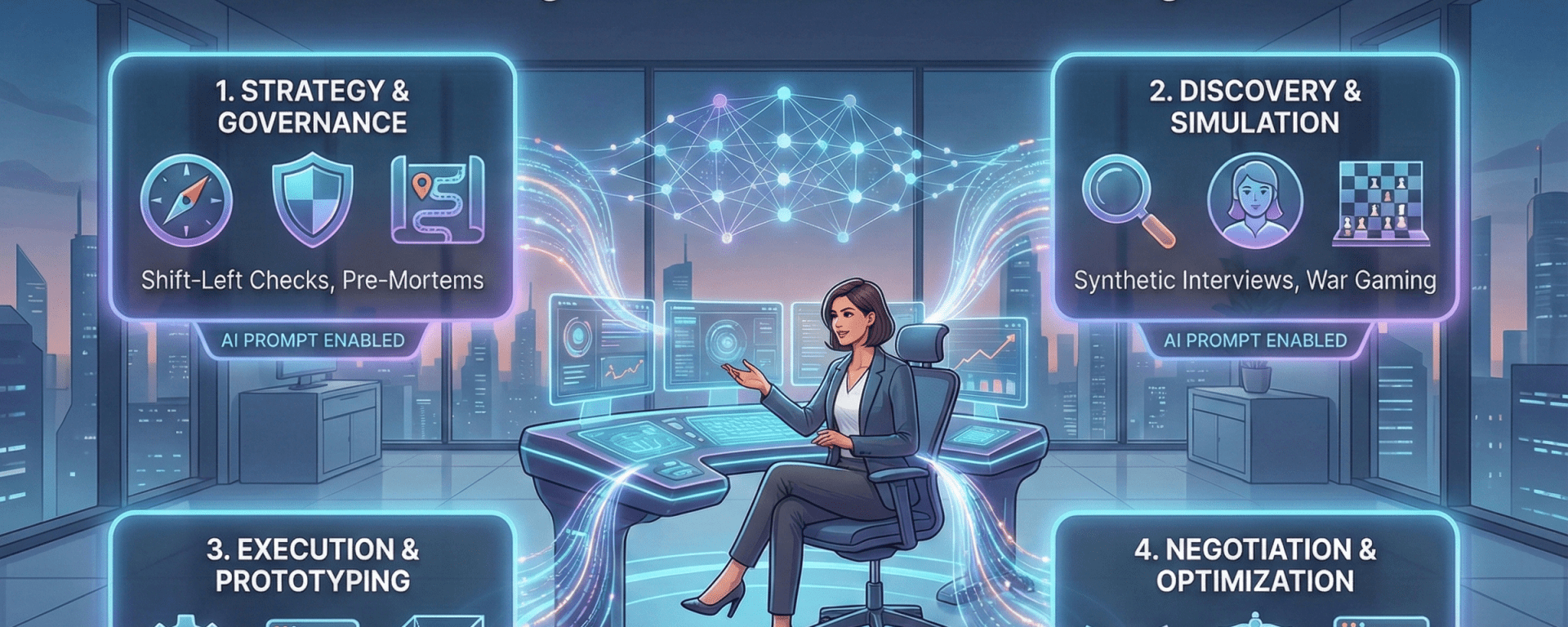
Some of you are just itching to use GenAI to accelerate your daily work. To help you, here is a pragmatic selection of AI workflows and their related prompts (both simple and comprehensive) to “level-up your game”.
Don’t think of these workflows / prompts as independent activities to get quick answers. Use a single conversation chat for all the prompts you are going to use related to your product. Over a period of time, these conversations will give you more than tactical gains – they will create and train a powerful “AI sidekick” that can keep accelerating and upgrading your product strategy, planning, delivery, and even governance.
More than getting quick answers, train a powerful AI assistant / sidekick that can accelerate and upgrate your products for many months to come!
Which GenAI should you use for these workflows / prompts SAFELY?
Either (A) use GenAI your organization already approves (where your company/product/customer data is already protected) OR (B) you will need to annonymize any company and product data you feed into the AI OR (C) if neither A or B are possible, simply wait. Don’t take the risk and don’t ignore the risk. That risk may not feel present (now) but it is very real and very personal. Do not share confidential customer or company data with GenAI unless that data remains protected. To reduce your learning risk, I’ve selected workflows with less confidential data.
I have something to help you quicky and convenienty probide baseline understanding of your product to your GenAI. Most of these examples rely on the Product Owner / Manager providing GenAI with such basic product understanding. I recommend you have this info stored as a text file you can provide and modify as needed. If the product is confidential, I would recommend you either use a code name and annonimize the info you use secure company-approved GenAI tool that keeps your information secure. Example of such a file is provided here, just below list of prompts (below).
Here is a summary of workflows / prompts and what level of protected company / product / customer information they require.
| PO/PM use case | AI tool ACCESS | DATA REQUIRED | RISK level |
|---|---|---|---|
| 1. Competitor Product Review | Any | Basic product data (public / internal) | Low |
| 2. Product Outcome Framing | Any but reco you use protected tools | Basic product data and customer personas (internal confidential) | Low to Medium |
| 3. Identify Ideal Target Customers | Any but reco you use protected tools | Basic product data and customer personas (internal confidential) | Low to Medium |
| 4. Customer Interview Simulator | Reco you use protected tools | Basic product data and customer personas (internal confidential) | Low to Medium |
| 5. Problem Discovery and Reframing | Any but reco you use protected tools | Basic product data (public / internal) | Low to Medium |
| 6. Proactive Governance Assessment | Any | Basic product data (public / internal) | Low to Medium |
| 7. Product Roadmap Reco | Reco you use protected tools | Basic product data and customer personas (internal confidential) | Medium to High |
| 8. Break Features / Epics into Stories | Reco you use protected tools | Basic product data and customer personas (internal confidential) | Medium to High |
| 9. Rapid Experimentation and Prototyping | Any but reco you use protected tools | Basic product data (public / internal) | Low to Medium |
| 10. Prep for Executive Review / Proposal | Any but reco you use protected tools | Basic product data (public / internal) | Low to Medium |
| Bonus: Stakeholder Alignment | Any | Basic product data (public / internal) | Low to Medium |
Basic Product Understanding Text File
Here is an example of a Product Information file. The example provided is a Social Media Post AI Agent. Copy and modify this with your product information. Feel free to remove sections you don’t need or are not relevant.
If you need to annonymize this information, use fake company name, fake product name, and remove any confidential product information. Your prompt will give you less accurate results but at least your business, customer, and product data will be safe.
CLICK TO EXPAND AND COPY
========================================================PRODUCT INFORMATION FILE (EXAMPLE)========================================================Product Name:Social Media Post AgentProduct Type:Internal digital marketing product (AI-enabled)Organization Context:Mid-size North American organization operating in both Canada and the United States.Marketing team supports multiple business lines and must comply with brand, legal, and regulatory requirements across jurisdictions.--------------------------------------------------------1. PRODUCT PURPOSE & OUTCOMES--------------------------------------------------------Primary Purpose:Enable marketing teams to quickly create and schedule high-quality social media posts that are consistent with brand guidelines, compliant with regulations, and optimized for engagement.Target Outcomes:- Reduce time to create and publish social posts by 40–60%- Increase consistency of brand voice across channels- Improve engagement rates (likes, comments, shares) by 10–15%- Reduce manual review effort for compliant contentNon-Goals:- Fully autonomous publishing without human review- Real-time customer interaction or replies- Paid advertising copy generation (out of scope)--------------------------------------------------------2. TARGET USERS & USE CASES--------------------------------------------------------Primary Users:- Digital marketing specialists- Social media managers- Marketing coordinatorsSecondary Users:- Brand reviewers- Legal/compliance reviewers- Marketing managersCore Use Cases:- Draft social media posts from campaign briefs- Adapt a single message across multiple platforms- Schedule posts for future publication- Reuse approved content patterns- Apply brand tone automatically--------------------------------------------------------3. CHANNELS & SCOPE--------------------------------------------------------Supported Channels:- LinkedIn (professional tone, longer form)- X (short, concise, timely)- Facebook (conversational, community-focused)- Instagram (visual-first, concise copy)Out of Scope:- TikTok- YouTube scripts- Direct messaging--------------------------------------------------------4. KEY ASSUMPTIONS--------------------------------------------------------Business Assumptions:- Marketing teams want speed but still require control- Consistent tone improves brand trust- Human review is mandatory for regulated contentUser Assumptions:- Users will provide short campaign briefs- Users are not AI experts- Users need simple editing and approval flowsTechnical Assumptions:- Approved brand guidelines are available in digital format- Scheduling will integrate with existing social tools (e.g., Hootsuite, Sprout)- AI output quality will vary and must be reviewed--------------------------------------------------------5. DATA & AI CONSIDERATIONS--------------------------------------------------------Input Data:- Campaign briefs (text)- Brand voice guidelines- Past approved posts- Channel-specific rulesAI Capabilities:- Text generation- Tone adaptation by channel- Post length optimization- Hashtag suggestionsLimitations:- AI may hallucinate facts- AI may generate non-compliant language- AI may drift from brand tone without constraints--------------------------------------------------------6. GOVERNANCE, RISK & COMPLIANCE (CANADA & US)--------------------------------------------------------Key Risks:- Brand misrepresentation- Regulatory non-compliance (financial claims, healthcare claims, etc.)- Copyright or IP misuse- Inappropriate or biased languageRegulatory Considerations:- FTC advertising rules (US)- Competition Act marketing provisions (Canada)- Platform-specific content policies- Internal brand and legal review requirementsControls:- Mandatory human approval before publishing- Approved content libraries- Audit trail of AI-generated content- Clear labeling of AI-assisted content (internal)--------------------------------------------------------7. SUCCESS METRICS--------------------------------------------------------Leading Indicators:- Time to first draft- Number of posts generated per week- Review cycle time- User adoptionLagging Indicators:- Engagement rate per channel- Campaign reach- Marketing team satisfaction- Reduction in rework--------------------------------------------------------8. DELIVERY & PLANNING CONSTRAINTS--------------------------------------------------------Constraints:- Must integrate with existing scheduling tools- Must support bilingual content (EN/FR) in Canada- Must operate within existing marketing workflowsDependencies:- Brand team approval of tone guidelines- Legal review of high-risk templates- IT integration support--------------------------------------------------------9. OPEN QUESTIONS / RISKS--------------------------------------------------------- How much autonomy will be allowed over time?- Which content types are high-risk vs low-risk?- How will model drift be detected?- How will success be reviewed quarterly?--------------------------------------------------------10. CURRENT MATURITY--------------------------------------------------------Stage:Pilot (limited marketing teams)Next 90-Day Goals:- Expand to 2 additional business units- Reduce review time by 30%- Establish governance patterns- Validate engagement improvements========================================================END OF FILE========================================================Now let’s get to the workflows and prompts!
Workflow 1: Competitor Product Review (data risk level = low)
Most competitive reviews are shallow feature comparisons that quickly go out of date. Modern product competition is about capabilities, positioning, speed of learning, and ecosystem fit—especially for AI-enabled products. This prompt helps PMs map the landscape in a way that supports strategic decision-making rather than slideware.
Benefits:
- Clarifies where you actually compete
- Prevents feature chasing
- Identifies white space
# SIMPLE PROMPTList the top competitors for my product and summarize what each one does well and poorly.Product: [description]Market: [industry / segment]# ADVANCED PROMPTBased on my product information (attached), map the competitive landscape across direct, indirect, and substitute competitors.Compare them on value proposition, target users, AI capabilities (if applicable), and speed of iteration.Identify strategic gaps and overcrowded spaces.Analyze feature gaps in terms of customer value, strategic relevance, and implementation complexity.Recommend which gaps should be closed, ignored, or turned into differentiators.Map competitor user journeys and identify friction points, trust moments, and emotional highs/lows.Recommend experience-level differentiators.Analyze competitor pricing models, packaging logic, and value tiers.Analyze competitor go-to-market strategies, partnerships, onboarding flows, and sales enablement.Identify gaps we can exploit or defend.Ask me questions till you can complete this task with 95% confidence.Workflow 2: Product Outcome Framing (risk = low to medium)
Many product teams still start with features, even when they believe they are “outcome-driven.” This is especially risky in AI initiatives, where teams can build impressive capabilities that fail to move business metrics or user behavior. Mature product management begins with explicit outcomes and treats delivery as a means, not the goal. This prompt helps PO/PMs step back from scope discussions and re-anchor the product around measurable change in the organization or customer experience. It is equally valuable for AI and non-AI products, as it forces strategic clarity before planning begins.
Benefits:
- Improves prioritization and trade-offs
- Makes value visible earlier
- Aligns teams and executives on purpose
# SIMPLE PROMPTHelp me define the primary business outcome for this product.Product: [description]Users: [who]Success means: [what changes]Suggest 3 measurable outcomes and how to track them.# ADVANCED PROMPTAct as a senior product strategy advisor.Given this product context (product info file attached), define outcome metrics across business value, user impact, operational risk, and learning velocity.Identify leading and lagging indicators and suggest review cadences.Ask me questions till you can complete this task with 95% confidence.Workflow 3: Identify Ideal Target Customers (risk = low to medium)
Most teams start personas by describing users they already have. High-performing product teams start by defining users they most want to serve because they represent the strongest value, adoption, and retention potential. This prompt helps PMs explicitly define what “ideal” means in strategic terms.
Benefits:
- Higher proposal credibility
- Reduced downstream rework
- Clear discovery plan
# SIMPLE PROMPTHelp me define the ideal customer for my product.Product: [description]Industry / market: [context]What kind of customer gets the most value?# ADVANCED PROMPTAct as a senior product strategy advisor.Given this product context (product info file attached) and existing customer research (attached), define the ideal customer profile (ICP) based on value realization, adoption speed, risk profile, and long-term retention.Include customers we should not target and why.Segment customers by jobs-to-be-done, maturity, risk tolerance, and decision authority.Explain how each segment changes product priorities.Map motivations, constraints, incentives, and fears.Include organizational, regulatory, and technical constraints that influence decisions.Map the decision-making process including influencers, approvers, blockers, and compliance checkpoints.Define this persona’s risk tolerance, trust signals, compliance expectations, and evidence requirements.Define perceived value, success metrics, and switching thresholds from the persona’s perspective.Define expectations for onboarding, support, transparency, control, and automation.Define validation experiments, signals, and data sources that would confirm or disprove this persona.Ask me questions till you can complete this task with 95% confidence.Workflow 4: Customer Interview Simulator (risk = low to medium)
In traditional discovery, scheduling five customer interviews takes two weeks. By the time you speak to them, you might have already built the wrong thing. Furthermore, we often ask biased questions that confirm what we want to hear.
Benefits:
- Zero-Risk Practice: Allows PMs to “rehearse” interviews and refine their questions before speaking to a real human.
- Bias Detection: Helps identify if your questions are leading the witness.
- Instant Personas: You can “talk” to 10 different personas (e.g., a grumpy admin, a busy executive, a confused senior) in 30 minutes.
# SIMPLE PROMPTCreate a realistic user persona for my product.Product: [description]User type: [role]Context: [where/how they use it]# ADVANCED PROMPTAct as a senior customer research advisor.Given this product context (product info file attached), create a synthetic user persona grounded in known research, behavioral constraints, incentives, and risks.Include goals, frustrations, decision triggers, trust concerns, and environmental constraints.Explicitly state what this persona would not do.Act as a synthetic user persona with realistic constraints and imperfect knowledge.Answer as the user would, including hesitation, confusion, and trade-offs.Challenge my assumptions and hypotheses when appropriate.Ask me questions till you can complete this task with 95% confidence.Now let’s get to the workflows and prompts!
Workflow 5: Problem Discovery and Reframing (risk = low to medium)
Product teams often inherit problems that are already framed as solutions. In regulated or complex environments, this leads to incremental delivery of the wrong thing. AI accelerates this failure mode because it reduces the cost of building before understanding. This prompt helps PMs slow down just enough to reframe the problem, expose hidden assumptions, and create multiple testable interpretations before committing to a solution. It is one of the most powerful ways to improve discovery quality without adding process overhead.
Benefits:
- Creates better experiment design
- Prevents solution bias
- Improves discovery effectiveness
# SIMPLE PROMPTHelp me restate this problem from the user’s perspective.Current problem statement: [text]Who is affected and how?What assumptions am I making?# ADVANCED PROMPTAct as a senior product strategy advisor.Given this product context (product info file attached), reframe this problem into multiple testable hypotheses.Current problem statement: [text]Who is affected and how?What assumptions am I making?Include user, data, and operational assumptions.Identify what must be true for this product to succeed.Ask me questions till you can complete this task with 95% confidence.Workflow 6: Proactive Governance Assessment (risk = low to medium)
In regulated organizations, governance is often experienced as friction because it appears late in delivery. Leading teams reverse this model by designing governance into discovery, experimentation, and planning. This prompt helps PMs identify governance requirements early and translate them into design constraints rather than approval gates.
Benefits:
- Faster approvals
- Reduced rework
- Higher trust with risk partners
# SIMPLE PROMPTWhat governance or compliance concerns should I consider for this product early?# ADVANCED PROMPTAct as a senior product governance and regulatory advisor. Given this product context (product info file attached), Identify governance, risk, and ethical requirements that must be embedded in discovery, experimentation, and delivery.Recommend lightweight controls that enable speed.Ask me questions till you can complete this task with 95% confidence.Workflow 7: Product Roadmap Reco (risk = medium to high)
Quarterly roadmaps often fail because teams jump straight to features without defining the intent of the quarter. High-performing product organizations treat each quarter as a strategic bet: what must be learned, proven, or stabilized in the next 90 days. This prompt forces clarity on purpose before planning.
Please note: Since Product Roadmaps are often confidential, be cautious with what information you provide GenAI when using this prompt.
Benefits:
- Clear executive alignment
- Stronger prioritization
- Fewer mid-quarter resets
# SIMPLE PROMPTHelp me define the main focus for the next quarter for this product.Product: [description]Context: [market, goals, constraints]# ADVANCED PROMPTAct as a senior product strategy advisor.Given this product context (product info file attached), define the strategic intent for the next quarter across value creation, risk reduction, learning, and operational stability.Identify where discovery is required before delivery.Explicitly state what we are not trying to achieve this quarter.Embed governance, risk, and compliance checkpoints into initiatives and milestones.Create an executive narrative that connects strategy, outcomes, risks, governance, and investment.Include talking points and likely executive questions.Final output needs to include a table with 4 columns for each upcoming quarter and rows listing speific product activities: discovery work, main features / capabilities, and governance / risk activities Ask me questions till you can complete this task with 95% confidence.Workflow 8: Break Features / Epics into Stories (risk = low to medium)
Writing high-quality User Stories with Gherkin syntax (Given/When/Then) is tedious manual labor. PMs often skip details to save time, leading to vague requirements and developer friction.
Benefits:
- Standardization: Ensures every single ticket follows the organization’s “Definition of Ready.”
- Developers Love It: Provides clear acceptance criteria and edge cases instantly, reducing “back-and-forth” questions.
- 10x Efficiency: Turns a 1-hour “ticket writing” session into a 5-minute review session.
# SIMPLE PROMPTBreak this feature idea (info attached) down into 5-8 user stories. Include acceptance criteria for each.# ADVANCED PROMPT# ROLE Act as a Technical Product Owner expert in Behavior Driven Development (BDD).# INPUT Feature: (provide Feature information)# TASK Decompose this feature into vertical slices (User Stories).# FORMAT For each story, provide:Title: Clear and concise.User Story: As a... I want to... So that...Gherkin Syntax Acceptance Criteria: (Given [Context], When [Action], Then [Outcome]).Edge Cases: List at least 2 negative scenarios to watch out for.Ask me questions till you can complete this task with 95% confidence.Workflow 9: Rapid Experimentation and Prototyping (risk = low to medium)
AI and modern digital tools have dramatically reduced the cost of experimentation, but many PMs still treat experiments like mini-projects. This slows learning and creates false confidence. High-performing product teams design experiments that are deliberately incomplete, fast, and focused on decision-making. This prompt helps PMs design experiments that answer the right question quickly, rather than proving a preconceived idea correct.
Benefits:
- Better evidence-based decisions
- Faster learning cycles
- Lower investment risk
# SIMPLE PROMPTDesign a simple experiment to test this idea: [idea].Product context: [brief description]Known risks: [list]# ADVANCED PROMPTAct as a senior product strategy advisor.Given this product context (product info file attached), design a controlled experiment including success criteria, data requirements, ethical constraints, and kill/pivot signals.Optimize for learning speed, not feature completeness.Create explicit hypotheses linking user behavior, value creation, and risk reduction.Include expected signals and thresholds for action.Identify the top 3 uncertainties blocking investment or delivery.For each, define a learning question, success signal, and decision that will follow the experiment.Ask me questions till you can complete this task with 95% confidence.Workflow 10: Prep for Executive Review / Proposal
Executives do not approve products; they approve solutions to material business problems. Weak proposals start with technology or features. Strong proposals start with a problem that is strategic, urgent, and expensive to ignore. This prompt forces PMs to frame the product idea in executive language: impact, risk, and opportunity.
Benefits:
- Immediate executive relevance
- Stronger urgency
- Less feature-centric discussion
# SIMPLE PROMPTHelp me clearly describe the business problem this product addresses and why it matters now.Product idea: [description]Target users: [who]Business impact: [what changes]# ADVANCED PROMPTAct as a senior product strategy advisor.Given this product context (product info file attached), frame the problem in terms of strategic risk, missed opportunity, or inefficiency.Define the expected business, customer, and operational outcomes.Compare this product against direct competitors, substitutes, and internal options.Quantify the cost of inaction, identify who owns the problem at the executive level, and explain why this problem cannot be solved with existing products or processes.Simulate an executive review with CFO, CIO, Risk, and Business leaders.Generate hard questions and recommended responses.Ask me questions till you can complete this task with 95% confidence.Bonus Workflow: Stakeholder Alignment on Your Product Vision
AI and cross-functional products fail more often from misalignment than from technical issues. PMs must actively translate between executive, technical, and risk perspectives. This prompt helps PMs create tailored narratives that reduce friction and improve decision quality.
Benefits:
- Stronger sponsorship
- Faster decisions
- Fewer escalations
# SIMPLE PROMPTHelp me explain this product to stakeholders in simple business language.Help me sell my product idea to senior stakeholders.# ADVANCED PROMPTAct as a senior product strategy advisor. Given this product context (product info file attached), create tailored product narratives for executives, risk, legal, engineering, and operations—highlighting different concerns and success measures.Ask me questions till you can complete this task with 95% confidence.This article was written with my brain and two hands (primarily) with the help of Google Gemini, ChatGPT, Claude, and other wondorous toys.
 Adam Outside The Box