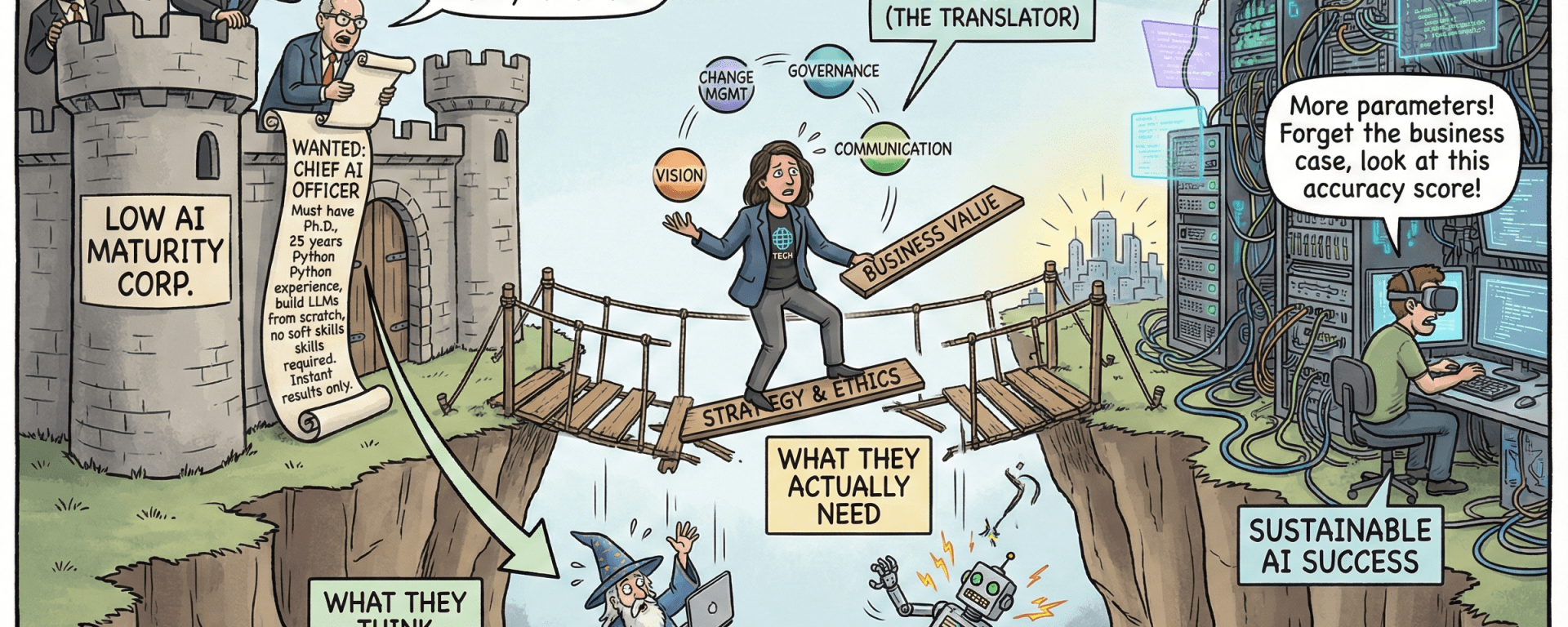
The integration of Artificial Intelligence (AI) into the operational and strategic fabric of North American enterprises represents one of the most significant paradigm shifts in modern management history. As organizations transition from the experimental phases of generative AI adoption to industrialized deployment, the demand for specialized leadership—most notably the Chief AI Officer (CAIO)—has surged. This transition is not merely technical; it is a profound organizational restructuring that challenges traditional hierarchies, governance models, and talent acquisition strategies.
For regulated industries—specifically finance, healthcare, government, higher education, and the nonprofit sector—the stakes of this leadership evolution are existential. Unlike the tech sector, where “move fast and break things” was once a celebrated mantra, regulated industries operate under the strictures of public trust, legal mandate, and ethical obligation. The leaders tasked with navigating this terrain must possess a rare duality: the technical foresight to harness rapidly evolving large language models (LLMs) and agentic workflows, combined with the seasoned judgment to navigate complex compliance landscapes and entrenched organizational cultures.
This report serves as a comprehensive strategic advisory document for senior organizational leaders. It rigorously examines the characteristics of highly successful AI leaders, contrasts these with the prevailing demands found in current job requisitions, and analyzes the “gap” between the two. Through a detailed synthesis of market data, executive search insights, and sector-specific case studies from 2024 and 2025, we test the hypothesis that a significant misalignment exists in AI leadership hiring—a gap that is disproportionately wider in organizations with lower AI maturity.
The analysis reveals that while the market creates a clamor for “technical unicorns”—individuals possessing PhD-level engineering prowess alongside C-suite business acumen—the actual drivers of success in regulated sectors are distinct. Successful leaders are defined not by their ability to code neural networks, but by their capacity for “Superagency,” change management, and the translation of probabilistic technology into deterministic business value.1 We explore how this misalignment leads to the “Science Project Trap” in low-maturity organizations and offer a roadmap for correcting these hiring inefficiencies.
Part I: The Archetype of the Successful AI Leader — Decoupling Hype from Reality
To understand the leadership gap, we must first establish a benchmark for success. What distinguishes the AI leader who successfully scales enterprise value from the one who oversees a portfolio of stalled pilot programs? Research across the 2024–2025 landscape indicates that the most effective AI executives in North America are strategic architects rather than purely technical engineers. They are characterized by a specific set of competencies that enable them to navigate the “trough of disillusionment” and deliver tangible Return on Investment (ROI).
1.1 The Strategic Visionary: Beyond the Proof-of-Concept
The defining characteristic of the successful AI leader in 2025 is the ability to transcend the “FOMO” (Fear Of Missing Out) that characterizes early-stage AI adoption. In an environment where 92% of companies plan to increase AI investments but only 1% of leaders consider their organizations “mature,” the successful leader acts as a stabilizing force.1 They ignore the relentless hype cycle to focus on sustainable business value.
Successful leaders are distinguished by their disciplined approach to ROI. In 2025, Chief AI Officers report an average AI ROI of 14%, a figure achieved only by moving beyond pilot programs to large-scale implementations.3 This requires a profound shift in mindset from “what is possible?” to “what is profitable?” The successful leader aligns technology investments strategically, ensuring that every AI initiative—from generative AI chatbots to complex predictive analytics—serves a specific business outcome rather than merely demonstrating technical feasibility.4
In regulated industries, this strategic vision is inextricable from capital allocation and risk management. For instance, in the financial sector, a successful leader does not merely deploy LLMs for novelty; they integrate them into workflows to reduce time-to-insight for wealth managers or to automate compliance checks, as seen in the strategies employed by leaders at major institutions like JPMorgan Chase.2 Teresa Heitsenrether, the Chief Data & Analytics Officer at JPMorgan Chase, exemplifies this archetype. Her success is not rooted in a background of fundamental AI research but in a career spanning decades of finance and strategy, allowing her to deploy the “LLM Suite” to 150,000 employees with a focus on productivity and data utility rather than raw algorithmic power.5
1.2 The “Bilingual” Translator: Bridging the Epistemic Divide
Perhaps the most frequently cited skill of a successful AI leader is the ability to act as a “translator”.6 The introduction of probabilistic systems into deterministic corporate environments creates an epistemic crisis. Business leaders are accustomed to binary outcomes (profit/loss, compliant/non-compliant), while AI systems deal in confidence intervals and hallucinations.
The successful CAIO possesses a dual fluency: they can discuss the nuances of retrieval-augmented generation (RAG) architectures with data scientists and then pivot to discuss EBITDA impacts with the CFO. This translation occurs on two axes:
- Vertical Translation: They interpret the organization’s high-level strategic goals into granular technical roadmaps for engineering teams. They prevent technical teams from solving the wrong problems by contextualizing their work within the broader business mission.7
- Horizontal Translation: They communicate the capabilities and limitations of AI to peer C-suite executives (CHRO, CLO, CMO), ensuring cross-functional alignment.8
In healthcare, this translation capability is a matter of life and death. Leaders must bridge the gap between clinical terminology and data science, ensuring that AI tools for diagnostics are not only accurate but also clinically relevant and trusted by physicians. Leaders like Dr. Bilal Mateen at PATH demonstrate this “trifecta” of skills—medical background, philanthropic experience, and technical knowledge—allowing them to speak the language of the doctors they serve.9 Without this translation layer, AI tools are often rejected by the “immune system” of the organization—the subject matter experts who do not trust the “black box.”
1.3 The Governance Architect: Managing Risk in Regulated Environments
In the regulated sectors of North America, the “move fast and break things” ethos is a liability. Successful AI leaders prioritize the establishment of robust data access and security frameworks over speed of deployment.3 They are deeply versed in the ethical considerations of AI, including bias mitigation, explainability, and privacy compliance (e.g., HIPAA in healthcare, GDPR/CCPA in data privacy, and the emerging EU AI Act).
The successful CAIO functions as a Governance Architect. They establish the “guardrails of success” before scaling applications. This involves implementing “human-in-the-loop” protocols and ensuring that AI agents—software capable of autonomous action—operate within strict ethical boundaries.6 In the government sector, this trait is paramount. Leaders are characterized by their familiarity with emerging regulations, such as US executive orders on safe AI and the requirements for transparency in algorithmic decision-making.12
The “Trust Gap” is a significant barrier to adoption, with only 52% of CEOs believing their generative AI investments are delivering value beyond cost reduction.3 Successful leaders close this gap by building transparent governance structures that allow stakeholders to see how decisions are made. They work closely with legal and risk officers to create “sandboxes” for innovation that do not jeopardize the institution’s license to operate.13
1.4 The Cultural Catalyst and Change Manager
Technological implementation is often the easiest part of an AI transformation; the human element is the bottleneck. McKinsey research highlights that while 92% of companies are increasing AI investment, the biggest barrier to scaling is not the technology itself, but leadership that fails to steer the organization through cultural change.1
Successful leaders possess high emotional intelligence (EQ) and change management skills. They address workforce fears regarding displacement by framing AI as an augmentation tool—”Superagency”—rather than a replacement mechanism.1 They actively cultivate a “growth mindset” across the organization, encouraging experimentation while managing the anxiety that comes with rapid technological shifts.7
This “Cultural Catalyst” role involves redefining the social contract of the workplace. Leaders must navigate the “flattening” of organizations, where AI tools reduce the need for middle management coordination, potentially eliminating 20% of such roles by 2026.14 Managing the morale and productivity of a workforce during such a transition requires a leader who is empathetic, transparent, and skilled in internal communications. They must be “evangelists” who can win stakeholder enthusiasm across the organization.15
1.5 The Ecosystem Builder
No AI leader succeeds in isolation. The complexities of the modern AI stack—requiring massive compute power, proprietary data, foundational models, and specialized applications—mean that no single organization can build everything in-house. The most effective executives are Ecosystem Builders.
- Internal Ecosystems: They forge alliances with the CHRO to manage talent pipelines and the CIO/CTO to manage infrastructure. They understand that AI is not an IT project but a business transformation project, requiring the integration of HR, Legal, and Operations.16
- External Ecosystems: They manage partnerships with vendors, academic institutions, and regulators. In higher education, for example, CAIOs are increasingly tasked with coordinating research, teaching, and administration, requiring a collaborative approach that spans the entire university ecosystem and connects with industry partners.17
Table 1: Core Competencies of Highly Successful AI Leaders
| Competency Domain | Key Skills & Traits | Business Impact in Regulated Sectors |
| Strategic Leadership | Business acumen, ROI orientation, Visionary thinking, Capital allocation | Aligns AI investments with long-term corporate strategy; avoids “shiny object” syndrome; ensures financial sustainability of expensive compute resources. |
| Technical Fluency | Understanding of ML/LLM lifecycles, Data architecture, Cloud infrastructure, RAG | Enables valid assessment of feasibility; earns respect of technical teams; distinguishes between “hype” and “reality” in vendor selection. |
| Governance & Ethics | Risk management, Regulatory compliance, Bias mitigation, Algorithmic accountability | Protects the organization from reputational damage and regulatory fines; ensures “Responsible AI” compliance with HIPAA/SEC/Federal mandates. |
| Change Management | Emotional intelligence, Communication, Persuasion, “Translation” | Overcomes internal resistance; drives adoption; fosters an AI-ready culture; manages workforce anxiety regarding automation. |
| Cross-Functional Collaboration | Stakeholder management, Negotiation, Political savvy, Ecosystem building | Breaks down silos; ensures data flows across departments; secures budget and buy-in from skeptical boards and functional heads. |
Part II: The Market Demand — Decoding the “Ask” in Job Postings
Having established the profile of the successful leader, we now turn our analytical lens to the market demand. What are organizations actually asking for when they post requisitions for AI leadership roles? An analysis of job postings and recruitment trends in 2024–2025 reveals a distinct set of priorities that companies are projecting into the market, often revealing a disconnect between perceived needs and actual success drivers.
2.1 The Rise of the “AI Czar” and Title Inflation
There is a palpable surge in the creation of dedicated AI leadership roles, often titled Chief AI Officer (CAIO) or Head of AI. This trend is driven by both defensive and offensive strategies. Defensively, organizations need someone to manage the risks of shadow AI; offensively, they need a leader to unlock the productivity gains promised by generative AI.
The CAIO role is fast becoming a fixture in the C-suite, particularly in the US federal government, where mandates now require agencies to designate Chief AI Officers to oversee compliance and strategy.12 In the private sector, the title is gaining traction as a signal of modernization to investors. However, job postings often reflect a “superhero” complex. Companies are frequently searching for individuals who are simultaneously PhD-level researchers, seasoned enterprise executives, and legal compliance experts.20
2.2 The “Technical Unicorn” Demand
A significant portion of job postings, particularly in organizations with lower AI maturity, heavily over-index on technical specifications. The anxiety of “missing out” leads organizations to believe that the solution to their AI challenges is to hire a leader with the deepest possible technical knowledge.
- Hard Skills Dominance: Postings frequently list requirements for proficiency in Python, TensorFlow, PyTorch, and specific experience with RAG (Retrieval-Augmented Generation) architectures, even for C-suite roles.7 This suggests that many organizations expect their CAIO to be a “hands-on keyboard” contributor, a requirement that often conflicts with the strategic demands of the role.
- The PhD Bias: There is a persistent preference for advanced degrees (PhD in Computer Science, Machine Learning, or Computational Linguistics), assuming that deep academic knowledge equates to leadership capability.11 While deep technical knowledge is valuable, the correlation between academic publishing records and the ability to navigate corporate politics or manage a P&L is tenuous.
2.3 Sector-Specific Hiring Nuances
The demand profile varies significantly across regulated sectors, reflecting the unique pressures and “immune systems” of each industry.
2.3.1 Healthcare: The Clinical-Technical Trifecta
In healthcare, the bar is exceptionally high. Organizations like PATH and large health systems seek a “trifecta” of skills: a medical background (MD), philanthropic/business experience, and deep technical knowledge in AI.9
- The Trend: Job postings emphasize “improving patient outcomes,” “reducing clinician burnout,” and “clinical decision support” alongside technical deployment.22 The ideal candidate is often envisioned as a physician-scientist who can code—a profile that is exceptionally rare.
- The Reality: Candidates possessing all three traits are vanishingly rare, leading to long vacancy times or the appointment of internal “physician champions” who may lack enterprise scaling experience, or technical leaders who lack clinical credibility.
2.3.2 Finance: The Risk-First Leader
Financial institutions operate under the watchful eye of regulators like the SEC, FINRA, and the OCC. Consequently, hiring trends here favor candidates with strong backgrounds in data governance, anti-money laundering (AML), and cybersecurity.5
- The Trend: Postings emphasize “risk frameworks,” “security clearances,” “audit trails,” and “model validation.” The “AI Czar” in banking is often an evolution of the Chief Data Officer (CDO) or Chief Risk Officer (CRO).24 The demand is for a “Safe Hands” leader who can innovate without breaking the bank’s risk posture.
2.3.3 Government: The Mandated Bureaucrat
The US federal landscape is unique due to the “AI Corps” initiative and executive orders. Hiring is driven by statutory requirements to appoint CAIOs in agencies like the DHS, DOT, and State Department.19
- The Trend: These roles prioritize “policy implementation,” “public trust,” and “workforce upskilling” over pure profit generation. The focus is on finding leaders who can navigate the bureaucracy to modernize legacy systems.12 The job descriptions often require a familiarity with federal procurement regulations (FAR) and the ability to work within the constraints of the civil service.
2.3.4 Higher Education: The Academic Administrator
Universities are appointing CAIOs to manage the dual challenge of AI in research and AI in the classroom (academic integrity).
- The Trend: These roles are frequently filled by internal promotions—tenured faculty with administrative experience (e.g., Associate Vice Presidents of Research). External hires are rare because the cultural nuance of “faculty governance” and “academic freedom” is difficult for corporate outsiders to navigate.17
2.3.5 Nonprofit: The Fractional Solution
The nonprofit sector faces a unique constraint: the “salary gap.” With nonprofit tech wages lagging behind the for-profit sector by approximately 20%, attracting top-tier AI talent is difficult.29
- The Trend: Hiring focuses on “efficiency,” “fundraising automation,” and “donor engagement.” The demand is for leaders who can deliver immediate operational improvements with limited budgets. Consequently, this sector is pioneering the “Fractional CAIO” model, hiring experts on a part-time or retainer basis to guide strategy without the full-time cost.30
Table 2: Characteristics Requested in Job Postings (The “Market Ask”)
| Sector | Top Requested Skills/Traits | Typical Background Requested | Hidden Expectation |
| Healthcare | Clinical understanding, Patient safety focus, HIPAA compliance, Technical R&D | MD/PhD, previous Chief Medical Information Officer (CMIO) or Research Lead. | “Fix our efficiency problems without upsetting the doctors.” |
| Finance | Risk management, Regulatory compliance (SEC/FINRA), Large-scale data processing | CDO, Head of Quant, or Senior Risk Officer with tech fluency. | “Innovate like a fintech but remain compliant like a bank.” |
| Government | Policy formulation, Federal procurement (FAR), Workforce development, Security clearance | Federal CIO/CTO experience, Policy Advisors, Academic/Think Tank backgrounds. | “Modernize our legacy systems without asking for more budget.” |
| Education | Academic integrity policy, Research administration, Digital literacy pedagogy | Tenured Faculty, Dean of Computing, CIO of Higher Ed. | “Protect our reputation while keeping us relevant.” |
| General Tech | Python/PyTorch fluency, LLM architecture, Generative AI product shipping | Staff Data Scientist, VP of Engineering, Research Scientist. | “Build us a ChatGPT-killer immediately.” |
Part III: The Great Misalignment — Gap Analysis and Hypothesis Testing
A critical analysis comparing Part I (Success Factors) and Part II (Hiring Trends) confirms the hypothesis: There is a substantial gap between the attributes that drive AI success and the attributes companies are prioritizing in their hiring. This gap is not uniform; it varies significantly based on the AI Maturity of the organization.
3.1 The “Technical Fallacy”: Confusing Engineering with Strategy
The most pervasive gap identified is the “Technical Fallacy.” A large proportion of job postings, particularly in the general tech and low-maturity sectors, demand proficiency in coding languages and model architectures. However, the profiles of successful leaders like Teresa Heitsenrether (JP Morgan) or Micky Tripathi (Mayo Clinic) show that their primary leverage is not in writing code but in orchestrating resources.
- The Gap: Companies hire for the production of AI (coding, model training) when they actually need the consumption of AI (strategy, integration, change management).8
- Consequence: Organizations end up with a “Head of AI” who is a brilliant data scientist but lacks the political capital or strategic vision to integrate their models into the core business. This leads to the “Science Project” syndrome, where AI initiatives remain interesting pilots that never scale to production.3
3.2 The Maturity Gap Hypothesis: A Confirmed Divergence
The hypothesis that “the gap is bigger in organizations with lower AI maturity” is strongly supported by the data.
3.2.1 Low-Maturity Organizations (The “Magic Wand” Syndrome)
Organizations in the “Experimentation” phase exhibit the widest gap. They often view AI as a commodity to be bought or a switch to be flipped.
- The Mistake: Lacking a clear business case, they write job descriptions that are laundry lists of technical buzzwords. They hire “Data Scientists” or “AI Researchers” for the CAIO role, expecting them to “figure out the strategy”.8
- The Disconnect:
- What they need: A strategic change agent to define use cases, build data literacy, and secure basic data infrastructure.33
- What they hire: A technical expert who wants to build models from scratch.
- The Result: The new leader struggles to demonstrate ROI because the organization lacks the data foundation and cultural readiness. The leader speaks “code” while the board expects “profit,” leading to frustration and high turnover.33
3.2.2 High-Maturity Organizations (The Integration Challenge)
High-maturity organizations (the “AI Achievers”) have bridged the technical gap but face a different set of hiring challenges.
- The Alignment: High-maturity hiring aligns closer to the success characteristics. They prioritize leaders who can manage “AI Agents,” ensure “Sovereign AI” compliance, and drive “Industrialized” AI lifecycles.35
- Remaining Gap: Even here, a gap exists in finding leaders who can manage the ethical and societal implications of “Superagency” (AI acting with autonomy). The market supply of leaders with experience in governing autonomous agents is virtually non-existent, creating a skills shortage rather than a definition gap.1
3.3 The “Trust Gap” and Soft Skills
While job postings heavily weigh technical certification (AWS, Python), the success literature overwhelmingly points to soft skills (negotiation, storytelling, ethics, empathy) as the determinants of longevity and impact.4
- Evidence: In nonprofits and healthcare, “emotional intelligence” and “mission alignment” are increasingly cited as crucial for retention. Yet, automated tracking systems (ATS) and technical screening tools often filter out candidates based on keyword matches for software skills, exacerbating the gap by removing candidates with the very leadership traits needed to succeed.37
- The “Candidate Fraud” Factor: The rise of AI-generated resumes and candidates using AI during interviews has created a “Trust Gap” in hiring. Gartner reports that recruiters are increasingly skeptical of technical claims, yet they continue to prioritize them in job descriptions, creating a cycle of mistrust.39
3.4 The “Unicorn” Fallacy
Across all maturity levels, there is a persistent gap caused by unrealistic job descriptions. Companies frequently demand a single individual who can:
- Write production-level code (Technical).
- Navigate complex global regulations (Legal).
- Inspire and restructure the workforce (HR/Change Management).
- Define corporate strategy (CEO-level).
Insight: Successful organizations often solve this not by finding a unicorn, but by creating an “Office of the CAIO” or distributing these responsibilities. The “Gap” is therefore a structural error—trying to fit a cross-functional mandate into a single job requisition.40
Table 3: The Maturity-Gap Matrix — Diagnosing the Disconnect
| AI Maturity Level | Primary Need (Success Factor) | Typical Hiring Mistake (The Gap) | Consequence |
| Low (Experimentation) | Strategic Roadmap, Data Foundation, Cultural Evangelism | Hiring a PhD Data Scientist or Senior Engineer | “Science projects” that never scale; Leader leaves due to lack of infrastructure; “Solution looking for a problem.” |
| Medium (Operationalizing) | Process Integration, Governance Frameworks, ROI Measurement | Hiring a visionary “Futurist” without operational rigor | Exciting pilots that fail to integrate into core workflows; Security/Compliance risks due to shadow AI. |
| High (Transformational) | Change Management, Business Model Reinvention, Ethical Oversight | Hiring functional managers who lack cross-domain influence | Incremental gains only; failure to capitalize on transformative potential of Agentic AI; inability to govern autonomous agents. |
Part IV: Sector-Specific Deep Dives — The Landscape of Leadership
The nature of the leadership gap manifests differently across the regulated sectors of North America. The specific regulatory bodies, cultural norms, and economic pressures of each sector create unique environments that successful leaders must navigate.
4.1 Finance: The Algorithmic Fortresses
In the financial sector (e.g., JPMorgan Chase, Capital One, Citi), the AI leader operates within an “Algorithmic Fortress.” The primary constraint is not technical capability but regulatory compliance and risk management.
- The Environment: Financial institutions are heavily regulated by bodies such as the SEC, the Federal Reserve, and the OCC. They face strict requirements regarding model explainability (why did the AI deny this loan?) and fairness (did the AI discriminate?).
- Success Profile: Leaders like Teresa Heitsenrether at JPMorgan Chase succeed because they focus on data utility and workforce enablement rather than just algorithmic novelty. Heitsenrether, a career finance executive, led the rollout of an LLM Suite to 150,000 employees, framing it as a productivity tool rather than a replacement for bankers.2 Her success stems from her deep understanding of the bank’s risk appetite and her ability to navigate the internal politics of a massive, siloed organization.
- The Gap: Financial firms often over-rotate on hiring from Big Tech (Google, Meta). While these hires bring technical excellence, they often struggle with the rigid regulatory environment and the legacy banking infrastructure (“spaghetti code”). The “Tech Bro” culture of “shipping fast” clashes with the “Banker” culture of “checking twice.” The most successful finance AI leaders are often internal promotions who understand the “plumbing” of the bank or external hires who are paired with strong internal “Sherpas”.21
4.2 Healthcare: The Clinical-Digital Interface
Healthcare faces the most acute “Trust Gap.” The integration of AI into clinical workflows is not just an efficiency play; it is a clinical intervention that requires the trust of doctors, nurses, and patients.
- The Environment: Healthcare is regulated by HIPAA (privacy) and the FDA (medical devices/algorithms). The culture is risk-averse, hierarchical, and deeply skeptical of technology that disrupts the doctor-patient relationship.
- Success Profile: Leaders like Dr. Bilal Mateen (PATH) and Micky Tripathi (Mayo Clinic) exemplify the “hybrid” background—medical training combined with policy or data science expertise.9 They succeed because they hold credibility with clinical staff. They do not approach AI as a way to replace doctors but as a way to remove administrative burden (the “pajama time” spent on electronic health records). They focus on “Human-Centered AI”.44
- The Gap: Hospitals often try to hire pure technologists to “fix” efficiency. These leaders fail because they underestimate the complexity of clinical workflows. A data scientist might build a model that predicts sepsis with 99% accuracy, but if it requires a nurse to enter data into a separate iPad during a code blue, it will never be used. The gap here is a lack of domain empathy in the hiring profile.20
4.3 Government: The Regulatory Vanguard
With the issuance of Executive Orders and OMB memos, US agencies are scrambling to appoint CAIOs. This is a sector driven by mandate rather than market forces.
- The Environment: The US federal government is the largest employer in the country, operating under strict procurement laws (FAR) and civil service rules. The “AI Corps” initiative aims to bring technical talent into government, but the cultural clash is significant.26
- Success Profile: Successful government AI leaders (often dual-hatted CIOs/CTOs) focus on procurement reform and talent pipelines. They are bureaucratic hackers who know how to move projects through red tape. They prioritize “Safe and Secure AI” over “Cutting Edge AI,” focusing on national security and public trust.12
- The Gap: The government struggles to attract top private-sector talent due to compensation limits (the “GS Scale” vs. Google salaries). The gap is often filled by appointing existing IT leaders who may lack deep AI strategic vision, leading to a “compliance-first” rather than “innovation-first” approach. Additionally, the political nature of these roles means that leaders must navigate shifting administration priorities (e.g., Biden’s AI Order vs. Trump’s deregulatory approach).45
4.4 Higher Education: The Ivory Tower’s Digital Renovation
Universities operate on shared governance, a system where faculty have significant power over curriculum and research direction.
- The Environment: Higher education is facing a crisis of relevance and integrity. Generative AI threatens traditional assessment methods (essays), while also offering new ways to personalize learning.
- Success Profile: CAIOs like Amarda Shehu (George Mason University) succeed by focusing on literacy and access for students and faculty. Shehu, a tenured professor, frames AI as a tool for “knowledge creation” rather than just administrative efficiency.17 This academic credibility allows her to lead faculty training and curriculum redesign.18
- The Gap: Universities that hire corporate AI leaders often face rejection from the faculty body. The corporate focus on “efficiency,” “customer service” (referring to students), and “automation” clashes with the academic values of “inquiry” and “tenure.” Successful hiring in this sector almost exclusively favors the “Academic-Administrator” model over the “Corporate Tech” model. The gap is cultural: corporate leaders speak the language of “scale,” while academics speak the language of “depth”.46
4.5 Nonprofit: The Efficiency Imperative
Nonprofits face a resource crisis. They are squeezed by rising costs and flat funding, making the efficiency promises of AI incredibly attractive, yet they are priced out of the talent market.
- The Environment: Nonprofits operate on tight budgets with a focus on mission impact. They are often risk-averse regarding data privacy (donor data) and are sensitive to the ethical implications of AI bias on the vulnerable populations they serve.
- Success Profile: Success here looks like efficiency. Leaders who can implement off-the-shelf tools (ChatGPT Enterprise, Salesforce AI) to automate grant writing, donor analysis, and program monitoring.31 The “Fractional CAIO” model is emerging as a key success strategy, allowing nonprofits to access high-level expertise for 5-10 hours a month to set strategy, while junior staff execute.32
- The Gap: Small nonprofits often aspire to build custom models (low maturity thinking) and try to hire engineers they can’t afford. The gap is closed when they realize they need a strategist to implement existing tools, often on a part-time basis, rather than a full-time developer. The “wage gap” drives a “quality gap,” where nonprofits struggle to hire experienced full-time leaders, making the fractional model essential.29
Part V: The Maturity Factor — How Organizational Readiness Dictates Hiring Success
The correlation between AI maturity and hiring success is the central dynamic explaining the “Gap.” The MIT CISR Enterprise AI Maturity Model provides a useful framework for understanding this.48
5.1 Level 1: Experimentation (The “Science Project” Phase)
- State: Ad hoc pilots, shadow AI, lack of central data governance.
- Hiring Dynamic: High failure rate. These organizations often hire a “Head of AI” to “figure it out.” This leader usually lacks the mandate to force the CIO to clean up the data or the CHRO to change hiring practices.
- Outcome: The leader leaves within 18 months, frustrated by bureaucracy. The organization concludes “AI doesn’t work for us.”
5.2 Level 2: Practicing (The “Process” Phase)
- State: Standardized tools, emerging governance, some deployed models.
- Hiring Dynamic: Moderate success. Organizations here start to hire for “Data Engineering” and “ML Ops” to build the plumbing.
- Outcome: They successfully deploy internal tools (e.g., a customer service bot), but struggle to transform the business model.
5.3 Level 3: Industrialized (The “Scale” Phase)
- State: AI platforms, centralized “AI Factory,” widespread adoption.
- Hiring Dynamic: High alignment. These organizations hire “Product Managers” for AI and “Governance Leads.” They understand that the CAIO is a business leader.
- Outcome: AI drives significant revenue or cost savings. The CAIO is a key strategic partner to the CEO.
5.4 Level 4: Future-Ready (The “Transformation” Phase)
- State: AI is embedded in the product and the culture. The organization sells AI-enabled services.
- Hiring Dynamic: These organizations (like Tech Giants or advanced Financial firms) hire “Visionaries” and “Ethicists.”
- Outcome: They are shaping the market. The CAIO role might dissolve as AI becomes everyone’s job, evolving into roles like “Chief Algorithmic Officer” or simply merging back into the CEO role.
Part VI: Strategic Recommendations for Organizational Leaders
For senior leaders in regulated industries, closing the leadership gap requires a fundamental rethink of talent strategy. It is not enough to simply post a job description and hope for the best.
6.1 Recommendation 1: Audit Your Maturity First
Before opening a requisition for a CAIO, conduct an honest audit of your AI maturity.
- If you are at Level 1: Do not hire a CAIO. Hire a Fractional Advisor to help you build the business case and data foundation. Or, appoint an internal “Project Lead” to manage the initial pilots.
- If you are at Level 2/3: Hire a “Builder-Strategist”—someone with experience scaling products, not just building models.
6.2 Recommendation 2: Prioritize “Internal Mobility” for the CAIO Role
The data suggests that for regulated industries, internal mobility is often a more successful strategy than external acquisition for the top AI role.
- Why: It is often easier to teach a trusted senior executive (who knows where the bodies are buried) about AI strategy than it is to teach an external AI expert about the complex regulatory and cultural inner workings of your organization.28
- Action: Look at your Chief Data Officer, Chief Strategy Officer, or Chief Innovation Officer. Do they have the aptitude? If so, upskill them.
6.3 Recommendation 3: Implement the “Office of the CAIO”
Recognize that the “Unicorn” does not exist. Build a team that covers the necessary bases.
- The Structure:
- CAIO: The Strategist and Face of AI (Business/Internal Hire).
- Head of AI Engineering: The Technologist (External Hire/PhD).
- AI Governance Lead: The Risk Manager (Legal/Compliance background).
- This distributed model ensures all competencies—technical, legal, and strategic—are covered without expecting one person to embody them all.8
6.4 Recommendation 4: Redefine the Job Description (Outcomes over Outputs)
Move away from keyword-stuffed job descriptions.
- Instead of: “Must have 10 years of Python and experience with Transformers.”
- Ask for: “Proven track record of deploying automated decision systems in a regulated environment that delivered measurable ROI.”
- Prioritize: Change management, stakeholder negotiation, and ethical governance.
6.5 Recommendation 5: Embrace Fractional Leadership
For nonprofits and mid-sized organizations, the Fractional CAIO is a strategic unlock.
- Action: Engage a senior AI leader for a 6-month retainer to set your strategy, select vendors, and hire your first junior engineers. This gives you C-suite guidance at a fraction of the cost and reduces the risk of a bad full-time hire.49
Conclusion
The chasm between successful AI leadership and current hiring practices is not merely a recruitment issue; it is a strategic vulnerability. Organizations in North America’s regulated sectors are at a crossroads. Those that persist in viewing the CAIO role as a technical trophy to be hunted will likely face high turnover, stalled initiatives, and regulatory friction. They will fall into the “Science Project Trap.”
Conversely, organizations that recognize the AI leader as a strategic change agent—a bilingual translator of technology and business value—will be positioned to harness the true “Superagency” of the AI era. The gap is indeed widest where maturity is lowest, but it is bridgeable. The solution lies not in finding better candidates, but in becoming better organizations—ones that understand that while AI is artificial, leadership remains undeniably human.
Key Takeaways for Senior Leaders:
- Don’t Hire a Scientist to Run a Business: If your problem is adoption, hire for change management.
- Context is King: In regulated industries, compliance knowledge > raw coding speed.
- Bridge the Gap with Teams: Stop looking for Unicorns. Build a balanced “Office of AI.”
- Maturity Matters: Know where you are. Don’t hire a Formula 1 driver for a go-kart.
- Look Inside: Your best next CAIO might already be working for you.
Sources:
- Superagency in the workplace: Empowering people to unlock AI’s full potential – McKinsey, accessed December 21, 2025, https://www.mckinsey.com/capabilities/tech-and-ai/our-insights/superagency-in-the-workplace-empowering-people-to-unlock-ais-full-potential-at-work
- Teresa Heitsenrether – JPMorganChase, accessed December 21, 2025, https://www.jpmorganchase.com/about/leadership/teresa-heitsenrether
- 2025 CEO Study: 5 mindshifts to supercharge business growth | IBM, accessed December 21, 2025, https://www.ibm.com/thought-leadership/institute-business-value/en-us/report/2025-ceo
- Preparing the C-Suite for the AI Economy in 2025: The Essential Role of the Chief AI Officer as a Catalyst – Executive Search – Boyden, accessed December 21, 2025, https://www.boyden.com/media/preparing-the-c-suite-for-the-ai-economy-in-2025-45024418/
- How Big Banks Are Turning AI Into a Workforce Advantage – CIO.inc, accessed December 21, 2025, https://www.cio.inc/how-big-banks-are-turning-ai-into-workforce-advantage-a-29883
- How a chief AI officer can help accelerate your AI strategy – PwC, accessed December 21, 2025, https://www.pwc.com/us/en/tech-effect/ai-analytics/generative-ai-officer.html
- 7 Top Skills and Traits of Successful Chief AI Officers – IDC, accessed December 21, 2025, https://www.idc.com/resource-center/blog/7-top-skills-and-traits-of-successful-chief-ai-officers/
- Eager to Hire a Chief AI Officer? Avoid These 5 Mistakes – HRPA, accessed December 21, 2025, https://www.hrpa.ca/hr-insights/eager-to-hire-a-chief-ai-officer-avoid-these-5-mistakes/
- Why global health organizations must adopt chief AI officers | World Economic Forum, accessed December 21, 2025, https://www.weforum.org/stories/2024/09/why-global-health-organizations-are-increasingly-adopting-chief-ai-officers/
- PATH’s first chief AI officer on how the technology will shape the global health ecosystem, accessed December 21, 2025, https://www.exemplars.health/stories/paths-first-chief-ai-officer-on-how-the-technology
- Chief AI Officer Job Description Template for 2025 – Chief Jobs | The C-Suite Job Board, accessed December 21, 2025, https://www.chiefjobs.com/chief-ai-officer-job-description-template-for-2024/
- AI Needs a Quarterback: The case for AI leadership just got stronger after OMB’s latest guidelines – Office of Artificial Intelligence – Georgia.gov, accessed December 21, 2025, https://ai.georgia.gov/blog/2025-04-17/ai-needs-quarterback-case-ai-leadership-just-got-stronger-after-ombs-latest
- AI Board Governance Roadmap | Deloitte US, accessed December 21, 2025, https://www.deloitte.com/us/en/programs/center-for-board-effectiveness/articles/board-of-directors-governance-framework-artificial-intelligence.html
- Transforming Work: Gartner’s AI Predictions Through 2029 – SHRM, accessed December 21, 2025, https://www.shrm.org/topics-tools/flagships/ai-hi/gartner-ai-predictions-through-2029
- What Is a Chief AI Officer? | IBM, accessed December 21, 2025, https://www.ibm.com/think/topics/chief-ai-officer
- CAIOs are stepping out from the CIO’s shadow, accessed December 21, 2025, https://www.cio.com/article/3845414/caios-role-reclaims-its-position-from-that-of-cio.html
- George Mason University’s Amarda Shehu appointed inaugural Chief Artificial Intelligence Officer, accessed December 21, 2025, https://www.gmu.edu/news/2024-09/george-mason-universitys-amarda-shehu-appointed-inaugural-chief-artificial
- The Chief AI Officer Becomes a New Fixture in Higher Education – The National CIO Review, accessed December 21, 2025, https://nationalcioreview.com/articles-insights/extra-bytes/the-chief-ai-officer-becomes-a-new-fixture-in-higher-education/
- Here are the agency officials leading AI deployment under Trump | FedScoop, accessed December 21, 2025, https://fedscoop.com/agency-officials-leading-ai-deployment-under-trump-caio/
- Chief AI Officer: Healthcare’s hot new role demands a rare combination of skill sets, accessed December 21, 2025, https://www.healthcareitnews.com/news/chief-ai-officer-healthcares-hot-new-role-demands-rare-combination-skill-sets
- The Rise of the Chief AI Officer: Insights & Trends – Findem, accessed December 21, 2025, https://www.findem.ai/blog/insights-chief-ai-officer
- The Future of Healthcare HR: Workforce & Compliance Trends for 2025 | SPARK Blog – ADP, accessed December 21, 2025, https://www.adp.com/spark/articles/2025/03/the-future-of-healthcare-hr-workforce-compliance-trends-for-2025.aspx
- Twimbit AI Spotlight: J.P. Morgan Chase, accessed December 21, 2025, https://content.twimbit.com/insights/twimbit-ai-spotlight-j-p-morgan-chase/
- AI in Banking: Where We’re Headed Next | American Banker, accessed December 21, 2025, https://www.americanbanker.com/video/the-most-powerful-women-in-banking-conference-2024/ai-in-banking-where-were-headed-next
- The Important Differences Between Chief Data Officer And Chief AI Officer | Bernard Marr, accessed December 21, 2025, https://bernardmarr.com/the-important-differences-between-chief-data-officer-and-chief-ai-officer/
- DHS Launches First-of-its-Kind Initiative to Hire 50 Artificial Intelligence Experts in 2024, accessed December 21, 2025, https://www.dhs.gov/archive/news/2024/02/06/dhs-launches-first-its-kind-initiative-hire-50-artificial-intelligence-experts-2024
- MEMORANDUM – OPM, accessed December 21, 2025, https://www.opm.gov/chcoc/latest-memos/building-the-ai-workforce-of-the-future.pdf
- Private Sector Drives 63% of Chief AI Officer Appointments as AI Influences Corporate Talent Strategy – VKTR.com, accessed December 21, 2025, https://www.vktr.com/the-wire/private-sector-drives-63-of-chief-ai-officer-appointments-as-ai-influences-corporate-talent-strategy/
- Why We May Soon See An Increase In Fractional Leadership At Nonprofits – Forbes, accessed December 21, 2025, https://www.forbes.com/councils/forbesbusinesscouncil/2025/12/18/why-we-may-soon-see-an-increase-in-fractional-leadership-at-nonprofits/
- 2025 in Review: Key Nonprofit Hiring Trends and a Look Ahead to 2026 – DSG Global, accessed December 21, 2025, https://www.dsgco.com/2025-in-review-key-nonprofit-hiring-trends-and-a-look-ahead-to-2026/
- AI Can’t Be Ignored: Exploring the Opportunities for Nonprofits and the Social Sector, accessed December 21, 2025, https://www.bridgespan.org/insights/exploring-ai-opportunities-for-nonprofits-and-the-social-sector
- Why Every Growth Company Needs a Fractional CMO in the Age of AI, accessed December 21, 2025, https://mavenmarketingsolutions.com/why-every-growth-company-needs-a-fractional-cmo-in-the-age-of-ai/
- The 5 Biggest Mistakes Companies Make When Hiring AI Leaders – Christian & Timbers, accessed December 21, 2025, https://www.christianandtimbers.com/insights/the-5-biggest-mistakes-companies-make-when-hiring-ai-leaders
- How AI maturity impacts risk, speed, and strategy – AuditBoard, accessed December 21, 2025, https://auditboard.com/blog/how-ai-maturity-impacts-risk-speed-and-strategy
- The Art of AI Maturity – Accenture, accessed December 21, 2025, https://www.accenture.com/us-en/insights/artificial-intelligence/ai-maturity-and-transformation
- AI trends 2025: Adoption barriers and updated predictions – Deloitte, accessed December 21, 2025, https://www.deloitte.com/us/en/what-we-do/capabilities/applied-artificial-intelligence/blogs/pulse-check-series-latest-ai-developments/ai-adoption-challenges-ai-trends.html
- New 2026 Nonprofit Compensation & Talent Strategies Report Highlights Resilience, Progress, and Innovation in the Sector, accessed December 21, 2025, https://careerblazersnonprofitsearch.com/new-2026-nonprofit-compensation-talent-strategies-report-highlights-resilience-progress-and-innovation-in-the-sector/
- 10 Vendor Selection Mistakes to Avoid When Choosing Your AI Recruiting Partner, accessed December 21, 2025, https://www.index.dev/blog/ai-recruiting-vendor-selection-mistakes
- Gartner Survey Shows Just 26% of Job Applicants Trust AI Will Fairly Evaluate Them, accessed December 21, 2025, https://www.gartner.com/en/newsroom/press-releases/2025-07-31-gartner-survey-shows-just-26-percent-of-job-applicants-trust-ai-will-fairly-evaluate-them
- The Development of the Chief AI Officer in Healthcare – WittKieffer, accessed December 21, 2025, https://wittkieffer.com/insights/the-development-of-the-chief-ai-officer-in-healthcare
- 11 HR Trends for 2026: Shaping What’s Next – AIHR, accessed December 21, 2025, https://www.aihr.com/blog/hr-trends/
- Designing the C-suite for generative AI adoption – Deloitte, accessed December 21, 2025, https://www.deloitte.com/us/en/insights/topics/digital-transformation/gen-ai-adoption-in-csuite.html
- Micky Tripathi, PhD – Kaiser Permanente Institute for Health Policy, accessed December 21, 2025, https://www.kpihp.org/bio/micky-tripathi-ph-d/
- 5 Things Healthcare Leaders Want from AI in 2025 and Beyond, accessed December 21, 2025, https://www.naco.org/news/5-things-healthcare-leaders-want-ai-2025-and-beyond
- The CAIOs Leading Responsible AI Development Across Government, accessed December 21, 2025, https://govciomedia.com/the-caios-leading-responsible-ai-development-across-government/
- Chief AI Officer: Higher Ed’s New Leadership Role – GovTech, accessed December 21, 2025, https://www.govtech.com/education/higher-ed/chief-ai-officer-higher-eds-new-leadership-role
- 5 Nonprofit Trends to Watch Out for this 2025 – CharityEngine Blog, accessed December 21, 2025, https://blog.charityengine.net/nonprofit-trends-2025
- What’s your company’s AI maturity level? – MIT Sloan, accessed December 21, 2025, https://mitsloan.mit.edu/ideas-made-to-matter/whats-your-companys-ai-maturity-level
- Are Fractional AI Officers the Next Big Hiring Trend? – Build Mode by A.Team, accessed December 21, 2025, https://blog.a.team/mission/startups-fractional-ai-officers
- Fractional Head of AI vs Full-Time CAIO: Which Model Fits Your Business Needs?, accessed December 21, 2025, https://ai-penguin.com/blog/fractional-head-of-ai-vs-full-time-caio
 Adam Outside The Box