Executive Summary
The widespread integration of Artificial Intelligence (AI) into the enterprise sector has precipitated a fundamental reassessment of organizational dynamics. No longer is AI adoption viewed solely as a technological upgrade; rather, it is increasingly recognized as a comprehensive transformation of human capital management. This report, grounded in extensive market intelligence and academic research from the 2024-2025 period, posits that an organization’s “AI Maturity”—its ability to not just deploy but to derive sustained value from AI—is causally linked to specific Human Resources (HR) policy architectures.
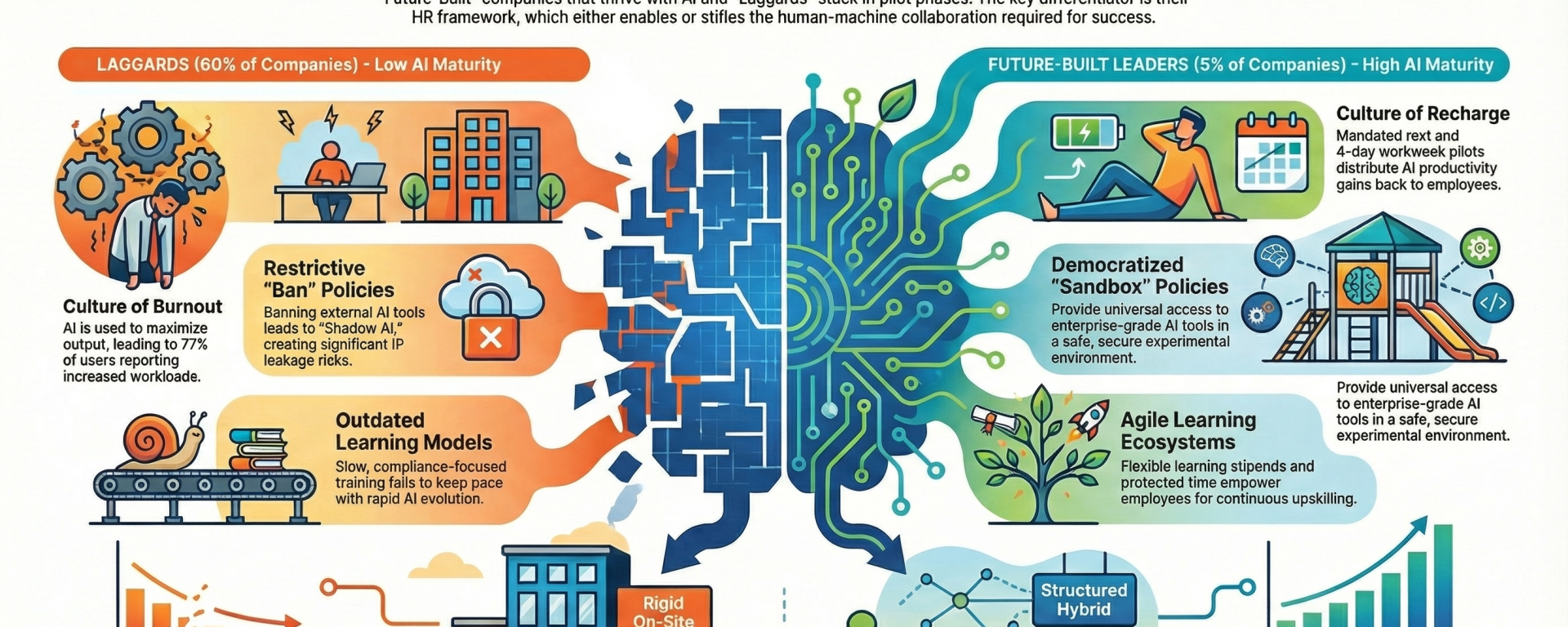
Our analysis of the current landscape reveals a stark divergence. A small cohort of “Future-Built” organizations (approximately 5% of the market) has successfully embedded AI into their core operating models, achieving significant revenue and efficiency gains.1 Conversely, a vast majority of “Laggards” (60%) remain trapped in pilot purgatory, unable to scale their initiatives.1 The differentiator is rarely the quality of the silicon, but rather the quality of the social contract established between the employer and the workforce.
This report explores the correlations between specific HR policies—ranging from vacation structures and remote work mandates to diversity frameworks and learning stipends—and AI maturity. The findings suggest that mature AI organizations exhibit a distinct “policy signature”: they prioritize psychological safety to encourage experimentation, leverage flexible work models to digitize workflows, enforce rigorous diversity standards to mitigate algorithmic risk, and institutionalize continuous learning through aggressive financial and temporal support.
By examining the interplay between human policy and machine capability, this document serves as a strategic roadmap for senior HR leaders. It argues that to accelerate AI maturity, organizations must transition from rigid, compliance-based HR models to adaptive, human-centric systems that empower the workforce to collaborate effectively with autonomous digital agents.
Section 1: The AI Maturity Spectrum and the Human Operating System
To understand the relationship between HR policy and AI success, we must first establish a rigorous definition of AI maturity and the current state of the market. As of late 2024 and early 2025, the global business environment is characterized by a paradox: while investment in AI is ubiquitous, genuine maturity remains elusive.
1.1 The State of AI Adoption: A Vision-Execution Gap
The trajectory of AI adoption has been steep, yet uneven. Research indicates that 92% of companies plan to increase their AI investments over the next three years.2 However, a mere 1% of leaders classify their organizations as fully “mature,” implying that AI is deeply integrated into workflows and driving substantial business outcomes.3 This discrepancy is further highlighted by ServiceNow’s “Enterprise AI Maturity Index 2025,” which reported a surprising 9-point decline in average maturity scores year-over-year.4 This regression suggests that the complexity of deploying AI at scale is outpacing the organizational capacity to absorb it.
We can categorize organizations into three distinct maturity tiers, each characterized by a specific HR and operational profile:
- The Laggards (60%): These organizations typically view AI through a narrow lens of cost reduction or efficiency. Their adoption is fragmented, often characterized by “Shadow AI” where employees use tools without authorization due to restrictive policies. HR in these firms functions primarily as a compliance engine, enforcing rigid job descriptions and traditional performance metrics that fail to account for AI-augmented workflows.1
- The Scalers (35%): Having moved beyond initial piloting, these organizations are attempting to standardize AI usage across functions. However, they often encounter the “frozen middle”—a layer of management and policy that resists the fluidity required for AI integration. While they may have invested in the technology, their HR policies regarding training and role redesign lag behind, creating friction.1
- The Future-Built Leaders (5%): This elite cohort systematically builds AI capabilities across all functions. They have moved toward an “AI-first operating model” rooted in human-machine collaboration.1 Their HR policies are proactive, anticipating the skills and psychological needs of an AI-augmented workforce. These firms report significantly higher revenue growth and cost savings, attributing their success to a holistic strategy that aligns technology with human potential.1
1.2 The Human Element as the Primary Variable
The correlation between HR policy and AI maturity is rooted in the nature of Generative AI (GenAI) itself. Unlike previous waves of automation (e.g., robotic process automation), GenAI is nondeterministic and creative. It requires a “human in the loop” to prompt, guide, audit, and refine its outputs. This interaction is deeply human and requires a workforce that is cognitively engaged, psychologically safe, and continuously learning.
Therefore, the stagnation in AI maturity scores observed in 2025 is largely a failure of organizational culture and policy, not technology. As noted in the McKinsey report “Superagency in the Workplace,” the biggest barrier to scaling is not the employees—who are ready and willing—but the leaders who fail to steer the organization fast enough.3 HR leaders are thus uniquely positioned to bridge this gap by architecting policies that unlock human agency.
The following sections will dissect specific policy domains, demonstrating how each correlates with AI maturity and providing evidence-based insights for HR strategy.
Section 2: The Cognitive Economy – Vacation, Burnout, and the Productivity Paradox
One of the most counterintuitive findings in the research is the relationship between AI adoption and employee burnout. While the promise of AI is to liberate humans from drudgery, the reality of the transition phase often involves increased cognitive load and intensified pressure. HR policies regarding time off, workload management, and mental health are therefore critical predictors of sustainable AI maturity.
2.1 The “Productivity Paradox” and Burnout
The narrative that AI will simply “save time” is increasingly challenged by data from the field. Research by Upwork reveals a troubling trend: 77% of employees using AI tools report that these tools have actually added to their workload rather than alleviating it.5 Furthermore, 71% of full-time employees report feeling burned out, a condition exacerbated by the pressure to maintain higher productivity levels enabled by AI.5
This phenomenon, known as the “productivity paradox,” occurs when the efficiency gains from AI are immediately filled with more work, rather than recovery time. Highly productive AI users—those who have mastered the tools—are often the most at risk. They face a “cognitive tax” of constant learning, prompting, and auditing, leading to a state where they are “wired but tired”.6
- Policy Correlation: Organizations with “Laggard” AI maturity often lack policies that decouple output from hours worked. They view AI as a tool to squeeze more efficiency out of the same number of hours. In contrast, “Future-Built” organizations recognize that high-cognitive work requires high-quality recovery.
2.2 Vacation Policy Architectures: Unlimited vs. Mandated
The structure of vacation policies serves as a litmus test for an organization’s understanding of cognitive sustainability in the AI era.
- The Trap of “Unlimited PTO”: Many tech-forward companies, including AI startups like GitHub and Asana, offer “unlimited” paid time off (PTO).7 While this signals flexibility—a hallmark of AI maturity—it can backfire in high-pressure environments. Without clear boundaries, “unlimited” often translates to “zero” due to the intense “crunch culture” prevalent in software and AI development.8 Employees in these environments may fear that taking time off will signal a lack of commitment, especially when AI tools are theoretically making them “faster.”
- The Shift to Mandated “Recharge”: Recognizing the limitations of unlimited policies, mature organizations are increasingly adopting mandated rest periods. Microsoft, a global leader in AI, has implemented policies that encourage “recharge weeks” or specific team-wide disconnection days.10 This shift acknowledges that in an always-on, AI-augmented world, the permission to rest must be explicit and collective.
- The Correlation: The research suggests a positive correlation between AI maturity and policies that enforce predictable time off. Mature organizations understand that the “hallucination” rate of AI models is matched by the error rate of exhausted humans. To maintain the integrity of “human-in-the-loop” systems, the human loop must be rested.
2.3 The 4-Day Workweek: The Ultimate AI Dividend?
Perhaps the most provocative policy frontier is the 4-day workweek. Once considered a fringe benefit, it is now being seriously evaluated by AI-mature organizations as the logical mechanism to distribute the “efficiency dividend” of AI.
- The Mechanism: If AI can deliver a 40% productivity gain—as seen in Microsoft Japan’s pilots and other trials—then reducing work hours by 20% (one day) creates a net positive for both the firm (which keeps 20% of the gain) and the employee (who gains a day of life).12
- Strategic Adoption: Startups and agile companies are using the 4-day week as a competitive wedge to attract top talent from slower incumbents. Companies like Buffer have reported a 22% productivity increase and a 66% decrease in absenteeism after adopting a 4-day model.12
- Maturity Indicator: The willingness to pilot or discuss a 4-day workweek correlates with high AI maturity because it requires an organization to have already transitioned to outcome-based performance management. You cannot run a 4-day week if you are still measuring “seats in chairs.” Thus, the policy itself is a proxy for advanced management practices that are essential for AI success.13
2.4 Managing the “Fear of Replacement”
Burnout is not just physical; it is psychological. A significant stressor in the AI transition is the fear of job displacement. Research shows that AI adoption is associated with lower levels of psychological safety, which in turn is linked to higher levels of depression.14
- Policy Intervention: Mature organizations address this through “Employment Security Policies” or “Redeployment Guarantees.” By explicitly stating that AI is intended to augment rather than replace, and by committing to retraining rather than layoffs, these organizations reduce the existential anxiety that fuels burnout. This creates a safer environment where employees are willing to experiment with AI without fear of automating themselves out of a job.15
Section 3: The Spatial Dynamics of Innovation – WFH, Hybrid, and Digital Nomads
The debate over “Return-to-Office” (RTO) versus remote work is inextricably linked to AI maturity. The infrastructure required for a distributed workforce—cloud-based collaboration, digitized documentation, and asynchronous communication—is the exact same infrastructure required to train and deploy AI models.
3.1 The Digital Backbone as a Prerequisite
Organizations that embraced digital transformation early, often forced by the necessity of remote work policies during the pandemic, are now statistically better positioned for AI adoption.16 This is because AI models, particularly Large Language Models (LLMs), consume text and data.
- The Data-Remote Link: In a remote-first or hybrid environment, communication happens via text (Slack, Teams, Email, Jira). This creates a massive, searchable corpus of “institutional knowledge” that can be used to fine-tune internal AI models. In contrast, office-centric cultures that rely on verbal, hallway conversations generate less training data.
- Policy Correlation: Therefore, policies that support remote and hybrid work positively correlate with Data Maturity, which is a precursor to AI Maturity. Companies with mature “Work from Anywhere” policies have likely already solved the problems of cloud security, identity management, and digital access control—all of which are foundational for deploying enterprise AI.17
3.2 The Hybrid Model of AI Leaders: “Moments that Matter”
While digital infrastructure is key, many leading AI companies are adopting a Structured Hybrid policy rather than a fully remote one. The nuance lies in the purpose of the office.
- Microsoft’s “Team Days”: Microsoft, a bellwether for AI maturity, has evolved its policy to expect roughly 50% in-person time, but with a twist. They utilize their own AI tools (Microsoft Places) to coordinate “moments that matter”—ensuring that teams gather for creative, high-bandwidth collaboration rather than rote tasks.18 The policy is not “come in to badge swipe”; it is “come in to innovate.”
- Nvidia’s Project-Based Fluidity: Nvidia operates with a policy framework that favors “project-based teams” over rigid hierarchies. This structure allows them to assemble the best talent for a specific AI challenge, regardless of physical location, while still maintaining a culture of intense collaboration.20 Their policy is one of agility rather than geography.
3.3 Shadow IT and the “Ban” Culture
A strong negative correlation exists between restrictive WFH/AI policies and AI maturity. In organizations that enforce rigid RTO mandates or ban the use of external AI tools without providing internal alternatives, “Shadow AI” proliferates.
- The Risk: Employees, driven by the need to be productive, will use unauthorized AI tools on personal devices if corporate policies are too restrictive. This creates massive IP leakage risks.22
- The Mature Policy: Future-Built organizations implement policies of “Democratized Access.” They provide enterprise-grade access to tools like ChatGPT Enterprise or Copilot to all employees, remote or on-site. This policy aligns the desire for flexibility with the need for security, ensuring that the “digital exhaust” of the workforce remains within the corporate firewall.23
Table 1: Work Policy Models and AI Maturity
| Work Policy Model | Description | AI Maturity Correlation | Reasoning |
| Rigid On-Site | Mandated 5 days/week; focus on presence. | Low (Laggard) | Relies on verbal/analog communication; lacks digital data trail; limits talent pool. |
| Unmanaged Remote | 100% remote with no coordination; disconnected. | Medium (Scaler) | Good digital infrastructure, but risks isolation and reduced collaborative innovation (“spark”). |
| Structured Hybrid | Coordinated in-person time for innovation; flexible execution. | High (Leader) | Balances “deep work” (execution) with “collaborative work” (innovation); optimized for agile teams. |
| Project-Based/Fluid | Location determined by project needs; non-hierarchical. | Very High (Future-Built) | Maximizes talent allocation efficiency; mimics the agility of AI agents themselves. |
Section 4: The Diversity Imperative – DEI as Algorithmic Risk Management
In the past, Diversity, Equity, and Inclusion (DEI) policies were often categorized under “Corporate Social Responsibility.” In the age of AI, they have migrated to the center of “Product Strategy” and “Risk Management.” There is a robust, quantifiable correlation between the maturity of an organization’s DEI policies and its AI maturity.
4.1 Bias In, Bias Out: The Technical Case for DEI
AI systems are mirrors of the data they are trained on. If that data reflects historical biases (which it almost always does), the AI will replicate and amplify those biases. Homogenous teams—those lacking diversity in gender, race, neurodiversity, and background—are statistically less likely to identify these biases during the development and testing phases.24
- Quantitative Evidence: Research shows that diverse leadership teams are more likely to have mature AI commitments and broader adoption strategies.25 Furthermore, companies with diverse design teams report fewer “AI incidents” (e.g., discriminatory chatbots, biased hiring algorithms) because diverse teams serve as a natural “Red Team” against blind spots.26
- Policy Shift: In mature AI organizations, DEI policies are no longer just about hiring quotas; they are about Algorithmic Integrity. HR policies in these firms explicitly link DEI goals to technical outcomes. For example, a policy might mandate that any AI product team must meet a certain diversity threshold before a model is released to production to ensure adequate bias testing.28
4.2 The Role of the Chief Diversity Officer (CDO)
The interaction between the Chief Diversity Officer (CDO) and the Chief AI Officer (CAIO) is a key maturity indicator.
- The Gap: Currently, only 9% of CDOs feel prepared to address Generative AI.29 This gap represents a significant risk.
- The Solution: Mature organizations have policies that integrate the CDO into the AI Governance Board. This ensures that DEI is not an afterthought but a “gatekeeper” function. HR policies in these firms often include specific upskilling mandates for DEI leaders to ensure they understand the technical nuances of LLMs and can effectively audit them for fairness.29
4.3 Inclusion Monitoring and AI
Interestingly, the relationship is bidirectional: while diversity improves AI, AI can also improve diversity—if the right policies are in place.
- Sentiment Analysis: Mature organizations utilize AI tools to monitor internal communications for sentiment, identifying patterns of exclusion or microaggressions that might otherwise go unnoticed. This allows HR to intervene proactively.30
- Policy Caution: However, this requires strict Privacy and Ethics Policies. “Laggard” organizations may use these tools for surveillance, eroding trust. “Leader” organizations use them for “organizational health monitoring,” aggregating data to protect anonymity while acting on the insights.31
Section 5: The Learning Organization – Upskilling, Stipends, and the “AI Academy”
If there is a single HR policy lever that most strongly predicts AI maturity, it is the depth, structure, and agility of Learning and Development (L&D). The transition to AI is fundamentally a skills transition. “Future-built” companies are characterized by what BCG calls “tenacious upskilling”.1
5.1 The Failure of Traditional L&D
In “Laggard” organizations, L&D is often episodic, compliance-focused, and centralized. Training is something that “happens to” employees once a quarter. This model is wholly inadequate for the speed of AI evolution, where a tool learned in January may be obsolete by June.
- The Skill Gap: By 2025, 60% of organizations expect to face challenges in upskilling employees for AI.2 The traditional “curriculum design” process is too slow to keep up.
5.2 The Rise of the “Learning Stipend”
To combat the speed of change, mature organizations are decentralizing L&D through policy mechanisms like the Learning Stipend.
- The Mechanism: Companies like Grammarly and other tech leaders offer dedicated stipends that allow employees to pursue AI literacy in ways that suit their individual learning styles and immediate needs.32 This policy acknowledges that the “best” AI course might be a YouTube series, a Substack subscription, or a weekend workshop, not necessarily a corporate LMS module.
- Correlation: A generous, flexible learning stipend correlates with AI maturity because it fosters agency. It signals to employees that they are trusted to identify their own skill gaps and fill them. This “bottom-up” learning culture is essential for GenAI, where the most valuable use cases are often discovered by frontline workers rather than mandated by executives.34
5.3 The Internal AI Academy
While stipends handle the “long tail” of skills, mature organizations also invest heavily in centralized AI Academies to establish a baseline of fluency.
- Case Studies: JPMorgan Chase (JPMC) successfully rolled out its “AI Made Easy” program to tens of thousands of employees, driving “viral” adoption of its internal AI platforms.34 Similarly, consulting giants like Bain and BCG use their academies not just to teach technical skills, but to instill “AI intuition”—the ability to know when to use AI and how to verify it.36
- Policy Detail: A critical component of these policies is Time-Protected Learning. A policy that offers content without time is a recipe for burnout. Mature HR policies explicitly allocate work hours—sometimes modeled on Google’s famous “20% time”—specifically for AI experimentation and upskilling.37
5.4 Reskilling vs. Upskilling: The “Redeployment” Mandate
Finally, L&D policies in mature firms are tightly coupled with Talent Mobility.
- The “Laggard” View: Hire new AI talent; fire old non-AI talent. This is expensive and destroys morale.
- The “Leader” View: Reskill existing talent. Mature policies prioritize internal mobility, creating “talent marketplaces” where employees can apply their newly learned AI skills to different parts of the organization. This preserves institutional knowledge while upgrading technical capability.38
Section 6: Governance and Democratization – The “Sandbox” Policy
How an organization governs access to AI tools is a definitive marker of its maturity. HR plays a pivotal role here, often serving as the bridge between IT security and workforce capability.
6.1 The “Ban” vs. “Sandbox” Dichotomy
- Restrictive Policies (Low Maturity): Many organizations still maintain policies that ban Generative AI tools entirely or restrict them to a small group of data scientists. This approach ignores the reality that GenAI is a general-purpose technology. Banning it is akin to banning the internet. It leads to “Shadow AI” and prevents the organization from building the “muscle memory” required for adoption.22
- Democratization Policies (High Maturity): “Leader” organizations implement policies of Universal Access. They secure enterprise licenses for tools (e.g., ChatGPT Enterprise, Microsoft Copilot) and make them available to the entire workforce.
- The Sandbox: Crucially, these policies are paired with a “Sandbox” environment—a safe, secure digital space where employees can experiment with internal data without risk of leaking IP or violating compliance regulations. JPMC’s rollout is a prime example: they empowered employees to build their own AI assistants, creating a “flywheel” of innovation.34
6.2 The Ethics Board Architecture
In mature firms, the AI Ethics Board is a formal institution with clear policy powers. HR is a central pillar of this board, alongside Legal, IT, and DEI.39
- Policy Mechanism: A standard policy in mature firms is the Algorithmic Impact Assessment (AIA). Before any HR-related AI tool (e.g., a resume scanner or performance analyzer) is deployed, it must undergo an AIA to check for bias, explainability, and privacy risks.40
- Whistleblower Protection: Mature policies also extend “whistleblower” protections to AI ethics. Employees are encouraged to report “unsafe” or “biased” AI behaviors without fear of retaliation, fostering a culture of continuous auditing.41
Section 7: Organizational Structure and Agility
The final dimension of correlation lies in the very structure of the organization. AI maturity demands a shift from rigid hierarchies to fluid, network-based designs.
7.1 From Hierarchies to “Superagency”
McKinsey describes the potential of AI to create “Superagency” in the workplace—empowering individuals to achieve outcomes that previously required entire teams.3 However, this is only possible if the organizational structure permits it.
- The “Digital Factory” Model: Mature organizations often adopt a “Digital Factory” or “Product Platform” operating model. In this structure, small, multidisciplinary “pods” (consisting of business experts, developers, and designers) work autonomously to solve specific problems using AI.38
- HR Policy Implication: This requires HR to rethink Job Descriptions. Instead of rigid, task-based descriptions (“Must type 60 WPM”), mature policies use outcome-based descriptions (“Responsible for customer communication strategy”). This allows the “how” of the job to evolve as AI tools improve, without requiring a rewrite of the employment contract every six months.42
7.2 The Decline of Middle Management?
There is a growing discourse on the impact of AI on middle management. “Laggard” organizations often see AI as a way to eliminate these layers. “Future-Built” organizations, however, view middle managers as the “human routers” of the AI network.
- Policy Shift: Mature HR policies shift the focus of middle management from “monitoring” to “coaching.” Managers are evaluated not on the compliance of their teams, but on their “AI Upskilling Rate”—how effectively they are helping their teams integrate AI to increase impact.1
Conclusion: The Strategic Roadmap for HR Leaders
The evidence from 2024-2025 is conclusive: AI Maturity is a function of Human Policy. Organizations that attempt to graft advanced AI technology onto antiquated human resource frameworks will fail to realize the technology’s potential. They will face burnout, resistance, bias, and stagnation.
For the senior HR leader, the path forward involves a systematic policy audit and renovation. The goal is to build an “AI-Ready Culture” defined by safety, agility, and continuous growth.
Strategic Recommendations (The “Leader” Playbook)
- Institute a “Right to Experiment”: Codify psychological safety by creating “No-Fault” zones for AI experimentation. Make it clear that efficiency dips during the learning curve are expected and protected.
- Mandate “Recharge” to Combat Burnout: Move beyond “unlimited” vacation to structured, mandatory disconnection periods. Consider piloting a 4-day workweek as a mechanism to share the AI productivity dividend.
- Democratize Access with Governance: Replace bans with “Sandboxes.” Provide enterprise-grade tools to all, backed by clear “Red/Green” data usage policies.
- Integrate DEI into the AI Lifecycle: Empower the CDO with a seat on the AI Ethics Board. Mandate algorithmic impact assessments for all internal tools.
- Fund “Agency” through Learning: Implement flexible learning stipends and protect work hours for study. Move from episodic training to a culture of continuous “cognitive upgrading.”
- Redesign for Agility: Transition from rigid job descriptions to outcome-based roles. Foster project-based, hybrid teams that can swarm around problems regardless of location.
By executing these policy shifts, HR leaders do not merely support the AI strategy; they become the architects of the organization’s future, ensuring that the rise of the machine elevates, rather than diminishes, the human spirit.
Data Sources & Citations:
- AI Maturity & Adoption Statistics: 1
- Psychological Safety & Burnout: 5
- Vacation & 4-Day Workweek: 7
- Work Arrangements (Remote/Hybrid): 16
- Diversity & Inclusion (DEI): 24
- L&D and Upskilling: 1
- Governance & Ethics: 22
- Organizational Structure: 38
Works cited
- AI Leaders Outpace Laggards with Double the Revenue Growth and 40% More Cost Savings – Boston Consulting Group, accessed December 19, 2025, https://www.bcg.com/press/30september2025-ai-leaders-outpace-laggards-revenue-growth-cost-savings
- 100 + AI in HR Statistics 2025 | Insights & Emerging HR Trends – Hirebee.ai, accessed December 19, 2025, https://hirebee.ai/blog/ai-in-hr-statistics/
- Superagency in the workplace: Empowering people to unlock AI’s full potential – McKinsey, accessed December 19, 2025, https://www.mckinsey.com/capabilities/tech-and-ai/our-insights/superagency-in-the-workplace-empowering-people-to-unlock-ais-full-potential-at-work
- Enterprise AI Maturity Index 2025 – ServiceNow, accessed December 19, 2025, https://www.servicenow.com/content/dam/servicenow-assets/public/en-us/doc-type/resource-center/white-paper/wp-enterprise-ai-maturity-index-2025.pdf
- The Hidden AI Burnout Crisis Among Leaders: Why C-suite Burnout is Growing in AI Adoption | Artificial Intelligence – ARTiBA, accessed December 19, 2025, https://www.artiba.org/blog/the-hidden-ai-burnout-crisis-among-leaders-why-c-suite-burnout-is-growing-in-ai-adoption
- Upwork: Highly productive AI employees are more likely to be burnt out | UNLEASH, accessed December 19, 2025, https://www.unleash.ai/artificial-intelligence/upwork-highly-productive-ai-employees-are-more-likely-to-be-burnt-out/
- Top 20 Companies with Unlimited PTO: Tech Giants Leading the Way – MentorCruise, accessed December 19, 2025, https://mentorcruise.com/blog/top-20-companies-with-unlimited-pto-tech-giants-leading-the-way/
- Ethical Challenges with Crunch Culture – Viterbi Conversations in Ethics, accessed December 19, 2025, https://vce.usc.edu/volume-8-issue-2/ethical-challenges-with-crunch-culture/
- Crunch culture is a detriment to developers – here’s how businesses can prevent it – ITPro, accessed December 19, 2025, https://www.itpro.com/business/careers-and-training/why-crunch-culture-is-a-negative-for-developers-and-how-to-prevent-it
- 10 Remote Work Best Practices to Thrive in 2025 – Mount-It!, accessed December 19, 2025, https://www.mount-it.com/blogs/articles/remote-work-best-practices
- AI Talent Retention Strategy Framework – Scribd, accessed December 19, 2025, https://www.scribd.com/document/929387376/AI-Talent-Retention-Strategy-Framework
- Could a four-day work week reshape the labour market? – The World Economic Forum, accessed December 19, 2025, https://www.weforum.org/stories/2025/10/four-day-week-work-jobs-and-skills/
- Why the 4-Day Workweek Should Be Part of the AI Conversation | Great Place To Work®, accessed December 19, 2025, https://www.greatplacetowork.com/resources/blog/4-day-workweek-part-of-the-ai-conversation
- accessed December 19, 2025, https://www.psypost.org/psychological-safety-mediates-link-between-ai-adoption-and-worker-depression/#:~:text=The%20results%20showed%20that%20AI,to%20higher%20levels%20of%20depression.
- Psychological Safety Drives AI Adoption | Jonathan Brill, accessed December 19, 2025, https://jonathanbrill.com/media/psychology-today-psychological-safety-drives-ai-adoption/
- Transitioning to a Remote Workforce: Organizations should focus their digital transformation on these 3 areas | Stanford Online, accessed December 19, 2025, https://online.stanford.edu/transitioning-to-a-remote-workforce
- Digital Transformation maturity and its impact on the employee experience, accessed December 19, 2025, https://www.gagenmacdonald.com/blog/digital-transformation-maturity-and-its-impact-on-the-employee-experience
- Flexible work update – The Official Microsoft Blog, accessed December 19, 2025, https://blogs.microsoft.com/blog/2025/09/09/flexible-work-update/
- Empowering flexibility: Our guide for deploying and driving adoption of Microsoft Places – Inside Track Blog, accessed December 19, 2025, https://www.microsoft.com/insidetrack/blog/empowering-flexibility-our-guide-for-deploying-and-driving-adoption-of-microsoft-places/
- The Leading Blog – Leadership Now, accessed December 19, 2025, https://www.leadershipnow.com/leadingblog/2025/06/
- Nvidia Organizational Structure Analysis – Business Model Analyst, accessed December 19, 2025, https://businessmodelanalyst.com/nvidia-organizational-structure-analysis/
- Democratizing AI: Benefits, Challenges and Governance – CoreSite, accessed December 19, 2025, https://www.coresite.com/blog/democratizing-ai-benefits-challenges-and-governance
- Governance of Generative AI | Policy and Society – Oxford Academic, accessed December 19, 2025, https://academic.oup.com/policyandsociety/article/44/1/1/7997395
- AI for All: Identifying AI incidents Related to Diversity and Inclusion – arXiv, accessed December 19, 2025, https://arxiv.org/html/2408.01438v1
- Diversity matters even more: The case for holistic impact – McKinsey, accessed December 19, 2025, https://www.mckinsey.com/featured-insights/diversity-and-inclusion/diversity-matters-even-more-the-case-for-holistic-impact
- Picture a data scientist: a call to action for increasing diversity, equity, and inclusion in the age of AI – PMC – NIH, accessed December 19, 2025, https://pmc.ncbi.nlm.nih.gov/articles/PMC9667164/
- Why Diversity in AI Matters: Moving towards inclusivity and away from bias, accessed December 19, 2025, https://nationalcentreforai.jiscinvolve.org/wp/2025/06/30/why-diversity-in-ai-matters-moving-towards-inclusivity-and-away-from-bias/
- Diversity, Equity, and Inclusion in Artificial Intelligence: An Evaluation of Guidelines, accessed December 19, 2025, https://www.tandfonline.com/doi/full/10.1080/08839514.2023.2176618
- Navigating the Intersection of AI and DEI | Seramount, accessed December 19, 2025, https://seramount.com/wp-content/uploads/2024/12/Navigating-the-Intersection-of-AI-and-DEI.pdf
- AI for inclusion: Promoting diversity and equity in the technology sector – Artefact, accessed December 19, 2025, https://www.artefact.com/blog/ai-for-inclusion-promoting-diversity-and-equity-in-the-technology-sector/
- Towards Diverse, Equitable, and Inclusive AI Governance – Responsible AI, accessed December 19, 2025, https://www.responsible.ai/news/towards-diverse-equitable-and-inclusive-ai-governance/
- How an AI-Literate Workforce Is the New Competitive Advantage – SHI, accessed December 19, 2025, https://www.content.shi.com/cms-content/accelerator/media/pdfs/grammarly/grammarly-ai-literate-ebook.pdf
- How an AI-Literate Workforce Is the New Competitive Advantage, accessed December 19, 2025, https://assets.ctfassets.net/1e6ajr2k4140/1A1S33sZ3TH9GFfTG3BWJw/fe9150e009f57e75d6adae869cc9c272/Grammarly_178411_AI_Literacy_Refresh_compressed_V1.pdf
- JP Morgan says 60% of workers use AI voluntarily | Employee Experience – HR Grapevine, accessed December 19, 2025, https://www.hrgrapevine.com/us/content/article/2025-12-18-jp-morgan-says-majority-of-workers-use-ai-voluntarily
- How JPMorgan is Embedding AI into Employee Performance – AI Magazine, accessed December 19, 2025, https://aimagazine.com/news/how-jpmorgan-is-embedding-ai-into-employee-performance
- Bain 2023 GRI Index, accessed December 19, 2025, https://www.bain.com/contentassets/6b37083d53dc4e9aa676993fa0c4c7dc/gri-report-2023.pdf
- Employee Wellbeing is The Key to Innovation – Your Work Wellness, accessed December 19, 2025, https://www.yourworkwellness.com/employee-wellbeing-is-the-key-to-innovation/
- How to implement an AI and digital transformation | McKinsey, accessed December 19, 2025, https://www.mckinsey.com/capabilities/tech-and-ai/our-insights/rewired-to-outcompete
- AI ethics rules HR leaders can take to the C-suite – SAP, accessed December 19, 2025, https://www.sap.com/blogs/ethics-rules-hr-leaders-can-take-to-c-suite
- The Ethics of AI in HR: Building Responsible Automation Frameworks – Ignite HCM, accessed December 19, 2025, https://www.ignitehcm.com/blog/the-ethics-of-ai-in-hr-building-responsible-automation-frameworks
- How Does Organizational Culture Influence the Adoption of AI Ethics Practices Across Sectors? – Muma Business Review, accessed December 19, 2025, https://mumabusinessreview.org/2025/MBR-09-18-193-210-Culbertson-EthicalAI.pdf
- Tailor AI Adoption Strategies to Meet Workforce Needs – SHRM, accessed December 19, 2025, https://www.shrm.org/enterprise-solutions/insights/tailor-ai-adoption-strategies-to-meet-workforce-needs
- Is AI already reducing demand for workers? | J.P. Morgan Asset Management, accessed December 19, 2025, https://am.jpmorgan.com/us/en/asset-management/liq/insights/market-insights/market-updates/on-the-minds-of-investors/is-ai-already-reducing-demand-for-workers/
- Cultural Adoption: Psychological Safety’s Role in AI Success – AI CERTs News, accessed December 19, 2025, https://www.aicerts.ai/news/cultural-adoption-psychological-safetys-role-in-ai-success/
- Cultivating Psychological Safety in AI Adoption: Creating a Fearless and Innovative Workplace – Zak Human Solutions, accessed December 19, 2025, https://zakhumansolutions.com/cultivating-psychological-safety-in-ai-adoption-creating-a-fearless-and-innovative-workplace/
- Why We Need to Talk About AI Burnout | The Workplace Mental Health Method™, accessed December 19, 2025, https://www.melissadoman.com/blog/ai-burnout
- The 4-Day AI Workweek: How Startups Are Redefining Productivity – M Accelerator, accessed December 19, 2025, https://maccelerator.la/en/blog/entrepreneurship/ai-workweek-startups-redefining-productivity/
- (PDF) Remote Work Culture: The Impact of Digital Transformation on Workforce Productivity, accessed December 19, 2025, https://www.researchgate.net/publication/392776968_Remote_Work_Culture_The_Impact_of_Digital_Transformation_on_Workforce_Productivity
- How BCG Uses AI in Learning and Development, accessed December 19, 2025, https://careers.bcg.com/global/en/blogarticle/how-bcg-uses-ai-learning-development
AI Policy Development for the Workplace – HRCI, accessed December 19, 2025, https://www.hrci.org/community/blogs-and-announcements/hr-leads-business-blog/hr-leads-business/2025/09/09/ai-policy-hr-leadership
This article was written with the assistance of my brain, two hands, Google Gemini, ChatGPT, Claude, NotebookLM, and other wondorous toys.
 Adam Outside The Box