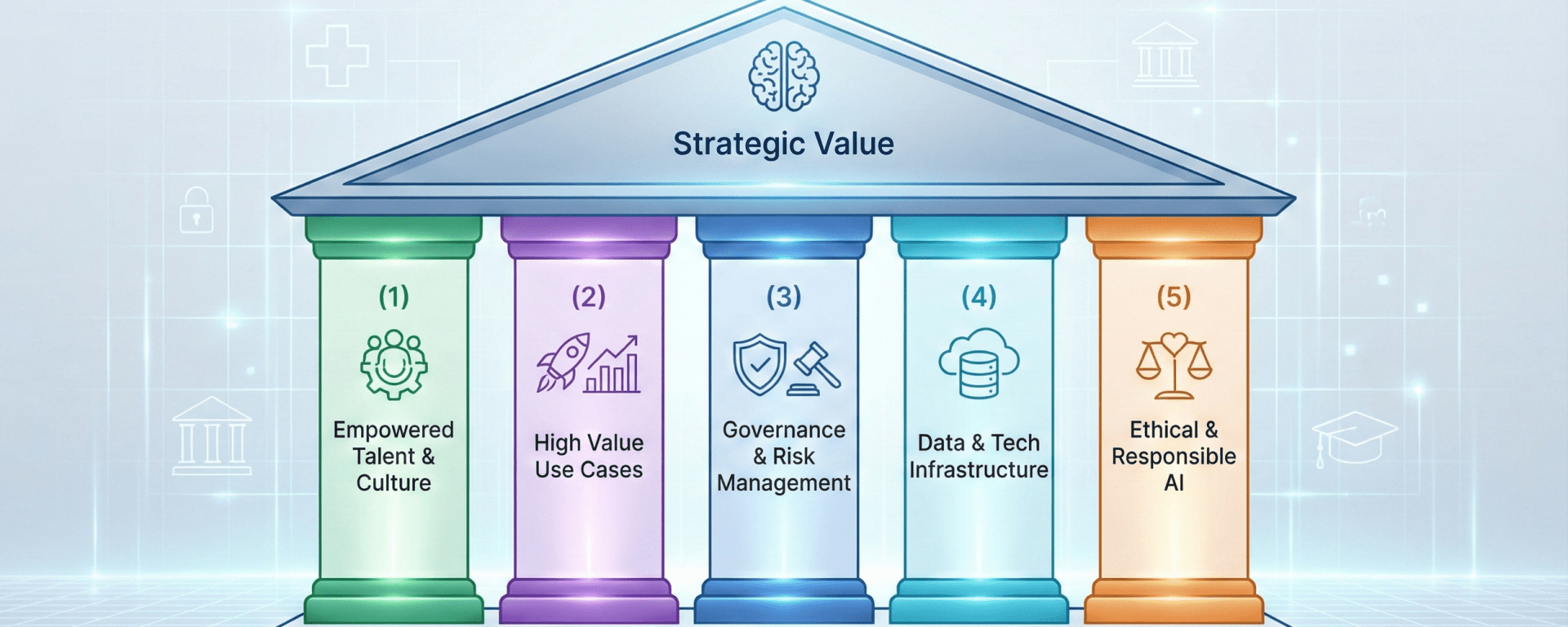
For North American executives in regulated sectors—finance, healthcare, government, and education—the pressure to adopt AI is matched only by the peril of getting it wrong. Unlike a nimble software startup, you cannot “move fast and break things” when you hold patient data, student records, or financial assets. You need a structure that balances velocity with stability.
Inspired by the “House of Lean” which revolutionized manufacturing, the House of AI offers a pragmatic architecture for sustainable adoption. It moves beyond the hype cycle to provide the structural integrity required to create lasting strategic value in a constrained environment.
The Architecture of Value
Many organizations attempt to build the “roof” (Strategic Value) by simply buying the “plumbing” (Data & Tech). This leads to expensive pilots that never scale—a “shanty town” of disconnected experiments rather than a robust enterprise capability. A true House of AI requires five distinct pillars resting on a singular, immovable foundation.
The Foundation: Leadership Alignment & Commitment
A skyscraper cannot stand on shifting sands. In regulated industries, AI transformation requires a Foundation of Leadership Alignment. This is not merely signing off on a budget; it is an active, unified commitment from the C-suite. Leaders must define the risk appetite, establish the “North Star” metrics, and model the curiosity they expect from the workforce. Without this explicit commitment to the blueprint, the pillars above will fracture under the weight of regulatory scrutiny.
The Roof: Strategic Value
When the foundation is solid and the pillars are balanced, the structure supports the Roof: Strategic Value. This is realized not just in cost savings, but in new revenue streams, superior patient outcomes, and personalized constituent services. The roof protects the organization, ensuring that AI investments deliver resilience and competitive advantage.
Pillar 1: Empowered Talent & Culture
We place this pillar first for a reason: AI is a tool, but people are the engine. In banking and healthcare, legacy processes run deep. Transformation requires an Empowered Talent & Culture that embraces augmentation over replacement. This means upskilling not just data scientists, but the compliance officers, nurses, and loan adjudicators who will work alongside these models daily.
Pillar 2: High Value Use Cases
Avoid the trap of “AI tourism”—building interesting models that offer no return. This pillar focuses on High Value Use Cases. The discipline here is to ruthlessly prioritize problems where AI offers an order-of-magnitude improvement. Whether it is predictive patient scheduling or real-time fraud detection, these use cases must deliver the early wins that fund the longer journey.
Pillar 3: Governance & Risk Management
In unregulated sectors, governance is often an afterthought. For you, it is a structural necessity. Governance & Risk Management is not a bottleneck; it is the braking system that allows you to drive fast safely. This pillar ensures Model Risk Management (MRM) frameworks are updated for generative AI, ensuring audit trails, accountability, and explainability are baked in from day one, not bolted on post-deployment.
Pillar 4: Data & Tech Infrastructure
This is the internal machinery of the house. Data & Tech Infrastructure in regulated entities must solve for difficult interoperability (e.g., HL7 in health, ISO 20022 in finance) while ensuring absolute security. It represents the shift from siloed, dusty data warehouses to accessible, secure data fabrics that feed hungry models with clean, reliable fuel.
Pillar 5: Ethical & Responsible AI
Distinct from standard compliance, Ethical & Responsible AI addresses your social license to operate. It asks not “Can we do this?” but “Should we?” This pillar actively mitigates bias in lending algorithms or admissions processes and ensures transparency. In 2025, trust is your most volatile asset; this pillar protects it.
Key Insights for the C-Suite
- Order Matters: Do not build Pillar 4 (Tech) before pouring the Foundation (Leadership). Technology searching for a strategy is a liability.
- Governance is an Accelerator: In regulated markets, robust governance reduces rework. If you build it compliant the first time, you scale faster than competitors who get stuck in regulatory review.
- Culture Eats Code: The best algorithms will fail if your culture rejects them. Invest as much in change management (Pillar 1) as you do in compute power (Pillar 4).
Final Insight
The House of AI is not a static monument; it is a functional living space that requires maintenance, inspection, and renovation. For leaders in regulated North American industries, your advantage lies in your existing discipline. You already know how to manage risk and adhere to rigorous standards. Apply that same rigor to this framework, and you will build an AI capability that is not only innovative but enduring.
This article was written with the assistance of my brain, Google Gemini, ChatGPT, Claude, and other wondorous toys.
 Adam Outside The Box