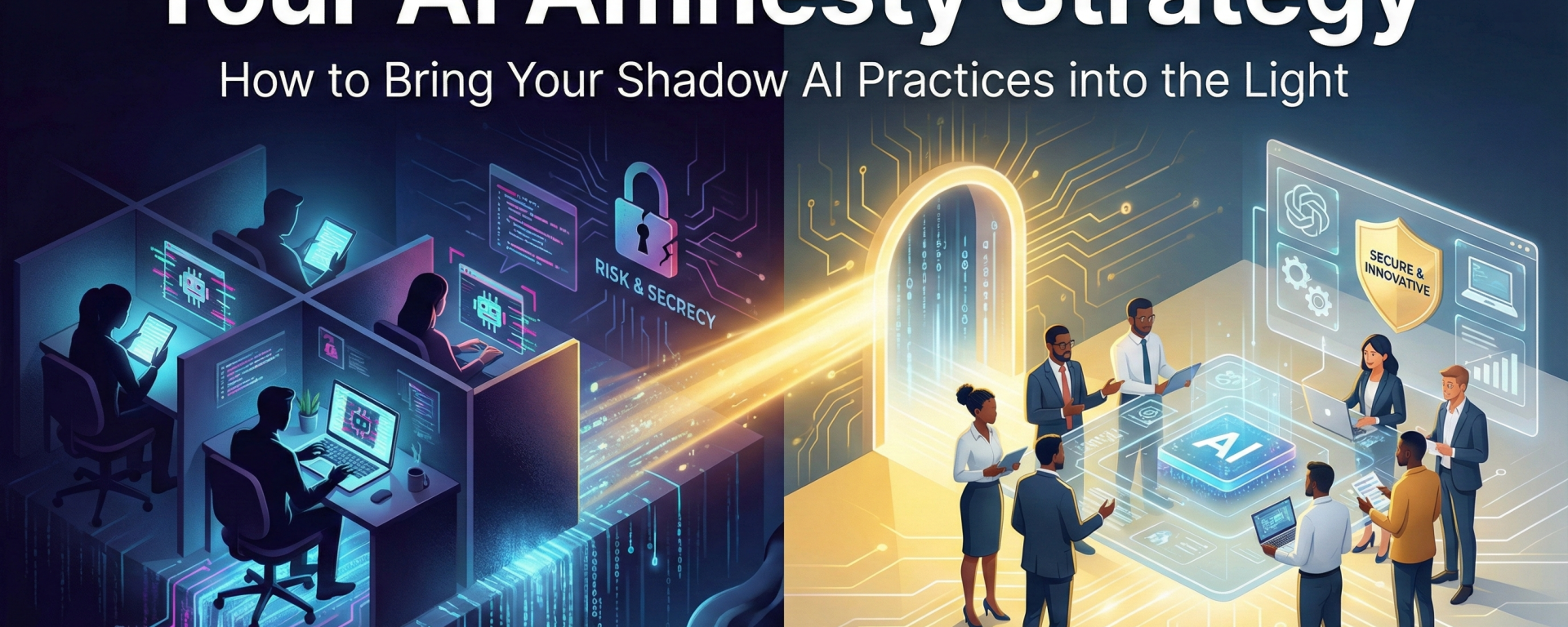
A quiet crisis is unfolding in North American enterprises. It is the rise of “Shadow AI”: employees covertly using unapproved Generative AI tools (like ChatGPT or Claude) to write code, draft sensitive emails, or analyze proprietary data.
According to the 2024 Microsoft Work Trend Index, 78% of AI users bring their own AI (BYOAI) to work because their organizations move too slowly.
For executives, Shadow AI is a double-edged sword. On one side, it represents a massive security risk (data leakage). On the other, it is a clear signal of unmet market demand. Your employees are desperate for efficiency. The goal is not to extinguish this energy, but to channel it.
Here is how to move from “Shadow Risk” to “Sanctioned Innovation.”
Step 1: The “Walled Garden” Strategy (Don’t Ban, Build)
The knee-jerk reaction to Shadow AI is a ban. This almost always fails. When you block access without providing an alternative, you don’t stop the behavior; you just drive it onto personal devices where you have zero visibility.
The Strategy: You must provide an enterprise-grade “Walled Garden”—a secure, internal instance of a Large Language Model (LLM) that protects your data.
The Cautionary Tale (Samsung): In 2023, Samsung engineers inadvertently leaked proprietary code by pasting it into the public version of ChatGPT to check for bugs. Samsung responded by banning the tool. While understandable, this approach creates a “cat and mouse” game with employees.
The Better Way (Walmart): Walmart recognized the same risk but took the opposite approach. They rapidly deployed “My Assistant,” a Generative AI tool available to 50,000 corporate associates. By giving employees a better, safer tool than the free public ones, they naturally killed the Shadow market.
Step 2: The “Amnesty” Audit (Healthcare & Education)
In highly regulated industries like Healthcare and Education, Shadow AI is terrifying because of privacy laws (HIPAA/FERPA). However, strict enforcement often leads to a culture of secrecy.
The Strategy: Declare a 30-day “AI Amnesty.” Encourage department heads to come forward with the tools they are currently using to solve problems, with the promise that they will not be punished. Instead, IT will work to “vet and secure” those specific use cases.
Scenario (Education/EdTech): A University Dean discovers that faculty are using unapproved AI tools to grade papers (a FERPA violation). instead of disciplinary action, the administration audits why. They realize the Learning Management System (LMS) grading tools are clunky. The Fix: They fast-track the procurement of a secure, compliant AI grading assistant. The “Shadow” behavior highlighted the friction point that needed solving.
Step 3: From “Shadow Users” to “Citizen Developers” (Finance & Software)
Shadow AI often exists because the “Central AI Team” is too slow to build what the business needs.
The Strategy: Democratize the build. Shift from a centralized bottleneck to a distributed “Citizen Developer” model. Provide the governance guardrails, but let the Line of Business build the specific prompt libraries they need.
Real World Example (Morgan Stanley): Morgan Stanley didn’t just give their Financial Advisors a chatbot and wish them luck. They built a system where the AI acts as a layer over their massive library of proprietary research. They effectively turned every advisor into a power user, capable of querying thousands of documents instantly. By sanctioning this workflow, they ensured that no advisor needed to paste client data into an external tool.
Final Insight: The Flashlight Test
Shadow AI is not a disease; it is a symptom of an organizational immune system trying to cure inefficiency. If you have a massive Shadow AI problem, it means your employees are innovative, but your infrastructure is obsolete.
Executive Self-Evaluation: To determine if you have a “Shadow Division,” ask yourself these three questions:
- The “No” Test: When an employee asks for an AI tool, does it take 4 weeks for Compliance to say “No,” or 4 days for IT to say “Here is the safe version”?
- The Usage Gap: Is there a massive gap between your official software utilization metrics and the productivity your teams are claiming? (If output is high but tool usage is low, they are using something else).
- The “Banned” List: Have you blocked ChatGPT/Claude on the corporate firewall without rolling out an internal enterprise alternative? (If yes, you have Shadow AI. Guaranteed.)
Don’t operate in the dark. Turn on the lights.
References:
Samsung Data Leak: Bloomberg Report on Samsung
Microsoft Work Trend Index (78% BYOAI Statistic): Microsoft 2024 Work Trend Index
This article was written with the assistance of my brain, Google Gemini, ChatGPT, and other wondorous toys.
 Adam Outside The Box