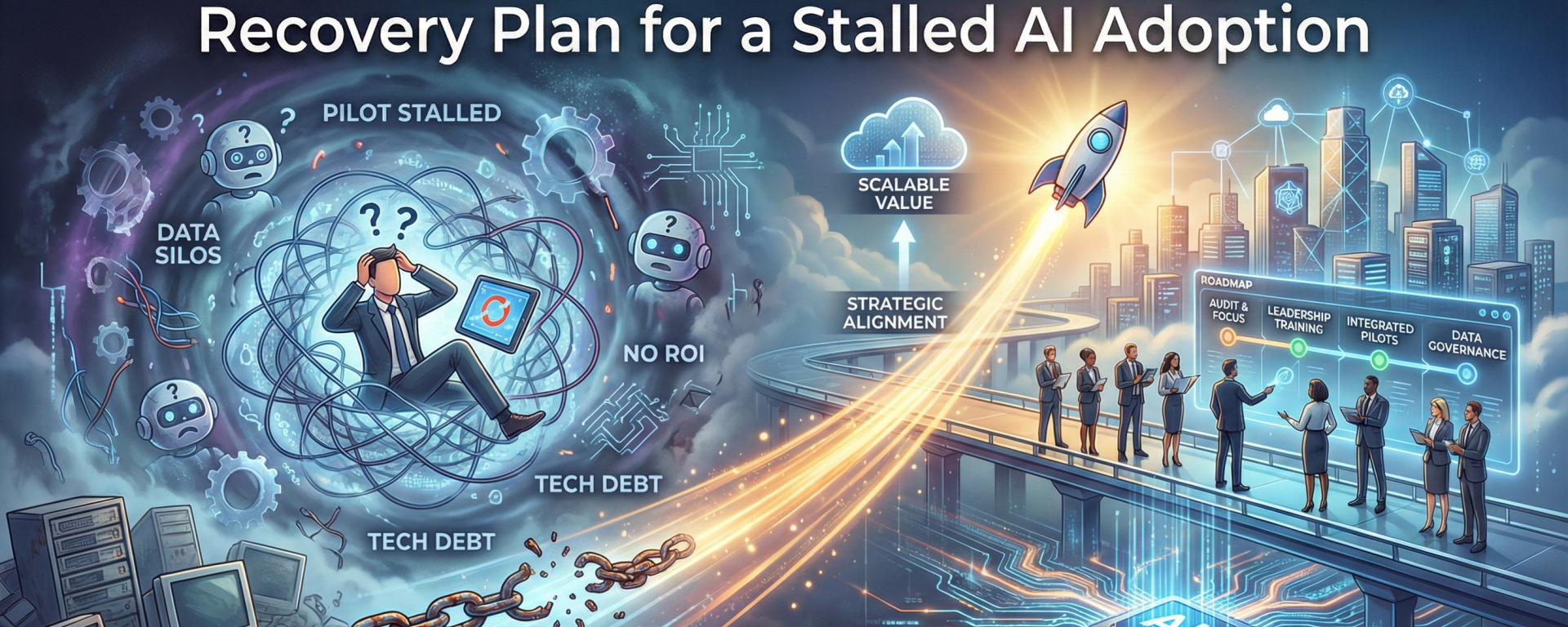
After the initial “Gold Rush” of Generative AI, organizations are hitting a wall. We call this “Pilot Purgatory”: a state where a company has dozens of active AI experiments, exhausted teams, and significant cloud spend, yet zero demonstrable ROI or competitive advantage.
The issue isn’t the technology; it’s the tactics. Most organizations have approached AI as a software purchase rather than a capability build. To escape purgatory, leaders must pivot from Tactical Adoption (buying tools to chase efficiency) to Strategic Transformation (training leaders to chase value).
Here is the pragmatic roadmap to stop “doing AI” and start driving value.
Step 1: The “Audit & Amputate” (Stop the Bleeding)
You cannot execute a strategy with 50 unaligned pilots running simultaneously. The first step to recovery is focus.
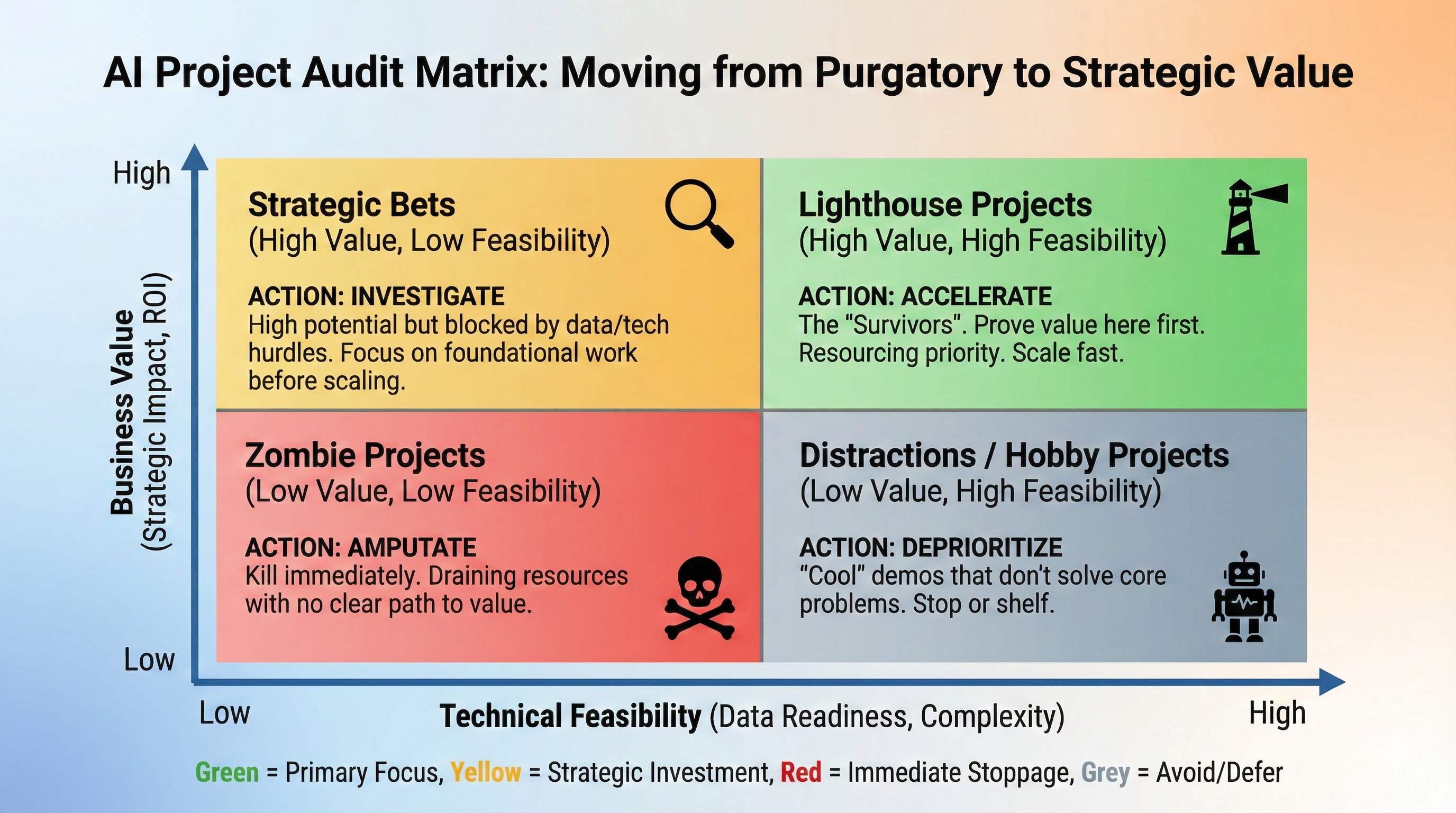
The Strategy: Implement a “Zombie Audit.” Map every current AI initiative against a simple matrix: Business Value vs. Technical Feasibility. Ruthlessly “kill” low-value hobby projects to free up resources for 1-2 “Lighthouse” initiatives.
Scenario (Financial Services): A mid-sized North American bank we advised had 14 disparate GenAI pilots running, ranging from “HR policy chat” to “Marketing copy generation.” None were scalable.
The Fix: They shut down 12 of the 14 projects. They reallocated those budgets and engineering hours to a single, high-impact goal: Automating Commercial Loan Underwriting analysis. By narrowing their focus, they moved from a buggy prototype to a deployed tool that reduced processing time by 40% in six months.
Step 2: Thaw the “Frozen Middle” (Training & Culture)
The C-Suite wants AI, and junior developers love it. The blockage is almost always middle management. Managers often view AI as a risk to accuracy or a threat to their headcount. If you don’t train them, they will passively block adoption.
The Strategy: Shift your training budget from “Technical Skilling” (coding) to “AI Literacy & Leadership.” Leaders need to understand how to manage an AI-augmented workforce, not just how to prompt a chatbot.
Real World Insight (Healthcare): Many healthcare systems face clinician burnout. However, adoption of AI scribes (tools that listen to patient visits and auto-fill Electronic Health Records) often stalls because administrators fear compliance risks.
The Fix: Organizations like The Mayo Clinic and UC San Diego Health didn’t just deploy tools; they launched pilot programs that explicitly measured “pajama time” (time doctors spend charting at night). By framing the AI as a “wellness tool” for staff retention rather than an “efficiency tool” for profit, they won over the middle management layer.
Step 3: Integrate, Don’t Isolate
If your employees have to log into a separate “AI Portal” to do their work, you have already failed. AI should not be a destination; it should be electricity—invisible and powering the tools they already use.
The Strategy: Move from “Chatbot” interfaces to “Copilot” integrations. Embed the AI directly into the CRM, the LMS, or the IDE.
Scenario (Education/EdTech): A large educational publisher tried to launch a standalone “AI Tutor” app. Engagement was low because it required students to leave their primary learning platform.
The Fix: They scrapped the standalone app and integrated the API directly into their existing Learning Management System (LMS). Now, when a student gets a quiz answer wrong, the AI automatically offers a “hint” button inside the quiz flow. Usage spiked 300% because the friction was removed.
Step 4: Data Governance as an Accelerator
In Purgatory, Legal and IT are enemies. Legal blocks AI because the data isn’t safe; IT pushes AI because the tech is ready.
The Strategy: Create a “Data Safe Haven” for your Lighthouse project. Don’t try to govern all your data at once. Clean and govern only the specific dataset required for your primary use case.
Scenario (Software/SaaS): A CRM software company struggled to ship AI features because their legacy customer data was messy and riddled with PII (Personally Identifiable Information).
The Fix: Instead of trying to “boil the ocean” and clean the entire database, they created a “Golden Dataset”—a small, sanitized, high-quality subset of data used exclusively for training their new features. This allowed them to ship a beta product in weeks, not years.
Final Insight: From “AI Tourism” to “AI Native”
The difference between organizations that stay in Purgatory and those that reach “Heaven” is intent.
“AI Tourists” visit the technology. They buy a license, take a few photos (run a pilot), and go home unchanged. “AI Natives” move there. They change their infrastructure, their leadership training, and their daily workflows to accommodate this new intelligence.
The Next Step: Cancel your next “Ideation Workshop.” Instead, convene your leadership team for a “Blocker Removal” session. Identify the one high-value project you must ship, and systematically remove the governance, cultural, and technical barriers standing in its way.
This article was written with the assistance of my brain, Google Gemini, ChatGPT, and other wondorous toys.
 Adam Outside The Box