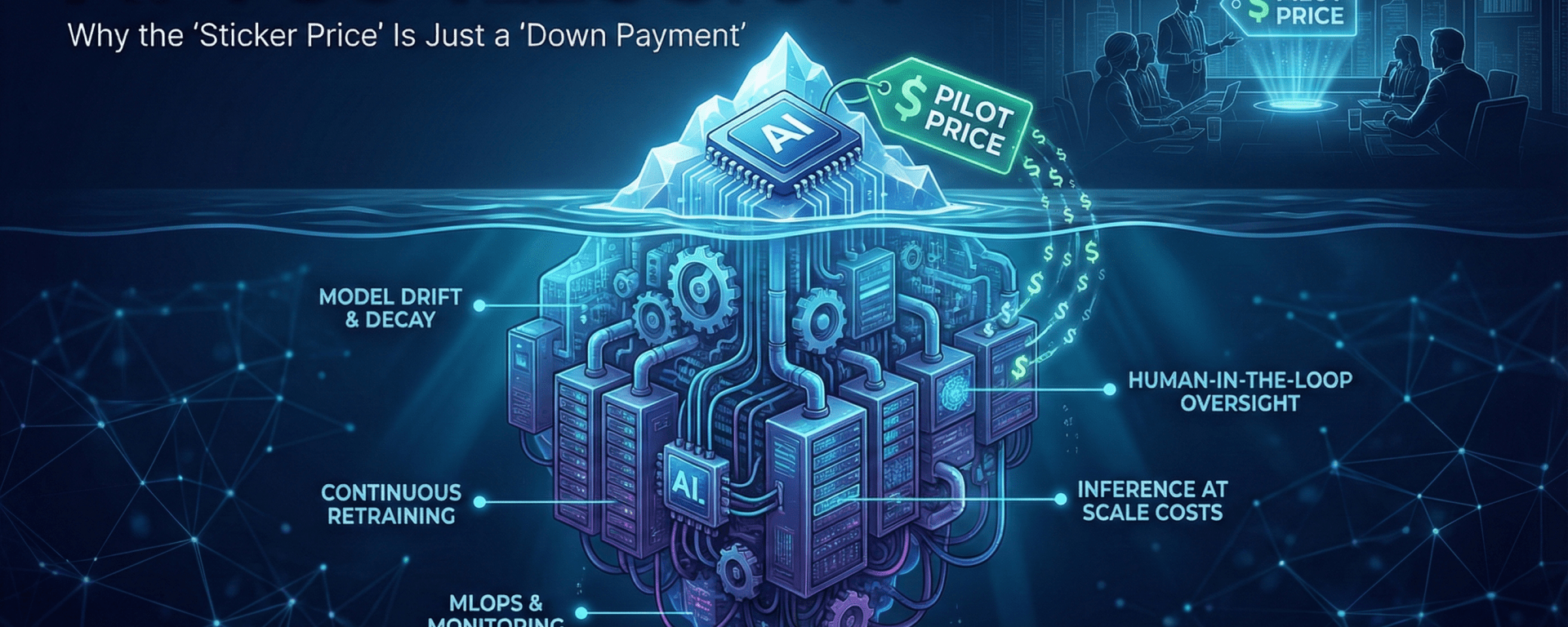
In the boardroom, the conversation about Artificial Intelligence usually revolves around two numbers: the cost of the initial contract and the projected ROI. Both numbers are likely wrong. The “pilot phase”—is merely the tip of the iceberg. The true Total Cost of Ownership (TCO) in AI is not a procurement figure; it is a lifecycle commitment.
As we move from experimentation to industrialization, we are seeing a pattern where operational expenses (OpEx) dwarf the initial capital expenditure (CapEx). Here is where the budget actually bleeds, and how mature leaders are mitigating it.
1. The “Innovation Tax” and Failed Experiments
In traditional software, you build a feature, and it works. In AI, you build five models to find one that works.
The Overlooked Cost: The cost of the “cutting room floor.” You are paying for the failures required to reach success.
Scenario: Higher Education A major North American university sought to build an LLM-based student advisor to handle enrollment queries. They budgeted for the final implementation but ignored the iterative cost of prompt engineering and RAG (Retrieval-Augmented Generation) testing.
- The Reality: The first three iterations hallucinated course prerequisites. Fixing this required weeks of involvement from senior academic advisors (expensive subject matter experts) to curate clean data sets. The cost wasn’t GPU hours; it was the diversion of human capital from core operations.
2. The Silent Killer: Model Drift and Decay
Software code doesn’t rot; it stays static. AI models, however, decay the moment they touch the real world because the world changes. This is “Model Drift.
The Overlooked Cost: Continuous retraining pipelines and observability tools.
Scenario: Financial Services A mid-sized bank deployed a fraud detection model trained on 2023 spending behaviors.
- The Reality: By late 2024, consumer spending patterns shifted due to inflation and new digital wallet technologies. The model’s accuracy dropped by 8%, flagging legitimate high-net-worth transactions as fraud.
- The Cost: The bank faced a triple penalty: 1) The cost of computing power to retrain the model, 2) The operational cost of customer service agents handling angry client calls, and 3) Reputational damage.
3. The “Human-in-the-Loop” Premium
In high-stakes industries, AI is rarely “set and forget.” It requires supervision.
The Overlooked Cost: High-wage monitoring. You aren’t paying interns to check these models; you are paying radiologists, senior developers, and compliance officers.
Scenario: Healthcare A hospital network implemented an AI diagnostic tool for preliminary triage of X-rays to speed up ER throughput.
- The Reality: To meet liability and compliance standards, a board-certified radiologist still had to validate the AI’s “confidence score” for every edge case.
- The Cost: The AI didn’t replace the radiologist; it changed their workflow. The organization had to absorb the cost of new UI/UX tools to integrate the AI findings into the existing PACS (Picture Archiving and Communication System), costing 3x the price of the AI model itself.
4. Inference at Scale: The Success Penalty
In SaaS and product companies, success can be expensive. If your traditional software scales, your server costs rise incrementally. If your GenAI feature scales, your inference costs can skyrocket exponentially.
Scenario: Software / SaaS A project management software company added a “Summarize Meeting” button powered by a third-party LLM.
- The Reality: The feature was a hit. Usage exploded by 400% in month two.
- The Cost: Because they charged a flat subscription fee but paid the API provider per token, their margins collapsed. They had failed to model unit economics at scale. They eventually had to bring the model in-house (a massive engineering lift) to control costs.
The Strategic Pivot
To manage TCO effectively, executives must shift their mindset from Project to Product.
- Budget for the Lifecycle: Allocate 40% of the budget to build, and 60% to year-one maintenance and retraining.
- Define “Good Enough”: Do not chase 99.9% accuracy if 95% drives the same business outcome but costs half as much to infer.
- Monitor the Model, Not Just the Server: Invest in MLOps (Machine Learning Operations) platforms early to detect drift before it impacts the P&L.
AI is not a one-time purchase. It is a new high-maintenance employee. Budget accordingly.
This article was written with the assistance of my brain, Google Gemini, ChatGPT, and other wondorous toys.
 Adam Outside The Box