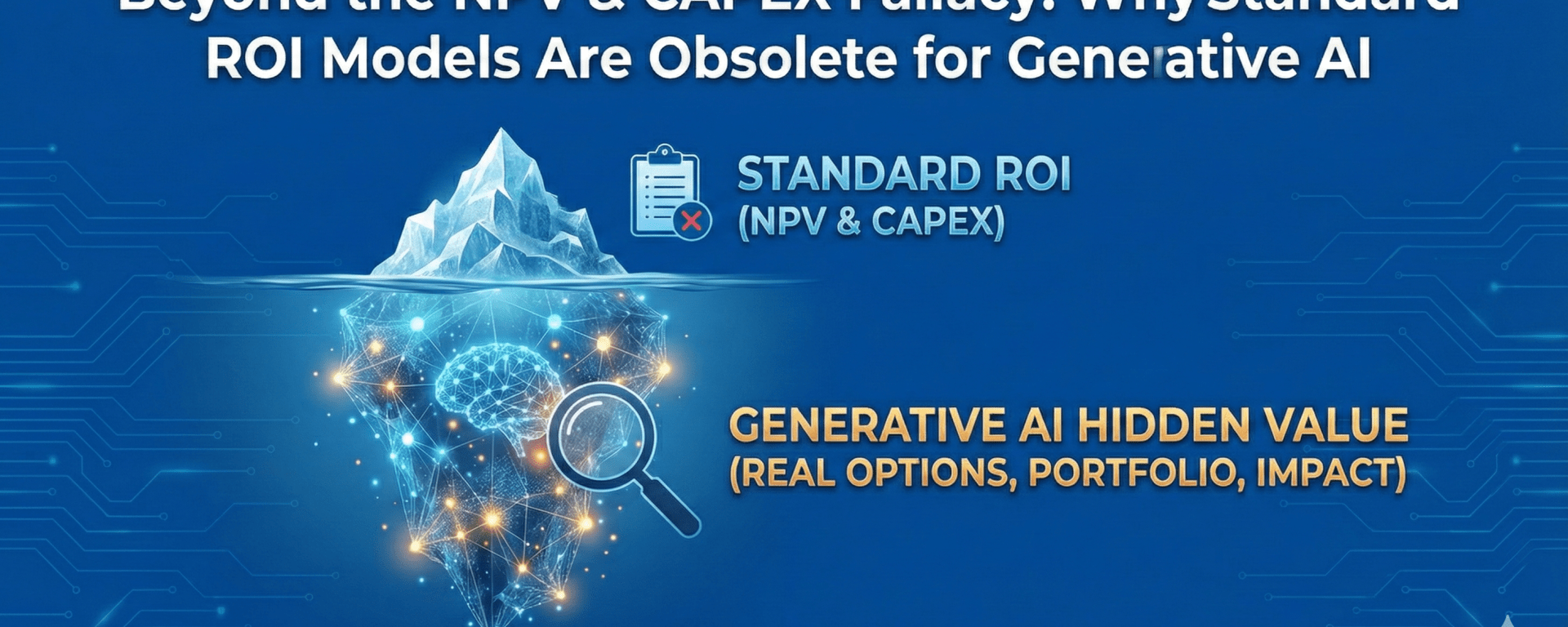
For decades, the Net Present Value (NPV) spreadsheet has been the gatekeeper of corporate innovation in North America. In the predictable worlds of financial services, legacy software updates, or non-profit capital campaigns, this deterministic approach worked. You input a cost, estimated a fixed return, and calculated the timeline.
However, when applied to Artificial Intelligence (AI) and Generative AI transformation, traditional ROI frameworks are not just insufficient; they are often obsolete.
Asking for a guaranteed 12-month ROI on a foundational AI initiative is akin to asking for the ROI of the internet in 1994. It forces executives to shoehorn transformative potential into linear maintenance budgets, resulting in “No-Go” decisions on technologies that are actually existential imperatives.
To lead effectively in the AI era, VPs and C-suite leaders across finance, tech, and the non-profit sector must shift from deterministic accounting to probabilistic valuation.
The Failure of the “Capex” Mindset
Why does the standard spreadsheet fail? Because traditional capital expenditure (Capex) assumes certainty of outcome and depreciation of asset.
AI operates inversely:
- Probabilistic Outcomes: Unlike a server upgrade, an AI model’s performance is stochastic. It involves experimentation.
- Appreciating Assets: A properly tuned AI system learns. Its value should compound over time, unlike a piece of software that technically depreciates the moment it is deployed.
- The Cost of Inaction (COI): Traditional ROI sets the baseline at “zero change.” In the current market, the baseline is negative. If your competitors automate underwriting or donor segmentation and you do not, your status quo is actually a loss in market share.
Better Frameworks: How to Measure AI Value
To evaluate AI projects without stifling innovation, executives should pivot to these three frameworks:
1. Real Options Valuation (ROV)
Borne from financial engineering but essential for tech strategy, ROV treats AI investments not as “projects” but as “options.”
- The Pilot as a Premium: View your initial AI spend not as a sunk cost, but as the price of an option to expand later.
- Logic: A $100k pilot buys you the information needed to decide on the $5M rollout. If the pilot fails, you didn’t lose $100k; you bought risk reduction.
2. The Portfolio Approach (VC Style)
Financial institutions and Non-profits often look for a 100% success rate. This is fatal for AI. Adopting a Venture Capital mindset means managing a portfolio of 5-10 AI initiatives:
- 60% will drive incremental efficiency (The “Safe” Bets).
- 30% will fail or pivot.
- 10% will be transformative “Moonshots” that pay for the failures 10x over.
3. Impact-Weighted Efficiency (For Non-Profits & Mission-Driven Orgs)
For our non-profit leaders, strict EBITDA return implies mission drift. Instead, use Impact-Weighted Efficiency.
- Formula:
(Hours Saved x Staff Rate) + (Increase in Service Velocity / Donor Retention). - If an AI tool allows a case manager to process 3x more claims, the ROI isn’t just salary saved—it is the Mission Velocity of helping three times as many constituents.
The “Silent” Variable: Change Management
The most sophisticated financial model will read “Zero” if the team refuses to use the tool. The correlation between AI ROI and Change Readiness is 1:1.
We often see organizations invest heavily in the algorithm (Technical ROI) but starve the adoption (People ROI).
- The Framework: Do not approve an AI budget without an attached ADKAR (Awareness, Desire, Knowledge, Ability, Reinforcement) strategy.
- The Check: If your budget line for “Training & Change Management” is less than 20% of the technical implementation cost, your risk profile is dangerously high.
The Executive Takeaway
Stop asking “What is the guaranteed return of this AI project in Q4?” Start asking “What is the value of the option this project creates, and what is the existential risk if we fail to acquire this capability?”
The organizations that win over the next five years will not be the ones with the strictest spreadsheets. They will be the ones that learned how to measure—and value—uncertainty.
This article was written with the assistance of my brain, Google Gemini, ChatGPT, and other wondorous toys.
 Adam Outside The Box