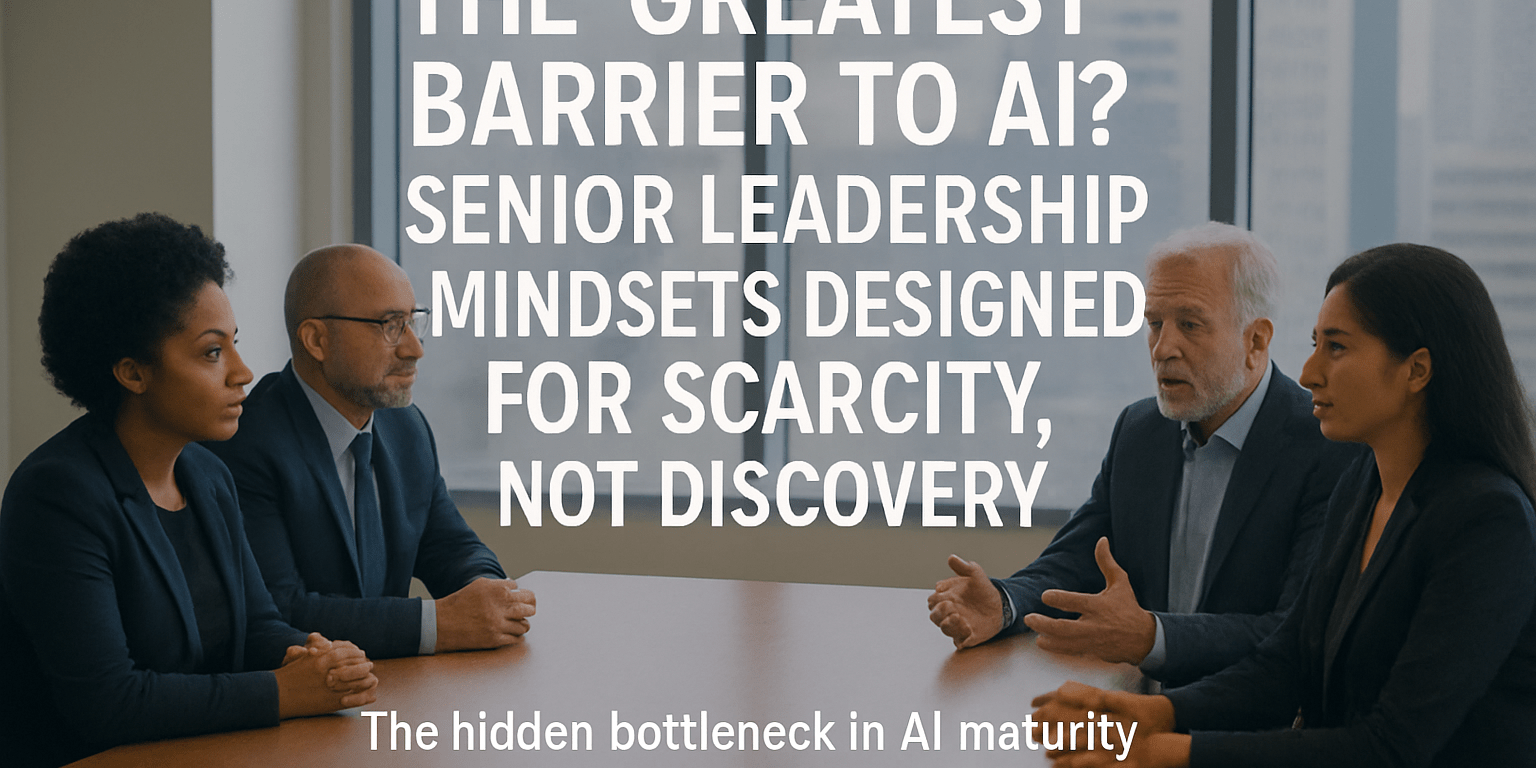
The biggest challenge to AI org maturity is Senior Leaders responsibly embracing uncertainty and ambiguity
Most large organizations aren’t held back by technology or talent shortages—they’re held back by senior leaders who resist evolving their own mindset maturity, require unreasonable certainty, expect perfect plans, and pursue linear progress. The real accelerator is the opposite: leaders who can responsibly embrace uncertainty, navigate ambiguity, and model adaptive decision-making.
The Mindset Barrier to AI Adoption
AI adoption is no longer a technical transformation; it’s a leadership transformation. In financial services, nonprofits, and software companies, the most significant impediment to AI maturity isn’t model performance, data quality, or cloud infrastructure. It’s the mindset of senior leaders who still rely on predictability, risk elimination, and long-term planning cycles to drive progress.
Executives are trained—often rewarded—for reducing uncertainty. But AI introduces a new operating reality: non-linear value creation, experimentation, emergent risks, and learning-oriented governance. Organizations don’t mature in AI faster because they invest more; they mature faster because executives evolve how they think, decide, and lead.
Why Mindset Is the Real Constraint
Most organizations attempt to implement AI through traditional change management approaches: define a roadmap, secure funding, train staff, roll out tools. But these approaches assume stability and clarity. AI transformations are inherently exploratory.
Classic models like Kotter’s 8-Step Change Model emphasize urgency, coalition-building, and short-term wins—but they don’t fully account for environments where leaders must make decisions before the answers are known.
Modern frameworks are clearer about this shift. The McKinsey Influence Model highlights the importance of role modelling and reinforcing new mindsets.
Gartner’s AI Maturity Model similarly shows that organizations plateau not because of technical limitations, but due to leadership hesitation and lack of aligned behaviours.
Behaviours That Slow AI Maturity
- Over-reliance on business cases when the value pathways are still emerging
- Demanding certainty before experimentation has begun
- Delegating AI learning downward instead of developing personal capability
- Using risk frameworks designed for stable systems instead of adaptive ones
- Expecting linear ROI from non-linear technologies
Behaviours That Accelerate AI Maturity
- Executives role model experimentation, not just endorse it
- Teams are encouraged to “start small, learn fast”
- Governance focuses on responsible guardrails, not approvals
- Leaders measure learning velocity, not project completion
- AI literacy is treated as a leadership competency, not a technical one
The Shift: From Gate-Keeper to Gardner
AI demands a shift from command-and-control leadership toward stewardship—leaders who shape conditions for discovery rather than dictate outcomes. The executives who win are those who confidently say: “I don’t know yet—but I’m committed to learning, experimenting, and stewarding responsible outcomes.”
Few Questions Leaders Should Ask Themselves
- Where am I demanding certainty when I should be encouraging discovery?
- Which of my current leadership behaviours unintentionally slow experimentation and learning?
- What am I personally doing to build my AI capability—not just sponsor others to do so?
- Where am I unintentionally prioritizing control over learning?
- What assumptions about risk, value, or expertise might no longer be true in an AI-enabled world?
- How visibly am I modeling curiosity, experimentation, and responsible exploration?
- Do I reward teams for progress made in uncertainty, or only for outcomes with clear ROI?
- Where am I resisting change because I don’t yet feel personally competent in AI?
This article was written with the assistance of my brain, Google Gemini, ChatGPT, and other wondorous toys.
 Adam Outside The Box
The mindset point is spot on. Most AI slowdowns aren’t technical they come from leaders trying to apply old certainty-driven habits to a fast, exploratory system. The shift from control to discovery is going to be the real unlock.