Digital Transformation requires a different approach to generating ideas.
Typical Approach: Idea Validation / Execution
Here are the steps commonly used by corporations:
- Brainstorm (either as a group or an individual)
- Short discussion of the idea
- Subjecting the idea to a type of VALIDATION where it is attacked using an “execution checklist” of requirements, qualifiers, potential issues, and risks… often feels like a firing squad firing at a person who presented the idea
- Only ideas that pass most or all of the checklist items survive (typically none)
- Ideas are often planned and implemented with limited information and significant risks
Key problem here is that for ideas to survive, they have to be (1) quite developed, (2) already bulletproof, and (3) often judged via lens of historic failures that may or may not be even relevant in current market. This approach simply does NOT work well for Digital Transformation requiring exploration and often involving significant information gaps.
There must be a better way…
Recommended Approach: Active Idea Creation
I would like to propose a different approach… one that already used by many creative agencies and even some research firms. Let’s start with a concept.
Great ideas are grown, not simply discovered.
What does that mean? It means that Ideation is NOT a passive process or discerning which idea represents PERFECTION… rather ideas are actively groomed and evolved over time from small baby ideas into great ones. This is especially the case for Digital Transformation where perfect solution is not know, must be explored, or simply keeps changing.
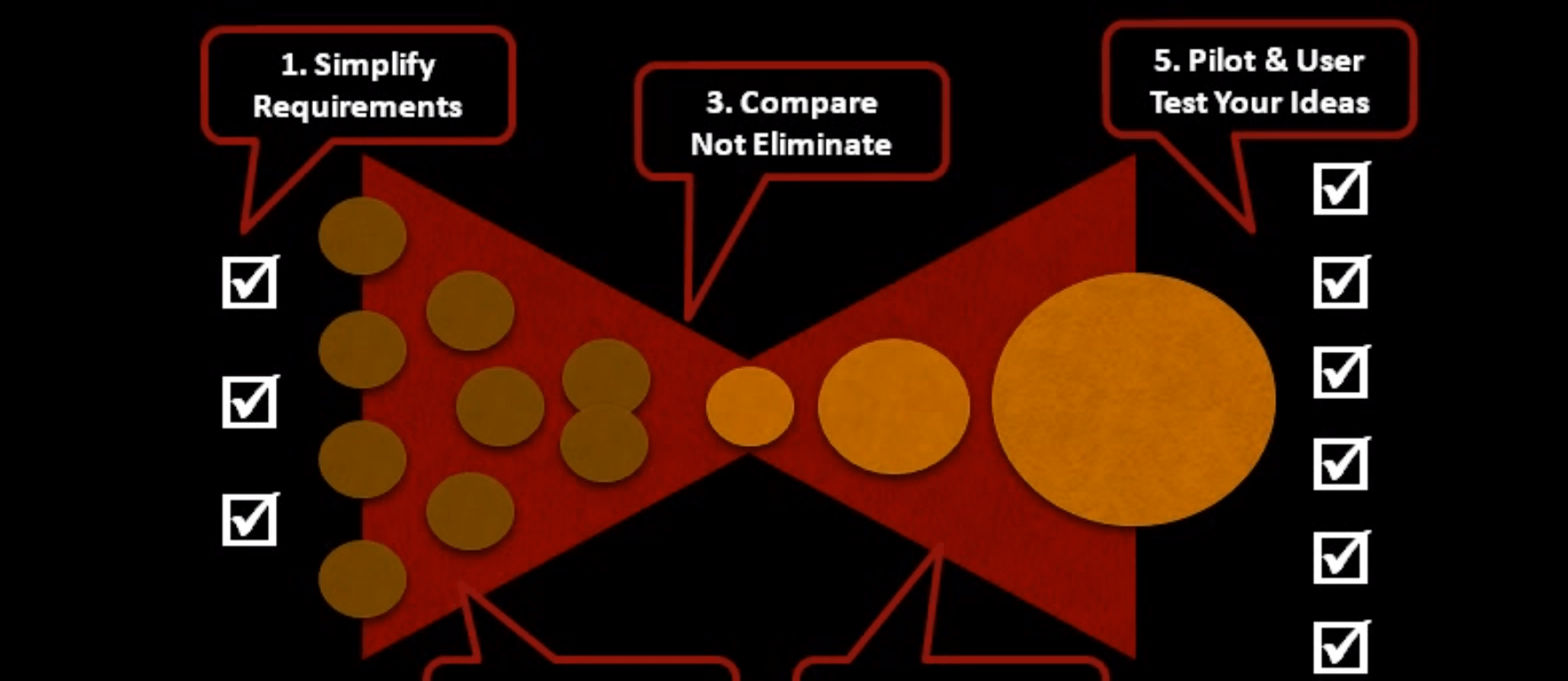
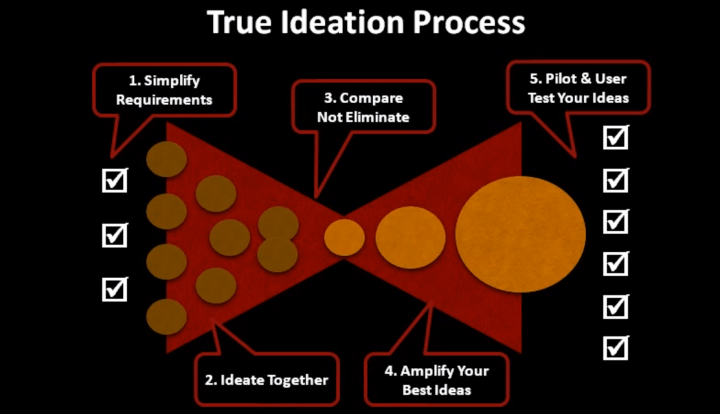
The method is called IDEA GARDENING or simply IDEATION and here is how it works (visualization further below / featured image):
- Simplify your initial requirements to two or three most critical ones. These will guide, not eliminate your ideas. This is analogous to creating a “garden” where you can “plant” your ideas to grow.
- Brainstorm collaboratively to come up with a large list of ideas really quickly. Doing this collaboratively will bring the first level of evolution to many ideas. This is analogous to planting various “seeds” (ideas) into the soil.
- Compare, not eliminate ideas based on the simplified criteria from Step 1. This is a relative comparison. You are not looking for a perfect idea. You are looking to identify three to five ideas that are simply better from the others. This is analogous to certain seeds taking roots and growing well vs others not so much.
- Work with the best ideas by evolving them so they can grow bigger and stronger. This is analogous to a gardener grooming young plans to help them grow healthy and strong. This is the step that’s commonly missed.
- Once sufficiently developed (e.g. prototype), pilot / test and iterate your ideas with various customer groups (e.g. panels). This allows for additional phases of exploration and growth but with end-users. This is analogous to further grooming and even transplanting the plant to different soils to test how it will grow to generate more nutrients.
In this approach, you create an environment and effort to grow the best idea from a seed to something far greater then you could have even imagined in Step 1. The approach is iterative and really never has to stop because it can continue evolving in Step 5.
Of course, you can use this approach for almost anything from product strategy to planning a family vacation.
BTW, the same concept of “growing ideas” is used in numerous approaches including Google Design Sprints for product development. If you’re curious how that works, here is the approach and the toolkit. Having said that, Google released their framework in 2014 and the book in 2016. I’ve released this approach in 2013 on YouTube, adapted from a number of creative approaches used in marketing agency I worked in Capital C. Either way, everyone is welcome to use it.
 Adam Outside The Box